Launches
NO DATA0MISSIONS
The launch archive is still being mirrored, so this day has no launches listed yet.
ARCHIVE // DAY OF YEAR
Wikipedia records 6 spaceflight and astronomy events on December 7. Below are the pictures NASA published on December 7 in 5 different years — each one taken or released on this exact date.
0MISSIONS
The launch archive is still being mirrored, so this day has no launches listed yet.
6ENTRIES
Spaceflight and astronomy entries from Wikipedia's record of this date, oldest first — from 1972 onward.
5IMAGES
NASA's Astronomy Picture of the Day for December 7, one per year. Some are public domain and some belong to the photographer — each says which.
NASA’s Astronomy Picture of the Day, for this calendar date in each of the last several years.
2025
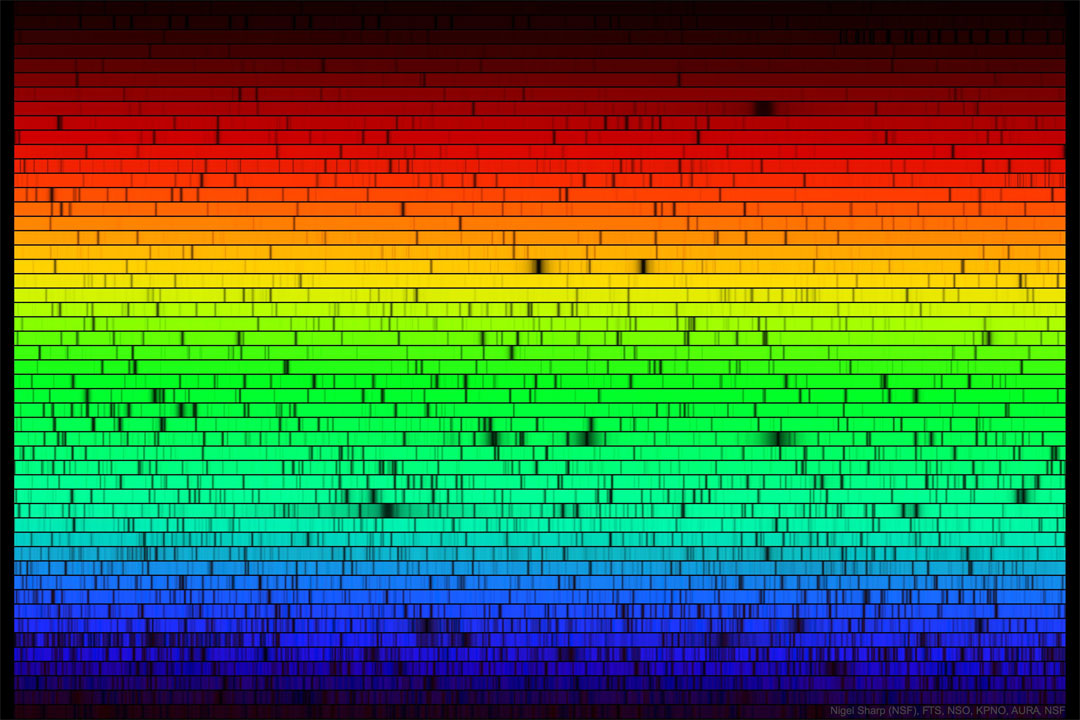
It is still not known why the Sun's light is missing some colors. Here are all the visible colors of the Sun, produced by passing the Sun's light through a prism-like device. The spectrum was created at the McMath-Pierce Solar Observatory and shows, first off, that although our white-appearing Sun emits light of nearly every color, it appears brightest in yellow-green light. The dark patches in the featured spectrum arise from gas at or above the Sun's surface absorbing sunlight emitted below. Since different types of gas absorb different colors of light, it is possible to determine what gasses compose the Sun. Helium, for example, was first discovered in 1868 on a solar spectrum and only later found here on Earth. Today, the majority of spectral absorption lines have been identified - but not all. Free APOD Lecture in Phoenix: Wednesday, December 10 at 7 pm
NASA · public domain

2024
You might not think a close up view of rocket engines producing 8.8 million pounds of thrust would be relaxing, but here it can be. In fact, you can get a warm and cozy feeling just spending a few moments watching NASA's holiday rocket engine fireplace. The video features a loop of the Space Launch System rocket's RS-25 main engines throttled up and running flanked by solid rocket boosters and framed by a stone fireplace. The accompanying audio track mixes the drastically muted sounds of the rocket engines firing with the more familiar sounds of a burning, crackling wood fire. AI elements are included in the composed video along with an image and logo from the Artemis I mission. The Artemis I uncrewed mission to the Moon and back again launched in November 2022 on a Space Launch System rocket.
NASA · public domain
2023
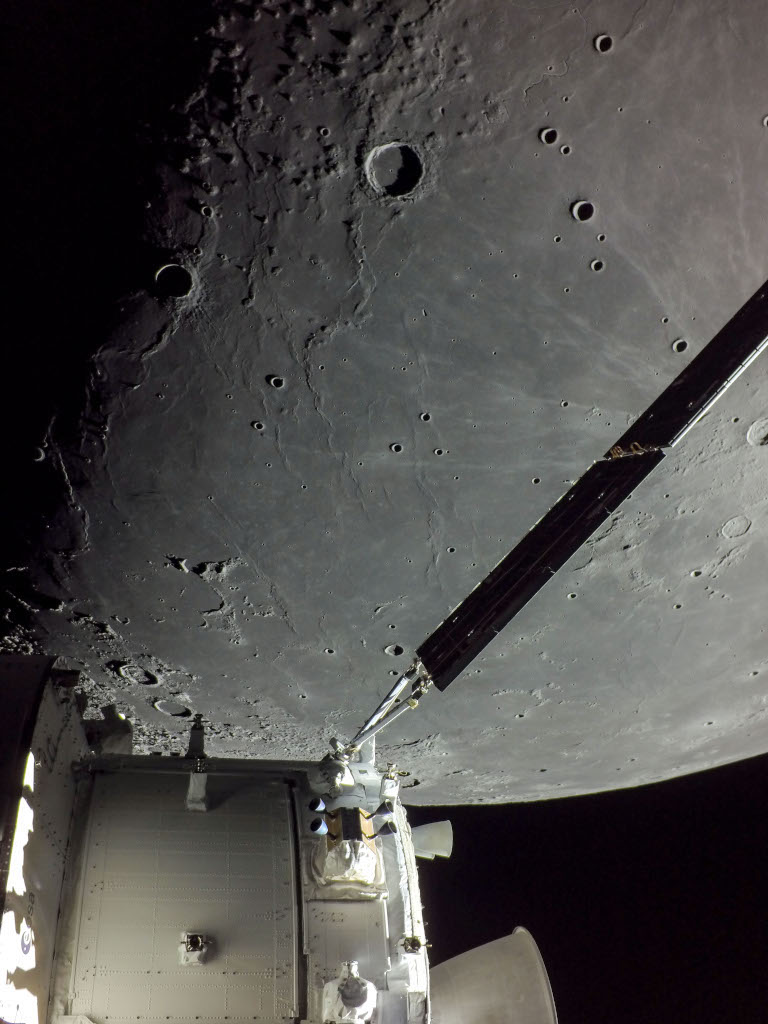
On December 5, 2022, a camera on board the uncrewed Orion spacecraft captured this view as Orion approached its return powered flyby of the Moon. Beyond one of Orion's extended solar arrays lies dark, smooth, terrain along the western edge of the Oceanus Procellarum. Prominent on the lunar nearside Oceanus Procellarum, the Ocean of Storms, is the largest of the Moon's lava-flooded maria. The lunar terminator, shadow line between lunar night and day, runs along the left of this frame. The 41 kilometer diameter crater Marius is top center, with ray crater Kepler peeking in at the edge, just right of the solar array wing. Kepler's bright rays extend to the north and west, reaching the dark-floored Marius. By December 11, 2022 the Orion spacecraft had reached its home world. The historic Artemis 1 mission ended with Orion's successful splashdown in planet Earth's water-flooded Pacific Ocean.
NASA · public domain
2022
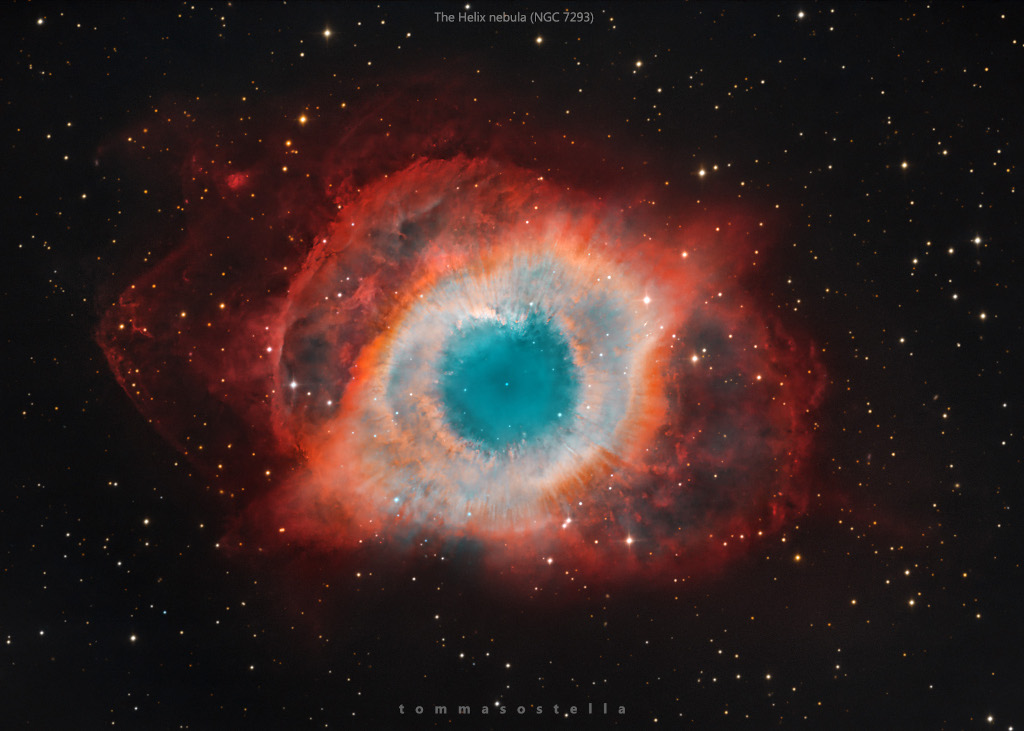
A mere seven hundred light years from Earth, toward the constellation Aquarius, a sun-like star is dying. The dying star's last few thousand years have produced the Helix Nebula (NGC 7293), a well studied and nearby example of a Planetary Nebula, typical of this final phase of stellar evolution. Combining narrow band image data from emission lines of hydrogen atoms in red and oxygen atoms in blue-green hues, it shows tantalizing details of the Helix, including its bright inner region about 3 light-years across. The white dot at the Helix's center is this Planetary Nebula's hot, central star. A simple looking nebula at first glance, the Helix is now understood to have a surprisingly complex geometry.
© Tommaso Stella — used with the credit NASA publishes
2021
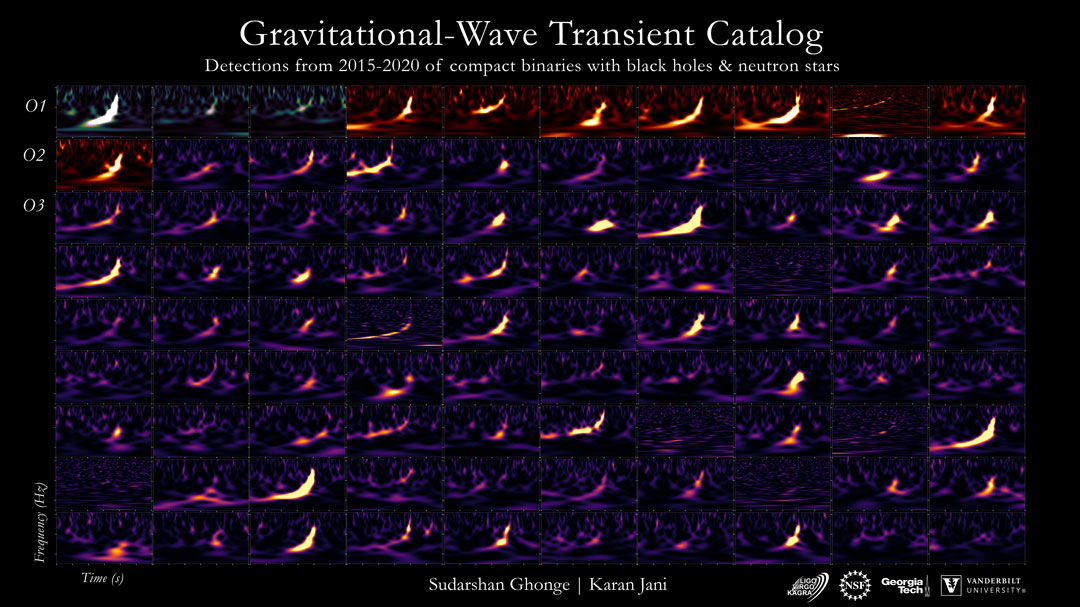
very time two massive black holes collide, a loud chirping sound is broadcast out into the universe in gravitational waves. Humanity has only had the technology to hear these unusual chirps for the past seven years, but since then we have heard about 90 -- during the first three observing runs. Featured above are the spectrograms -- plots of gravitational-wave frequency versus time -- of these 90 as detected by the giant detectors of LIGO (in the USA), VIRGO (in Europe), and KAGRA (in Japan). The more energy received on Earth from a collision, the brighter it appears on the graphic. Among many science firsts, these gravitational-radiation chirps are giving humanity an unprecedented inventory of black holes and neutron stars, and a new way to measure the expansion rate of our universe. A fourth gravitational wave observing run with increased sensitivity is currently planned to begin in 2022 December.
NASA · public domain

1972
Apollo 17, the last Apollo Moon mission, is launched. The crew takes the photograph known as The Blue Marble as they leave the Earth.
Apollo 17 ↗
1995
The Galileo spacecraft arrived at Jupiter, a little more than six years after it was launched by Space Shuttle Atlantis during Mission STS-34.
Galileo (spacecraft) ↗1995
The Galileo spacecraft arrives at Jupiter, a little more than six years after it was launched by Space Shuttle Atlantis during Mission STS-34.
Galileo (spacecraft) ↗2005
Rigoberto Alpizar, a passenger on American Airlines Flight 924 who allegedly claimed to have a bomb, is shot and killed by a team of U.S. federal air marshals at Miami International Airport.
Killing of Rigoberto Alpizar ↗
2015
The JAXA space probe Akatsuki entered into orbit around Venus to study the planet's atmosphere, five years after its first attempt failed.
JAXA ↗2015
The JAXA probe Akatsuki successfully enters orbit around Venus five years after the first attempt.
JAXA ↗Event text and thumbnails come from Wikipedia and are used under CC BY-SA 4.0. Images are drawn only from Wikimedia Commons, which does not accept non-free content — each thumbnail links to its file page, where its licence and author are recorded.
Launch records are from The Space Devs’ Launch Library 2. This archive is still being mirrored, so some days are incomplete. Pictures are NASA’s Astronomy Picture of the Day; NASA imagery is generally not subject to copyright, but individual APOD entries are frequently the property of the photographer, and each caption says which applies.
General-audience astronomy and spaceflight — none of it a textbook.
As an Amazon Associate I earn from qualifying purchases. Links here cost you nothing extra.
LISTING
Still the best single argument for why any of this matters, and it leaves the arithmetic in. For a reader who wants the science, not just the awe.
LISTING
The case for leaving Earth, written by someone unsentimental about how hard that is. Suits readers who want the argument rather than the poster.
LISTING
Hard-SF problem solving in The Martian's key — for anyone who liked the engineering more than the peril. The only novel on this list.
BROWSE opens an Amazon search, not a specific recommendation.
LINKS AMAZON.COM