Launches
NO DATA0MISSIONS
The launch archive is still being mirrored, so this day has no launches listed yet.
ARCHIVE // DAY OF YEAR
Wikipedia records 4 spaceflight and astronomy events on December 6. Below are the pictures NASA published on December 6 in 5 different years — each one taken or released on this exact date.
0MISSIONS
The launch archive is still being mirrored, so this day has no launches listed yet.
4ENTRIES
Spaceflight and astronomy entries from Wikipedia's record of this date, oldest first — from 1882 onward.
5IMAGES
NASA's Astronomy Picture of the Day for December 6, one per year. Some are public domain and some belong to the photographer — each says which.
NASA’s Astronomy Picture of the Day, for this calendar date in each of the last several years.

2025
Fifty three years ago, in December of 1972, Apollo 17 astronauts Eugene Cernan and Harrison Schmitt spent about 75 hours on the Moon exploring the Taurus-Littrow valley, while colleague Ronald Evans orbited overhead. This snapshot from another world was taken by Cernan as he and Schmitt roamed the lunar valley's floor. The image shows Schmitt next to the lunar rover parked along the south rim of Shorty Crater. That location is near the spot where geologist Schmitt discovered orange lunar soil. The Apollo 17 crew returned with 110 kilograms of rock and soil samples, more than was returned from any of the other lunar landing sites. And for now, Cernan and Schmitt are the last to walk on the Moon.
NASA · public domain

2024
Colorful and bright, this streaking fireball meteor was captured in a single exposure taken at Purple Mountain (Tsuchinshan) Observatory’s Xuyi Station in 2020, during planet Earth's annual Perseid meteor shower. The dome in the foreground houses the China Near Earth Object Survey Telescope (CNEOST), the largest multi-purpose Schmidt telescope in China. Located in Xuyi County, Jiangsu Province, the station began its operation as an extension of China's Purple Mountain Observatory in 2006. Darling of planet Earth's night skies in 2024, the bright comet designated Tsuchinshan-ATLAS (C/2023 A3) was discovered in images taken there on 2023 January 9. The discovery is jointly credited to NASA's ATLAS robotic survey telescope at Sutherland Observatory, South Africa. Other comet discoveries associated with the historic Purple Mountain Observatory and bearing the observatory's transliterated Mandarin name include periodic comets 60/P Tsuchinshan and 62/P Tsuchinshan.
© Purple Mountain (Tsuchinshan) — used with the credit NASA publishes
2023
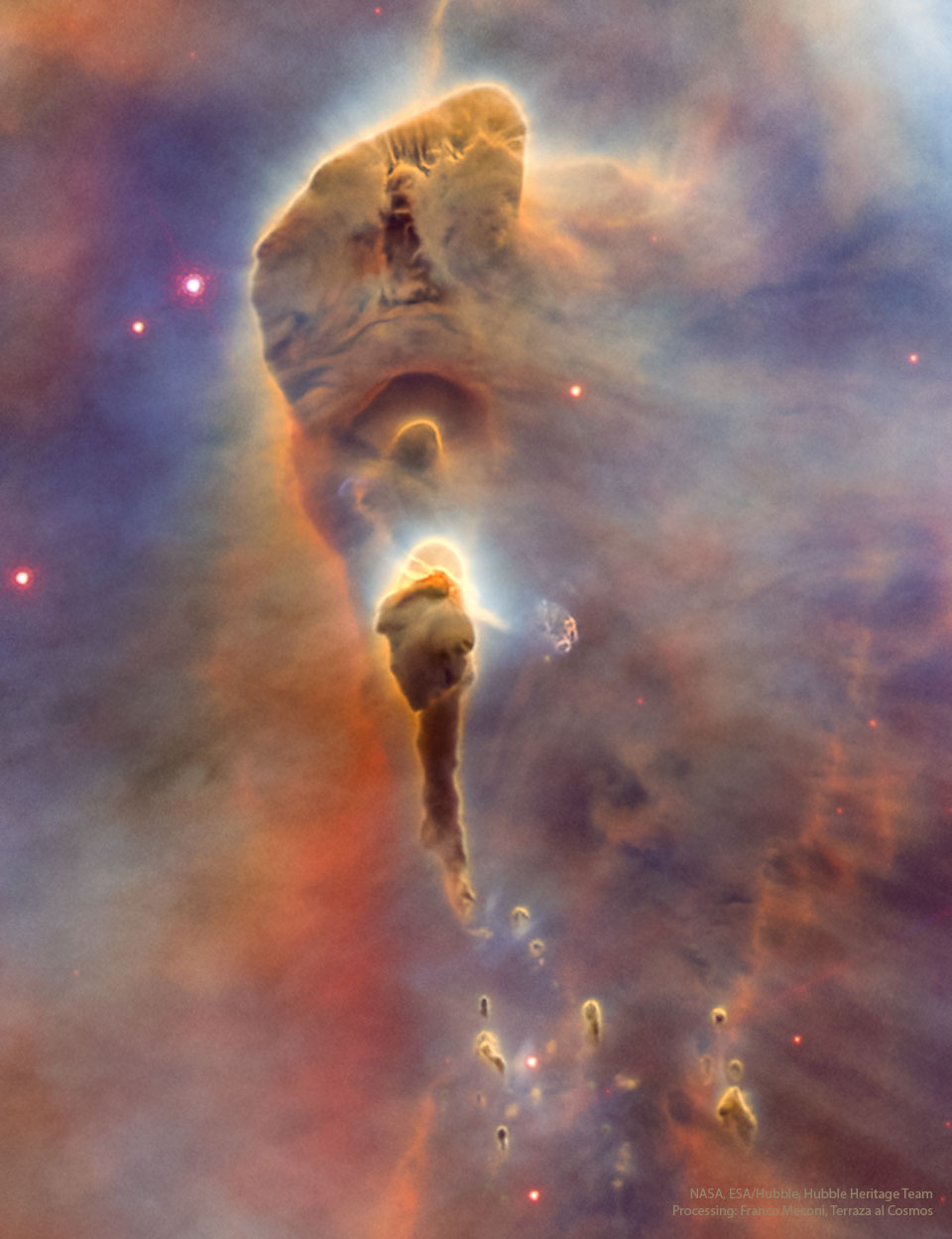
It's stars versus dust in the Carina Nebula and the stars are winning. More precisely, the energetic light and winds from massive newly formed stars are evaporating and dispersing the dusty stellar nurseries in which they formed. Located in the Carina Nebula and inside a region known informally as Mystic Mountain, these pillars' appearance is dominated by opaque brown dust even though it is composed mostly of clear hydrogen gas. Even though some of the dust pillars look like torches, their ends are not on fire -- rather, they are illuminated by nearby stars. About 7,500 light-years distant, the featured image was taken with the Hubble Space Telescope and highlights an interior region of Carina known as HH1066 which spans nearly a light year. Within a few million years, the stars will likely win out completely and the dust torches will completely evaporate.
NASA · public domain
2022
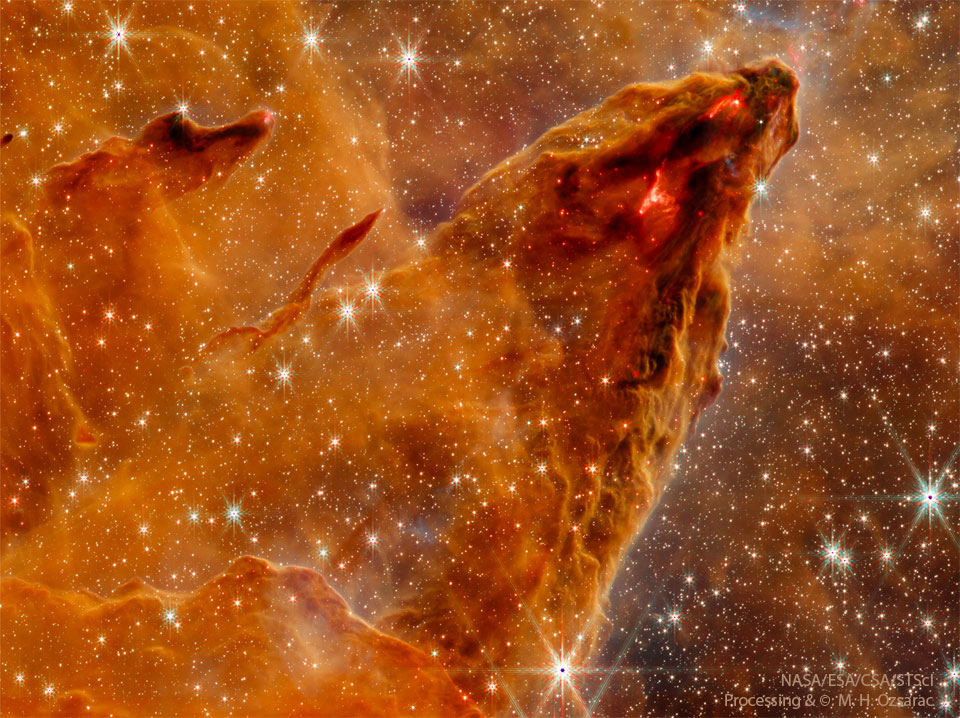
What’s happening inside this interstellar mountain? Stars are forming. The mountain is actually a column of gas and dust in the picturesque Eagle Nebula (M16). A pillar like this is so low in density that you could easily fly though it -- it only appears solid because of its high dust content and great depth. The glowing areas are lit internally by newly formed stars. These areas shine in red and infrared light because blue light is scattered away by intervening interstellar dust. The featured image was captured recently in near-infrared light in unprecedented detail by the James Webb Space Telescope (JWST), launched late last year. Energetic light, abrasive winds, and final supernovas from these young stars will slowly destroy this stellar birth column over the next 100,000 years. Astrophysicists: Browse 2,900+ codes in the Astrophysics Source Code Library
NASA · public domain
2021
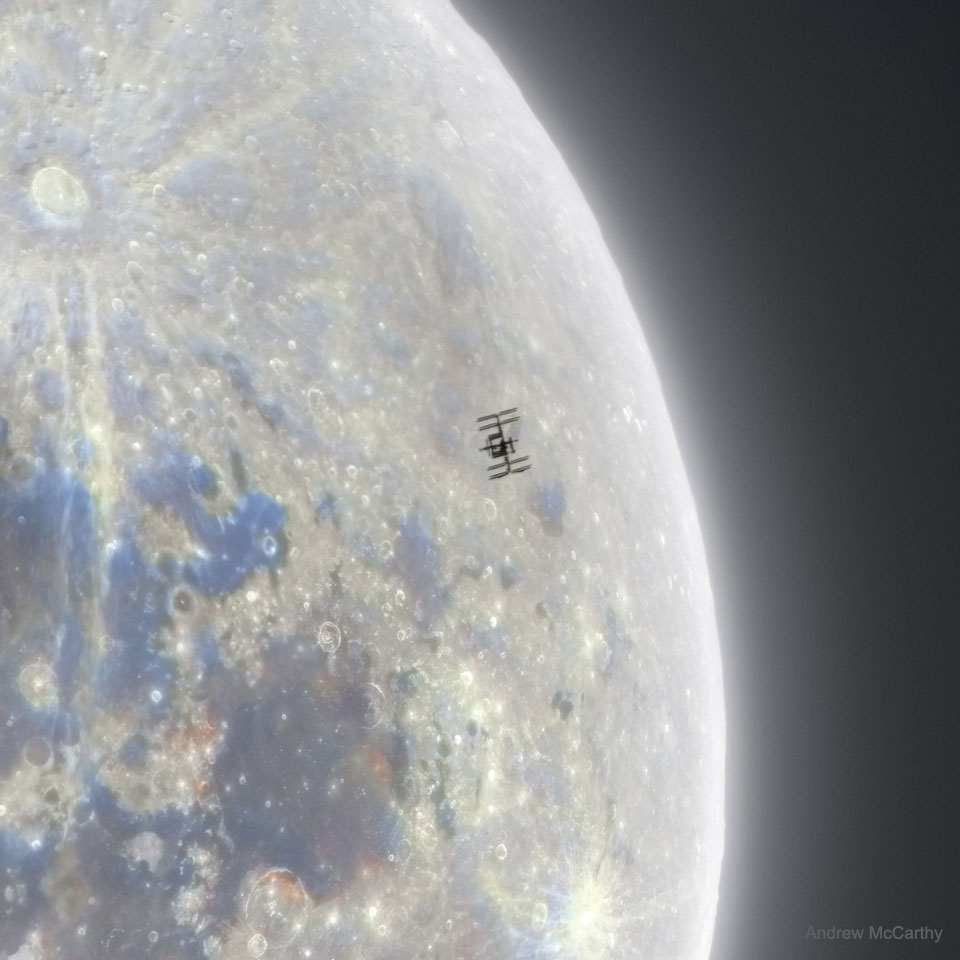
What's that unusual spot on the Moon? It's the International Space Station. Using precise timing, the Earth-orbiting space platform was photographed in front of a partially lit gibbous Moon last month. The featured composite, taken from Payson, Arizona, USA last month, was intricately composed by combining, in part, many 1/2000-second images from a video of the ISS crossing the Moon. A close inspection of this unusually crisp ISS silhouette will reveal the outlines of numerous solar panels and trusses. The bright crater Tycho is visible on the upper left, as well as comparatively rough, light colored terrain known as highlands, and relatively smooth, dark colored areas known as maria. On-line tools can tell you when the International Space Station will be visible from your area.
© Andrew McCarthy — used with the credit NASA publishes


1957
The first U.S. attempt to launch a satellite failed with an explosion on the launch pad at Cape Canaveral.
Vanguard TV-3 ↗1957
Project Vanguard: A launchpad explosion of Vanguard TV3 thwarts the first United States attempt to launch a satellite into Earth orbit.
Project Vanguard ↗
2006
NASA reveals photographs taken by Mars Global Surveyor suggesting the presence of liquid water on Mars.
NASA ↗Event text and thumbnails come from Wikipedia and are used under CC BY-SA 4.0. Images are drawn only from Wikimedia Commons, which does not accept non-free content — each thumbnail links to its file page, where its licence and author are recorded.
Launch records are from The Space Devs’ Launch Library 2. This archive is still being mirrored, so some days are incomplete. Pictures are NASA’s Astronomy Picture of the Day; NASA imagery is generally not subject to copyright, but individual APOD entries are frequently the property of the photographer, and each caption says which applies.
General-audience astronomy and spaceflight — none of it a textbook.
As an Amazon Associate I earn from qualifying purchases. Links here cost you nothing extra.
LISTING
Still the best single argument for why any of this matters, and it leaves the arithmetic in. For a reader who wants the science, not just the awe.
LISTING
The case for leaving Earth, written by someone unsentimental about how hard that is. Suits readers who want the argument rather than the poster.
LISTING
Hard-SF problem solving in The Martian's key — for anyone who liked the engineering more than the peril. The only novel on this list.
BROWSE opens an Amazon search, not a specific recommendation.
LINKS AMAZON.COM