Launches
NO DATA0MISSIONS
The launch archive is still being mirrored, so this day has no launches listed yet.
ARCHIVE // DAY OF YEAR
Wikipedia records 1 spaceflight and astronomy event on October 25. Below are the pictures NASA published on October 25 in 5 different years — each one taken or released on this exact date.
0MISSIONS
The launch archive is still being mirrored, so this day has no launches listed yet.
1ENTRY
Spaceflight and astronomy entries from Wikipedia's record of this date, oldest first — from 1968 onward.
5IMAGES
NASA's Astronomy Picture of the Day for October 25, one per year. Some are public domain and some belong to the photographer — each says which.
NASA’s Astronomy Picture of the Day, for this calendar date in each of the last several years.

2025
A mere 390 light-years away, Sun-like stars and future planetary systems are forming in the Rho Ophiuchi molecular cloud complex, the closest star-forming region to our fair planet. The James Webb Space Telescope's NIRCam peered into the nearby natal chaos to capture this infrared image at an inspiring scale. The frame spans less than a light-year across the Rho Ophiuchi region and contains about 50 young stars. Brighter stars clearly show Webb's characteristic pattern of diffraction spikes. Huge jets of shocked molecular hydrogen blasting from newborn stars are red in the image, with the large, yellowish dusty cavity carved out by the energetic young star near its center. Near some stars in the stunning image are shadows cast by their protoplanetary disks. The spectacular cosmic snapshot was released in 2023 to celebrate the successful first year of Webb's exploration of the Universe.
NASA · public domain
2024
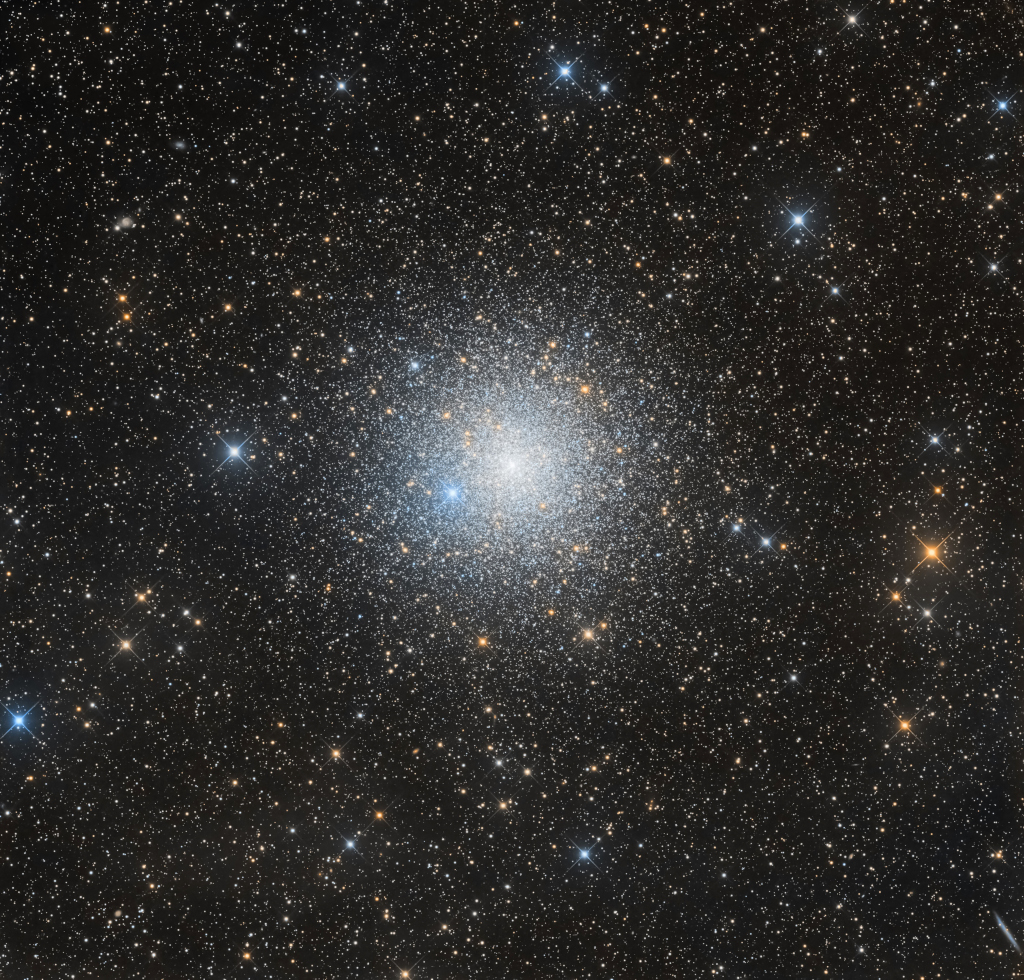
Some 13,000 light-years away toward the southern constellation Pavo, the globular star cluster NGC 6752 roams the halo of our Milky Way galaxy. Over 10 billion years old, NGC 6752 follows clusters Omega Centauri, 47 Tucanae, and Messier 22 as the fourth brightest globular in planet Earth's night sky. It holds over 100 thousand stars in a sphere about 100 light-years in diameter. Telescopic explorations of NGC 6752 have found that a remarkable fraction of the stars near the cluster's core are multiple star systems. They also reveal the presence of blue straggle stars, stars which appear to be too young and massive to exist in a cluster whose stars are all expected to be at least twice as old as the Sun. The blue stragglers are thought to be formed by star mergers and collisions in the dense stellar environment at the cluster's core. This sharp color composite also features the cluster's ancient red giant stars in yellowish hues. (Note: The bright, spiky blue star about 8 o'clock from the cluster center is a foreground star along the line-of-sight to NGC 6752)
© Massimo Di Fusco — used with the credit NASA publishes
2023
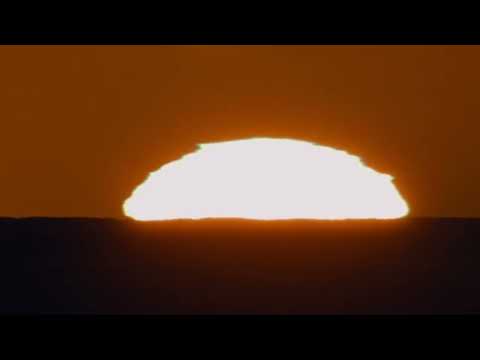
In 60 seconds, this setting Sun will turn green. Actually, the top of the Sun already appears not only green, but wavey -- along with all of its edges. The Sun itself is unchanged -- both effects are caused by looking along hot and cold layers in Earth's atmosphere. The unusual color is known as a green flash and occurs because these atmospheric layers not only shift background images but disperse colors into slightly different directions, like a prism. The featured video was captured earlier this month off the coast of Hawaii, USA. After waiting those 60 seconds, at the video's end, the upper part of the Sun seems to hover alone in space, while turning not only green, but blue. Then suddenly, the Sun appears to shrink to nothing -- only to return tomorrow.
© Tengyu Cai — used with the credit NASA publishes
2022
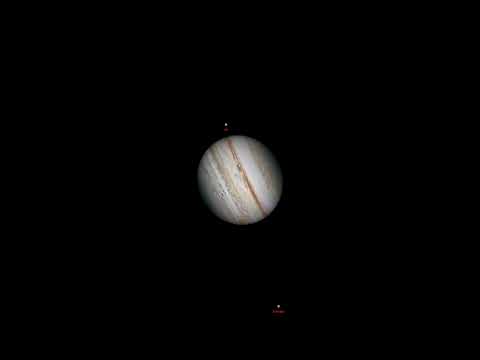
Jupiter and its moons move like our Sun and its planets. Similarly, Jupiter spins while its moons circle around. Jupiter’s rotation can be observed by tracking circulating dark belts and light zones. The Great Red Spot, the largest storm known, rotates to become visible after about 15 seconds in the 48-second time lapse video. The video is a compilation of shorts taken over several nights last month and combined into a digital recreation of how 24-continuous hours would appear. Jupiter's brightest moons always orbit in the plane of the planet's rotation, even as Earth’s spin makes the whole system appear to tilt. The moons Europa, Ganymede, and Io are all visible, with Europa's shadow appearing as the icy Galilean moon crosses Jupiter's disk. Jupiter remains near opposition this month, meaning that it is unusually bright, near to its closest to the Earth, and visible nearly all night long. Almost Hyperspace: Random APOD Generator
© Makrem Larnaout — used with the credit NASA publishes
2021
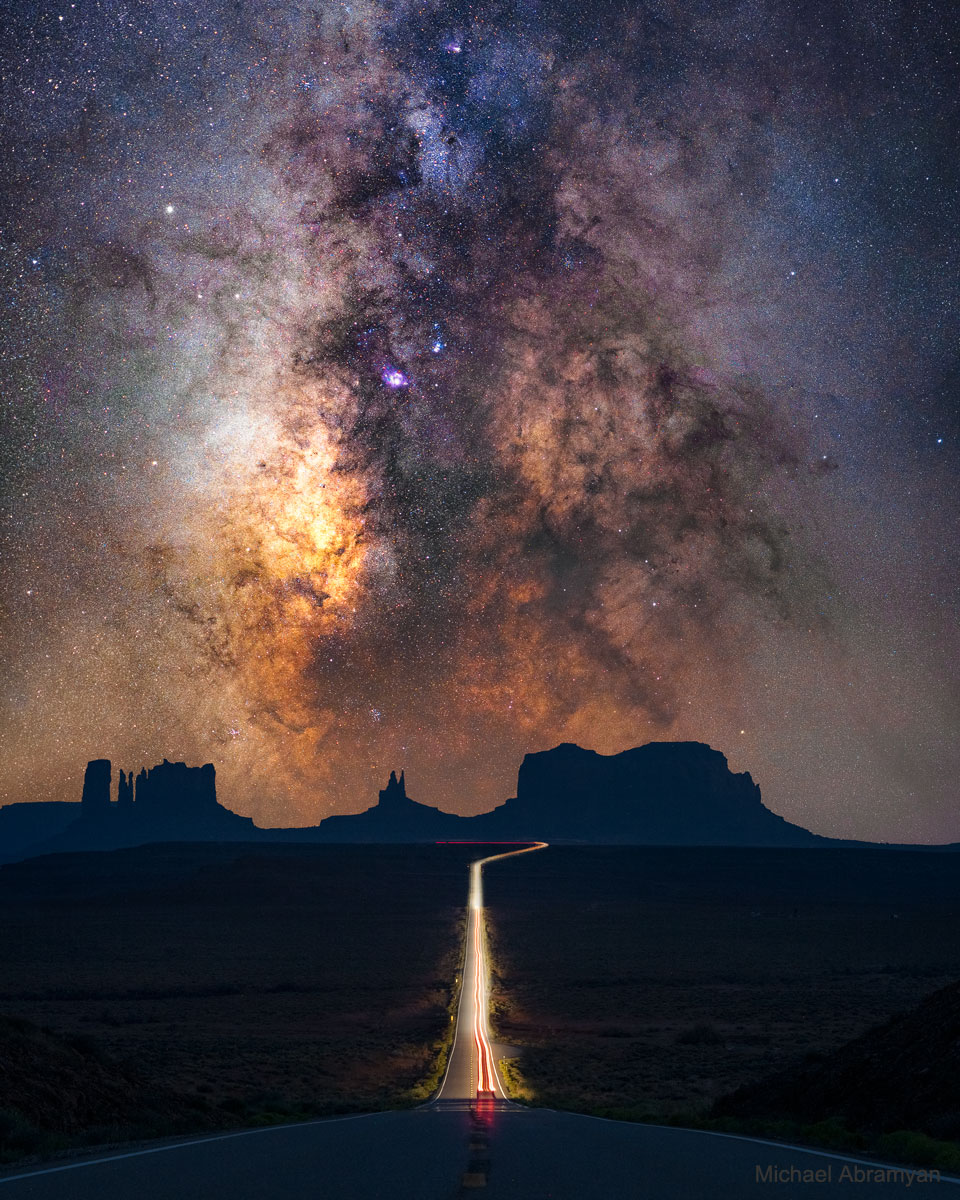
Does the road to our galaxy's center go through Monument Valley? It doesn't have to, but if your road does -- take a picture. In this case, the road is US Route 163 and iconic buttes on the Navajo National Reservation populate the horizon. The band of Milky Way Galaxy stretches down from the sky and appears to be a continuation of the road on Earth. Filaments of dust darken the Milky Way, in contrast to billions of bright stars and several colorful glowing gas clouds including the Lagoon and Trifid nebulas. The featured picture is a composite of images taken with the same camera and from the same location -- Forest Gump Point in Utah, USA. The foreground was taken just after sunset in early September during the blue hour, while the background is a mosaic of four exposures captured a few hours later. Discovery + Outreach: Graduate student research position open for APOD
© Michael Abramyan — used with the credit NASA publishes
Event text and thumbnails come from Wikipedia and are used under CC BY-SA 4.0. Images are drawn only from Wikimedia Commons, which does not accept non-free content — each thumbnail links to its file page, where its licence and author are recorded.
Launch records are from The Space Devs’ Launch Library 2. This archive is still being mirrored, so some days are incomplete. Pictures are NASA’s Astronomy Picture of the Day; NASA imagery is generally not subject to copyright, but individual APOD entries are frequently the property of the photographer, and each caption says which applies.
General-audience astronomy and spaceflight — none of it a textbook.
As an Amazon Associate I earn from qualifying purchases. Links here cost you nothing extra.
LISTING
Still the best single argument for why any of this matters, and it leaves the arithmetic in. For a reader who wants the science, not just the awe.
LISTING
The case for leaving Earth, written by someone unsentimental about how hard that is. Suits readers who want the argument rather than the poster.
LISTING
Hard-SF problem solving in The Martian's key — for anyone who liked the engineering more than the peril. The only novel on this list.
BROWSE opens an Amazon search, not a specific recommendation.
LINKS AMAZON.COM