Launches
NO DATA0MISSIONS
The launch archive is still being mirrored, so this day has no launches listed yet.
ARCHIVE // DAY OF YEAR
Wikipedia records 9 spaceflight and astronomy events on October 24. Below are the pictures NASA published on October 24 in 5 different years — each one taken or released on this exact date.
0MISSIONS
The launch archive is still being mirrored, so this day has no launches listed yet.
9ENTRIES
Spaceflight and astronomy entries from Wikipedia's record of this date, oldest first — from 1851 onward.
5IMAGES
NASA's Astronomy Picture of the Day for October 24, one per year. Some are public domain and some belong to the photographer — each says which.
NASA’s Astronomy Picture of the Day, for this calendar date in each of the last several years.

2025
Saturn is bright in Earth's night skies. Telescopic views of the outer gas giant planet and its beautiful rings often make it a star at star parties. But this stunning view of Saturn's rings and night side just isn't possible from telescopes in the vicinity of planet Earth. Peering out from the inner Solar System they can only bring Saturn's day side into view. In fact, this image of Saturn's slender sunlit crescent with night's shadow cast across its broad and complex ring system was captured by the Cassini spacecraft. A robot spacecraft from planet Earth, Cassini called Saturn orbit home for 13 years before it was directed to dive into the atmosphere of the gas giant on September 15, 2017. This magnificent mosaic is composed of frames recorded by Cassini's wide-angle camera only two days before its grand final plunge. Saturn's night will not be seen again until another spaceship from Earth calls.
NASA · public domain
2024
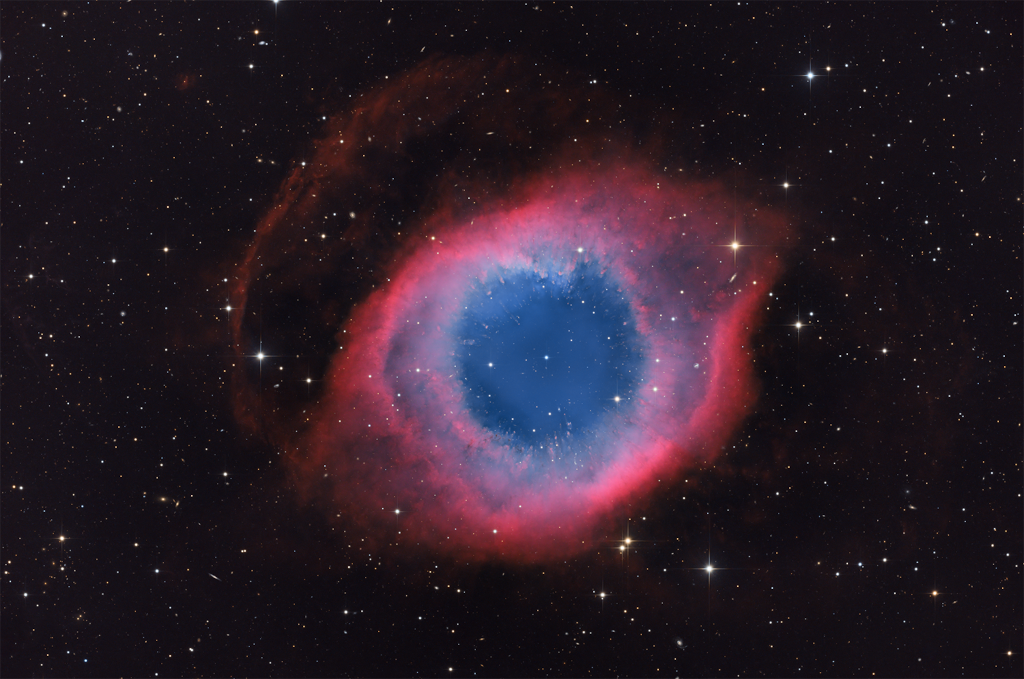
A mere seven hundred light years from Earth toward the constellation Aquarius, a star is dying. The once sun-like star's last few thousand years have produced the Helix Nebula. Also known as NGC 7293, the cosmic Helix is a well studied and nearby example of a Planetary Nebula, typical of this final phase of stellar evolution. Combining narrow band data from emission lines of hydrogen atoms in red and oxygen atoms in blue-green hues, this deep image shows tantalizing details of the Helix, including its bright inner region about 3 light-years across. The white dot at the Helix's center is this Planetary Nebula's hot, dying central star. A simple looking nebula at first glance, the Helix is now understood to have a surprisingly complex geometry.
© Patrick Winkler — used with the credit NASA publishes
2023
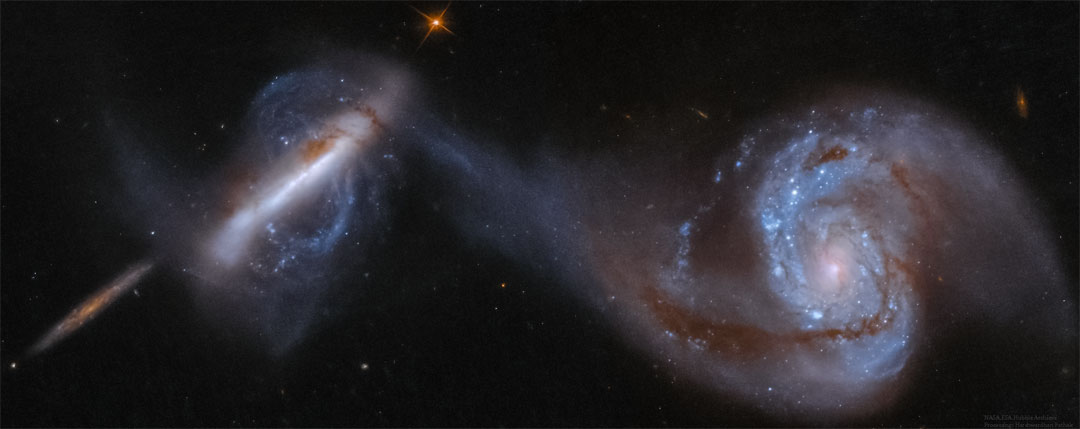
This dance is to the death. As these two large galaxies duel, a cosmic bridge of stars, gas, and dust currently stretches over 75,000 light-years and joins them. The bridge itself is strong evidence that these two immense star systems have passed close to each other and experienced violent tides induced by mutual gravity. As further evidence, the face-on spiral galaxy on the right, also known as NGC 3808A, exhibits many young blue star clusters produced in a burst of star formation. The twisted edge-on spiral on the left (NGC 3808B) seems to be wrapped in the material bridging the galaxies and surrounded by a curious polar ring. Together, the system is known as Arp 87. While such interactions are drawn out over billions of years, repeated close passages will ultimately create one merged galaxy. Although this scenario does look unusual, galactic mergers are thought to be common, with Arp 87 representing a stage in this inevitable process. The Arp 87 dancing pair are about 300 million light-years distant toward the constellation of the Lion (Leo). The prominent edge-on spiral galaxy at the far left appears to be a more distant background galaxy and not involved in the on-going merger.
NASA · public domain
2022
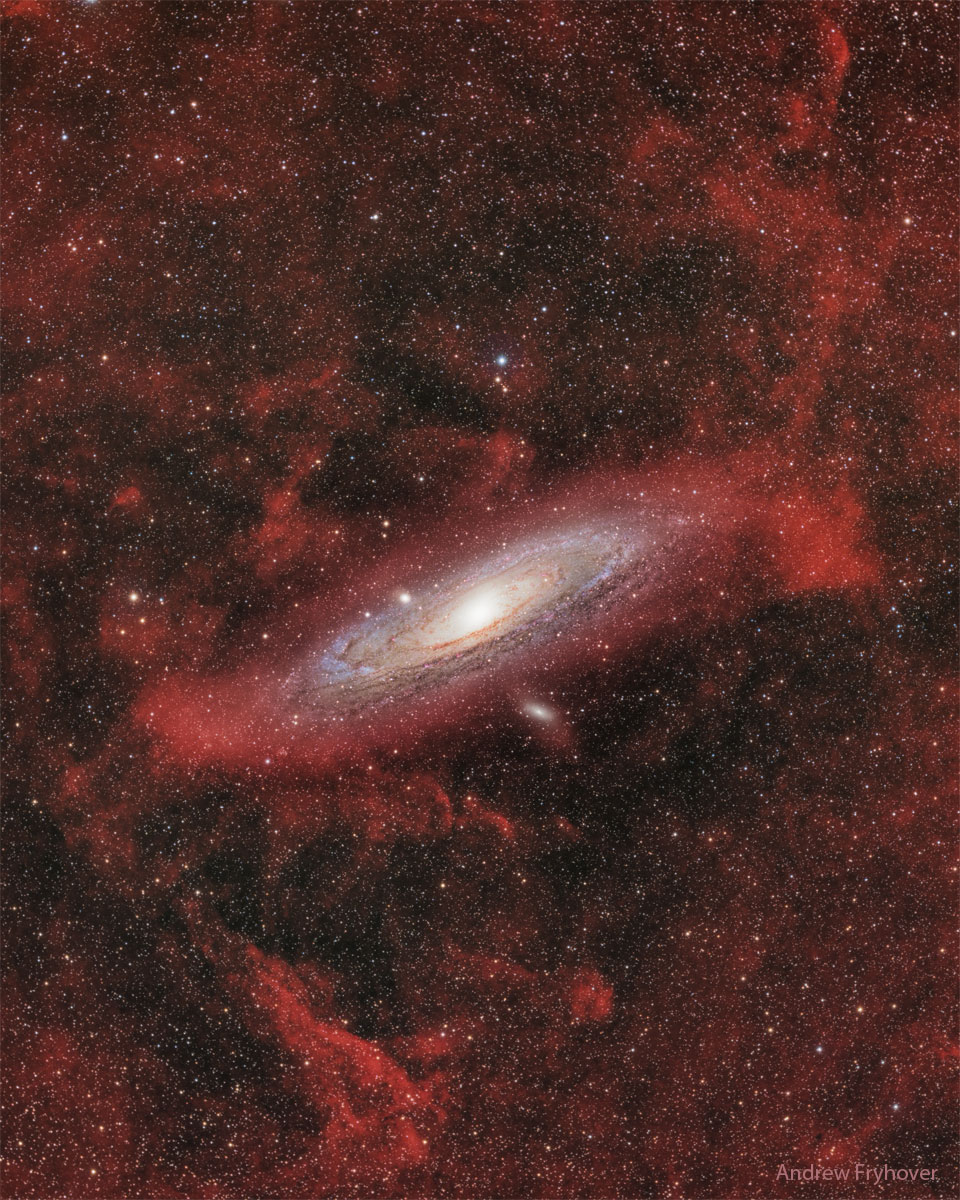
What are those red clouds surrounding the Andromeda galaxy? This galaxy, M31, is often imaged by planet Earth-based astronomers. As the nearest large spiral galaxy, it is a familiar sight with dark dust lanes, bright yellowish core, and spiral arms traced by clouds of bright blue stars. A mosaic of well-exposed broad and narrow-band image data, this deep portrait of our neighboring island universe offers strikingly unfamiliar features though, faint reddish clouds of glowing ionized hydrogen gas in the same wide field of view. Most of the ionized hydrogen clouds surely lie in the foreground of the scene, well within our Milky Way Galaxy. They are likely associated with the pervasive, dusty interstellar cirrus clouds scattered hundreds of light-years above our own galactic plane. Some of the clouds, however, occur right in the Andromeda galaxy itself, and some in M110, the small galaxy just below.
© Andrew Fryhover — used with the credit NASA publishes
2021
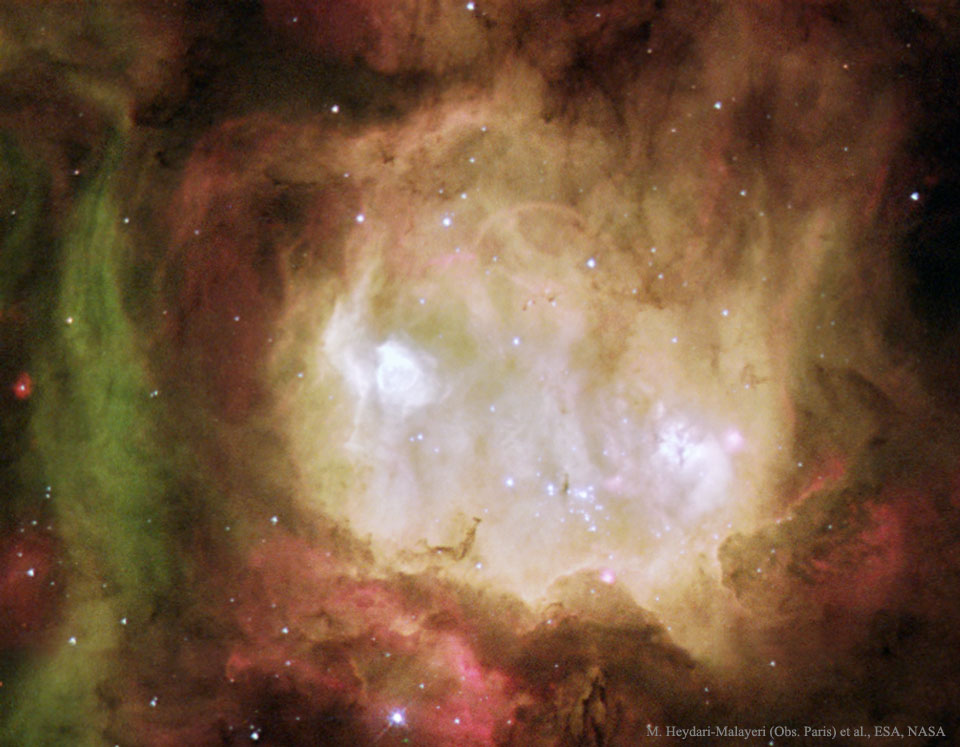
Halloween's origin is ancient and astronomical. Since the fifth century BC, Halloween has been celebrated as a cross-quarter day, a day halfway between an equinox (equal day / equal night) and a solstice (minimum day / maximum night in the northern hemisphere). With a modern calendar however, even though Halloween occurs next week, the real cross-quarter day will occur the week after. Another cross-quarter day is Groundhog Day. Halloween's modern celebration retains historic roots in dressing to scare away the spirits of the dead. Perhaps a fitting tribute to this ancient holiday is this view of the Ghost Head Nebula taken with the Hubble Space Telescope. Similar to the icon of a fictional ghost, NGC 2080 is actually a star forming region in the Large Magellanic Cloud, a satellite galaxy of our own Milky Way Galaxy. The Ghost Head Nebula (NGC 2080) spans about 50 light-years and is shown in representative colors.
NASA · public domain

1851
William Lassell found Umbriel and Ariel, the third and fourth Uranian moons to be discovered.
William Lassell ↗
1911
Orville Wright remains in the air for nine minutes and 45 seconds in a glider at Kill Devil Hills, North Carolina.
Wright brothers ↗
1946
A camera on board the V-2 No. 13 rocket takes the first photograph of earth from outer space.
V-2 No. 13 ↗
1960
Nedelin catastrophe: An R-16 ballistic missile explodes on the launch pad at the Soviet Union's Baikonur Cosmodrome space facility, killing over 100 people, including Field Marshal Mitrofan Nedelin.
Nedelin catastrophe ↗
1963
An oxygen leak from an R-9 Desna missile at the Baikonur Cosmodrome triggers a fire that kills seven people.
R-9 Desna ↗
1998
Deep Space 1 is launched to explore the asteroid belt and test new spacecraft technologies.
Deep Space 1 ↗
2007
Chang'e 1, the first satellite in the Chinese Lunar Exploration Program, is launched from Xichang Satellite Launch Center.
Chang'e 1 ↗2014
The China National Space Administration launches an experimental lunar mission, Chang'e 5-T1, which will loop behind the Moon and return to Earth.
China National Space Administration ↗Event text and thumbnails come from Wikipedia and are used under CC BY-SA 4.0. Images are drawn only from Wikimedia Commons, which does not accept non-free content — each thumbnail links to its file page, where its licence and author are recorded.
Launch records are from The Space Devs’ Launch Library 2. This archive is still being mirrored, so some days are incomplete. Pictures are NASA’s Astronomy Picture of the Day; NASA imagery is generally not subject to copyright, but individual APOD entries are frequently the property of the photographer, and each caption says which applies.
General-audience astronomy and spaceflight — none of it a textbook.
As an Amazon Associate I earn from qualifying purchases. Links here cost you nothing extra.
LISTING
Still the best single argument for why any of this matters, and it leaves the arithmetic in. For a reader who wants the science, not just the awe.
LISTING
The case for leaving Earth, written by someone unsentimental about how hard that is. Suits readers who want the argument rather than the poster.
LISTING
Hard-SF problem solving in The Martian's key — for anyone who liked the engineering more than the peril. The only novel on this list.
BROWSE opens an Amazon search, not a specific recommendation.
LINKS AMAZON.COM