Launches
ON RECORD12MISSIONS
12 of them reached orbit. The earliest was 1970, the most recent 2026.
ARCHIVE // DAY OF YEAR
12 orbital launches flew on March 20, the earliest of them in 1970, and 12 reached orbit. Wikipedia records 2 spaceflight and astronomy events on March 20. Below are the pictures NASA published on March 20 in 6 different years — each one taken or released on this exact date.
12MISSIONS
12 of them reached orbit. The earliest was 1970, the most recent 2026.
2ENTRIES
Spaceflight and astronomy entries from Wikipedia's record of this date, oldest first — from 1964 onward.
6IMAGES
NASA's Astronomy Picture of the Day for March 20, one per year. Some are public domain and some belong to the photographer — each says which.
NASA’s Astronomy Picture of the Day, for this calendar date in each of the last several years.
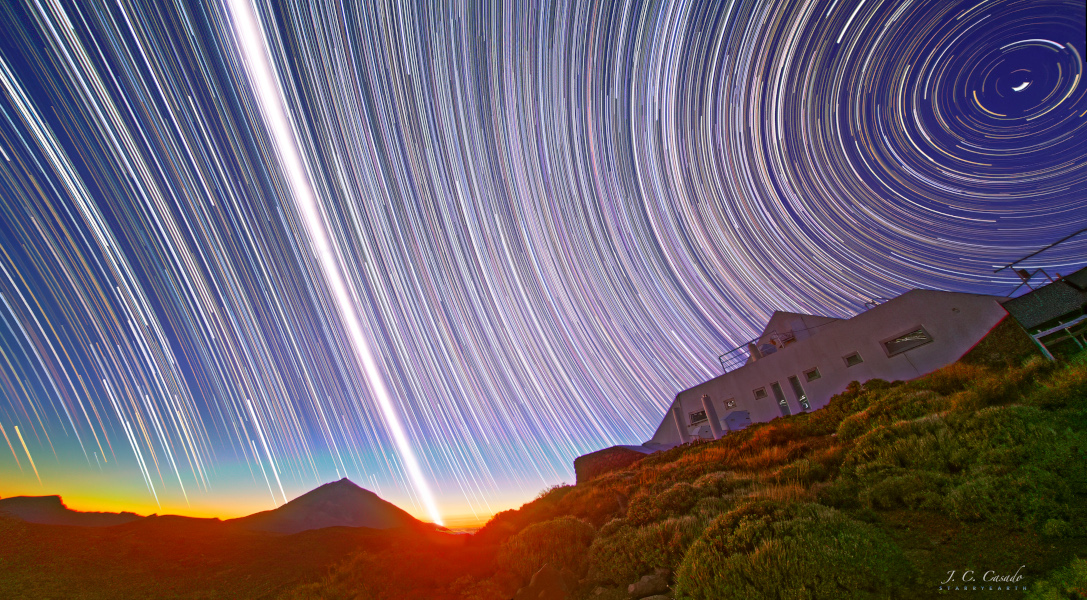
2026
The defining astronomical moment of the equinox today is at 14:46 UTC (March 20). That's when the Sun crosses the celestial equator moving north in its yearly journey through planet Earth's sky, marking the beginning of spring for our fair planet in the northern hemisphere and fall in the southern hemisphere. Then, day and night are nearly equal around the globe. In fact, both day and nighttime exposures from a spring equinox at the Observatorio del Teide in Tenerife, Canary Islands, Spain, are used in this composited skyscape. Over 1,000 images were taken with a fisheye lens and merged in the ambitious equinox project. The apparent motion of the Sun setting along the celestial equator on the equinox date follows the bright linear, diagonal track from the sequence of daytime exposures taken over 6 hours. After sunset, nighttime exposures recorded startrails, with the celestial equator as a linear track and concentric arcs circling the north celestial pole near Polaris at upper right and the south celestial pole beyond the lower left edge (and below the Teide horizon). The foreground includes the distant Teide volcano peak and the observatory's pyramid-shaped solar laboratory building.
© Juan Carlos Casado — used with the credit NASA publishes
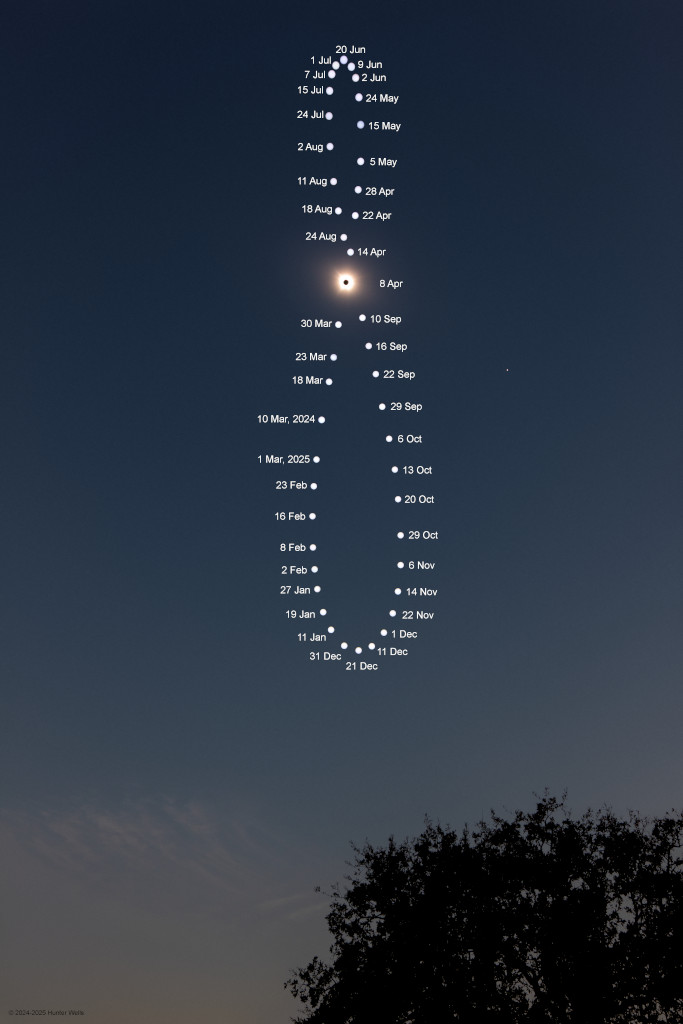
2025
Recorded from 2024 March 10, to 2025 March 1, this composited series of images reveals a pattern in the seasonal drift of the Sun's daily motion through planet Earth's sky. Known to some as an analemma, the figure-eight curve was captured in exposures taken on the indicated dates only at 18:38 UTC from the exact same location south of Stephenville, Texas. The Sun's position on the 2024 solstice dates of June 20 and December 21 would be at the top and bottom of the curve and correspond to the astronomical beginning of summer and winter in the north. Points that lie along the curve half-way between the solstices would mark the equinoxes. The 2024 equinox on September 22, and in 2025 the equinox on March 20 (today) are the start of northern fall and spring. And since one of the exposures was made on 2024 April 8 from the Stephenville location at 18:38:40 UTC, this analemma project also reveals the solar corona in planet Earth's sky during a total solar eclipse.
© Hunter Wells — used with the credit NASA publishes
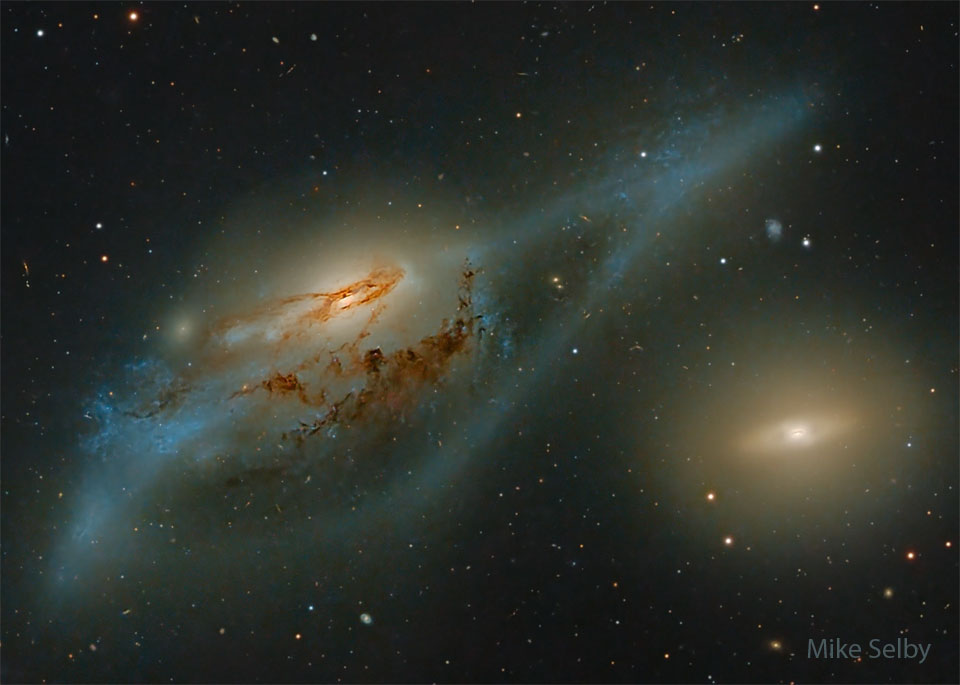
2024
Across the heart of the Virgo Galaxy Cluster lies a string of galaxies known as Markarian's Chain. Prominent in Markarian's Chain are these two interacting galaxies, NGC 4438 (left) and NGC 4435 - also known as The Eyes. About 50 million light-years away, the two galaxies appear to be about 100,000 light-years apart in this sharp close-up, but have likely approached to within an estimated 16,000 light-years of each other in their cosmic past. Gravitational tides from the close encounter have ripped away at their stars, gas, and dust. The more massive NGC 4438 managed to hold on to much of the material torn out in the collision, while material from the smaller NGC 4435 was more easily lost. The remarkably deep image of this crowded region of the universe also includes many more distant background galaxies.
© Mike Selby — used with the credit NASA publishes
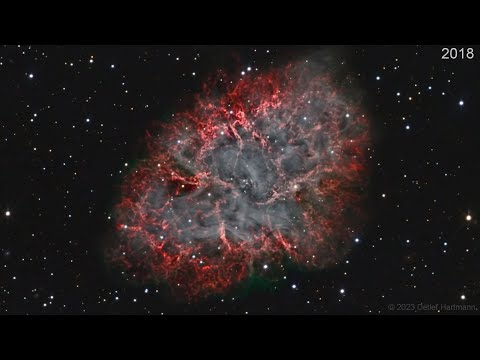
2023
Are your eyes good enough to see the Crab Nebula expand? The Crab Nebula is cataloged as M1, the first on Charles Messier's famous list of things which are not comets. In fact, the Crab is now known to be a supernova remnant, an expanding cloud of debris from the explosion of a massive star. The violent birth of the Crab was witnessed by astronomers in the year 1054. Roughly 10 light-years across today, the nebula is still expanding at a rate of over 1,000 kilometers per second. Over the past decade, its expansion has been documented in this stunning time-lapse movie. In each year from 2008 to 2022, an image was produced with the same telescope and camera from a remote observatory in Austria. The sharp, processed frames even reveal the dynamic energetic emission surrounding the rapidly spinning pulsar at the center. The Crab Nebula lies about 6,500 light-years away toward the constellation of the Bull (Taurus).
© Detlef Hartmann — used with the credit NASA publishes
2022
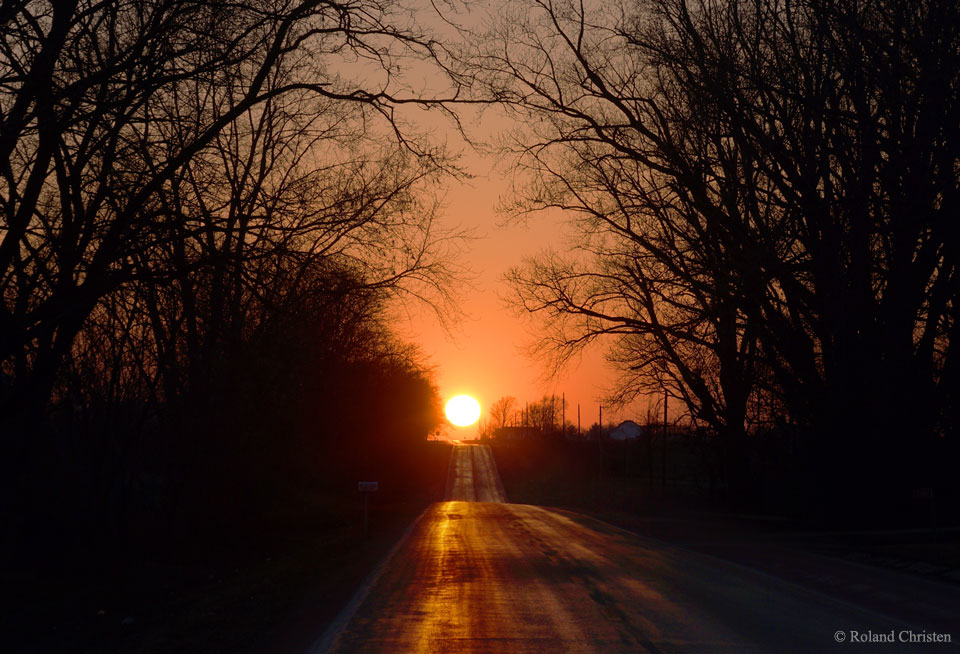
What's that at the end of the road? The Sun. Many towns have roads that run east - west, and on two days each year, the Sun rises and sets right down the middle. Today is one of those days: an equinox. Not only is today a day of equal night ("aequus"-"nox") and day time, but also a day when the sun rises precisely to the east and sets due west. Featured here is a picturesque road in northwest Illinois, USA that runs approximately east -west. The image was taken during the March Equinox of 2015, and shows the Sun down the road at sunset. In many cultures, this March equinox is taken to be the first day of a season, typically spring in Earth's northern hemisphere, and autumn in the south. Does your favorite street run east - west? Tonight, at sunset, you can find out with a quick glance.
© Roland Christen — used with the credit NASA publishes
2021
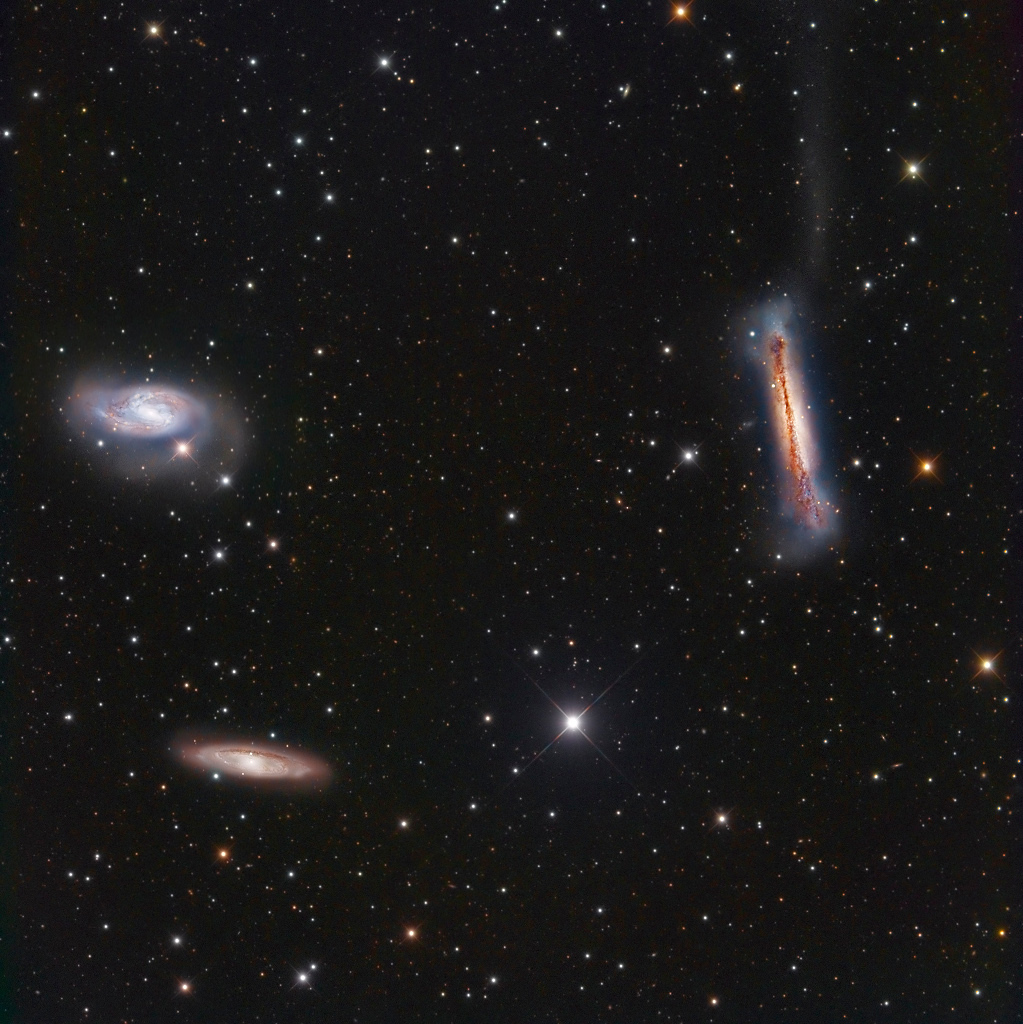
This popular group leaps into the early evening sky around the March equinox and the northern hemisphere spring. Famous as the Leo Triplet, the three magnificent galaxies found in the prominent constellation Leo gather here in one astronomical field of view. Crowd pleasers when imaged with even modest telescopes, they can be introduced individually as NGC 3628 (right), M66 (upper left), and M65 (bottom). All three are large spiral galaxies but tend to look dissimilar, because their galactic disks are tilted at different angles to our line of sight. NGC 3628, also known as the Hamburger Galaxy, is temptingly seen edge-on, with obscuring dust lanes cutting across its puffy galactic plane. The disks of M66 and M65 are both inclined enough to show off their spiral structure. Gravitational interactions between galaxies in the group have left telltale signs, including the tidal tails and warped, inflated disk of NGC 3628 and the drawn out spiral arms of M66. This gorgeous view of the region spans over 1 degree (two full moons) on the sky in a frame that covers over half a million light-years at the trio's estimated distance of 30 million light-years. Of course the spiky foreground stars lie well within our own Milky Way.
© Francis Bozon — used with the credit NASA publishes
1964
The precursor of the European Space Agency, ESRO (European Space Research Organisation) is established per an agreement signed on June 14, 1962.
European Space Agency ↗
2015
A solar eclipse, equinox, and a supermoon all occur on the same day.
Solar eclipse of March 20, 2015 ↗Event text and thumbnails come from Wikipedia and are used under CC BY-SA 4.0. Images are drawn only from Wikimedia Commons, which does not accept non-free content — each thumbnail links to its file page, where its licence and author are recorded.
Launch records are from The Space Devs’ Launch Library 2. Pictures are NASA’s Astronomy Picture of the Day; NASA imagery is generally not subject to copyright, but individual APOD entries are frequently the property of the photographer, and each caption says which applies.
General-audience astronomy and spaceflight — none of it a textbook.
As an Amazon Associate I earn from qualifying purchases. Links here cost you nothing extra.
LISTING
Still the best single argument for why any of this matters, and it leaves the arithmetic in. For a reader who wants the science, not just the awe.
LISTING
The case for leaving Earth, written by someone unsentimental about how hard that is. Suits readers who want the argument rather than the poster.
LISTING
Hard-SF problem solving in The Martian's key — for anyone who liked the engineering more than the peril. The only novel on this list.
BROWSE opens an Amazon search, not a specific recommendation.
LINKS AMAZON.COM