Launches
NO DATA0MISSIONS
The launch archive is still being mirrored, so this day has no launches listed yet.
ARCHIVE // DAY OF YEAR
Wikipedia records 3 spaceflight and astronomy events on March 19. Below are the pictures NASA published on March 19 in 6 different years — each one taken or released on this exact date.
0MISSIONS
The launch archive is still being mirrored, so this day has no launches listed yet.
3ENTRIES
Spaceflight and astronomy entries from Wikipedia's record of this date, oldest first — from 1965 onward.
6IMAGES
NASA's Astronomy Picture of the Day for March 19, one per year. Some are public domain and some belong to the photographer — each says which.
NASA’s Astronomy Picture of the Day, for this calendar date in each of the last several years.
2026
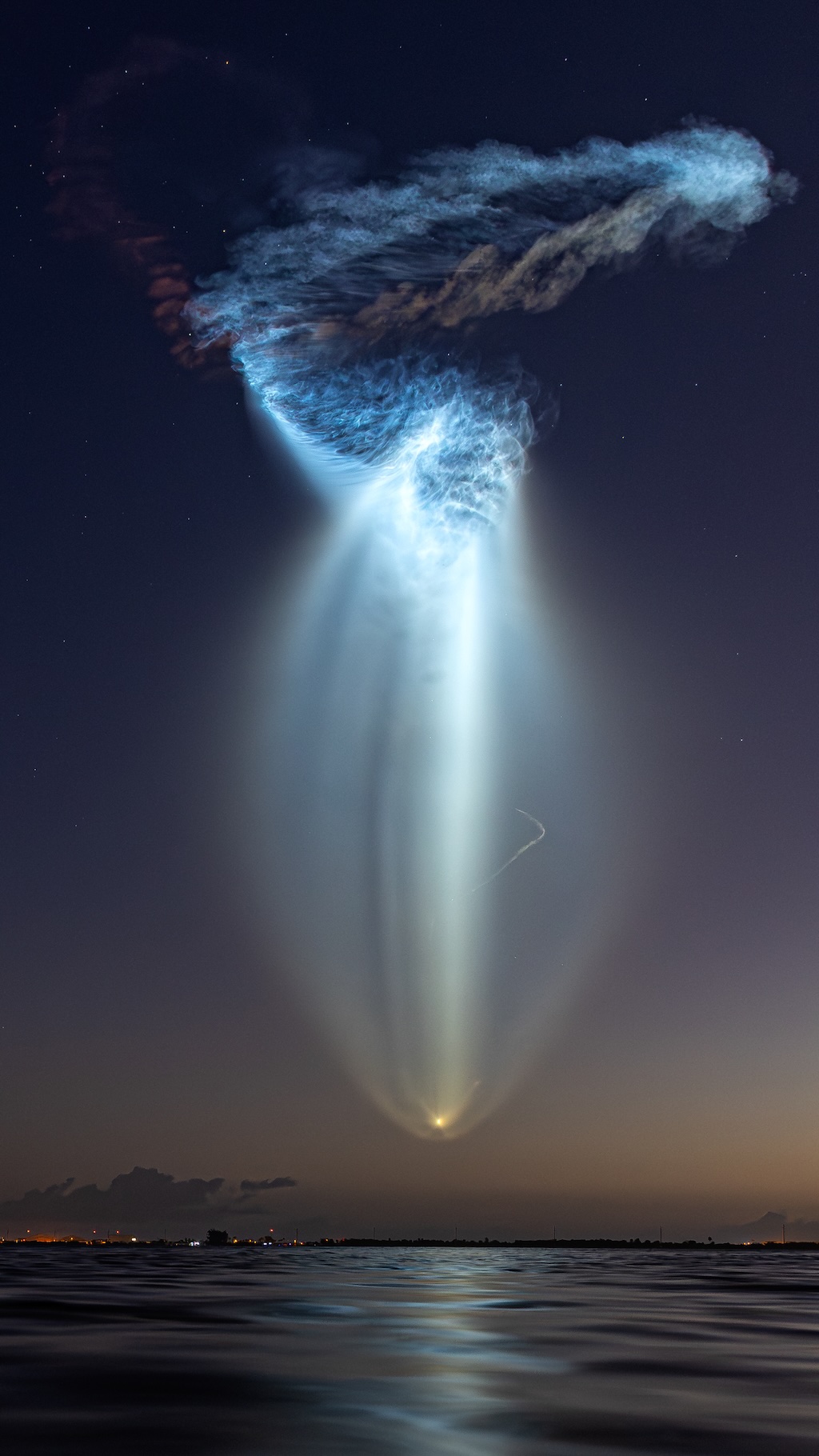
ven if you live with your head in the clouds, you won’t find a jellyfish like this one very often. The featured image shows a SpaceX Falcon 9 rocket launch from Cape Canaveral in Florida on March 4. The launch happened 52 minutes before sunrise, and the second stage rocket exhaust plume was high enough in the sky to catch the light of the rising sun, while the photographer was still in the dark. This combination of light and shadow, possible at dawn or dusk, makes the exhaust, mostly water vapor and carbon dioxide, appear as a glowing cloud. It only looks like it's going down, as the rocket follows the curvature of the Earth on its way to space. A related effect is the twilight phenomenon, which causes colorful contrails sometimes mistaken for UFOs. But, in case you are wondering: real jellyfish were sent to space by NASA in the 1990s as part of a science experiment.
© Michael Seeley — used with the credit NASA publishes
2025
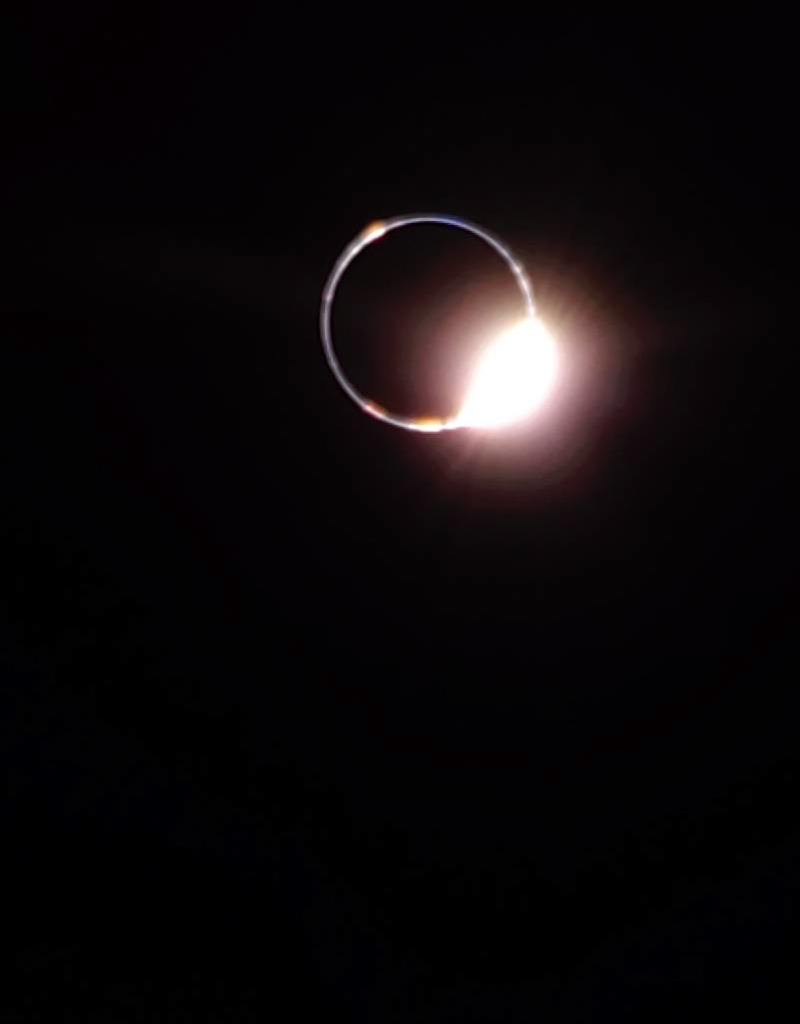
On March 14 the Full Moon slid through Earth's dark umbral shadow and denizens of planet Earth were treated to a total lunar eclipse. Of course, from the Moon's near side that same astronomical syzygy was seen as a solar eclipse. Operating in the Mare Crisium on the lunar surface, the Blue Ghost lander captured this video frame of Earth in silhouette around 3:30am CDT, just as the Sun was emerging from behind the terrestrial disk. From Blue Ghost's lunar perspective the beautiful diamond ring effect, familiar to earthbound solar eclipse watchers, is striking. Since Earth appears about four times the apparent size of the Sun from the lunar surface the inner solar corona, the atmosphere of the Sun most easily seen from Earth during a total solar eclipse, is hidden from view. Still, scattering in Earth's dense atmosphere creates the glowing band of sunlight embracing our fair planet.
NASA · public domain
2024
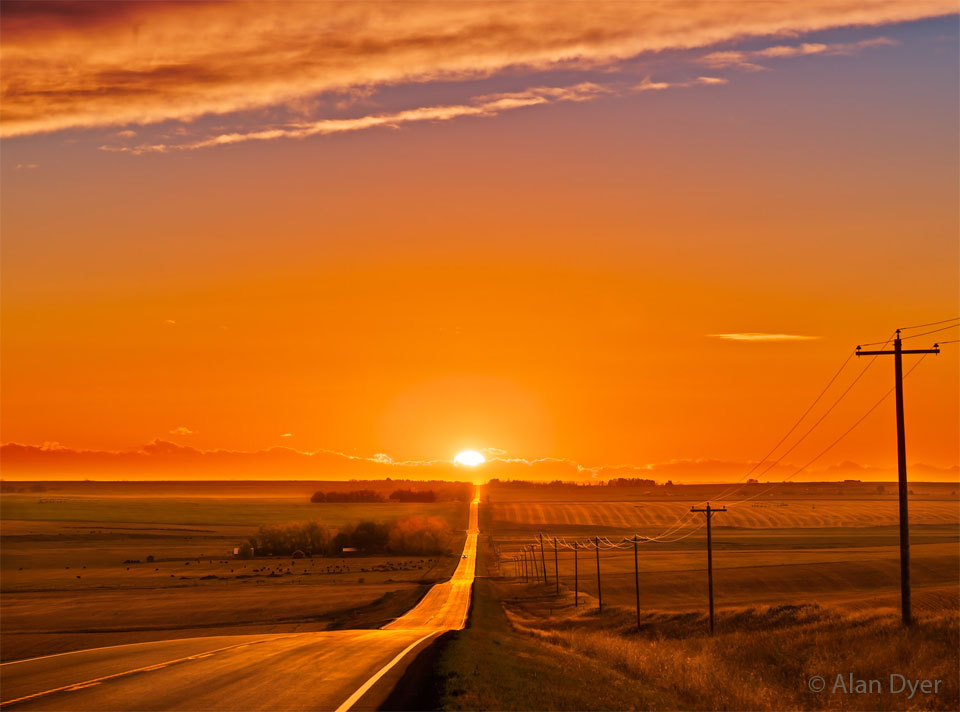
What's that at the end of the road? The Sun. Many towns have roads that run east-west, and on two days each year, the Sun rises and sets right down the middle. Today, in some parts of the world (tomorrow in others), is one of those days: an equinox. Not only is this a day of equal night ("aequus"-"nox") and day time, but also a day when the sun rises precisely to the east and sets due west. Displayed here is a picturesque rural road in Alberta, Canada that runs approximately east-west. The featured image was taken during the September Equinox of 2021, but the geometry remains the same every year. In many cultures, this March equinox is taken to be the first day of a season, typically spring in Earth's northern hemisphere, and autumn in the south. Does your favorite street run east-west? Tonight, at sunset, you can find out with a quick glance.
© Alan Dyer, Amazingsky.com, TWAN — used with the credit NASA publishes
2023
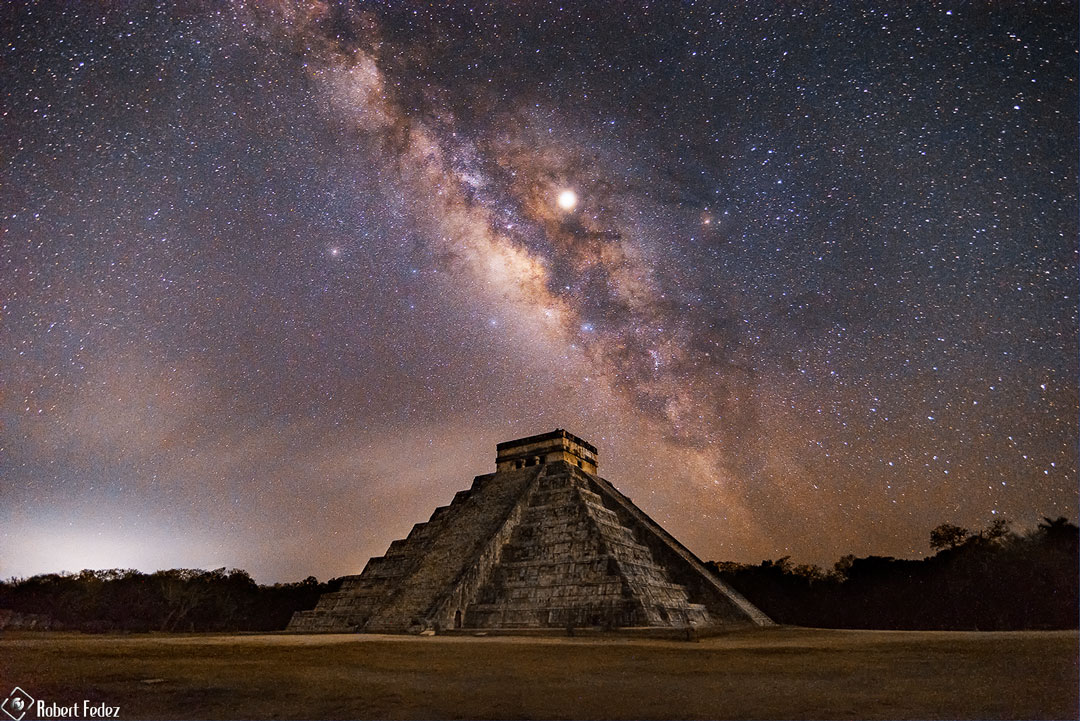
To see the feathered serpent descend the Mayan pyramid requires exquisite timing. You must visit El Castillo -- in Mexico's Yucatán Peninsula -- near an equinox. Then, during the late afternoon if the sky is clear, the pyramid's own shadows create triangles that merge into the famous illusion of a slithering viper. Also known as the Temple of Kukulkan, the impressive step-pyramid stands 30 meters tall and 55 meters wide at the base. Built up as a series of square terraces by the pre-Columbian civilization between the 9th and 12th century, the structure can be used as a calendar and is noted for astronomical alignments. The featured composite image was captured in 2019 with Jupiter and Saturn straddling the diagonal central band of our Milky Way galaxy. Tomorrow marks another equinox -- not only at Temple of Kukulcán, but all over planet Earth.
© Robert Fedez — used with the credit NASA publishes
2022
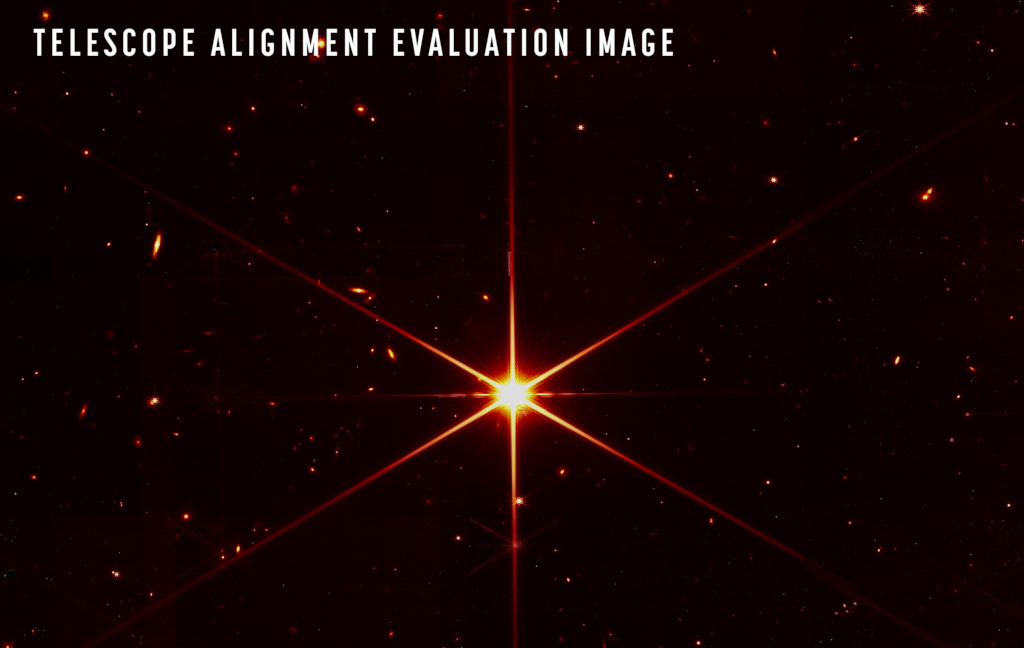
2MASS J17554042+6551277 doesn't exactly roll off the tongue but that's the name, a coordinate-based catalog designation, of the star centered in this sharp field of view. Fans of the distant universe should get used to its spiky appearance though. The diffraction pattern is created by the 18 hexagonal mirror segments of the James Webb Space Telescope. After unfolding, the segments have now been adjusted to achieve a diffraction limited alignment at infrared wavelengths while operating in concert as a single 6.5 meter diameter primary mirror. The resulting image taken by Webb's NIRcam demonstrates their precise alignment is the best physics will allow. 2MASS J17554042+6551277 is about 2,000 light-years away and well within our own galaxy. But the galaxies scattered across the background of the Webb telescope alignment evaluation image are likely billions of light-years distant, far beyond the Milky Way.
NASA · public domain
2021
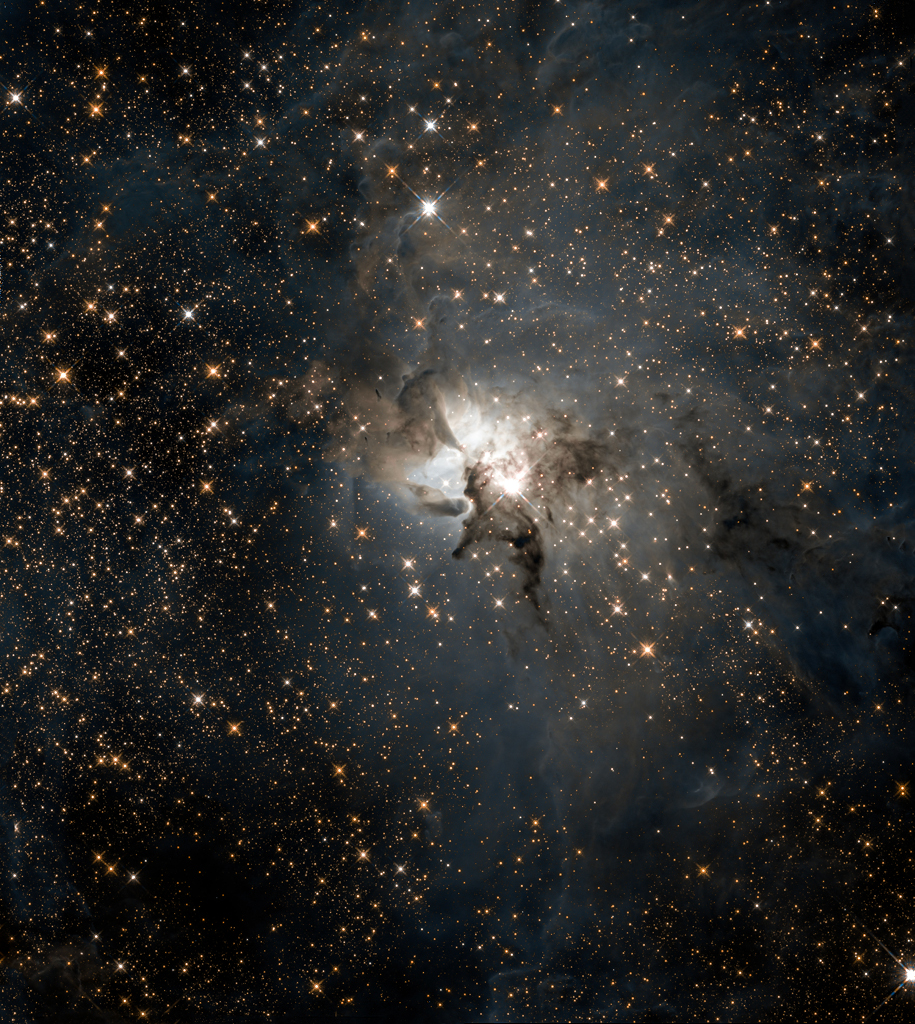
Stars fill this infrared view, spanning 4 light-years across the center of the Lagoon Nebula. Visible light images show the glowing gas and obscuring dust clouds that dominate the scene. But this infrared image, constructed from Hubble Space Telescope data, peers closer to the heart of the active star-forming region revealing newborn stars scattered within, against a crowded field of background stars toward the center of our Milky Way galaxy. This tumultuous stellar nursery's central regions are sculpted and energized by the massive, young Herschel 36, seen as the bright star near center in the field of view. Herschel 36 is actually a multiple system of massive stars. At over 30 times the mass of the Sun and less than 1 million years old, the most massive star in the system should live to a stellar old age of 5 million years. Compare that to the almost 5 billion year old Sun which will evolve into a red giant in only another 5 billion years or so. The Lagoon Nebula, also known as M8, lies about 4,000 light-years away within the boundaries of the constellation Sagittarius.
NASA · public domain
1965
The wreck of the SS Georgiana, valued at over $50,000,000 and said to have been the most powerful Confederate cruiser, is discovered by teenage diver and pioneer underwater archaeologist E. Lee Spence, exactly 102 years after its destruction.
SS Georgiana ↗
2008
The gamma-ray burst GRB 080319B, the farthest object from Earth that was observable by the naked eye, was observed.
Gamma-ray burst ↗2008
The gamma-ray burst GRB 080319B was observed, setting a record for the farthest event from Earth observable with the naked eye.
Gamma-ray burst ↗Event text and thumbnails come from Wikipedia and are used under CC BY-SA 4.0. Images are drawn only from Wikimedia Commons, which does not accept non-free content — each thumbnail links to its file page, where its licence and author are recorded.
Launch records are from The Space Devs’ Launch Library 2. This archive is still being mirrored, so some days are incomplete. Pictures are NASA’s Astronomy Picture of the Day; NASA imagery is generally not subject to copyright, but individual APOD entries are frequently the property of the photographer, and each caption says which applies.
General-audience astronomy and spaceflight — none of it a textbook.
As an Amazon Associate I earn from qualifying purchases. Links here cost you nothing extra.
LISTING
Still the best single argument for why any of this matters, and it leaves the arithmetic in. For a reader who wants the science, not just the awe.
LISTING
The case for leaving Earth, written by someone unsentimental about how hard that is. Suits readers who want the argument rather than the poster.
LISTING
Hard-SF problem solving in The Martian's key — for anyone who liked the engineering more than the peril. The only novel on this list.
BROWSE opens an Amazon search, not a specific recommendation.
LINKS AMAZON.COM