Launches
NO DATA0MISSIONS
The launch archive is still being mirrored, so this day has no launches listed yet.
ARCHIVE // DAY OF YEAR
Wikipedia records 4 spaceflight and astronomy events on January 13. Below are the pictures NASA published on January 13 in 5 different years — each one taken or released on this exact date.
0MISSIONS
The launch archive is still being mirrored, so this day has no launches listed yet.
4ENTRIES
Spaceflight and astronomy entries from Wikipedia's record of this date, oldest first — from 1993 onward.
5IMAGES
NASA's Astronomy Picture of the Day for January 13, one per year. Some are public domain and some belong to the photographer — each says which.
NASA’s Astronomy Picture of the Day, for this calendar date in each of the last several years.

2025
Comet ATLAS is really bright now, but also really close to the Sun. Outside the glow of the Sun, Comet C/2024 G3 (ATLAS) would be one of the more remarkable comet sights of recent years, reflecting about as much sunlight to Earth as Comet Tsuchinshan-ATLAS did in October, and now rivaling even planet Venus. But the giant snowball is now so close to the Sun that it can only be seen through the light of the early morning dawn or the early evening dusk. Today, Comet ATLAS is at perihelion -- its closest ever to the Sun. Although the future brightness of comets is notoriously hard to predict, there is hope that Comet ATLAS will survive its close pass near the Sun and remain bright enough to be seen with the unaided eye over the next few days -- and possibly a good camera comet for weeks. The featured image was taken early yesterday morning near Tornaľa, Slovakia. Tomorrow: Zoom APOD Lecture hosted by the Amateur Astronomers of Association of New York
© Petr Horalek / Institute of Physics in Opava — used with the credit NASA publishes
2024
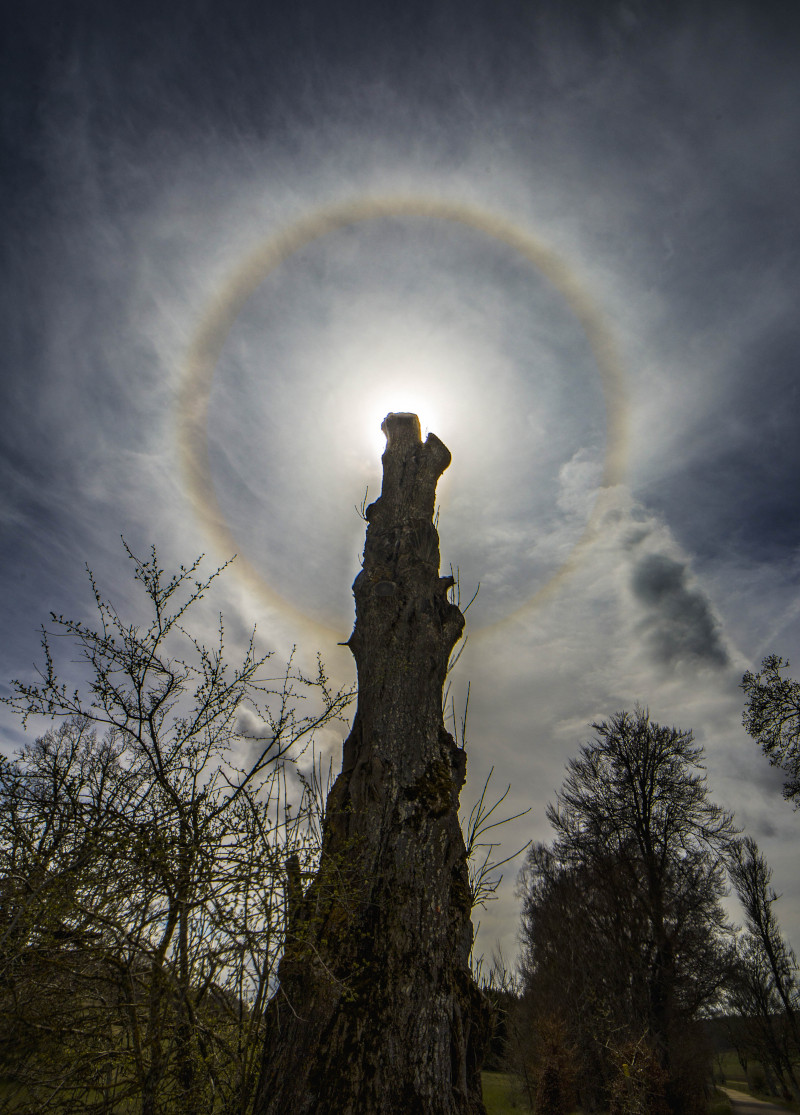
rth's orbit around the Sun is not a circle, it's an ellipse. The point along its elliptical orbit where our fair planet is closest to the Sun is called perihelion. This year, perihelion was on January 2 at 01:00 UTC, with the Earth about 3 million miles closer to the Sun than it was at aphelion (last July 6), the farthest point in its elliptical orbit. Of course, distance from the Sun doesn't determine the seasons, and it doesn't the determine size of Sun halos. Easier to see with the Sun hidden behind a tall tree trunk, this beautiful ice halo forms a 22 degree-wide circle around the Sun, recorded while strolling through the countryside near Heroldstatt, Germany. The Sun halo's 22 degree angular diameter is determined by the six-sided geometry of water ice crystals drifting high in planet Earth's atmosphere.
© Radoslav Zboran — used with the credit NASA publishes
2023
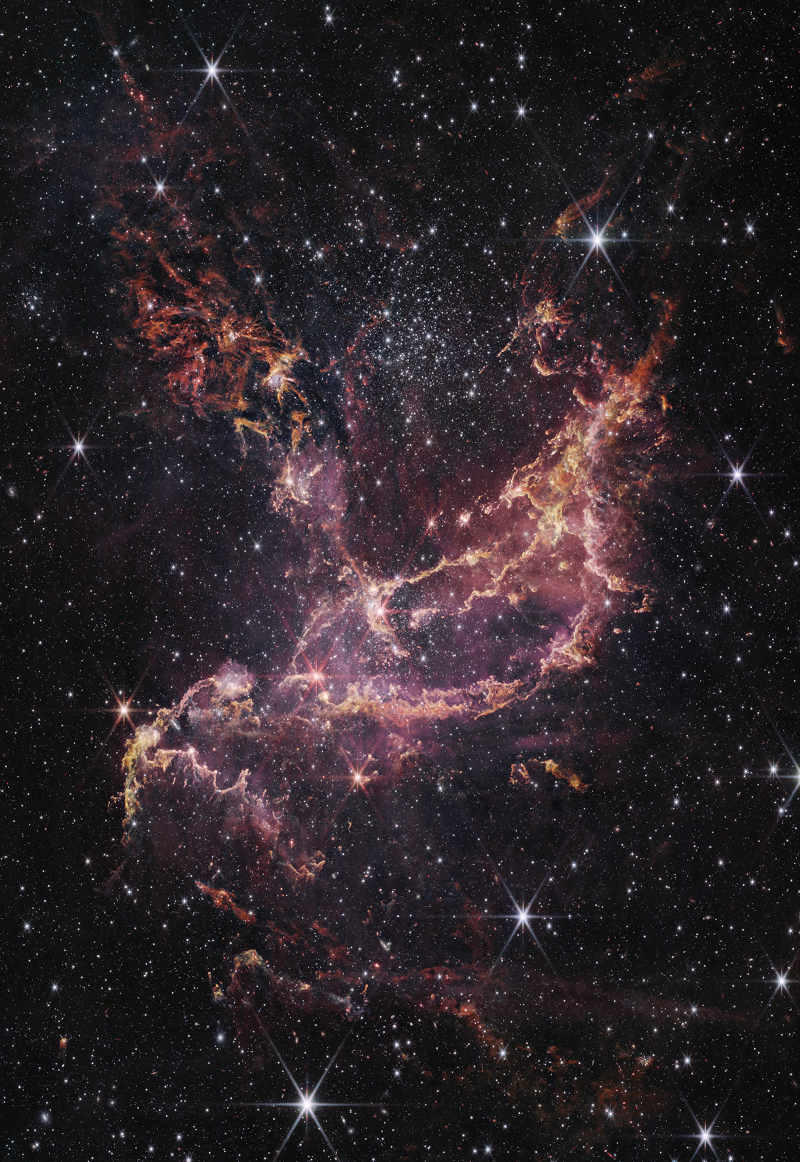
The most massive young star cluster in the Small Magellanic Cloud is NGC 346, embedded in our small satellite galaxy's largest star forming region some 210,000 light-years distant. Of course the massive stars of NGC 346 are short lived, but very energetic. Their winds and radiation sculpt the edges of the region's dusty molecular cloud triggering star-formation within. The star forming region also appears to contain a large population of infant stars. A mere 3 to 5 million years old and not yet burning hydrogen in their cores, the infant stars are strewn about the embedded star cluster. This spectacular infrared view of NGC 346 is from the James Webb Space Telescope's NIRcam. Emission from atomic hydrogen ionized by the massive stars' energetic radiation as well as molecular hydrogen and dust in the star-forming molecular cloud is detailed in pink and orange hues. Webb's sharp image of the young star-forming region spans 240 light-years at the distance of the Small Magellanic Cloud.
NASA · public domain
2022
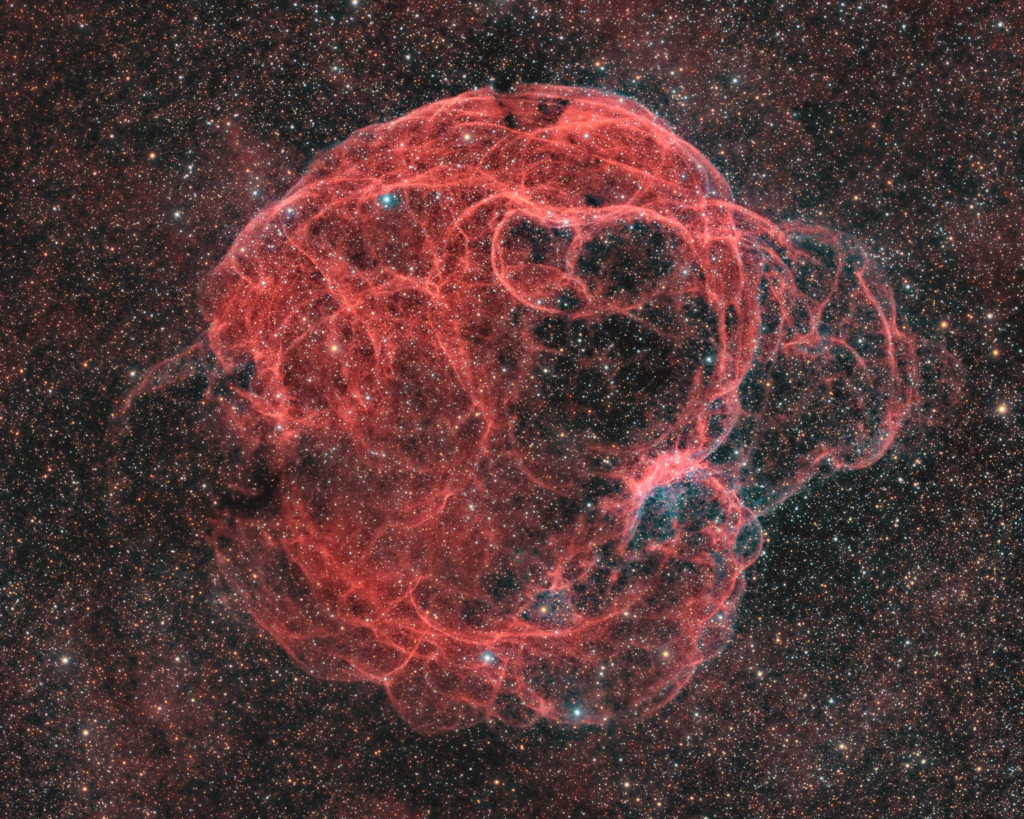
It's easy to get lost following the intricate, looping, twisting filaments in this detailed image of supernova remnant Simeis 147. Also cataloged as Sharpless 2-240 it goes by the popular nickname, the Spaghetti Nebula. Seen toward the boundary of the constellations Taurus and Auriga, it covers nearly 3 degrees or 6 full moons on the sky. That's about 150 light-years at the stellar debris cloud's estimated distance of 3,000 light-years. This composite includes image data taken through narrow-band filters where reddish emission from ionized hydrogen atoms and doubly ionized oxygen atoms in faint blue-green hues trace the shocked, glowing gas. The supernova remnant has an estimated age of about 40,000 years, meaning light from the massive stellar explosion first reached Earth 40,000 years ago. But the expanding remnant is not the only aftermath. The cosmic catastrophe also left behind a spinning neutron star or pulsar, all that remains of the original star's core.
© Jason Dain — used with the credit NASA publishes

2021
What are these two giant arches across the sky? Perhaps the more familiar one, on the left, is the central band of our Milky Way Galaxy. This grand disk of stars and nebulas here appears to encircle much of the southern sky. Visible below the stellar arch is the rusty-orange planet Mars and the extended Andromeda galaxy. For a few minutes during this cold arctic night, a second giant arch appeared to the right, encircling part of the northern sky: an aurora. Auroras are much closer than stars as they are composed of glowing air high in Earth's atmosphere. Visible outside the green auroral arch is the group of stars popularly known as the Big Dipper. The featured digital composite of 18 images was captured in mid-December over the Lofoten Islands in Norway. APOD Year in Review (2020): RJN's Night Sky Network Lecture
© Giulio Cobianchi — used with the credit NASA publishes

1993
Space Shuttle program: Endeavour heads for space for the third time as STS-54 launches from the Kennedy Space Center.
Space Shuttle program ↗
2000
A Short 360 aircraft chartered by the Sirte Oil Company crashes off the coast of Brega, Libya, killing 21.
Short 360 ↗
2003
The trans-Neptunian object 208996 Achlys was discovered by Chad Trujillo and Michael E. Brown at Palomar Observatory, California.
208996 Achlys ↗2003
208996 Achlys was discovered by Chad Trujillo and Michael E. Brown at Palomar Observatory.
208996 Achlys ↗Event text and thumbnails come from Wikipedia and are used under CC BY-SA 4.0. Images are drawn only from Wikimedia Commons, which does not accept non-free content — each thumbnail links to its file page, where its licence and author are recorded.
Launch records are from The Space Devs’ Launch Library 2. This archive is still being mirrored, so some days are incomplete. Pictures are NASA’s Astronomy Picture of the Day; NASA imagery is generally not subject to copyright, but individual APOD entries are frequently the property of the photographer, and each caption says which applies.
General-audience astronomy and spaceflight — none of it a textbook.
As an Amazon Associate I earn from qualifying purchases. Links here cost you nothing extra.
LISTING
Still the best single argument for why any of this matters, and it leaves the arithmetic in. For a reader who wants the science, not just the awe.
LISTING
The case for leaving Earth, written by someone unsentimental about how hard that is. Suits readers who want the argument rather than the poster.
LISTING
Hard-SF problem solving in The Martian's key — for anyone who liked the engineering more than the peril. The only novel on this list.
BROWSE opens an Amazon search, not a specific recommendation.
LINKS AMAZON.COM