Launches
NO DATA0MISSIONS
The launch archive is still being mirrored, so this day has no launches listed yet.
ARCHIVE // DAY OF YEAR
Wikipedia records 5 spaceflight and astronomy events on January 12. Below are the pictures NASA published on January 12 in 6 different years — each one taken or released on this exact date.
0MISSIONS
The launch archive is still being mirrored, so this day has no launches listed yet.
5ENTRIES
Spaceflight and astronomy entries from Wikipedia's record of this date, oldest first — from 1986 onward.
6IMAGES
NASA's Astronomy Picture of the Day for January 12, one per year. Some are public domain and some belong to the photographer — each says which.
NASA’s Astronomy Picture of the Day, for this calendar date in each of the last several years.

2026
What's happening to this meteor? It is shedding its outer layers as it passes through the Earth's atmosphere and heats up. The sudden high temperatures not only cause the bright glow along the dramatic streak but also melt and vaporize the meteor's component rock and ice, creating dust. Wind in the atmosphere typically blows this dust away over the next few seconds, leaving no visible trace after only a few minutes. Much of this dust will eventually settle down to the Earth. The featured image was captured in mid-December, coincident with the Geminids meteor shower. On the upper left is Sirius, the brightest star in the night sky, while in the foreground is fog-engulfed Huangshan, the Yellow Mountains of eastern China.
© Xu Chen — used with the credit NASA publishes

2025
Whatever hit Mimas nearly destroyed it. What remains is one of the largest impact craters on one of Saturn's smallest round moons. Analysis indicates that a slightly larger impact would have destroyed Mimas entirely. The huge crater, named Herschel after the 1789 discoverer of Mimas, Sir William Herschel, spans about 130 kilometers and is featured here. Mimas' low mass produces a surface gravity just strong enough to create a spherical body but weak enough to allow such relatively large surface features. Mimas is made of mostly water ice with a smattering of rock - so it is accurately described as a big dirty snowball. The featured image was taken during the closest-ever flyby of the robot spacecraft Cassini past Mimas in 2010 while in orbit around Saturn. Interactive: Take a trek across Mimas January 14: Zoom APOD Lecture hosted by the Amateur Astronomers of Association of New York
NASA · public domain
2024
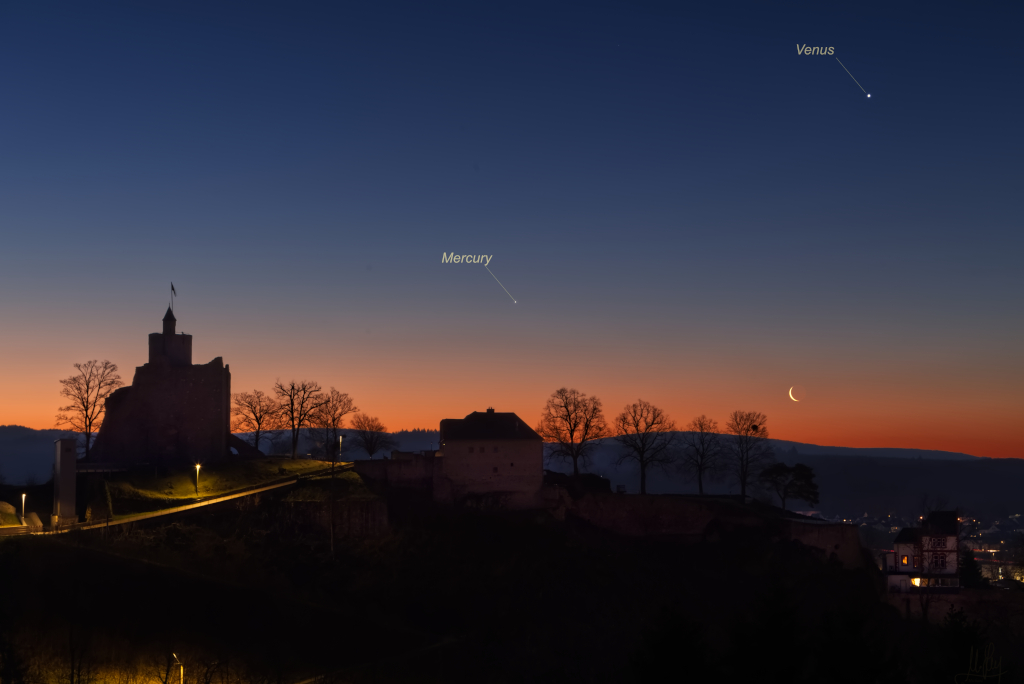
Yesterday, the Moon was New. But on January 9, early morning risers around planet Earth were treated to the sight of an old Moon, low in the east as the sky grew bright before dawn. Above the city of Saarburg in Rhineland-Palatinate, western Germany, this simple snapshot found the waning Moon's sunlit crescent just before sunrise. But also never wandering far from the Sun in Earth's sky, inner planets Venus and Mercury shared the cold morning skyview. In the foreground are the historic city's tower and castle with ruins from the 10th century.
© Michael Luy — used with the credit NASA publishes
2023
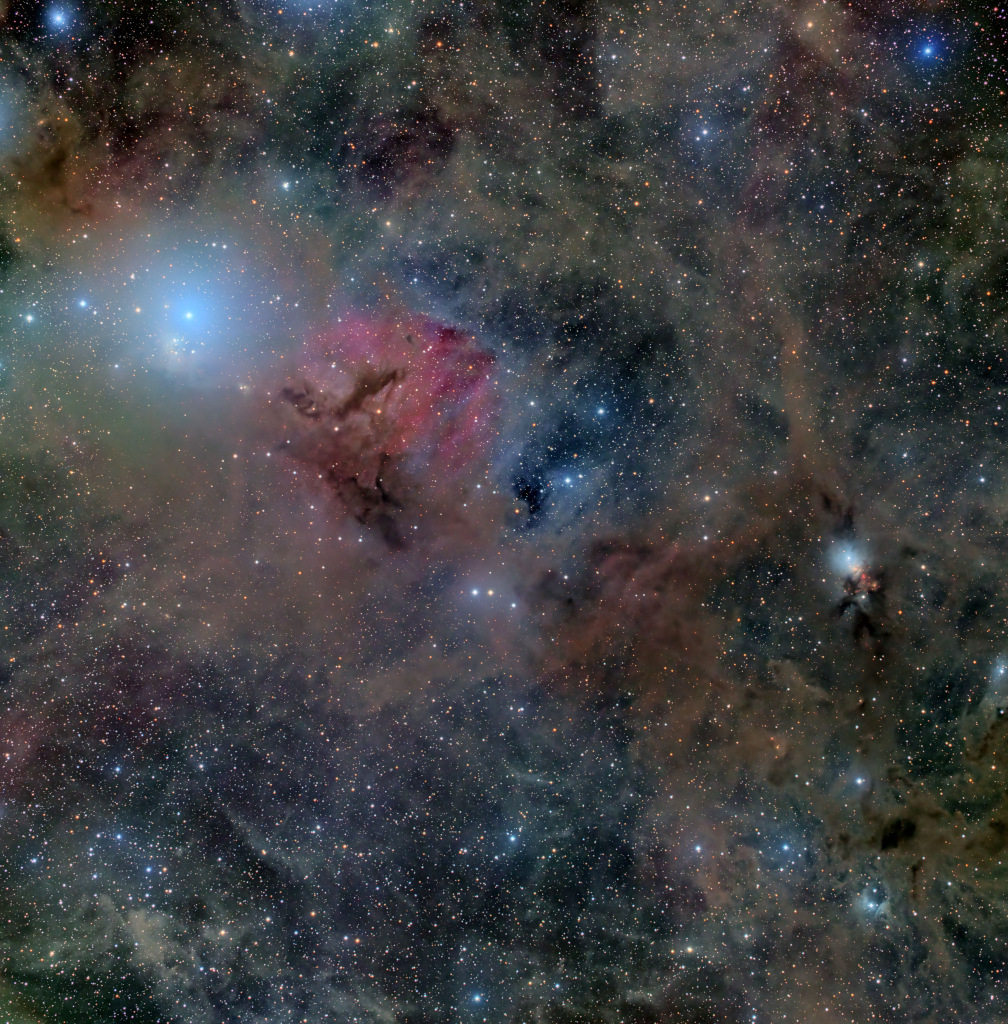
This cosmic expanse of dust, gas, and stars covers some 6 degrees on the sky in the heroic constellation Perseus. At upper left in the gorgeous skyscape is the intriguing young star cluster IC 348 and neighboring Flying Ghost Nebula with clouds of obscuring interstellar dust cataloged as Barnard 3 and 4. At right, another active star forming region NGC 1333 is connected by dark and dusty tendrils on the outskirts of the giant Perseus Molecular Cloud, about 850 light-years away. Other dusty nebulae are scattered around the field of view, along with the faint reddish glow of hydrogen gas. In fact, the cosmic dust tends to hide the newly formed stars and young stellar objects or protostars from prying optical telescopes. Collapsing due to self-gravity, the protostars form from the dense cores embedded in the molecular cloud. At the molecular cloud's estimated distance, this field of view would span over 90 light-years.
© Jack Groves — used with the credit NASA publishes
2022
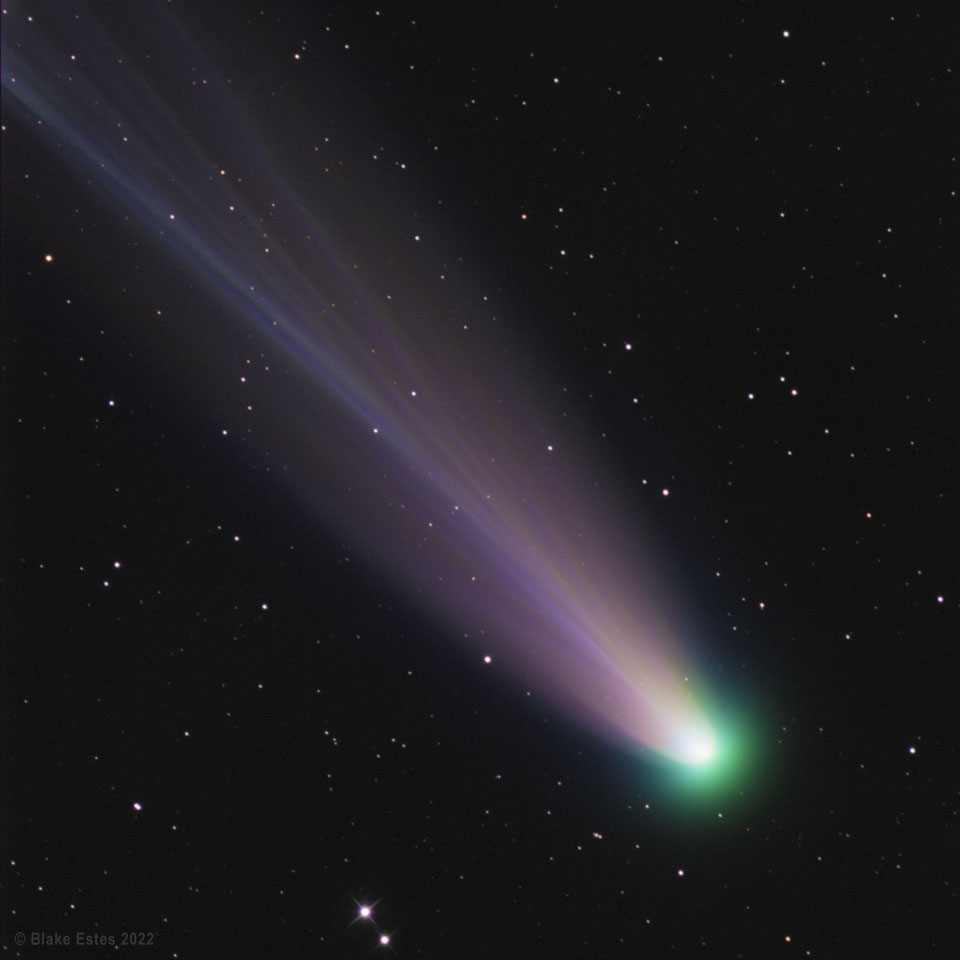
What does Comet Leonard look like up close? Although we can't go there, imaging the comet's coma and inner tails through a small telescope gives us a good idea. As the name implies, the ion tail is made of ionized gas -- gas energized by ultraviolet light from the Sun and pushed outward by the solar wind. The solar wind is quite structured and sculpted by the Sun's complex and ever changing magnetic field. The effect of the variable solar wind combined with different gas jets venting from the comet's nucleus accounts for the tail's complex structure. Following the wind, structure in Comet Leonard's tail can be seen to move outward from the Sun even alter its wavy appearance over time. The blue color of the ion tail is dominated by recombining carbon monoxide molecules, while the green color of the coma surrounding the head of the comet is created mostly by a slight amount of recombining diatomic carbon molecules. Diatomic carbon is destroyed by sunlight in about 50 hours -- which is why its green glow does not make it far into the ion tail. The featured image was taken on January 2 from Siding Spring Observatory in Australia. Comet Leonard, presently best viewed from Earth's Southern Hemisphere, has rounded the Sun and is now headed out of the Solar System.
© Blake Estes (itelescope.net) — used with the credit NASA publishes
2021
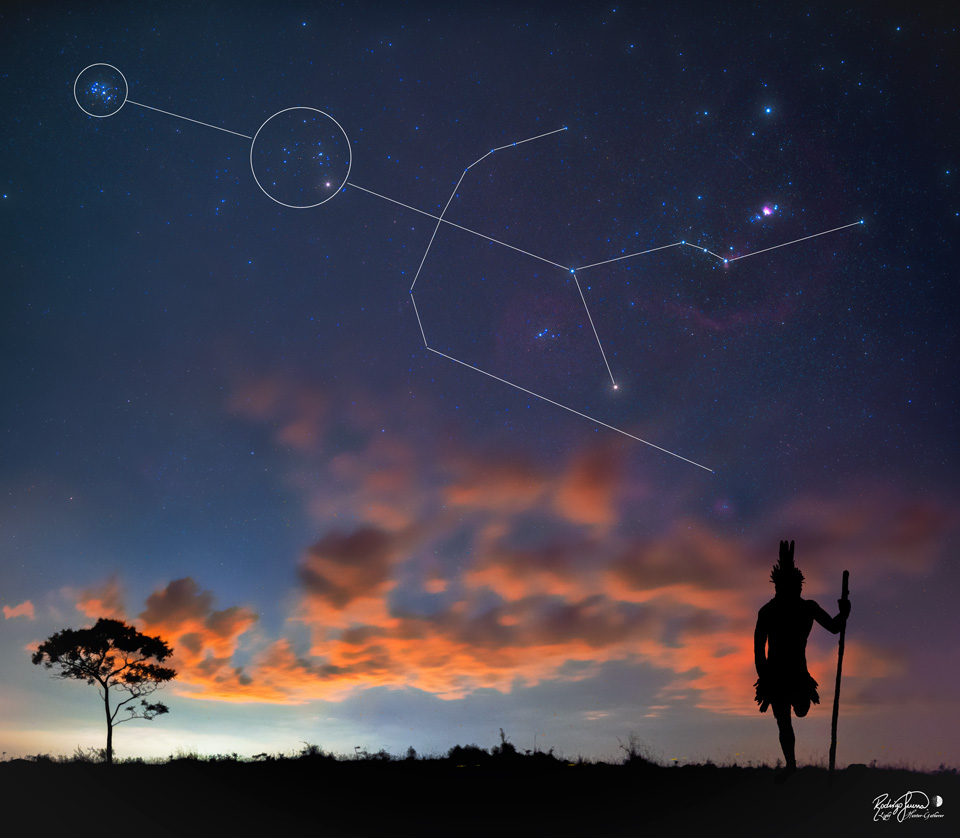
The night sky is filled with stories. Cultures throughout history have projected some of their most enduring legends onto the stars above. Generations of people see these stellar constellations, hear the associated stories, and pass them down. Featured here is the perhaps unfamiliar constellation of the Old Man, long recognized by the Tupi peoples native to regions of South America now known as Brazil. The Old Man, in more modern vernacular, may be composed of the Hyades star cluster as his head and the belt of Orion as part of one leg. Tupi folklore relates that the other leg was cut off by his unhappy wife, causing it to end at the orange star now known as Betelgeuse. The Pleiades star cluster, on the far left, can be interpreted as a head feather. In the featured image, the hobbled Old Man is mirrored by a person posing in the foreground. Folklore of the night sky is important for many reasons, including that it records cultural heritage and documents the universality of human intelligence and imagination. APOD in world languages: Arabic, Catalan, Chinese (Beijing), Chinese (Taiwan), Croatian, Czech, Dutch, Farsi, French, German, Hebrew, Indonesian, Japanese, Korean, Montenegrin, Polish, Russian, Serbian, Slovenian, Spanish, Taiwanese, Turkish, Turkish, and Ukrainian APOD online webinar January 12: Free registration, hosted by Amateur Astronomers Association of New York.
© Rodrigo Guerra — used with the credit NASA publishes

1986
Space Shuttle program: Congressman and future NASA Administrator Bill Nelson lifts off from Kennedy Space Center aboard Columbia on mission STS-61-C as a payload specialist.
Space Shuttle program ↗
1997
Space Shuttle program: Atlantis launches from the Kennedy Space Center on mission STS-81 to the Russian space station Mir, carrying astronaut Jerry M. Linenger for a four-month stay on board the station, replacing astronaut John E. Blaha.
Space Shuttle Atlantis ↗

2007
Comet McNaught (pictured) reached perihelion, becoming the brightest comet in over 40 years, with an apparent magnitude of −5.5.
Comet McNaught ↗2007
Comet C/2006 P1 (McNaught), one of the brightest comets ever observed is at its zenith visible during the day.
Comet McNaught ↗Event text and thumbnails come from Wikipedia and are used under CC BY-SA 4.0. Images are drawn only from Wikimedia Commons, which does not accept non-free content — each thumbnail links to its file page, where its licence and author are recorded.
Launch records are from The Space Devs’ Launch Library 2. This archive is still being mirrored, so some days are incomplete. Pictures are NASA’s Astronomy Picture of the Day; NASA imagery is generally not subject to copyright, but individual APOD entries are frequently the property of the photographer, and each caption says which applies.
General-audience astronomy and spaceflight — none of it a textbook.
As an Amazon Associate I earn from qualifying purchases. Links here cost you nothing extra.
LISTING
Still the best single argument for why any of this matters, and it leaves the arithmetic in. For a reader who wants the science, not just the awe.
LISTING
The case for leaving Earth, written by someone unsentimental about how hard that is. Suits readers who want the argument rather than the poster.
LISTING
Hard-SF problem solving in The Martian's key — for anyone who liked the engineering more than the peril. The only novel on this list.
BROWSE opens an Amazon search, not a specific recommendation.
LINKS AMAZON.COM