Launches
NO DATA0MISSIONS
The launch archive is still being mirrored, so this day has no launches listed yet.
ARCHIVE // DAY OF YEAR
Wikipedia records 5 spaceflight and astronomy events on January 5. Below are the pictures NASA published on January 5 in 5 different years — each one taken or released on this exact date.
0MISSIONS
The launch archive is still being mirrored, so this day has no launches listed yet.
5ENTRIES
Spaceflight and astronomy entries from Wikipedia's record of this date, oldest first — from 1969 onward.
5IMAGES
NASA's Astronomy Picture of the Day for January 5, one per year. Some are public domain and some belong to the photographer — each says which.
NASA’s Astronomy Picture of the Day, for this calendar date in each of the last several years.
2026
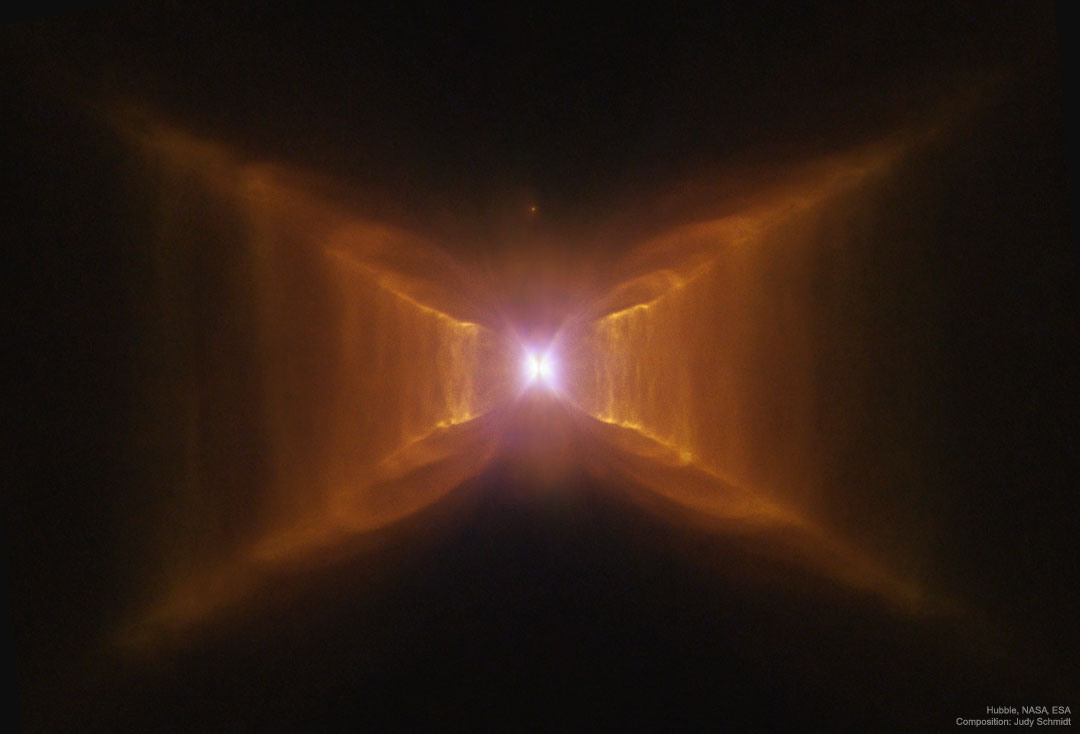
How was the unusual Red Rectangle nebula created? At the nebula's center is an aging binary star system that surely powers the nebula but does not, as yet, explain its colors. The unusual shape of the Red Rectangle is likely due to a thick dust torus which pinches the otherwise spherical outflow into tip-touching cone shapes. Because we view the torus edge-on, the boundary edges of the cone shapes seem to form an X. The distinct rungs suggest the outflow occurs in fits and starts. The unusual colors of the nebula are less well understood, however, and speculation holds that they are partly provided by hydrocarbon molecules that may actually be building blocks for organic life. The Red Rectangle nebula lies about 2,300 light years away towards the constellation of the Unicorn (Monoceros). The nebula is shown here in great detail as a reprocessed image from Hubble Space Telescope. In a few million years, as one of the central stars becomes further depleted of nuclear fuel, the Red Rectangle nebula will likely bloom into a planetary nebula.
NASA · public domain

2025
Have you ever seen a rocket launch -- from space? A close inspection of the featured time-lapse video will reveal a rocket rising to Earth orbit as seen from the International Space Station (ISS). The Russian Soyuz-FG rocket was launched in November 2018 from the Baikonur Cosmodrome in Kazakhstan, carrying a Progress MS-10 (also 71P) module to bring needed supplies to the ISS. Highlights in the 90-second video (condensing about 15-minutes) include city lights and clouds visible on the Earth on the lower left, blue and gold bands of atmospheric airglow running diagonally across the center, and distant stars on the upper right that set behind the Earth. A lower stage can be seen falling back to Earth as the robotic supply ship fires its thrusters and begins to close on the ISS, a space laboratory that celebrated its 25th anniversary in 2023. Astronauts who live aboard the Earth-orbiting ISS conduct, among more practical duties, numerous science experiments that expand human knowledge and enable future commercial industry in low Earth orbit.
NASA · public domain
2024
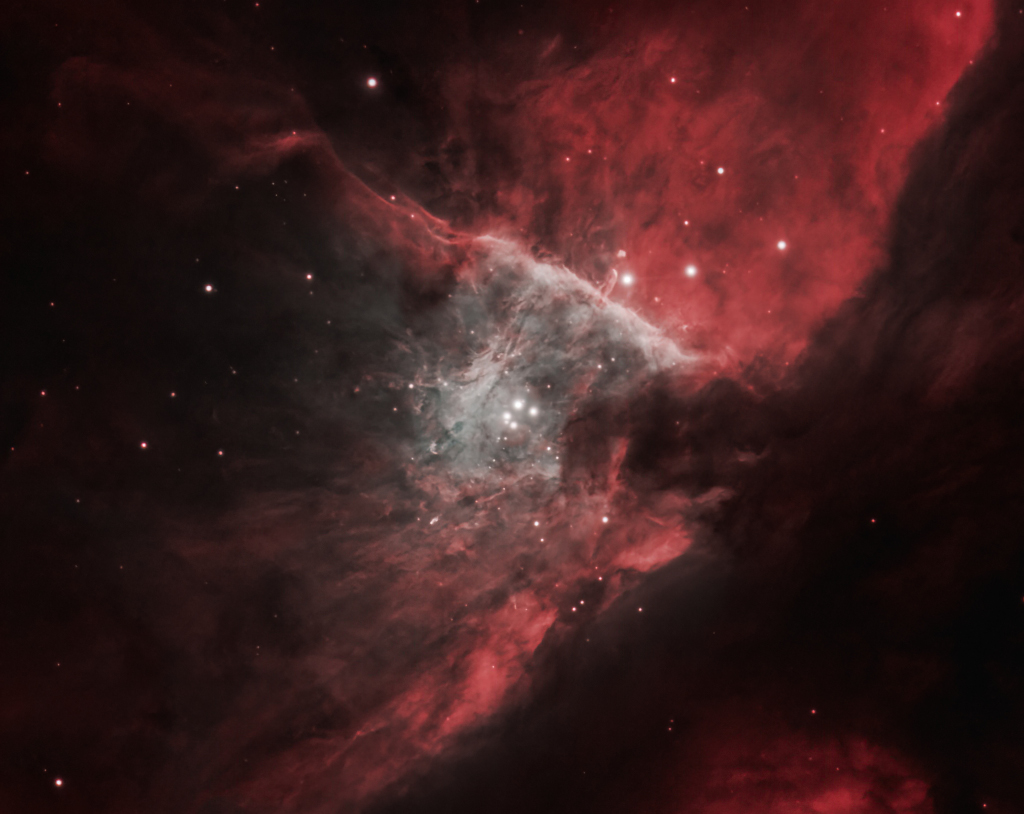
Near the center of this sharp cosmic portrait, at the heart of the Orion Nebula, are four hot, massive stars known as the Trapezium. Gathered within a region about 1.5 light-years in radius, they dominate the core of the dense Orion Nebula Star Cluster. Ultraviolet ionizing radiation from the Trapezium stars, mostly from the brightest star Theta-1 Orionis C powers the complex star forming region's entire visible glow. About three million years old, the Orion Nebula Cluster was even more compact in its younger years and a dynamical study indicates that runaway stellar collisions at an earlier age may have formed a black hole with more than 100 times the mass of the Sun. The presence of a black hole within the cluster could explain the observed high velocities of the Trapezium stars. The Orion Nebula's distance of some 1,500 light-years would make it one of the closest known black holes to planet Earth.
© Fred Zimmer — used with the credit NASA publishes
2023
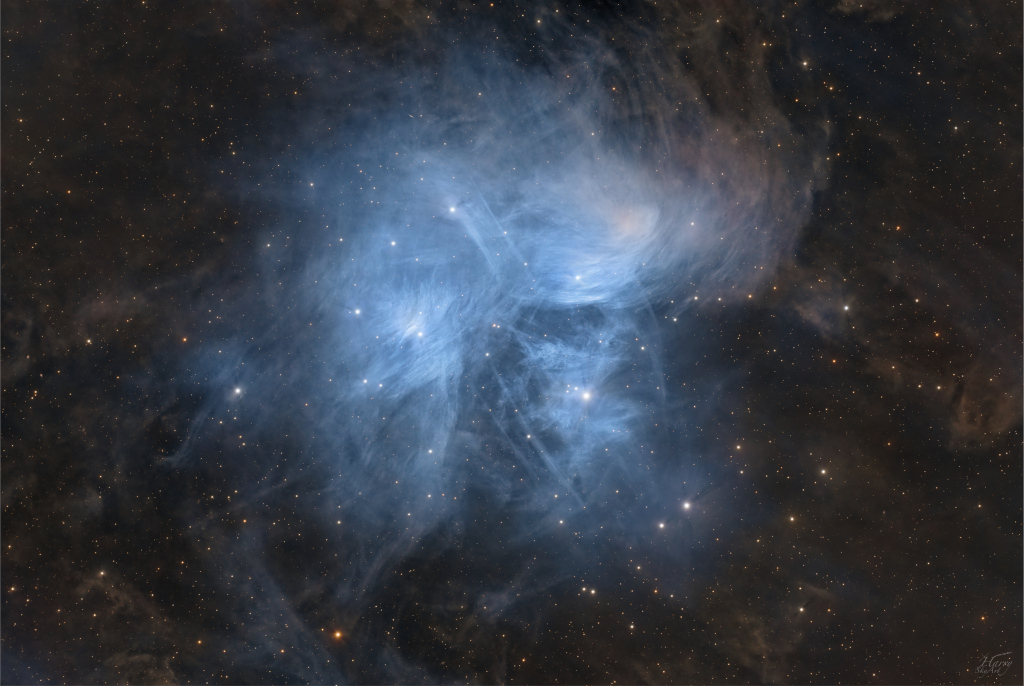
Hurtling through a cosmic dust cloud a mere 400 light-years away, the lovely Pleiades or Seven Sisters open star cluster is well-known for its striking blue reflection nebulae. It lies in the night sky toward the constellation Taurus and the Orion Arm of our Milky Way galaxy. The sister stars are not related to the dusty cloud though. They just happen to be passing through the same region of space. Known since antiquity as a compact grouping of stars, Galileo first sketched the star cluster viewed through his telescope with stars too faint to be seen by eye. Charles Messier recorded the position of the cluster as the 45th entry in his famous catalog of things which are not comets. In Greek myth, the Pleiades were seven daughters of the astronomical titan Atlas and sea-nymph Pleione. Their parents names are included in the cluster's nine brightest stars. This well-processed, color-calibrated telescopic image features pin-point stars and detailed filaments of interstellar dust captured in over 9 hours of exposure. It spans more than 20 light-years across the Pleiades star cluster.
© Stefan Thrun — used with the credit NASA publishes
2022
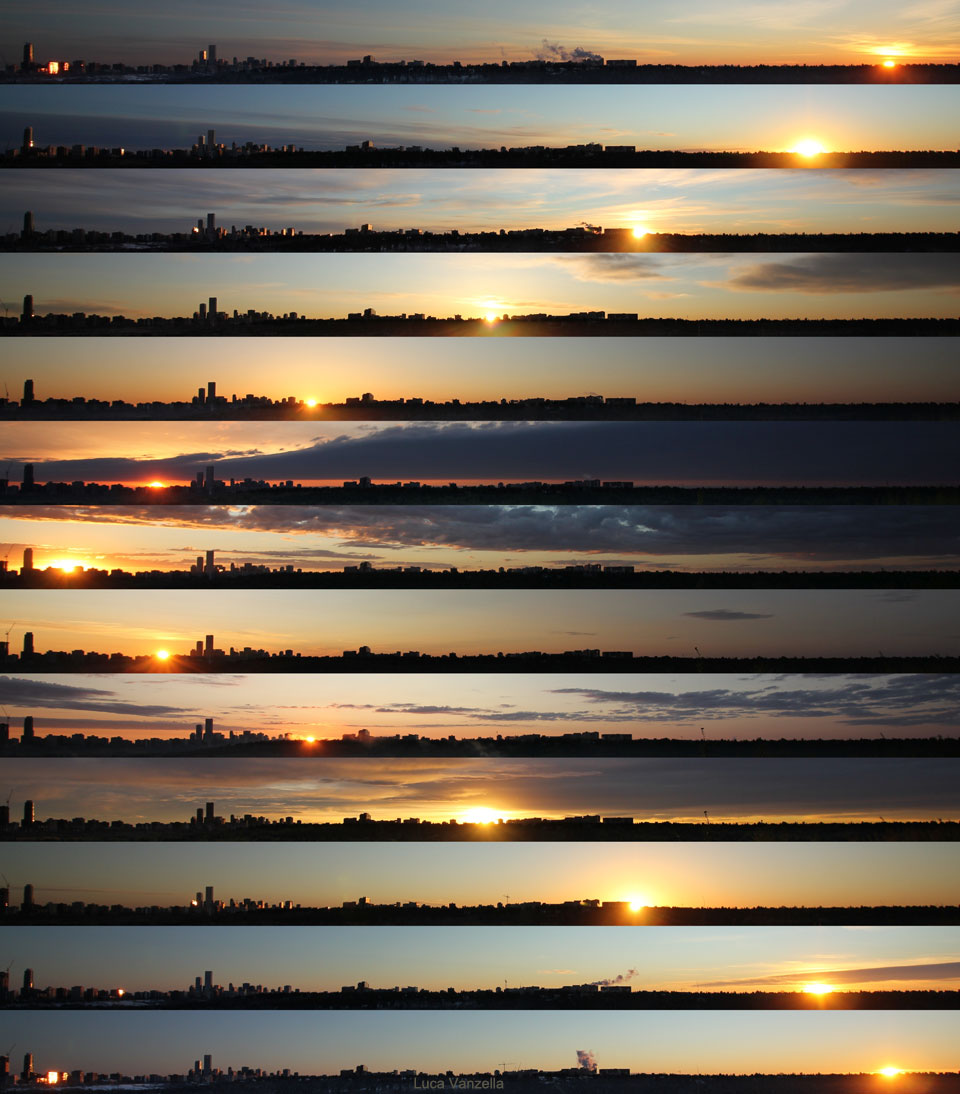
Does the Sun always rise in the same direction? No. As the months change, the direction toward the rising Sun changes, too. The featured image shows the direction of sunrise every month during 2021 as seen from the city of Edmonton, Alberta, Canada. The camera in the image is always facing due east, with north toward the left and south toward the right. As shown in an accompanying video, the top image was taken in 2020 December, while the bottom image was captured in 2021 December, making 13 images in total. Although the Sun always rises in the east in general, it rises furthest to the south of east near the December solstice, and furthest north of east near the June solstice. In many countries, the December Solstice is considered an official change in season: for example the first day of winter in the North. Solar heating and stored energy in the Earth's surface and atmosphere are near their lowest during winter, making the winter season the coldest of the year. Status Updates: Deploying the James Webb Space Telescope
© Luca Vanzella — used with the credit NASA publishes


2005
The dwarf planet Eris was discovered by a team using images from the Samuel Oschin telescope at Palomar Observatory.
Dwarf planet ↗
2005
The dwarf planet Eris is discovered by Palomar Observatory-based astronomers, later motivating the International Astronomical Union (IAU) to define the term planet for the first time.
Eris (dwarf planet) ↗2014
A launch of the communication satellite GSAT-14 aboard the GSLV MK.II D5 marks the first successful flight of an Indian cryogenic engine.
GSAT-14 ↗Event text and thumbnails come from Wikipedia and are used under CC BY-SA 4.0. Images are drawn only from Wikimedia Commons, which does not accept non-free content — each thumbnail links to its file page, where its licence and author are recorded.
Launch records are from The Space Devs’ Launch Library 2. This archive is still being mirrored, so some days are incomplete. Pictures are NASA’s Astronomy Picture of the Day; NASA imagery is generally not subject to copyright, but individual APOD entries are frequently the property of the photographer, and each caption says which applies.
General-audience astronomy and spaceflight — none of it a textbook.
As an Amazon Associate I earn from qualifying purchases. Links here cost you nothing extra.
LISTING
Still the best single argument for why any of this matters, and it leaves the arithmetic in. For a reader who wants the science, not just the awe.
LISTING
The case for leaving Earth, written by someone unsentimental about how hard that is. Suits readers who want the argument rather than the poster.
LISTING
Hard-SF problem solving in The Martian's key — for anyone who liked the engineering more than the peril. The only novel on this list.
BROWSE opens an Amazon search, not a specific recommendation.
LINKS AMAZON.COM