Launches
NO DATA0MISSIONS
The launch archive is still being mirrored, so this day has no launches listed yet.
ARCHIVE // DAY OF YEAR
Wikipedia records 4 spaceflight and astronomy events on January 4. Below are the pictures NASA published on January 4 in 6 different years — each one taken or released on this exact date.
0MISSIONS
The launch archive is still being mirrored, so this day has no launches listed yet.
4ENTRIES
Spaceflight and astronomy entries from Wikipedia's record of this date, oldest first — from 1958 onward.
6IMAGES
NASA's Astronomy Picture of the Day for January 4, one per year. Some are public domain and some belong to the photographer — each says which.
NASA’s Astronomy Picture of the Day, for this calendar date in each of the last several years.

2026
Most galaxies have a single nucleus -- does this galaxy have four? The strange answer leads astronomers to conclude that the nucleus of the surrounding galaxy is not even visible in this image. The central cloverleaf is rather light emitted from a background quasar. The gravitational field of the visible foreground galaxy breaks light from this distant quasar into four distinct images. The quasar must be properly aligned behind the center of a massive galaxy for a mirage like this to be evident. The general effect is known as gravitational lensing, and this specific case is known as the Einstein Cross. Stranger still, the images of the Einstein Cross vary in relative brightness, enhanced occasionally by the additional gravitational microlensing effect of specific stars in the foreground galaxy. Almost Hyperspace: Random APOD Generator
NASA · public domain
2025
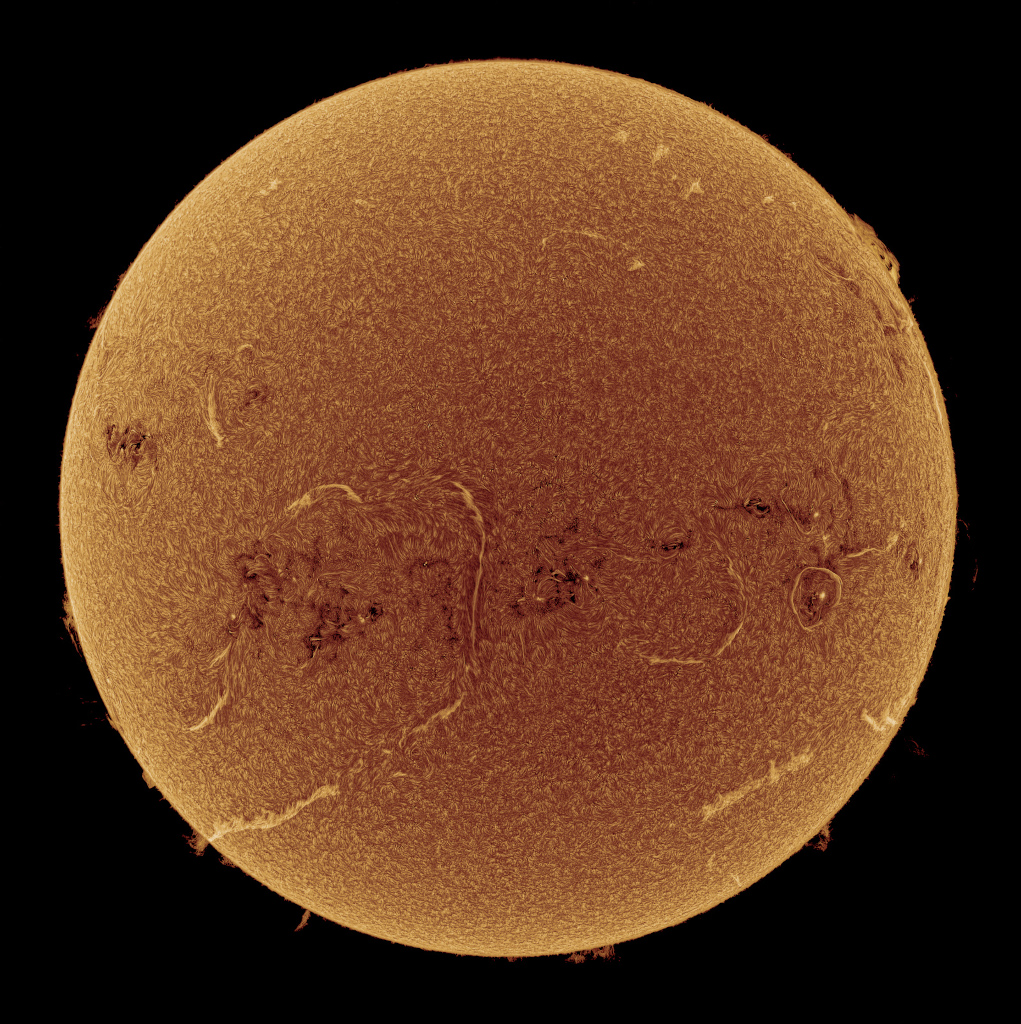
rth's orbit around the Sun is not a circle, it's an ellipse. The point along its elliptical orbit where our fair planet is closest to the Sun is called perihelion. This year perihelion is today, January 4, at 13:28 UTC, only a few hours before this H-alpha picture of the active Sun was taken. At perihelion the Earth was about 147 million kilometers from the Sun. For comparison, at aphelion on last July 3 Earth was at its farthest distance from the Sun, some 152 million kilometers away. But distance from the Sun doesn't determine Earth's seasons. It's only by coincidence that the beginning of southern summer (northern winter) on the December solstice is within 14 days of Earth's perihelion date. And it's only by coincidence that Earth's perihelion date is within 11 days of the historic perihelion of NASA's Parker Solar Probe. Launched in 2018, the Parker Solar Probe flew within 6.2 million kilometers of the Sun's surface on 2024 December 24, breaking its own record for closest perihelion for a spacecraft from planet Earth.
© Barden Ridge Observatory — used with the credit NASA publishes
2024
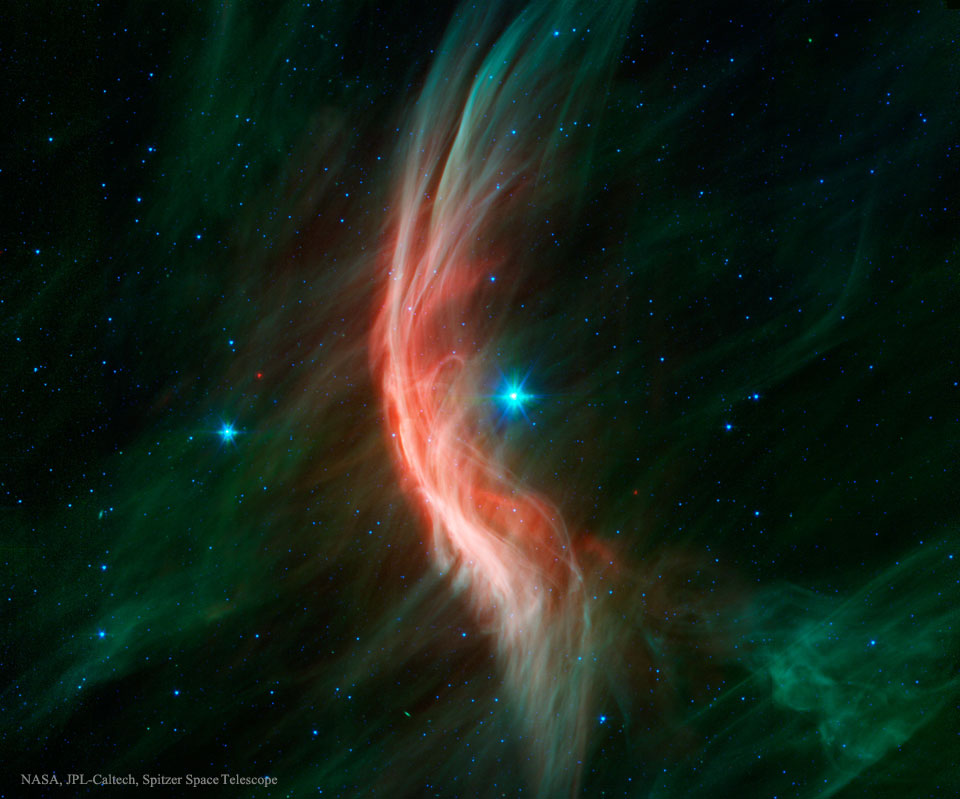
Like a ship plowing through cosmic seas, runaway star Zeta Ophiuchi produces the arcing interstellar bow wave or bow shock seen in this stunning infrared portrait. In the false-color view, bluish Zeta Oph, a star about 20 times more massive than the Sun, lies near the center of the frame, moving toward the left at 24 kilometers per second. Its strong stellar wind precedes it, compressing and heating the dusty interstellar material and shaping the curved shock front. What set this star in motion? Zeta Oph was likely once a member of a binary star system, its companion star was more massive and hence shorter lived. When the companion exploded as a supernova catastrophically losing mass, Zeta Oph was flung out of the system. About 460 light-years away, Zeta Oph is 65,000 times more luminous than the Sun and would be one of the brighter stars in the sky if it weren't surrounded by obscuring dust. The image spans about 1.5 degrees or 12 light-years at the estimated distance of Zeta Ophiuchi. In January 2020, NASA placed the Spitzer Space Telescope in safe mode, ending its 16 successful years of exploring the cosmos.
NASA · public domain
2023
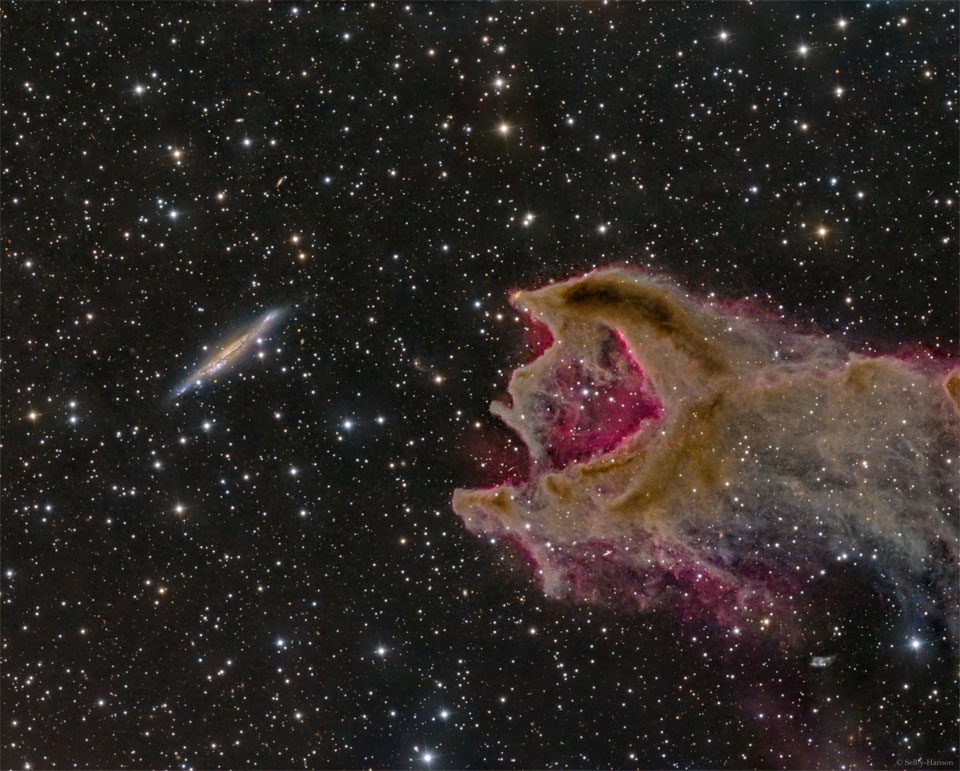
Can a gas cloud eat a galaxy? It's not even close. The "claw" of this odd looking "creature" in the featured photo is a gas cloud known as a cometary globule. This globule, however, has ruptured. Cometary globules are typically characterized by dusty heads and elongated tails. These features cause cometary globules to have visual similarities to comets, but in reality they are very much different. Globules are frequently the birthplaces of stars, and many show very young stars in their heads. The reason for the rupture in the head of this object is not yet known. The galaxy to the left of the globule is huge, very far in the distance, and only placed near CG4 by chance superposition. Discovery + Outreach: Graduate student research position open for APOD
© Mike Selby — used with the credit NASA publishes
2022
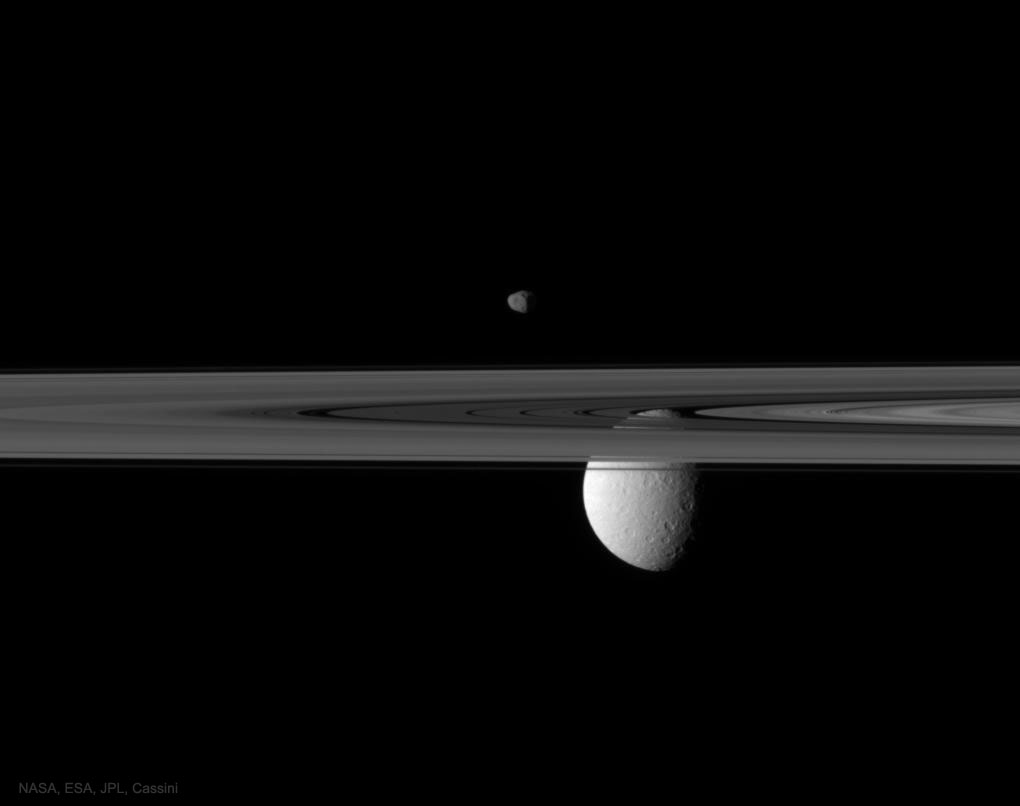
What's happened to that moon of Saturn? Nothing -- Saturn's moon Rhea is just partly hidden behind Saturn's rings. In 2010, the robotic Cassini spacecraft then orbiting Saturn took this narrow-angle view looking across the Solar System's most famous rings. Rings visible in the foreground include the thin F ring on the outside and the much wider A and B rings just interior to it. Although it seems to be hovering over the rings, Saturn's moon Janus is actually far behind them. Janus is one of Saturn's smaller moons and measures only about 180 kilometers across. Farther out from the camera is the heavily cratered Rhea, a much larger moon measuring 1,500 kilometers across. The top of Rhea is visible only through gaps in the rings. After more than a decade of exploration and discovery, the Cassini spacecraft ran low on fuel in 2017 and was directed to enter Saturn's atmosphere, where it surely melted. Explore Your Universe: Random APOD Generator
NASA · public domain
2021
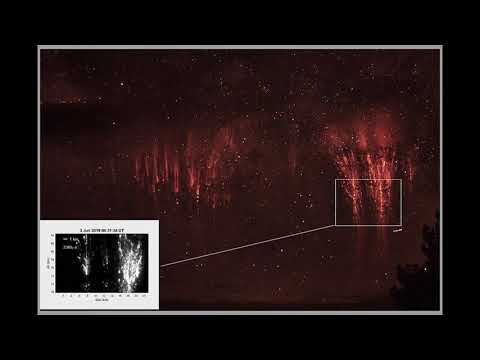
What causes sprite lightning? Mysterious bursts of light in the sky that momentarily resemble gigantic jellyfish have been recorded for over 30 years, but apart from a general association with positive cloud-to-ground lightning, their root cause remains unknown. Some thunderstorms have them -- most don't. Recently, however, high speed videos are better detailing how sprites actually develop. The featured video, captured in mid-2019, is fast enough -- at about 100,000 frames per second -- to time-resolve several sprite "bombs" dropping and developing into the multi-pronged streamers that appear on still images. Unfortunately, the visual clues provided by videos like these do not fully resolve the sprite origins mystery. High speed vidoes do indicate to some researchers, though, that sprites are more likely to occur when plasma irregularities exist in the upper atmosphere. Astrophysicists: Browse 2,300+ codes in the Astrophysics Source Code Library
© Matthew G McHarg, Jacob L Harley, Thomas Ashcraft, Hans Nielsen — used with the credit NASA publishes

1958
Sputnik 1, the first artificial Earth satellite, launched by the Soviet Union in 1957, falls to Earth from orbit.
Sputnik 1 ↗

2004
Spirit (artist's impression depicted), the first of two rovers of NASA's Mars Exploration Rover mission, successfully landed on Mars.
Spirit (rover) ↗Event text and thumbnails come from Wikipedia and are used under CC BY-SA 4.0. Images are drawn only from Wikimedia Commons, which does not accept non-free content — each thumbnail links to its file page, where its licence and author are recorded.
Launch records are from The Space Devs’ Launch Library 2. This archive is still being mirrored, so some days are incomplete. Pictures are NASA’s Astronomy Picture of the Day; NASA imagery is generally not subject to copyright, but individual APOD entries are frequently the property of the photographer, and each caption says which applies.
General-audience astronomy and spaceflight — none of it a textbook.
As an Amazon Associate I earn from qualifying purchases. Links here cost you nothing extra.
LISTING
Still the best single argument for why any of this matters, and it leaves the arithmetic in. For a reader who wants the science, not just the awe.
LISTING
The case for leaving Earth, written by someone unsentimental about how hard that is. Suits readers who want the argument rather than the poster.
LISTING
Hard-SF problem solving in The Martian's key — for anyone who liked the engineering more than the peril. The only novel on this list.
BROWSE opens an Amazon search, not a specific recommendation.
LINKS AMAZON.COM