Launches
NO DATA0MISSIONS
The launch archive is still being mirrored, so this day has no launches listed yet.
ARCHIVE // DAY OF YEAR
Wikipedia records 7 spaceflight and astronomy events on December 25. Below are the pictures NASA published on December 25 in 5 different years — each one taken or released on this exact date.
0MISSIONS
The launch archive is still being mirrored, so this day has no launches listed yet.
7ENTRIES
Spaceflight and astronomy entries from Wikipedia's record of this date, oldest first — from 1758 onward.
5IMAGES
NASA's Astronomy Picture of the Day for December 25, one per year. Some are public domain and some belong to the photographer — each says which.
NASA’s Astronomy Picture of the Day, for this calendar date in each of the last several years.
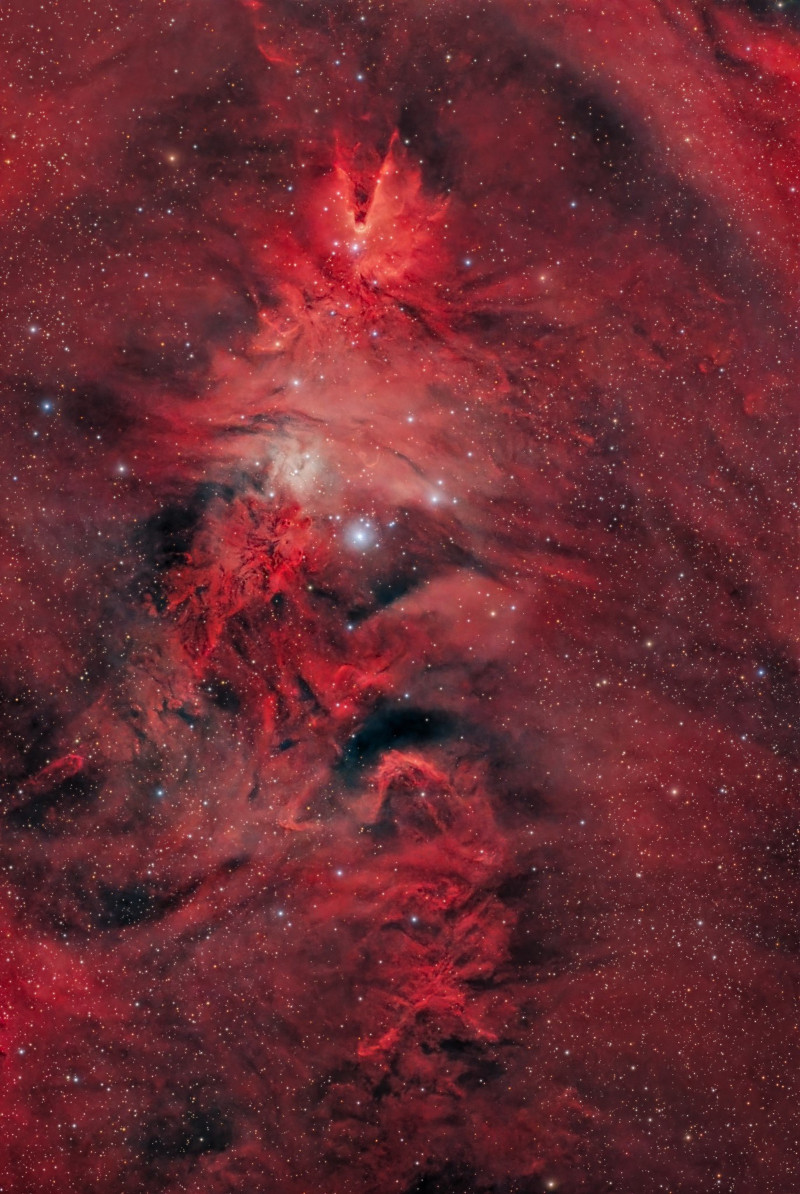
2025
A star forming region cataloged as NGC 2264, this beautiful but complex arrangement of interstellar gas and dust is about 2,700 light-years distant in the faint but fanciful constellation Monoceros, the Unicorn. Seen toward the celestial equator and near the plane of our Milky Way galaxy, the seasonal skyscape mixes reddish emission nebulae excited by energetic light from newborn stars with dark interstellar dust clouds. Where the otherwise obscuring dust clouds lie close to the hot, young stars, they also reflect starlight, forming blue reflection nebulae. In fact, bright variable star S Monocerotis is immersed in a blue-tinted haze near center. Arrayed with a simple triangular outline above S Monocerotis, the stars of NGC 2264 are popularly known as the Christmas Tree star cluster. Carved by energetic starlight, the Cone Nebula sits upside down at the apex of this cosmic Christmas tree while the dusty, convoluted pelt of glowing gas and dust under the tree is called the Fox Fur Nebula. This rich telescopic frame spans about 1.5 degrees or 3 full moons on the sky top to bottom, covering nearly 80 light-years at the distance of NGC 2264.
© Michael Kalika — used with the credit NASA publishes

2024
Why is there a huge eye in the sky? Diamond dust. That is an informal term for small ice crystals that form in the air and flitter to the ground. Because these crystals are geometrically shaped, they can together reflect light from the Sun or Moon to your eyes in a systematic way, causing huge halos and unusual arcs to appear. And sometimes, together the result can seem like a giant eye looking right back at you. In the featured image taken in the Ore Mountains of the Czech Republic last week, a bright Moon rising through ice fog-filled air resulted in many of these magnificent sky illusions to be visible simultaneously. Besides Moon dogs, tangent arcs, halos, and a parselenic circle, light pillars above distant lights are visible on the far left, while Jupiter and Mars can be found just inside the bottom of the 22-degree halo. Your Sky Surprise: What picture did APOD feature on your birthday? (post 1995)
© Jaroslav Fous — used with the credit NASA publishes
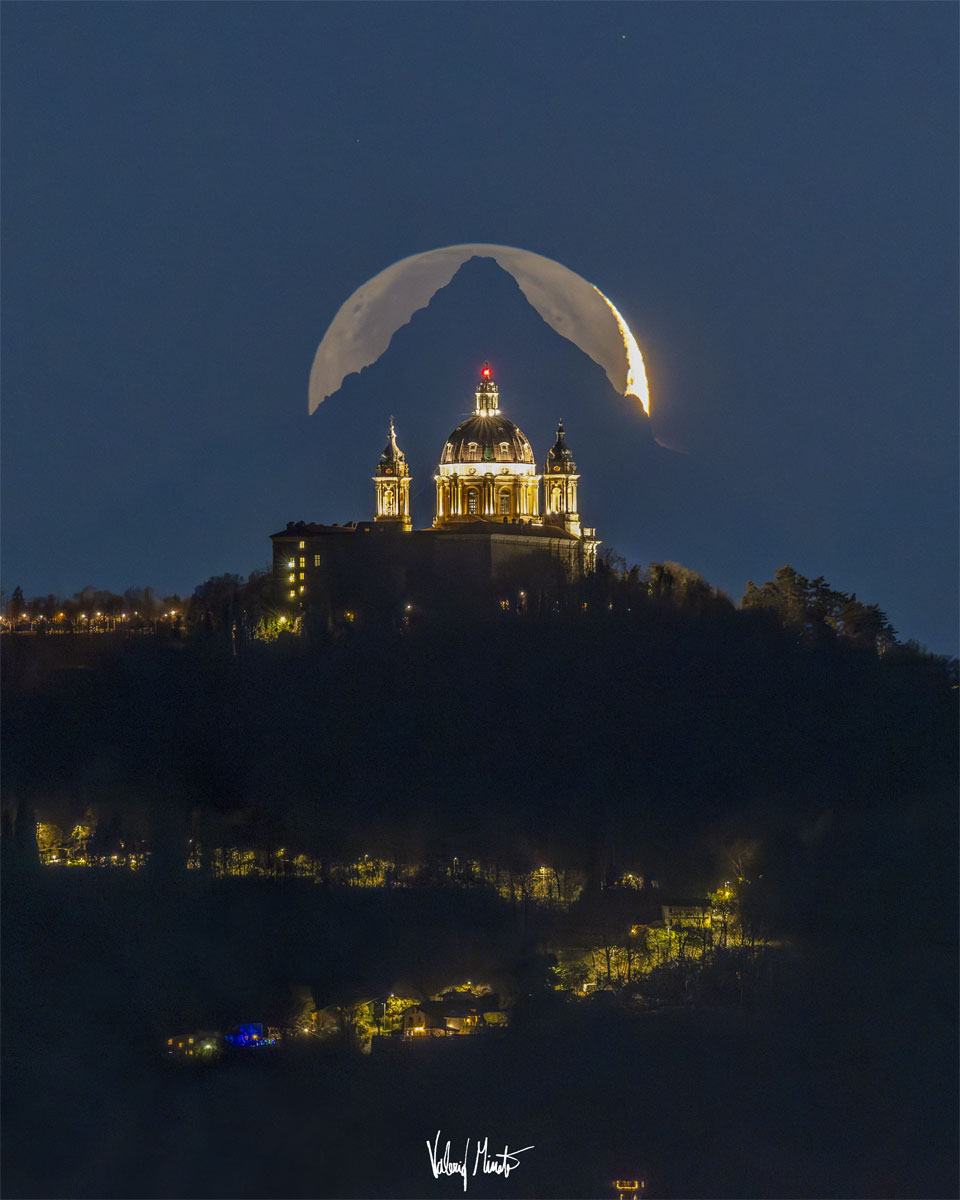
2023
Single shots like this require planning. The first step is to realize that such an amazing triple-alignment actually takes place. The second step is to find the best location to photograph it. But it was the third step: being there at exactly the right time -- and when the sky was clear -- that was the hardest. Five times over six years the photographer tried and found bad weather. Finally, just ten days ago, the weather was perfect, and a photographic dream was realized. Taken in Piemonte, Italy, the cathedral in the foreground is the Basilica of Superga, the mountain in the middle is Monviso, and, well, you know which moon is in the background. Here, even though the setting Moon was captured in a crescent phase, the exposure was long enough for doubly reflected Earthlight, called the da Vinci glow, to illuminate the entire top of the Moon. Your Sky Surprise: What picture did APOD feature on your birthday? (post 1995)
© Valerio Minato — used with the credit NASA publishes
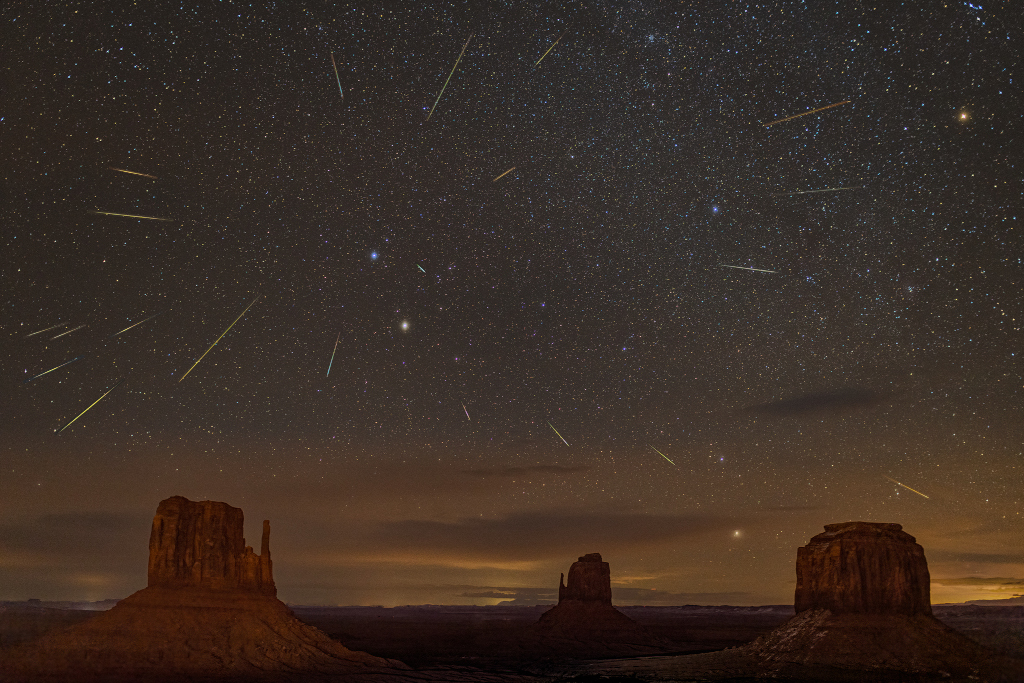
2022
Asteroid 3200 Phaethon's annual gift to planet Earth always arrives in December. Otherwise known as the Geminid meteor shower, the source of the meteroid stream is dust shed along the orbit of the mysterious asteroid. Near the December 13/14 peak of the shower's activity, geminid meteors are captured in this night skyscape, composited from 22 images of starry sky taken before the moon rose over Monument Valley in the American southwest. The bright stars near the position of the shower's radiant are the constellation Gemini's twin stars Castor (blue) and Pollux (yellow). As Earth sweeps through the dusty stream, the parallel meteor trails appear to radiate from a point on the sky in Gemini due to perspective, and so the yearly shower is named for the constellation. From the camera's perspective, this view of three prominent buttes across Monument Valley also suggests appropriate names for two of them. The third one is called Merrick Butte.
© Chuck Derus — used with the credit NASA publishes
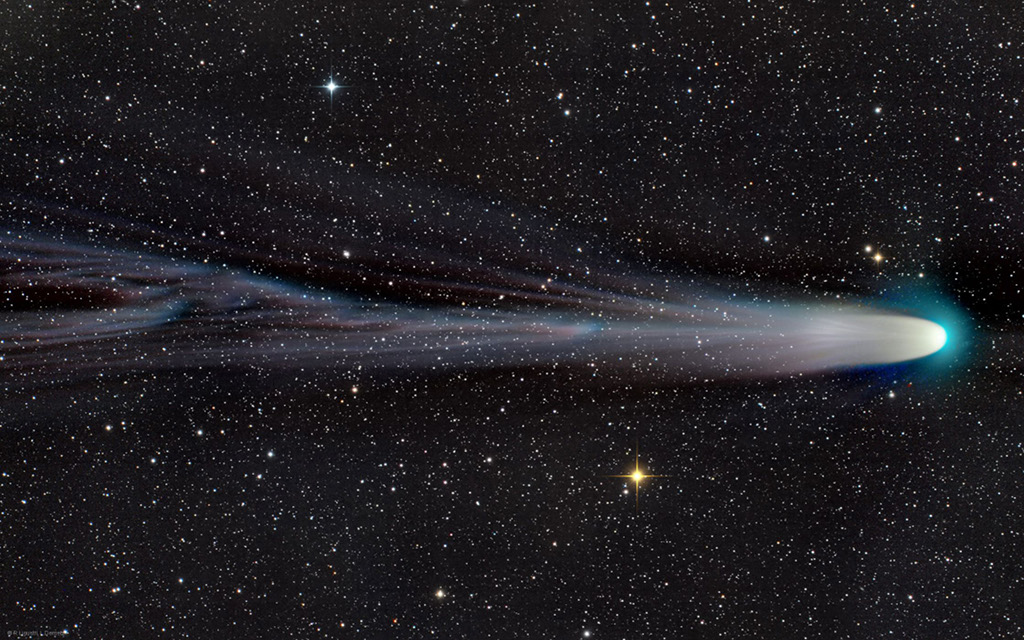
2021
The tail of a comet streams across this three degree wide telescopic field of view captured under dark Namibian skies on December 21. In outburst only a few days ago and just reaching naked eye visibility Comet Leonard (C/2021 A1) is this year's brightest comet. Binoculars will make the diffuse comet easier to spot though, close to the western horizon after sunset. Details revealed in the sharp image show the comet's coma with a greenish tinge, and follow the interaction of the comet's ion tail with magnetic fields in the solar wind. After passing closest to Earth on December 12 and Venus on December 18, Comet Leonard is heading toward perihelion, its closest approach to the Sun on January 3rd. Appearing in late December's beautiful evening skies Comet Leonard has also become known as 2021's Christmas Comet. Launch Update: James Webb Space Telescope
© The tail of a comet — used with the credit NASA publishes

1758
Based on predictions by Edmond Halley in 1705, Johann Georg Palitzsch observed a comet that was later named Halley's Comet .
Edmond Halley ↗
1758
Halley's Comet is sighted by Johann Georg Palitzsch, confirming Edmund Halley's prediction of its passage. This was the first passage of a comet predicted ahead of time.
Halley's Comet ↗
1814
Rev. Samuel Marsden holds the first Christian service on land in New Zealand at Rangihoua Bay.
Samuel Marsden ↗
1968
Apollo program: Apollo 8 performs the first successful Trans-Earth injection (TEI) maneuver, sending the crew and spacecraft on a trajectory back to Earth from Lunar orbit.
Apollo program ↗
2003
The ill-fated Beagle 2 probe, released from the Mars Express spacecraft on December 19, stops transmitting shortly before its scheduled landing.
Beagle 2 ↗
2004
The Cassini orbiter releases Huygens probe which successfully landed on Saturn's moon Titan on January 14, 2005.
Cassini–Huygens ↗
Event text and thumbnails come from Wikipedia and are used under CC BY-SA 4.0. Images are drawn only from Wikimedia Commons, which does not accept non-free content — each thumbnail links to its file page, where its licence and author are recorded.
Launch records are from The Space Devs’ Launch Library 2. This archive is still being mirrored, so some days are incomplete. Pictures are NASA’s Astronomy Picture of the Day; NASA imagery is generally not subject to copyright, but individual APOD entries are frequently the property of the photographer, and each caption says which applies.
General-audience astronomy and spaceflight — none of it a textbook.
As an Amazon Associate I earn from qualifying purchases. Links here cost you nothing extra.
LISTING
Still the best single argument for why any of this matters, and it leaves the arithmetic in. For a reader who wants the science, not just the awe.
LISTING
The case for leaving Earth, written by someone unsentimental about how hard that is. Suits readers who want the argument rather than the poster.
LISTING
Hard-SF problem solving in The Martian's key — for anyone who liked the engineering more than the peril. The only novel on this list.
BROWSE opens an Amazon search, not a specific recommendation.
LINKS AMAZON.COM