Launches
NO DATA0MISSIONS
The launch archive is still being mirrored, so this day has no launches listed yet.
ARCHIVE // DAY OF YEAR
Wikipedia records 2 spaceflight and astronomy events on December 9. Below are the pictures NASA published on December 9 in 5 different years — each one taken or released on this exact date.
0MISSIONS
The launch archive is still being mirrored, so this day has no launches listed yet.
2ENTRIES
Spaceflight and astronomy entries from Wikipedia's record of this date, oldest first — from 1917 onward.
5IMAGES
NASA's Astronomy Picture of the Day for December 9, one per year. Some are public domain and some belong to the photographer — each says which.
NASA’s Astronomy Picture of the Day, for this calendar date in each of the last several years.
2025
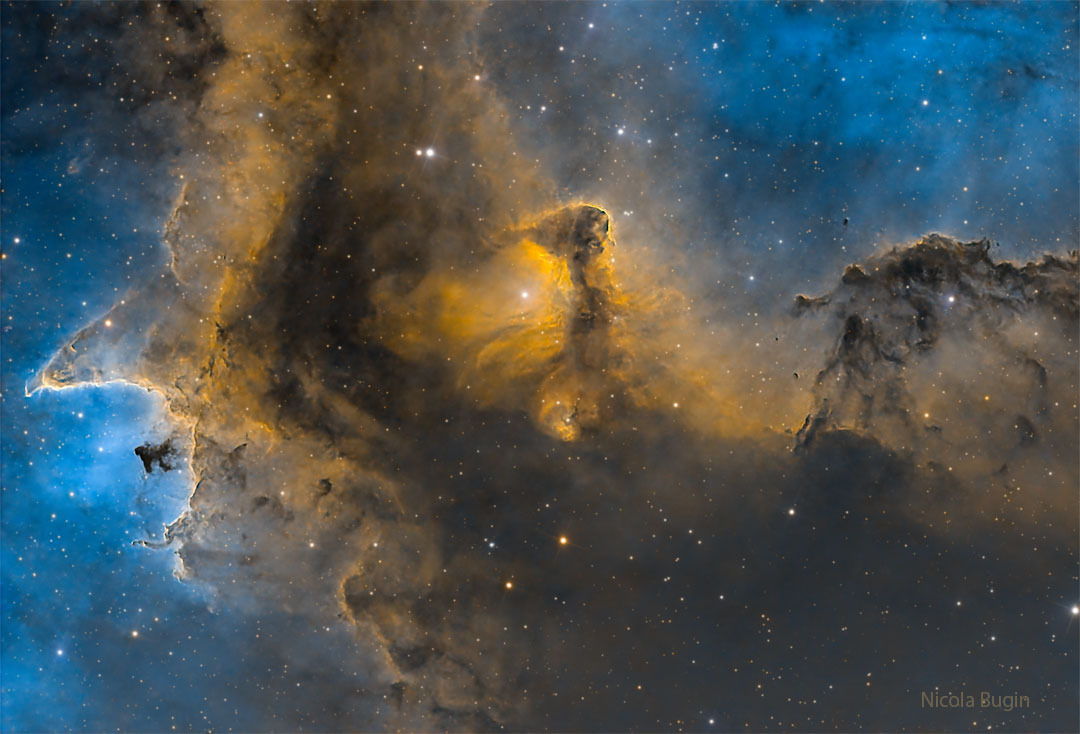
This cosmic close-up looks deep inside the Soul Nebula. The dark and brooding dust clouds outlined by bright ridges of glowing gas are cataloged as IC 1871. About 25 light-years across, the telescopic field of view spans only a small part of the much larger Heart and Soul nebulae. At an estimated distance of 6,500 light-years, the star-forming complex lies within the Perseus spiral arm of the Milky Way, seen in planet Earth's skies toward the constellation of the Queen of Aethiopia (Cassiopeia). An example of triggered star formation, the dense star-forming clouds of IC 1871 are themselves sculpted by the intense winds and radiation of the region's massive young stars. This color image adopts a palette made popular in Hubble images of star-forming regions.
© Nicola Bugin — used with the credit NASA publishes

2024
Have you ever seen the Pleiades star cluster? Even if you have, you probably have never seen it as large and clear as this. Perhaps the most famous star cluster on the sky, the bright stars of the Pleiades can be seen with the unaided eye even from the depths of a light-polluted city. With a long exposure from a dark location, though, the dust cloud surrounding the Pleiades star cluster becomes very evident. The featured 23-hour exposure, taken from Fagagna, Italy covers a sky area several times the size of the full moon. Also known as the Seven Sisters and M45, the Pleiades lies about 400 light years away toward the constellation of the Bull (Taurus). A common legend with a modern twist is that one of the brighter stars faded since the cluster was named, leaving only six of the sister stars visible to the unaided eye. The actual number of Pleiades stars visible, however, may be more or less than seven, depending on the darkness of the surrounding sky and the clarity of the observer's eyesight. New: Alternative multi-APOD front page
© Francesco Pelizzo — used with the credit NASA publishes
2023
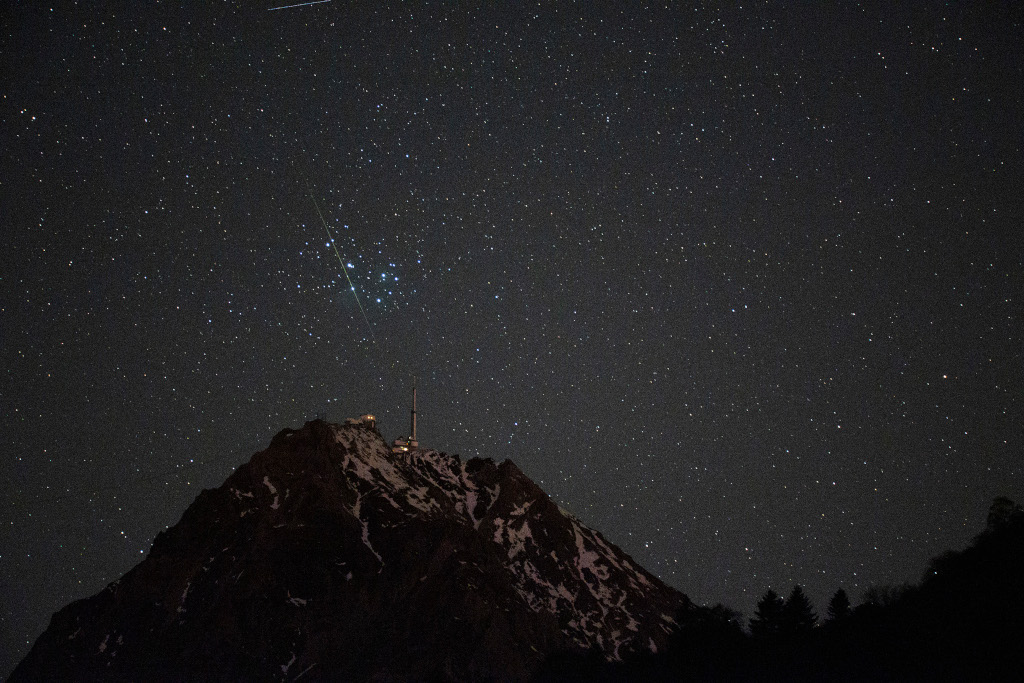
Near dawn on November 19 the Pleiades stood in still dark skies over the French Pyrenees. But just before sunrise a serendipitous moment was captured in this single 3 second exposure; a bright meteor streak appeared to pierce the heart of the galactic star cluster. From the camera's perspective, star cluster and meteor were poised directly above the mountain top observatory on the Pic du Midi de Bigorre. And though astronomers might consider the Pleiades to be relatively close by, the grain of dust vaporizing as it plowed through planet Earth's upper atmosphere actually missed the cluster's tight grouping of young stars by about 400 light-years. While recording a night sky timelapse series, the camera and telephoto lens were fixed to a tripod on the Tour-de-France-cycled slopes of the Col du Tourmalet about 5 kilometers from the Pic du Midi.
© Jean-Francois Graffand — used with the credit NASA publishes
2022
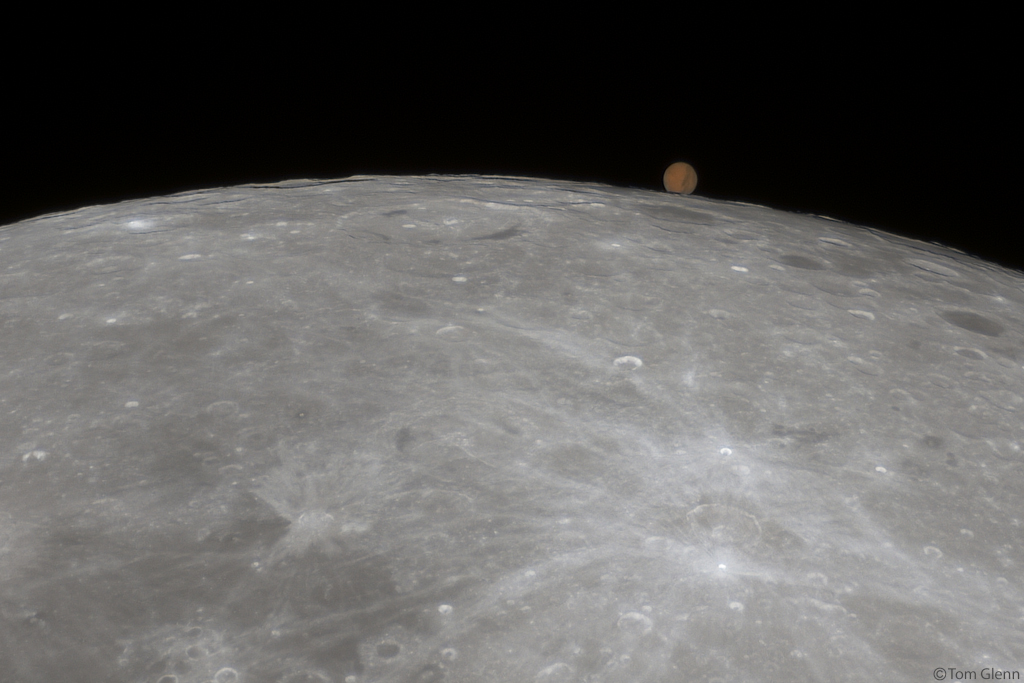
On the night of December 7 Mars wandered near the Full Moon. In fact the Red Planet was occulted, passing behind the Moon, when viewed from locations across Europe and North America. About an hour after disappearing behind the lunar disk Mars reappears in this stack of sharp video frames captured from San Diego, planet Earth. With the Moon in the foreground Mars was a mere 82 million kilometers distant, near its own opposition. Full Moon and full Mars were bright enough to provide the spectacular image with no exposure adjustments necessary. In the image Mars appears to rise just over ancient, dark-floored, lunar crater Abel very close to the southeastern edge of the Moon's near side. Humboldt is the large impact crater to its north (left).
© Tom Glenn — used with the credit NASA publishes
2021
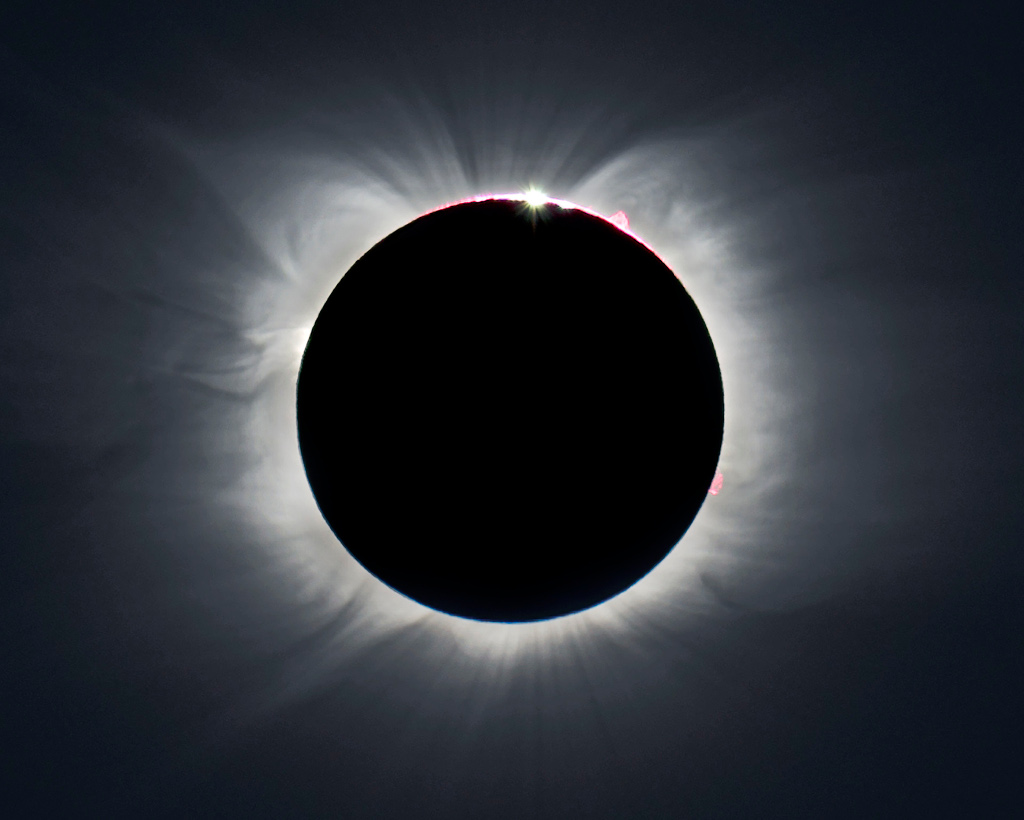
Few were able to stand in the Moon's shadow and watch the December 4 total eclipse of the Sun. Determined by celestial mechanics and not geographical boundaries, the narrow path of totality tracked across planet Earth's relatively inaccessible southernmost continent. Still, some enthusiastic and well-insulated eclipse chasers were rewarded with the dazzling spectacle in Antarctica's cold but clear skies. Taken just before the brief totality began, this image from a ground-based telescope inside the edge of the shadow path at Union Glacier catches a glimmer of sunlight near the top of the silhouetted lunar disk. Look closely for the pinkish solar prominences arcing above the Sun's limb. During totality, the magnificent solar corona, the Sun's outer atmosphere, made its much anticipated appearance, seen in the composite view streaming far from the Sun's edge.
© JM Pasachoff Antarctic Expedition — used with the credit NASA publishes


2006
Space Shuttle program: Space Shuttle Discovery is launched on STS-116 carrying the P5 truss segment of the International Space Station.
Space Shuttle program ↗Event text and thumbnails come from Wikipedia and are used under CC BY-SA 4.0. Images are drawn only from Wikimedia Commons, which does not accept non-free content — each thumbnail links to its file page, where its licence and author are recorded.
Launch records are from The Space Devs’ Launch Library 2. This archive is still being mirrored, so some days are incomplete. Pictures are NASA’s Astronomy Picture of the Day; NASA imagery is generally not subject to copyright, but individual APOD entries are frequently the property of the photographer, and each caption says which applies.
General-audience astronomy and spaceflight — none of it a textbook.
As an Amazon Associate I earn from qualifying purchases. Links here cost you nothing extra.
LISTING
Still the best single argument for why any of this matters, and it leaves the arithmetic in. For a reader who wants the science, not just the awe.
LISTING
The case for leaving Earth, written by someone unsentimental about how hard that is. Suits readers who want the argument rather than the poster.
LISTING
Hard-SF problem solving in The Martian's key — for anyone who liked the engineering more than the peril. The only novel on this list.
BROWSE opens an Amazon search, not a specific recommendation.
LINKS AMAZON.COM