Launches
NO DATA0MISSIONS
The launch archive is still being mirrored, so this day has no launches listed yet.
ARCHIVE // DAY OF YEAR
Wikipedia records 4 spaceflight and astronomy events on October 20. Below are the pictures NASA published on October 20 in 5 different years — each one taken or released on this exact date.
0MISSIONS
The launch archive is still being mirrored, so this day has no launches listed yet.
4ENTRIES
Spaceflight and astronomy entries from Wikipedia's record of this date, oldest first — from 1961 onward.
5IMAGES
NASA's Astronomy Picture of the Day for October 20, one per year. Some are public domain and some belong to the photographer — each says which.
NASA’s Astronomy Picture of the Day, for this calendar date in each of the last several years.

2025
Tonight, if you can see the stars of the Big Dipper, then you can find comet Lemmon in your evening sky. After sunset, look for the faint but extended comet above your northwestern horizon -- but below the handle of the famous celestial kitchen utensil of the north. It might be easier to see this visitor to the inner Solar System through your camera phone, which is better at picking up faint objects. Either way, look for a fuzzy green 'star' with a tail, though probably not so long a tail as in this impressive snapshot taken over Seč Lake in the Czech Republic two nights ago. Recent photographs of C/2025 A6 (Lemmon) often show a detailed and changing ion tail which extends farther than the eye can follow. This Sun-orbiting comet is now near its closest approach to Earth and will pass its closest to the Sun in early November.
© Petr Horalek / Institute of Physics in Opava — used with the credit NASA publishes
2024
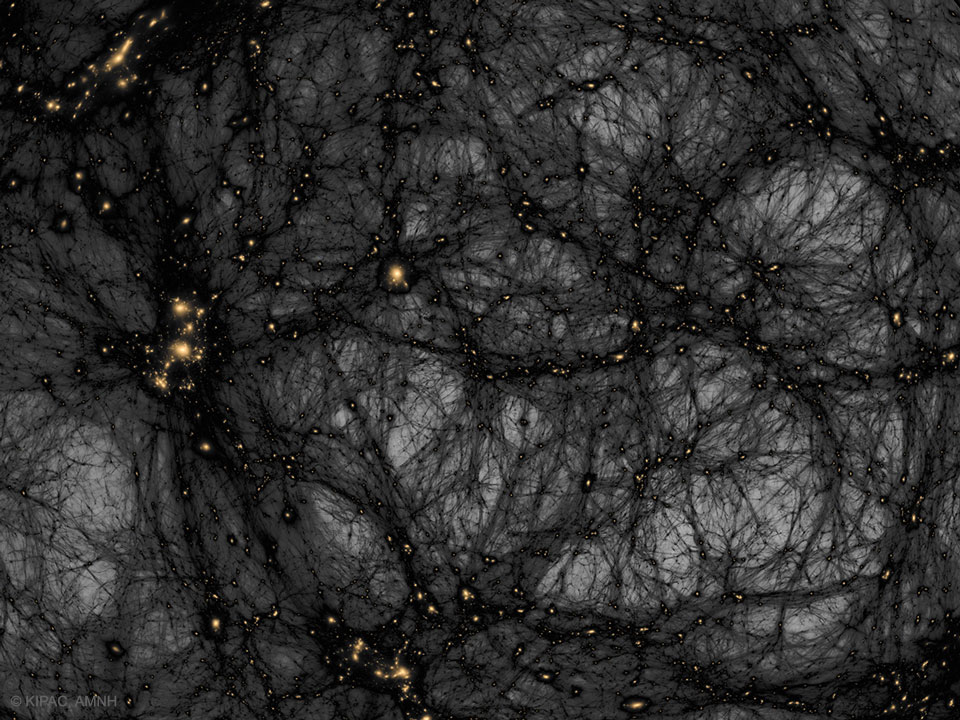
Is our universe haunted? It might look that way on this dark matter map. The gravity of unseen dark matter is the leading explanation for why galaxies rotate so fast, why galaxies orbit clusters so fast, why gravitational lenses so strongly deflect light, and why visible matter is distributed as it is both in the local universe and on the cosmic microwave background. The featured image from the American Museum of Natural History's Hayden Planetarium Space Show Dark Universe highlights one example of how pervasive dark matter might haunt our universe. In this frame from a detailed computer simulation, complex filaments of dark matter, shown in black, are strewn about the universe like spider webs, while the relatively rare clumps of familiar baryonic matter are colored orange. These simulations are good statistical matches to astronomical observations. In what is perhaps a scarier turn of events, dark matter -- although quite strange and in an unknown form -- is no longer thought to be the strangest source of gravity in the universe. That honor now falls to dark energy, a more uniform source of repulsive gravity that seems to now dominate the expansion of the entire universe. Explore Your Universe: Random APOD Generator
© Tom Abel & Ralf Kaehler (KIPAC, SLAC), AMNH — used with the credit NASA publishes
2023
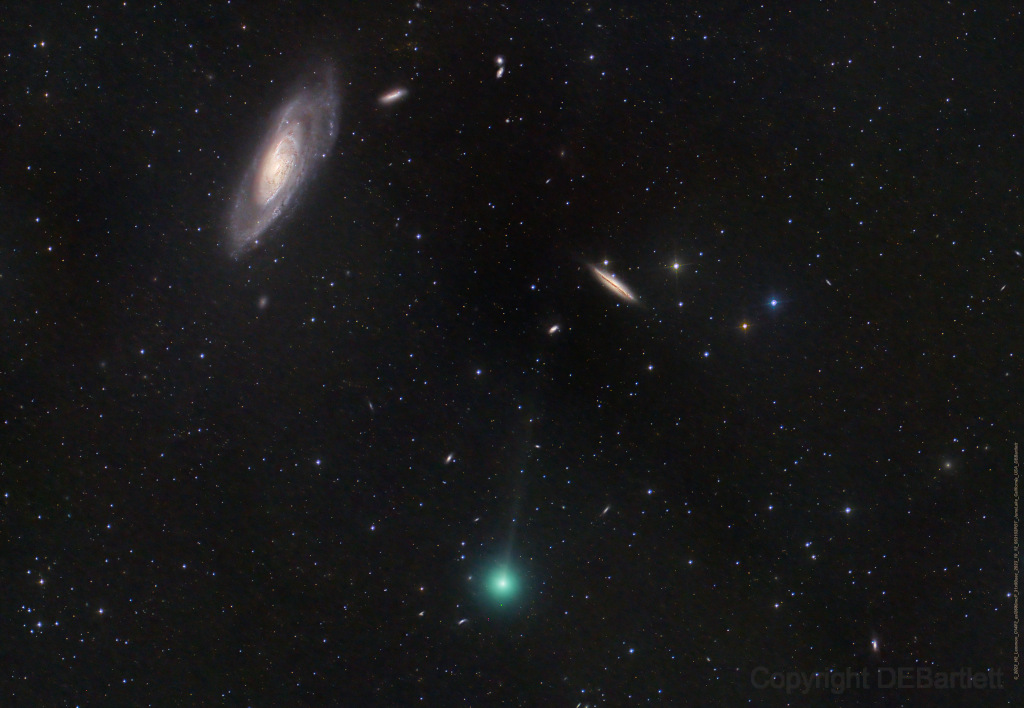
Galaxies abound in this sharp telescopic image recorded on October 12 in dark skies over June Lake, California. The celestial scene spans nearly 2 degrees within the boundaries of the well-trained northern constellation Canes Venatici. Prominent at the upper left 23.5 million light-years distant is big, beautiful spiral galaxy NGC 4258, known to some as Messier 106. Eye-catching edge-on spiral NGC 4217 is above and right of center about 60 million light-years away. Just passing through the pretty field of view is comet C/2023 H2 Lemmon, discovered last April in image data from the Mount Lemmon Survey. Here the comet sports more of a lime green coma though, along with a faint, narrow ion tail stretching toward the top of the frame. This visitor to the inner Solar System is presently less than 7 light-minutes away and still difficult to spot with binoculars, but it's growing brighter. Comet C/2023 H2 Lemmon will reach perihelion, its closest point to the Sun, on October 29 and perigee, its closest to our fair planet, on November 10 as it transitions from morning to evening northern skies.
© Dan Bartlett — used with the credit NASA publishes
2022
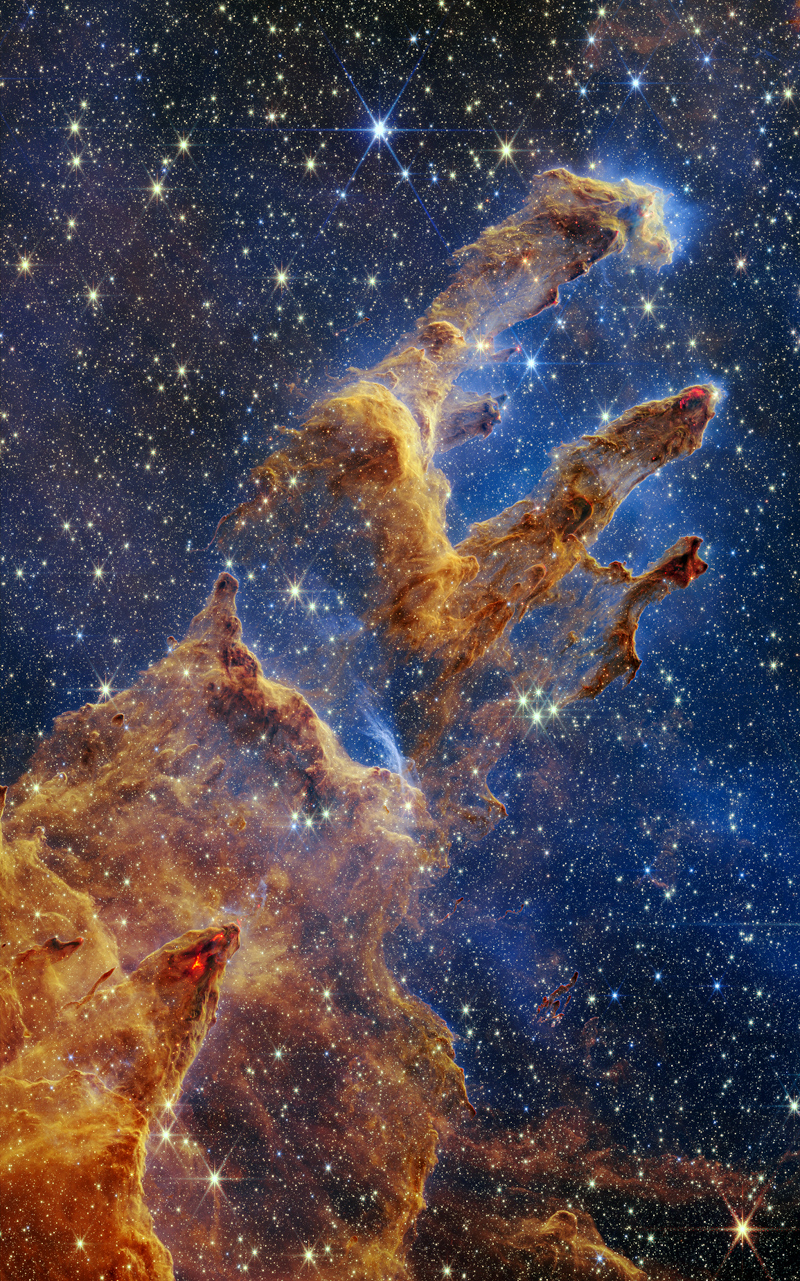
A now famous picture from the Hubble Space Telescope featured these star forming columns of cold gas and dust light-years long inside M16, the Eagle Nebula, dubbed the Pillars of Creation. This James Webb Space Telescope NIRCam image expands Hubble's exploration of that region in greater detail and depth inside the iconic stellar nursery. Particularly stunning in Webb's near infrared view is the telltale reddish emission from knots of material undergoing gravitational collapse to form stars within the natal clouds. The Eagle Nebula is some 6,500 light-years distant. The larger bright emission nebula is itself an easy target for binoculars or small telescopes. M16 lies along the plane of our Milky Way galaxy in a nebula rich part of the sky, toward the split constellation Serpens Cauda (the tail of the snake).
NASA · public domain
2021
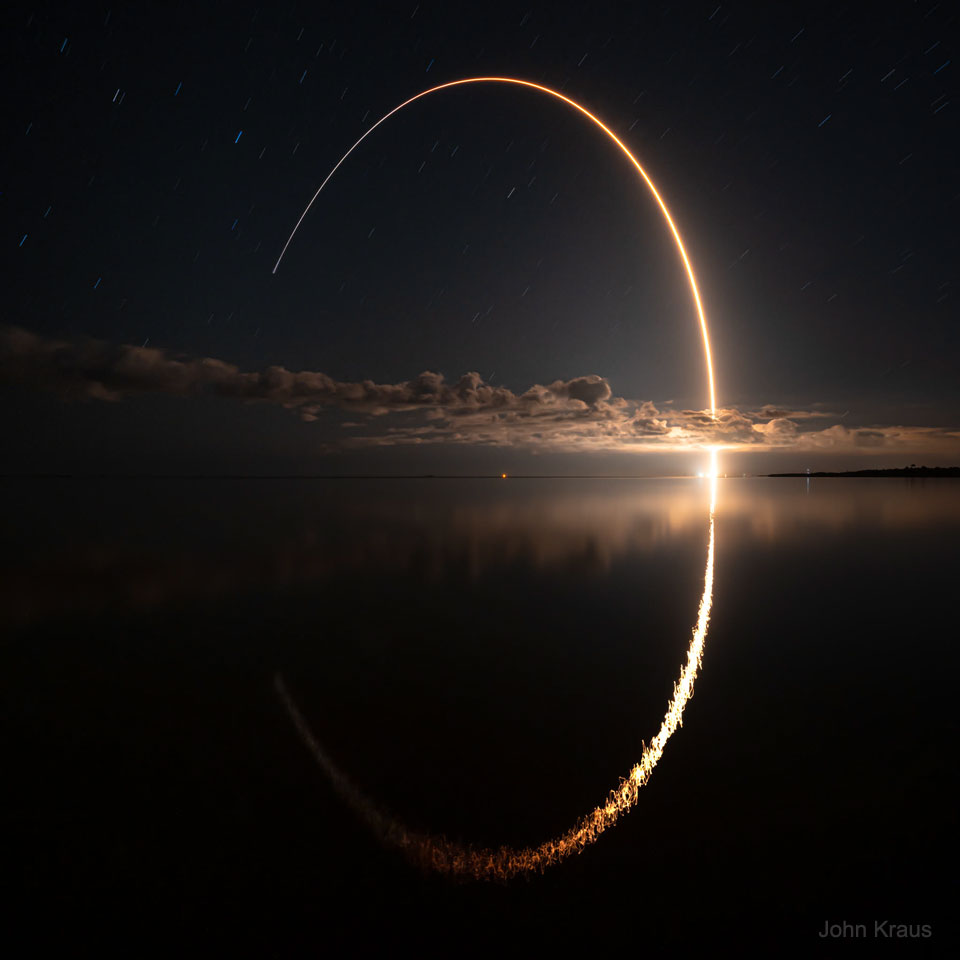
Why would this mission go out as far as Jupiter -- but then not visit Jupiter? Lucy's plan is to follow different leads about the origin of our Solar System than can be found at Jupiter -- where Juno now orbits. Jupiter is such a massive planet that its gravity captures numerous asteroids that orbit the Sun ahead of it -- and behind. These trojan asteroids formed all over our Solar System and some may have been trapped there for billions of years. Flying by these trojan asteroids enables studying them as fossils that likely hold unique clues about our early Solar System. Lucy, named after a famous fossil skeleton which was named after a famous song, is scheduled to visit eight asteroids from 2025 to 2033. Pictured, Lucy's launch was captured with reflection last week aboard a powerful Atlas V rocket from Cape Canaveral, Florida, USA.
© John Kraus — used with the credit NASA publishes

1961
The Soviet Navy performs the first armed test of a submarine-launched ballistic missile, launching an R-13 from a Golf-class submarine.
Soviet Navy ↗
1969
Experimental results from the Stanford Linear Accelerator Center were published showing that protons were composed of smaller particles, the first evidence of quarks.
SLAC National Accelerator Laboratory ↗

2003
The Sloan Great Wall, once the largest cosmic structures known to humanity, is discovered by students at Princeton University.
Sloan Great Wall ↗Event text and thumbnails come from Wikipedia and are used under CC BY-SA 4.0. Images are drawn only from Wikimedia Commons, which does not accept non-free content — each thumbnail links to its file page, where its licence and author are recorded.
Launch records are from The Space Devs’ Launch Library 2. This archive is still being mirrored, so some days are incomplete. Pictures are NASA’s Astronomy Picture of the Day; NASA imagery is generally not subject to copyright, but individual APOD entries are frequently the property of the photographer, and each caption says which applies.
General-audience astronomy and spaceflight — none of it a textbook.
As an Amazon Associate I earn from qualifying purchases. Links here cost you nothing extra.
LISTING
Still the best single argument for why any of this matters, and it leaves the arithmetic in. For a reader who wants the science, not just the awe.
LISTING
The case for leaving Earth, written by someone unsentimental about how hard that is. Suits readers who want the argument rather than the poster.
LISTING
Hard-SF problem solving in The Martian's key — for anyone who liked the engineering more than the peril. The only novel on this list.
BROWSE opens an Amazon search, not a specific recommendation.
LINKS AMAZON.COM