Launches
NO DATA0MISSIONS
The launch archive is still being mirrored, so this day has no launches listed yet.
ARCHIVE // DAY OF YEAR
Wikipedia records 9 spaceflight and astronomy events on October 18. Below are the pictures NASA published on October 18 in 5 different years — each one taken or released on this exact date.
0MISSIONS
The launch archive is still being mirrored, so this day has no launches listed yet.
9ENTRIES
Spaceflight and astronomy entries from Wikipedia's record of this date, oldest first — from 320 onward.
5IMAGES
NASA's Astronomy Picture of the Day for October 18, one per year. Some are public domain and some belong to the photographer — each says which.
NASA’s Astronomy Picture of the Day, for this calendar date in each of the last several years.

2025
Put on your red/blue glasses and float next to asteroid 101955 Bennu. Shaped like a spinning toy top with boulders littering its rough surface, the tiny Solar System world is about one Empire State Building (less than 500 meters) across. Frames used to construct this 3D anaglyph were taken by PolyCam on the OSIRIS_REx spacecraft on December 3, 2018 from a distance of about 80 kilometers. With a sample from the asteroid's rocky surface on board, OSIRIS_REx departed Bennu's vicinity in May of 2021. The robotic spacecraft successfully returned the sample to its home world in September of 2023.
NASA · public domain
2024
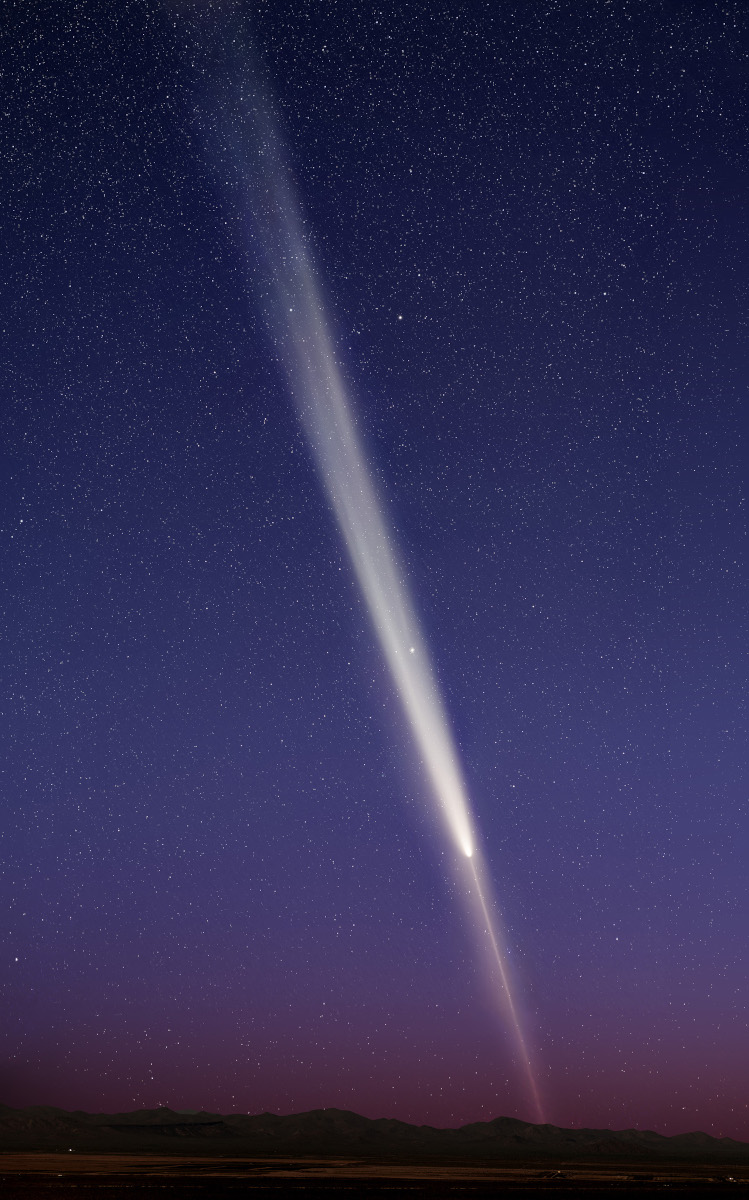
On October 14 it was hard to capture a full view of Comet C/2023 A3 Tsuchinshan-ATLAS. Taken after the comet's closest approach to our fair planet, this evening skyview almost does though. With two telephoto frames combined, the image stretches about 26 degrees across the sky from top to bottom, looking west from Gates Pass, Tucson, Arizona. Comet watchers that night could even identify globular star cluster M5 and the faint apparition of periodic comet 13P Olbers near the long the path of Tsuchinshan-ATLAS's whitish dust tail above the bright comet's coma. Due to perspective as the Earth is crossing the comet's orbital plane, Tsuchinshan-ATLAS also has a pronounced antitail. The antitail is composed of dust previously released and fanning out away from the Sun along the comet's orbit, visible as a needle-like extension below the bright coma toward the rugged western horizon. Growing Gallery: Comet Tsuchinshan-ATLAS in 2024
© Adam Block — used with the credit NASA publishes
2023
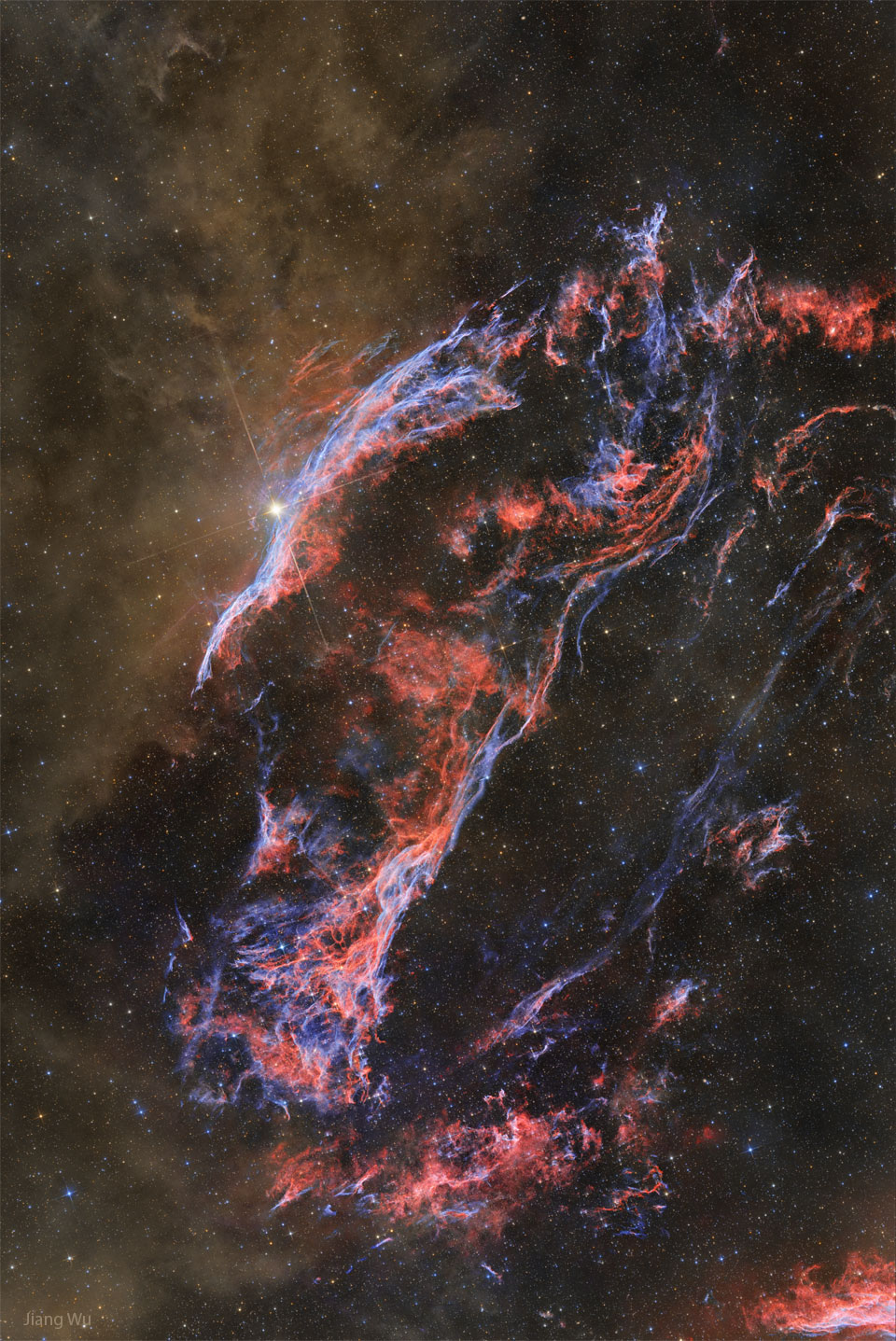
It's so big it is easy to miss. The entire Veil Nebula spans six times the diameter of the full moon, but is so dim you need binoculars to see it. The nebula was created about 15,000 years ago when a star in the constellation of the Swan (Cygnus) exploded. The spectacular explosion would have appeared brighter than even Venus for a week - but there is no known record of it. Pictured is the western edge of the still-expanding gas cloud. Notable gas filaments include the Witch's Broom Nebula on the upper left near the bright foreground star 52 Cygni, and Fleming's Triangular Wisp (formerly known as Pickering's Triangle) running diagonally up the image middle. What is rarely imaged -- but seen in the featured long exposure across many color bands -- is the reflecting brown dust that runs vertically up the image left, dust likely created in the cool atmospheres of massive stars.
© Jiang Wu — used with the credit NASA publishes
2022
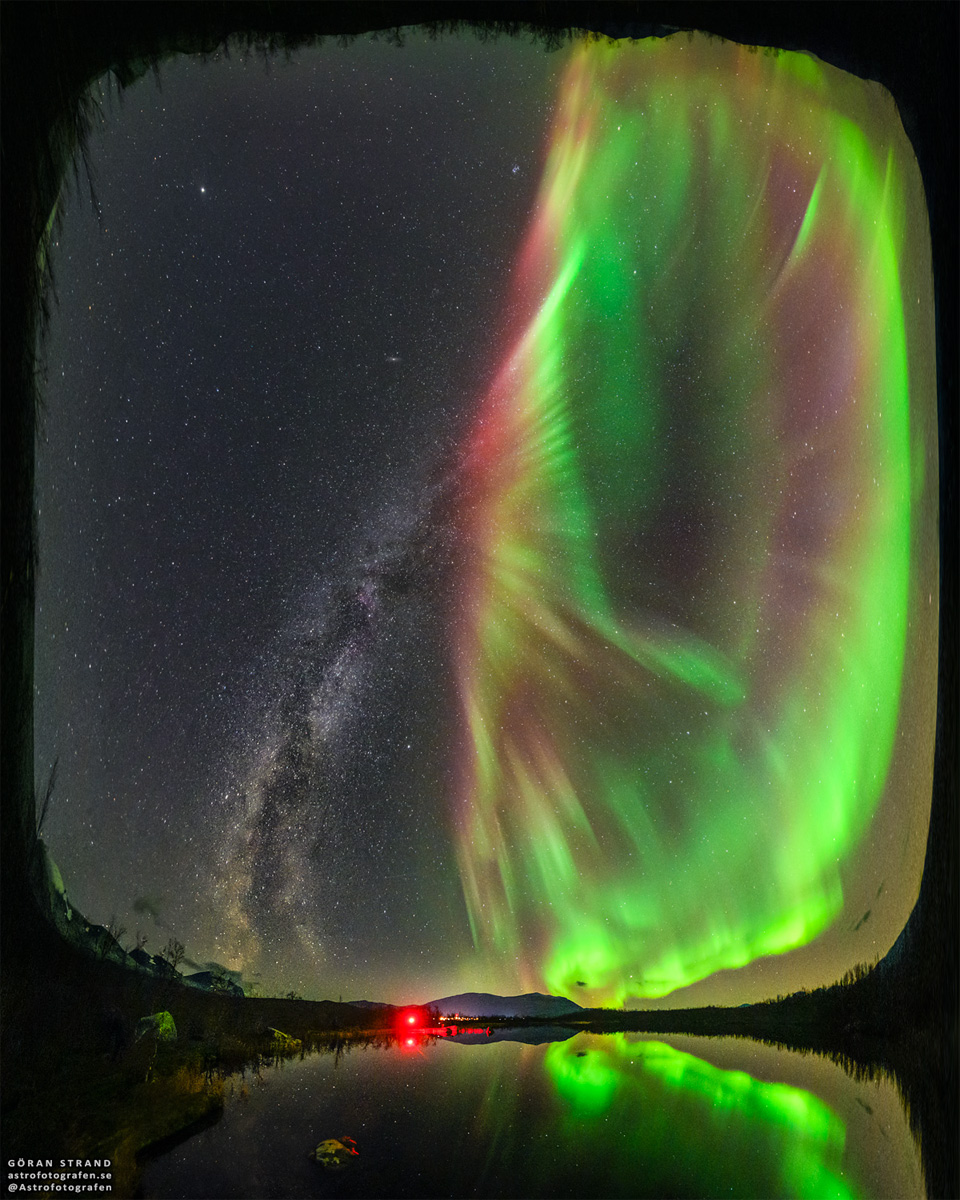
Could the stem of our Milky Way bloom into an auroral flower? No, not really, even though it may appear that way in today’s featured all-sky image. On the left, the central plane of our home galaxy extends from the horizon past the middle of the sky. On the right, an auroral oval also extends from the sky's center -- but is dominated by bright green-glowing oxygen. The two are not physically connected, because the aurora is relatively nearby, with the higher red parts occurring in Earth's atmosphere only about 1000 kilometers high. In contrast, an average distance to the stars and nebulas we see in the Milky Way more like 1000 light-years away - 10 trillion times further. The featured image composite was taken in early October across a small lake in Abisko, northern Sweden. As our Sun's magnetic field evolves into the active part of its 11-year cycle, auroras near both of Earth's poles are sure to become more frequent.
© Göran Strand — used with the credit NASA publishes
2021
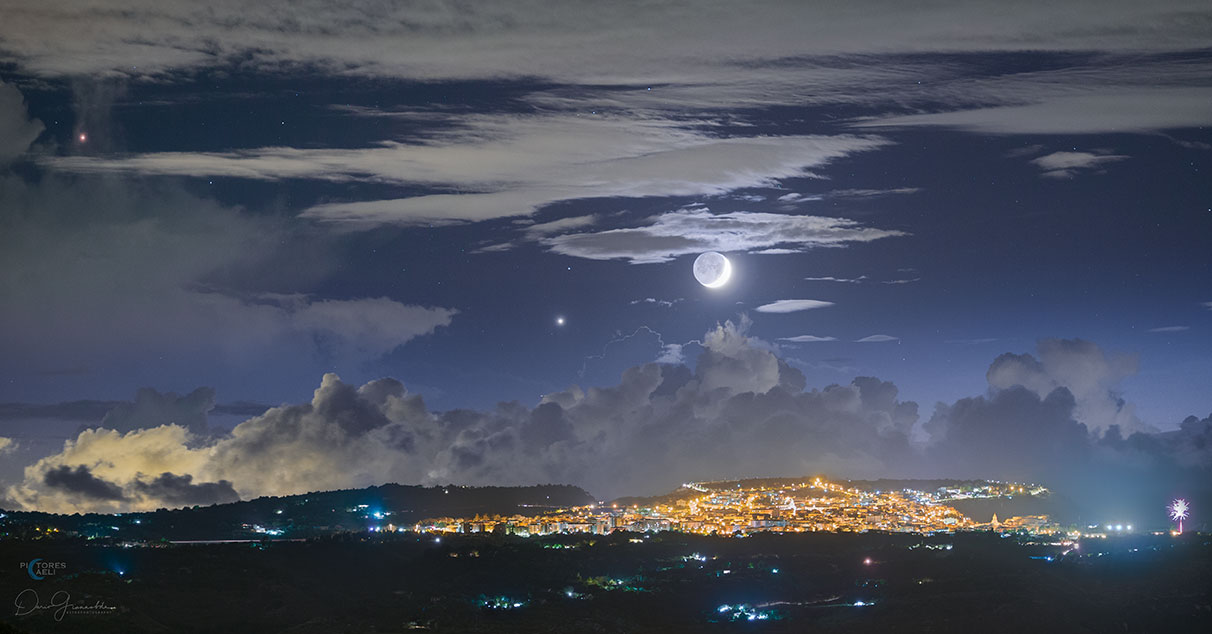
Why can we see the entire face of this Moon? When the Moon is in a crescent phase, only part of it appears directly illuminated by the Sun. The answer is earthshine, also known as earthlight and the da Vinci glow. The reason is that the rest of the Earth-facing Moon is slightly illuminated by sunlight first reflected from the Earth. Since the Earth appears near full phase from the Moon -- when the Moon appears as a slight crescent from the Earth -- earthshine is then near its brightest. Featured here in combined, consecutively-taken, HDR images taken earlier this month, a rising earthshine Moon was captured passing slowly near the planet Venus, the brightest spot near the image center. Just above Venus is the star Dschubba (catalogued as Delta Scorpii), while the red star on the far left is Antares. The celestial show is visible through scenic cloud decks. In the foreground are the lights from Palazzolo Acreide, a city with ancient historical roots in Sicily, Italy.
© Dario Giannobile — used with the credit NASA publishes

320
Pappus of Alexandria, Greek philosopher, observes an eclipse of the Sun and writes a commentary on The Great Astronomer (Almagest).
Pappus of Alexandria ↗
1944
World War II: The state funeral of Field Marshal Erwin Rommel takes place in Ulm, Germany.
Erwin Rommel ↗
1945
The USSR's nuclear program receives plans for the United States plutonium bomb from Klaus Fuchs at the Los Alamos National Laboratory.
Soviet Union ↗1963
The first cat in space, later known as Félicette, launched aboard a French Véronique rocket.
Félicette ↗
1967
The Soviet space probe Venera 4 became the first spacecraft to perform direct in situ analysis of the environment of another planet (Venus).
Venera 4 ↗1967
The Soviet probe Venera 4 reaches Venus and becomes the first spacecraft to measure the atmosphere of another planet.
Soviet Union ↗
1979
The Federal Communications Commission (FCC) begins allowing people to have home satellite earth stations without a federal government license.
Federal Communications Commission ↗
1989
The Space Shuttle Atlantis launches on STS-34 to deploy the Jupiter-bound Galileo space probe.
Space Shuttle Atlantis ↗
2019
NASA Astronauts Jessica Meir and Christina Koch take part in the first all-female spacewalk when they venture out of the International Space Station to replace a power controller.
NASA Astronaut Corps ↗Event text and thumbnails come from Wikipedia and are used under CC BY-SA 4.0. Images are drawn only from Wikimedia Commons, which does not accept non-free content — each thumbnail links to its file page, where its licence and author are recorded.
Launch records are from The Space Devs’ Launch Library 2. This archive is still being mirrored, so some days are incomplete. Pictures are NASA’s Astronomy Picture of the Day; NASA imagery is generally not subject to copyright, but individual APOD entries are frequently the property of the photographer, and each caption says which applies.
General-audience astronomy and spaceflight — none of it a textbook.
As an Amazon Associate I earn from qualifying purchases. Links here cost you nothing extra.
LISTING
Still the best single argument for why any of this matters, and it leaves the arithmetic in. For a reader who wants the science, not just the awe.
LISTING
The case for leaving Earth, written by someone unsentimental about how hard that is. Suits readers who want the argument rather than the poster.
LISTING
Hard-SF problem solving in The Martian's key — for anyone who liked the engineering more than the peril. The only novel on this list.
BROWSE opens an Amazon search, not a specific recommendation.
LINKS AMAZON.COM