Launches
NO DATA0MISSIONS
The launch archive is still being mirrored, so this day has no launches listed yet.
ARCHIVE // DAY OF YEAR
Wikipedia records 1 spaceflight and astronomy event on October 8. Below are the pictures NASA published on October 8 in 5 different years — each one taken or released on this exact date.
0MISSIONS
The launch archive is still being mirrored, so this day has no launches listed yet.
1ENTRY
Spaceflight and astronomy entries from Wikipedia's record of this date, oldest first — from 1829 onward.
5IMAGES
NASA's Astronomy Picture of the Day for October 8, one per year. Some are public domain and some belong to the photographer — each says which.
NASA’s Astronomy Picture of the Day, for this calendar date in each of the last several years.

2025
What powers are being wielded in the Wizard Nebula? Gravitation strong enough to form stars, and stellar winds and radiations powerful enough to create and dissolve towers of gas. Located only 8,000 light years away, the Wizard nebula, featured here, surrounds a developing open star cluster NGC 7380. Visually, the interplay of stars, gas, and dust has created a shape that appears to some like a fictional medieval sorcerer. The active star forming region spans about 100 light years, making it appear larger than the angular extent of the Moon. The Wizard Nebula can be located with a small telescope toward the constellation of the King of Aethiopia (Cepheus). Although the nebula may last only a few million years, some of the stars being formed may outlive our Sun.
© Nevenka Blagovic Horvat & Miroslav Horvat — used with the credit NASA publishes
2024
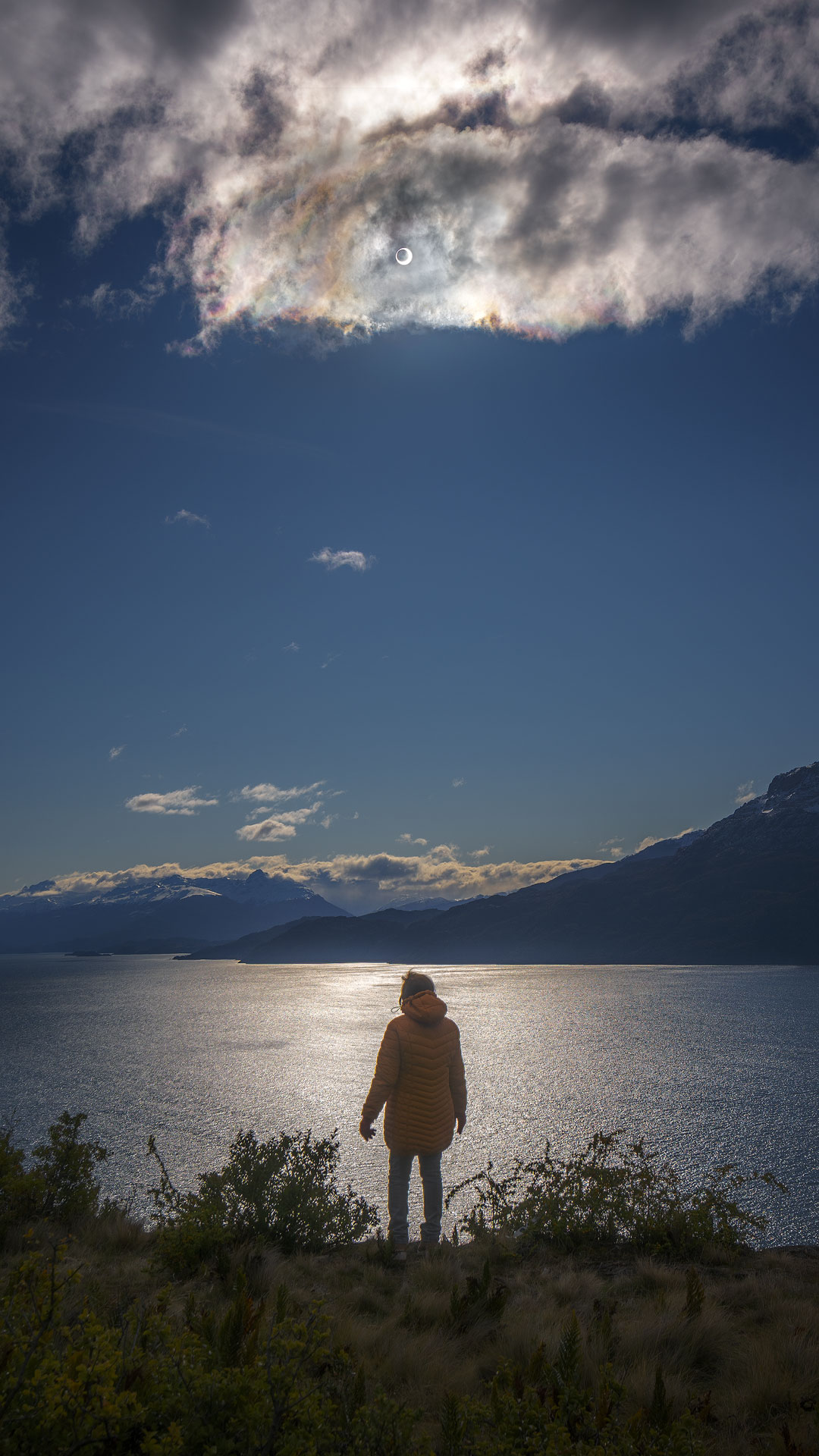
Can you find the Sun? OK, but can you explain why there’s a big dark spot in the center? The spot is the Moon, and the impressive alignment shown, where the Moon lines up inside the Sun, is called an annular solar eclipse. Such an eclipse occurred just last week and was visible from a thin swath mostly in Earth's southern hemisphere. The featured image was captured from Patagonia, Chile. When the Moon is significantly closer to the Earth and it aligns with the Sun, a total solar eclipse is then visible from parts of the Earth. Annular eclipses are slightly more common than total eclipses, but as the Moon moves slowly away from the Earth, before a billion more years, the Moon's orbit will no longer bring it close enough for a total solar eclipse to be seen from anywhere on Earth. Gallery: Annular Eclipse of October 2024
© Alexis Trigo — used with the credit NASA publishes
2023
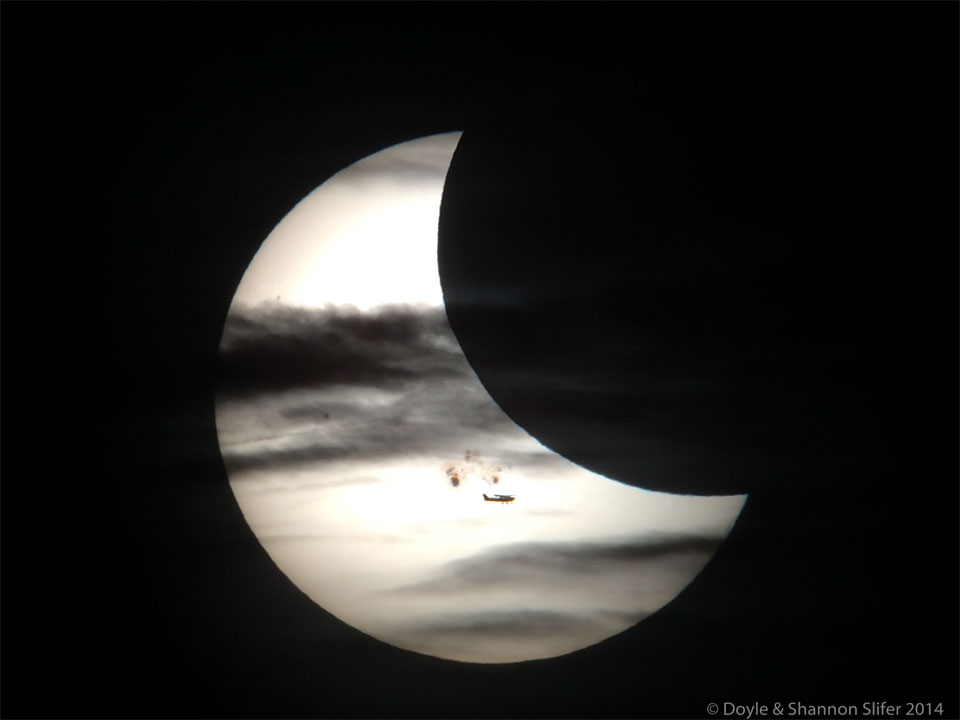
What's that in front of the Sun? The closest object is an airplane, visible just below the Sun's center and caught purely by chance. Next out are numerous clouds in Earth's atmosphere, creating a series of darkened horizontal streaks. Farther out is Earth's Moon, seen as the large dark circular bite on the upper right. Just above the airplane and just below the Sun's surface are sunspots. The main sunspot group captured here, AR 2192, was in 2014 one of the largest ever recorded and had been crackling and bursting with flares since it came around the edge of the Sun a week before. This show of solar silhouettes was unfortunately short-lived. Within a few seconds the plane flew away. Within a few minutes the clouds drifted off. Within a few hours the partial solar eclipse of the Sun by the Moon was over. Fortunately, when it comes to the Sun, even unexpected alignments are surprisingly frequent. Perhaps one will be imaged this Saturday when a new partial solar eclipse will be visible from much of North and South America. APOD editor to speak: in Houghton, Michigan on Thursday, October 12 at 6 pm
© Doyle and Shannon Slifer — used with the credit NASA publishes
2022
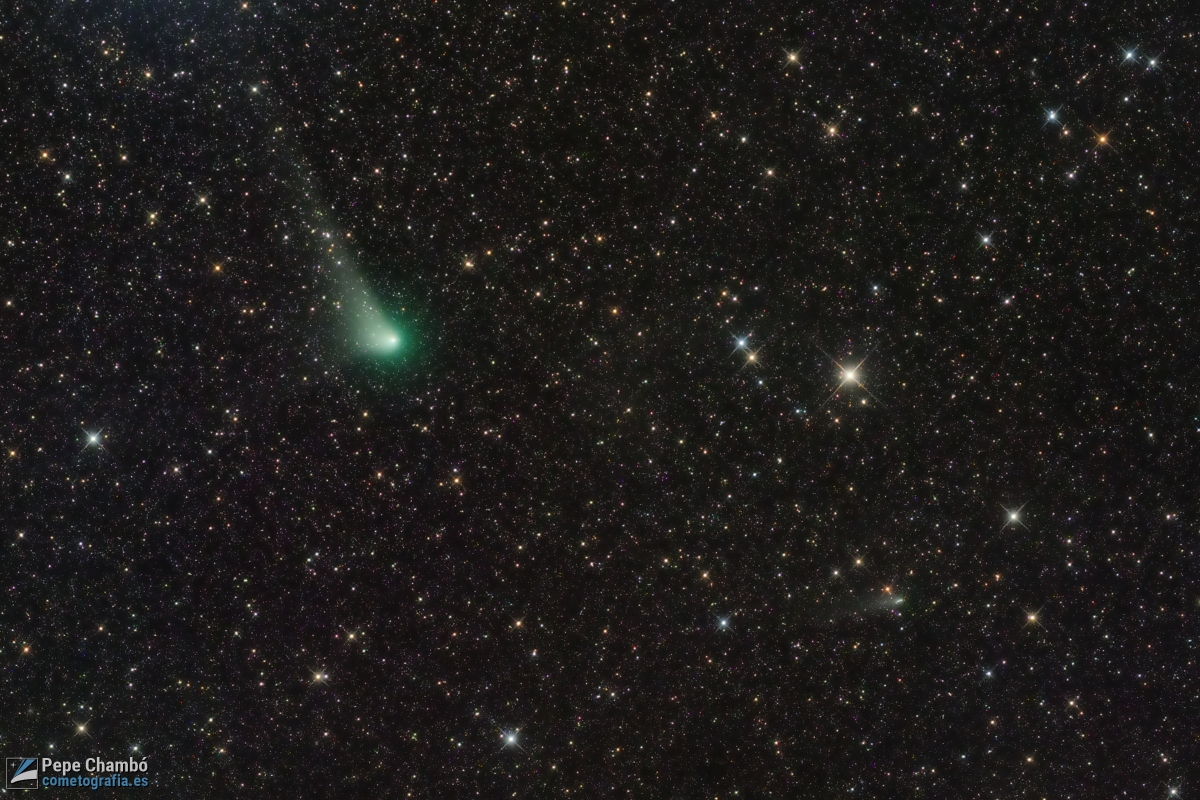
Heading for its closest approach to the Sun or perihelion on December 20, comet C/2017 K2 (PanSTARRS) remains a sight for telescopic observers as it sweeps through planet Earth's southern hemisphere skies. First time visitor from the remote Oort cloud this comet PanSTARRS sports a greenish coma and whitish dust tail about half a degree long at the upper left in a deep image from September 21. It also shares the starry field of view toward the constellation Scorpius with another comet, 73P/Schwassmann-Wachmann 3, seen about 1 degree below and right of PanSTARRS. Astronomers estimate that first time visitor comet C/2017 K2 (PanSTARRS) has been inbound from the Oort cloud for some 3 million years along a hyperbolic orbit. Schwassmann-Wachmann 3 is more familiar though. The periodic comet loops through its own elliptical orbit, from just beyond the orbit of Jupiter to the vicinity of Earth's orbit, once every 5.4 years. Just passing in the night, this comet PanSTARRS is about 20 light-minutes from Earth in the September 21 image. Seen to be disintegrating since 1995, Schwassmann-Wachmann 3 was about 7.8 light-minutes away.
© Jose J. Chambo — used with the credit NASA publishes
2021
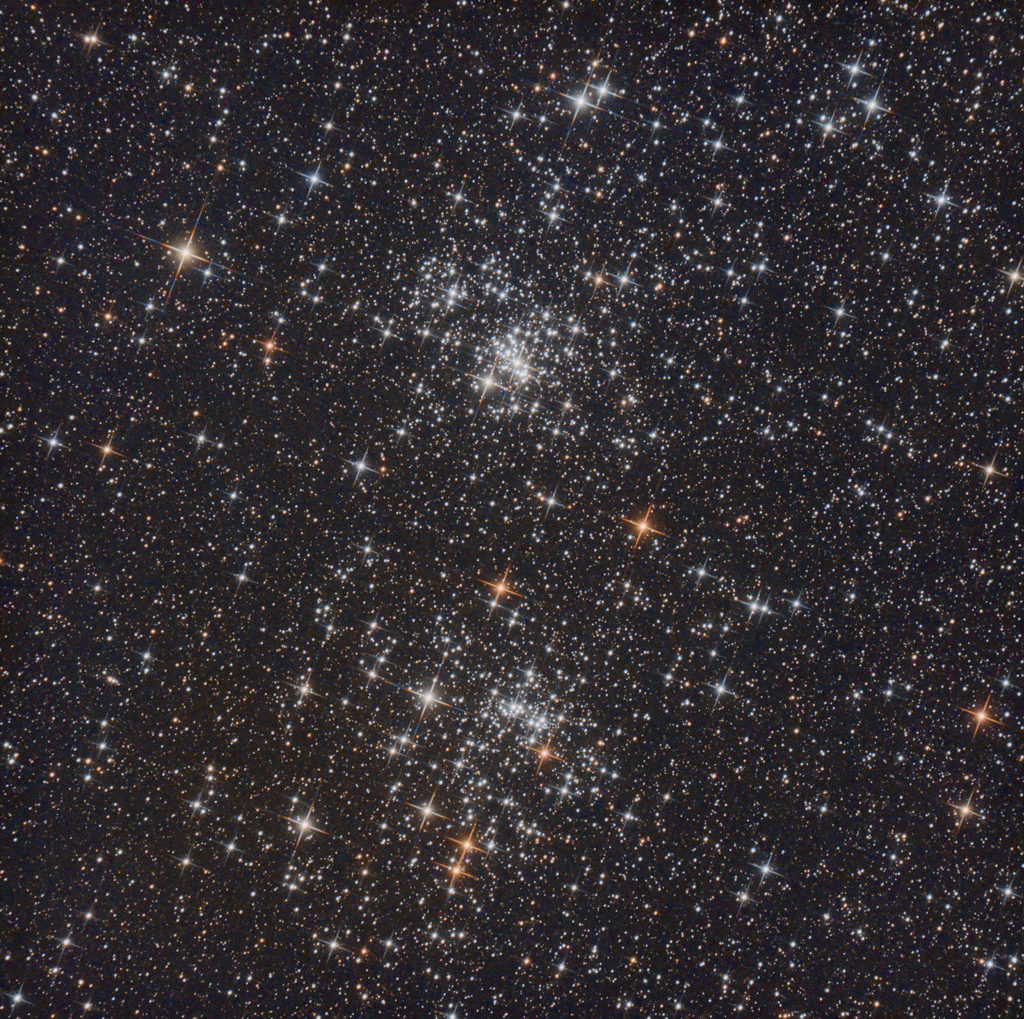
This pretty starfield spans about three full moons (1.5 degrees) across the heroic northern constellation of Perseus. It holds the famous pair of open star clusters, h and Chi Persei. Also cataloged as NGC 869 (top) and NGC 884, both clusters are about 7,000 light-years away and contain stars much younger and hotter than the Sun. Separated by only a few hundred light-years, the clusters are both 13 million years young based on the ages of their individual stars, evidence that they were likely a product of the same star-forming region. Always a rewarding sight in binoculars, the Double Cluster is even visible to the unaided eye from dark locations. But a shroud of guitar strings was used to produce diffraction spikes on the colorful stars imaged in this vibrant telescopic view. Global Moon Party: Including APOD's Best Moon Images: Saturday, October 9
© Jack Groves — used with the credit NASA publishes

Event text and thumbnails come from Wikipedia and are used under CC BY-SA 4.0. Images are drawn only from Wikimedia Commons, which does not accept non-free content — each thumbnail links to its file page, where its licence and author are recorded.
Launch records are from The Space Devs’ Launch Library 2. This archive is still being mirrored, so some days are incomplete. Pictures are NASA’s Astronomy Picture of the Day; NASA imagery is generally not subject to copyright, but individual APOD entries are frequently the property of the photographer, and each caption says which applies.
General-audience astronomy and spaceflight — none of it a textbook.
As an Amazon Associate I earn from qualifying purchases. Links here cost you nothing extra.
LISTING
Still the best single argument for why any of this matters, and it leaves the arithmetic in. For a reader who wants the science, not just the awe.
LISTING
The case for leaving Earth, written by someone unsentimental about how hard that is. Suits readers who want the argument rather than the poster.
LISTING
Hard-SF problem solving in The Martian's key — for anyone who liked the engineering more than the peril. The only novel on this list.
BROWSE opens an Amazon search, not a specific recommendation.
LINKS AMAZON.COM