Launches
ON RECORD26MISSIONS
25 of them reached orbit. The earliest was 1964, the most recent 2023.
ARCHIVE // DAY OF YEAR
26 orbital launches flew on October 5, the earliest of them in 1964, and 25 reached orbit. Wikipedia records 2 spaceflight and astronomy events on October 5. Below are the pictures NASA published on October 5 in 5 different years — each one taken or released on this exact date.
26MISSIONS
25 of them reached orbit. The earliest was 1964, the most recent 2023.
2ENTRIES
Spaceflight and astronomy entries from Wikipedia's record of this date, oldest first — from 1905 onward.
5IMAGES
NASA's Astronomy Picture of the Day for October 5, one per year. Some are public domain and some belong to the photographer — each says which.
NASA’s Astronomy Picture of the Day, for this calendar date in each of the last several years.

2025
It was one of the largest and longest lived storms ever recorded in our Solar System. First seen in late 2010, the featured cloud formation in the northern hemisphere of Saturn started larger than the Earth and soon spread completely around the planet. The storm was tracked not only from Earth but from up close by the robotic Cassini spacecraft then orbiting Saturn. Pictured here in false colored infrared in February, orange colors indicate clouds deep in the atmosphere, while light colors highlight clouds higher up. The rings of Saturn are seen nearly edge-on as the thin blue horizontal line. The warped dark bands are the shadows of the rings cast onto the cloud tops by the Sun to the upper left. A source of radio noise from lightning, the intense storm was thought to relate to seasonal changes when spring emerges in the north of Saturn. After raging for over six months, the iconic storm circled the entire planet and then tried to absorb its own tail -- which surprisingly caused it to fade away.
NASA · public domain
2024
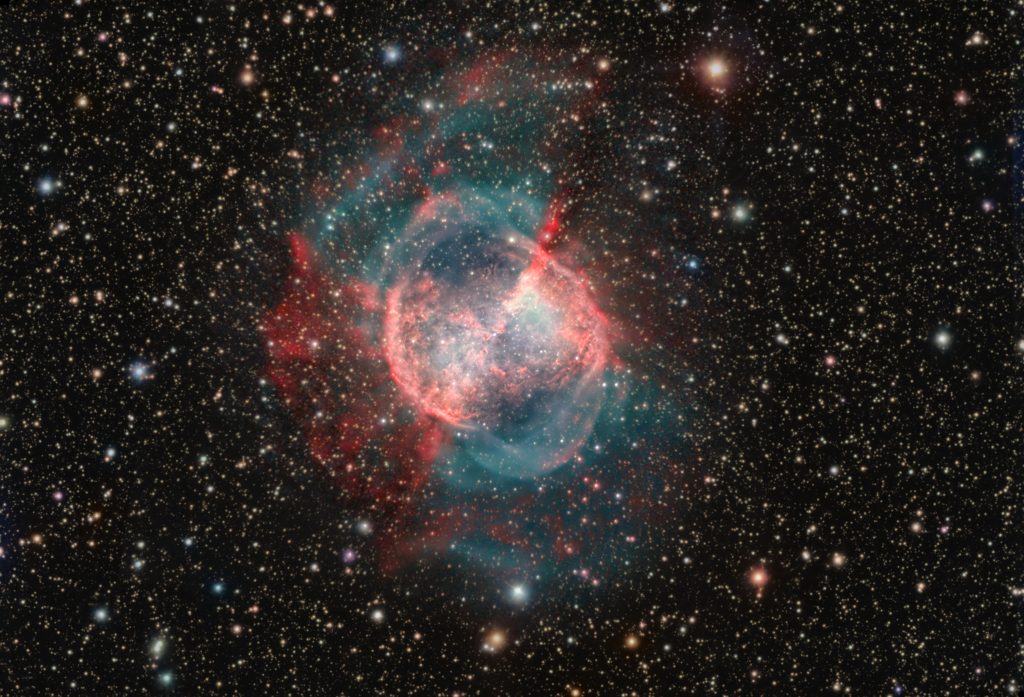
While hunting for comets in the skies above 18th century France, astronomer Charles Messier diligently kept a list of the things encountered during his telescopic expeditions that were definitely not comets. This is number 27 on his now famous not-a-comet list. In fact, 21st century astronomers would identify it as a planetary nebula, but it's not a planet either, even though it may appear round and planet-like in a small telescope. Messier 27 (M27) is an excellent example of a gaseous emission nebula created as a sun-like star runs out of nuclear fuel in its core. The nebula forms as the star's outer layers are expelled into space, with a visible glow generated by atoms excited by the dying star's intense but invisible ultraviolet light. Known by the popular name of the Dumbbell Nebula, the beautifully symmetric interstellar gas cloud is over 2.5 light-years across and about 1,200 light-years away in the constellation Vulpecula. This impressive color image highlights details within the well-studied central region and fainter, seldom imaged features in the nebula's outer halo.
© Francesco Sferlazza, Franco Sgueglia — used with the credit NASA publishes
2023
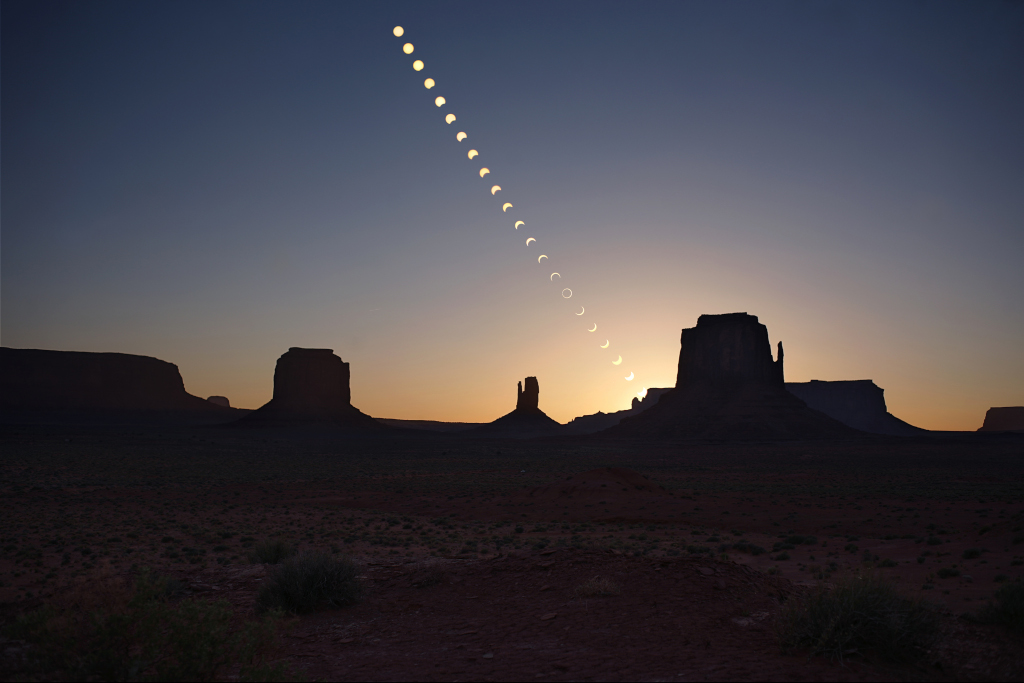
Tracking along a narrow path, the shadow of a new moon will race across North, Central, and South America, on October 14. When viewed from the shadow path the apparent size of the lunar disk will not quite completely cover the Sun though. Instead, the moon in silhouette will appear during the minutes of totality surrounded by a fiery ring, an annular solar eclipse more dramatically known as a ring of fire eclipse. This striking time lapse sequence from May of 2012 illustrates the stages of a ring of fire eclipse. From before eclipse start until sunset, they are seen over the iconic buttes of planet Earth's Monument Valley. Remarkably, the October 14 ring of fire eclipse will also be visible over Monument Valley, beginning after sunrise in the eastern sky.
© Tunc Tezel — used with the credit NASA publishes
2022
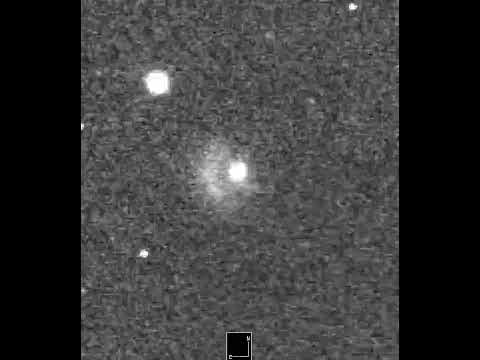
What happens if you crash a spaceship into an asteroid? In the case of NASA's DART spaceship and the small asteroid Dimorphos, as happened last week, you get quite a plume. The goal of the planned impact was planetary protection -- to show that the path of an asteroid can be slightly altered, so that, if done right, a big space rock will miss the Earth. The high brightness of the plume, though, was unexpected by many, and what it means remains a topic of research. One possibility is that 170-meter wide Dimorphos is primarily a rubble pile asteroid and the collision dispersed some of the rubble in the pile. The featured time-lapse video covers about 20 minutes and was taken from the Les Makes Observatory on France's Reunion Island, off the southeast coast of southern Africa. One of many Earth-based observatories following the impact, the initial dot is primarily Dimorphos's larger companion: asteroid Didymos. Most recently, images show that the Didymos - Dimorphos system has developed comet-like tails. DART Impact on Dimorphos: Notable images submitted to APOD
NASA · public domain
2021
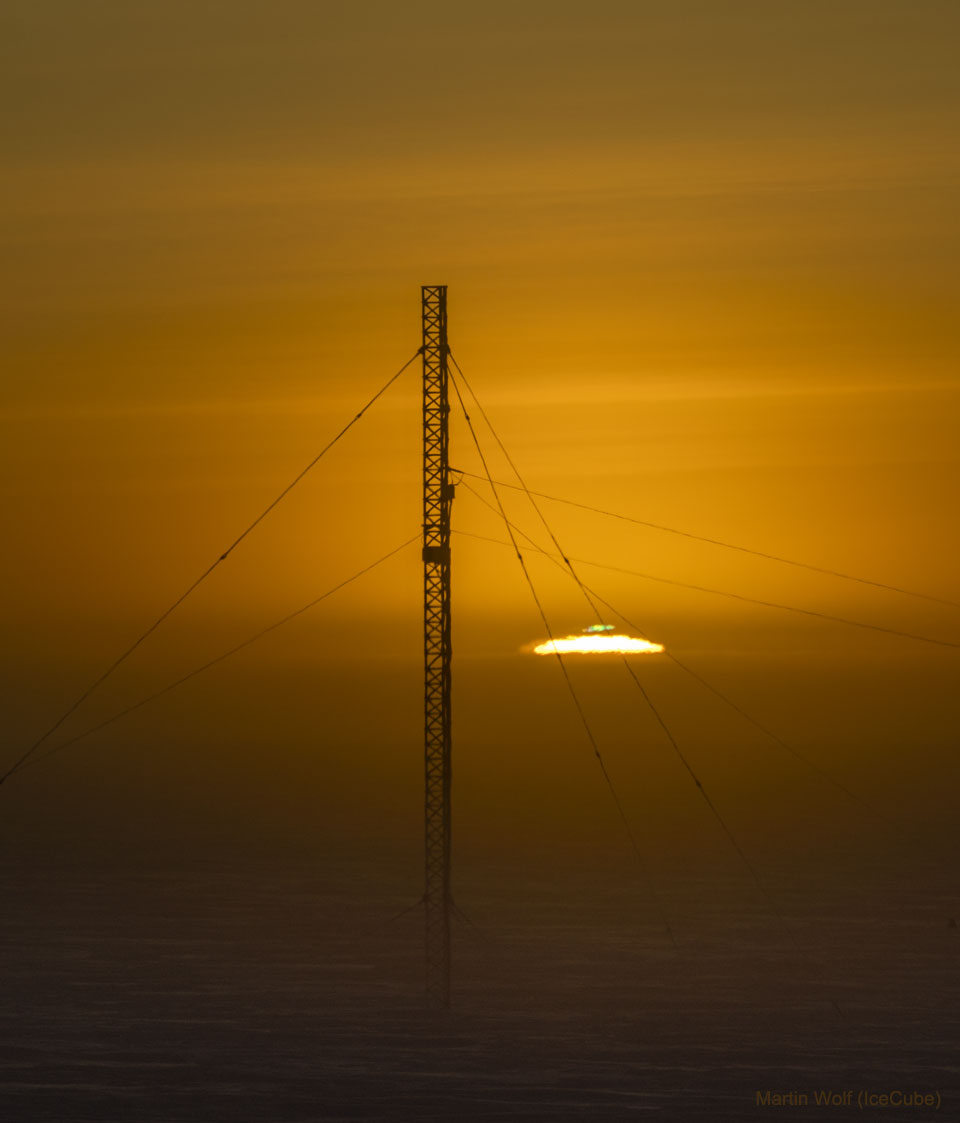
Sunrise at the South Pole is different. Usually a welcome sight, it follows months of darkness -- and begins months of sunshine. At Earth's poles, it can take weeks for the Sun to rise, in contrast with hours at any mid-latitude location. Sunrise at a pole is caused by the tilt of the Earth as it orbits the Sun, not by the rotation of the Earth. Although at a pole, an airless Earth would first see first Sun at an equinox, the lensing effect of the Earth's atmosphere and the size of the solar disk causes the top of the Sun to appear about two-weeks early. Pictured two weeks ago, the Sun peeks above the horizon of a vast frozen landscape at Earth's South Pole. The true South Pole is just a few meters to the left of the communications tower. This polar sunrise capture was particularly photogenic as the Sun appeared capped by a green flash.
© Martin Wolf (U. Wisconsin), IceCube Neutrino Obs., NSF; ht: Alice Allen — used with the credit NASA publishes

1905
The Wright brothers pilot the Wright Flyer III in a new world record flight of 24 miles in 39 minutes.
Wright brothers ↗
Event text and thumbnails come from Wikipedia and are used under CC BY-SA 4.0. Images are drawn only from Wikimedia Commons, which does not accept non-free content — each thumbnail links to its file page, where its licence and author are recorded.
Launch records are from The Space Devs’ Launch Library 2. Pictures are NASA’s Astronomy Picture of the Day; NASA imagery is generally not subject to copyright, but individual APOD entries are frequently the property of the photographer, and each caption says which applies.
General-audience astronomy and spaceflight — none of it a textbook.
As an Amazon Associate I earn from qualifying purchases. Links here cost you nothing extra.
LISTING
Still the best single argument for why any of this matters, and it leaves the arithmetic in. For a reader who wants the science, not just the awe.
LISTING
The case for leaving Earth, written by someone unsentimental about how hard that is. Suits readers who want the argument rather than the poster.
LISTING
Hard-SF problem solving in The Martian's key — for anyone who liked the engineering more than the peril. The only novel on this list.
BROWSE opens an Amazon search, not a specific recommendation.
LINKS AMAZON.COM