Launches
NO DATA0MISSIONS
The launch archive is still being mirrored, so this day has no launches listed yet.
ARCHIVE // DAY OF YEAR
Wikipedia records 2 spaceflight and astronomy events on September 20. Below are the pictures NASA published on September 20 in 5 different years — each one taken or released on this exact date.
0MISSIONS
The launch archive is still being mirrored, so this day has no launches listed yet.
2ENTRIES
Spaceflight and astronomy entries from Wikipedia's record of this date, oldest first — from 1971 onward.
5IMAGES
NASA's Astronomy Picture of the Day for September 20, one per year. Some are public domain and some belong to the photographer — each says which.
NASA’s Astronomy Picture of the Day, for this calendar date in each of the last several years.

2025
rly risers around planet Earth have enjoyed a shining crescent Moon near brilliant Venus, close to the eastern horizon in recent morning twilight skies. And yesterday, on September 19, skygazers watching from some locations in Earth's northern hemisphere were also able to witness Venus, in the inner planet's waxing gibbous phase, pass behind the Moon's waning crescent. In fact, this telescopic snapshot was taken moments before that occultation of gibbous Venus by the crescent Moon began. The close-up view of the beautiful celestial alignment records Venus approaching part of the Moon's sunlit edge in clear daytime skies from the Swiss Alps. Tomorrow, the Sun will pass behind a New Moon. But to witness that partial solar eclipse on September 21, skygazers will need to watch from locations in planet Earth's southern hemisphere.
© Luca Bartek — used with the credit NASA publishes
2024
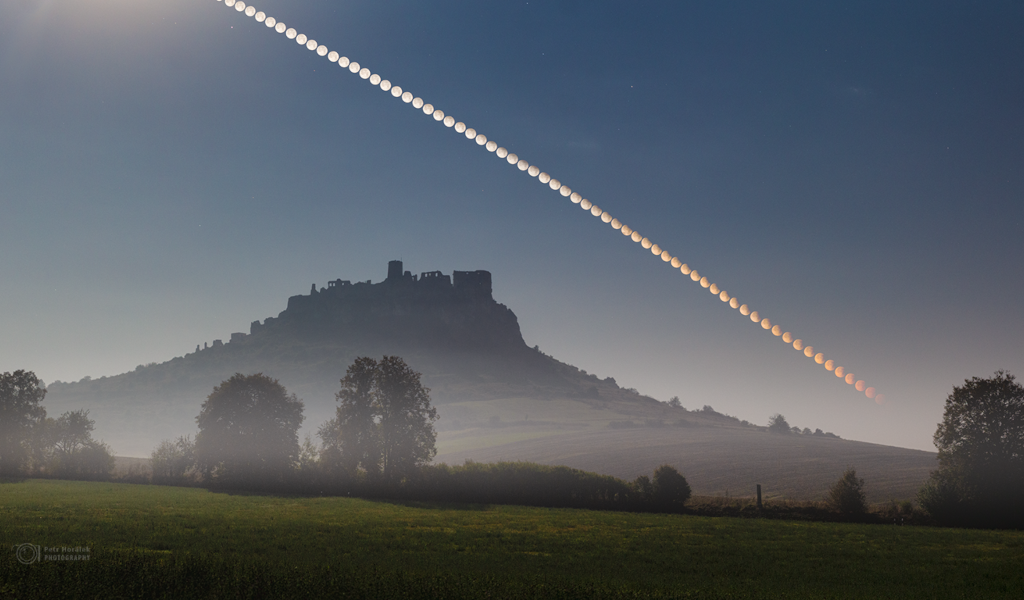
For northern hemisphere dwellers, September's Full Moon was the Harvest Moon. On September 17/18 the sunlit lunar nearside passed into shadow, just grazing Earth's umbra, the planet's dark, central shadow cone, in a partial lunar eclipse. Over the two and a half hours before dawn a camera fixed to a tripod was used to record this series of exposures as the eclipsed Harvest Moon set behind Spiš Castle in the hazy morning sky over eastern Slovakia. Famed in festival, story, and song, Harvest Moon is just the traditional name of the full moon nearest the autumnal equinox. According to lore the name is a fitting one. Despite the diminishing daylight hours as the growing season drew to a close, farmers could harvest crops by the light of a full moon shining on from dusk to dawn. This September's Harvest Moon was also known to some as a supermoon, a term becoming a traditional name for a full moon near perigee.
© Petr Horálek — used with the credit NASA publishes
2023
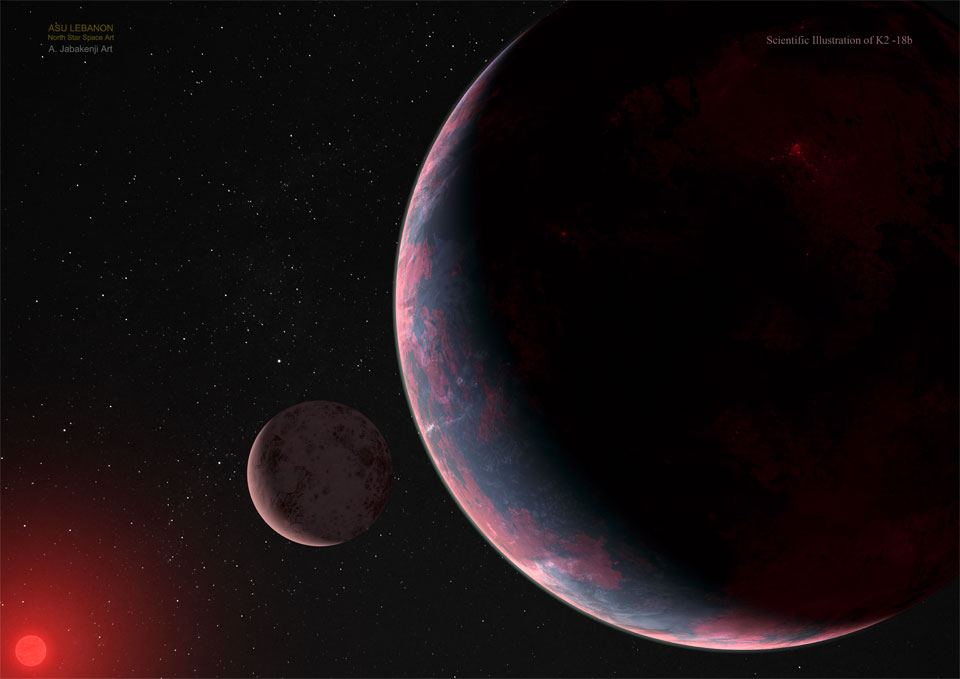
Where else might life exist? One of humanity's great outstanding questions, locating planets where extrasolar life might survive took a step forward in 2019 with the discovery of a significant amount of water vapor in the atmosphere of distant exoplanet K2-18b. The planet and its parent star, K2-18, lie about 124 light years away toward the constellation of the Lion (Leo). The exoplanet is significantly larger and more massive than our Earth, but orbits in the habitable zone of its home star. K2-18, although more red than our Sun, shines in K2-18b's sky with a brightness similar to the Sun in Earth's sky. The 2019 discovery of atmospheric water was made in data from three space telescopes: Hubble, Spitzer, and Kepler, by noting the absorption of water-vapor colors when the planet moved in front of the star. Now in 2023, further observations by the Webb Space Telescope in infrared light have uncovered evidence of other life-indicating molecules -- including methane. The featured illustration imagines exoplanet K2-18b on the far right orbited by a moon (center), which together orbit a red dwarf star depicted on the lower left.
NASA · public domain
2022
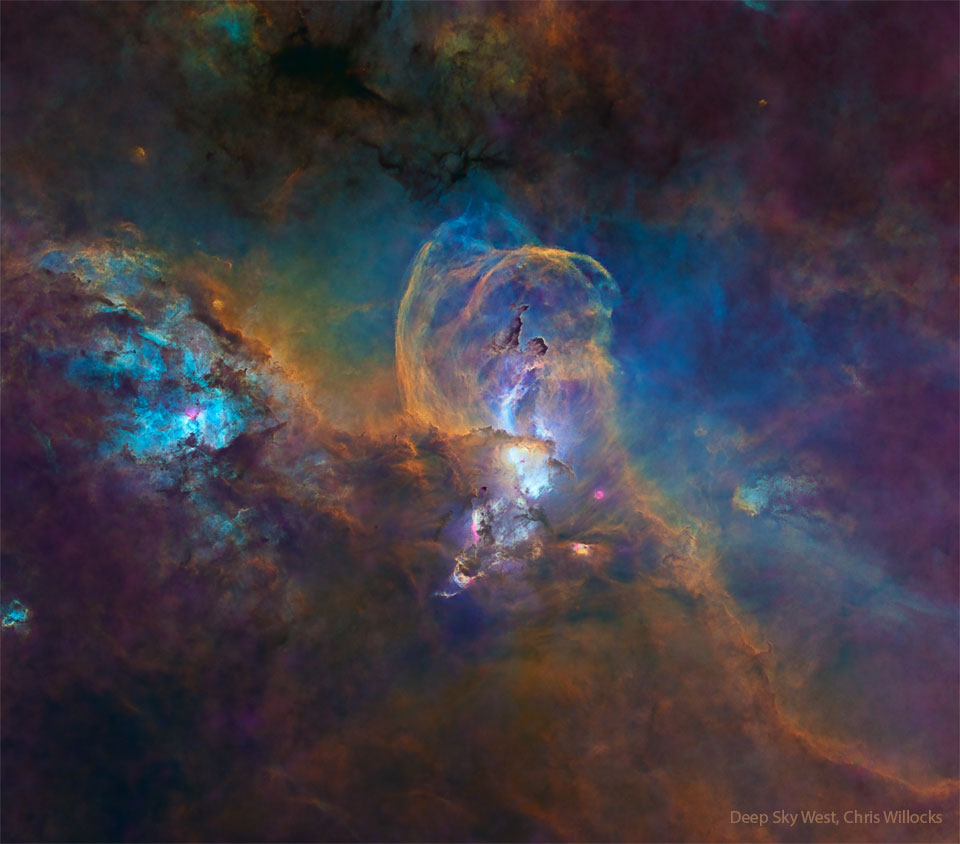
What's happening in the Statue of Liberty nebula? Bright stars and interesting molecules are forming and being liberated. The complex nebula resides in the star forming region called RCW 57, and besides the iconic monument, to some looks like a flying superhero or a weeping angel. By digitally removing the stars, this re-assigned color image showcases dense knots of dark interstellar dust, fields of glowing hydrogen gas ionized by these stars, and great loops of gas expelled by dying stars. A detailed study of NGC 3576, also known as NGC 3582 and NGC 3584, uncovered at least 33 massive stars in the end stages of formation, and the clear presence of the complex carbon molecules known as polycyclic aromatic hydrocarbons (PAHs). PAHs are thought to be created in the cooling gas of star forming regions, and their development in the Sun's formation nebula five billion years ago may have been an important step in the development of life on Earth. Your Sky Surprise: What picture did APOD feature on your birthday? (post 1995)
© Chris Willocks — used with the credit NASA publishes
2021
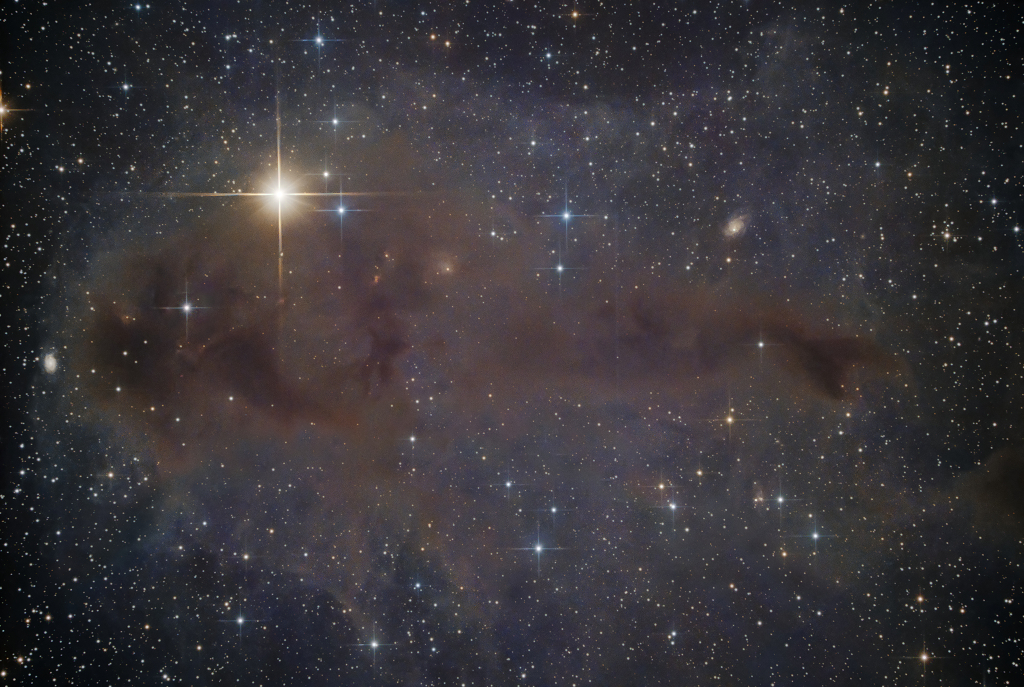
Stars are forming in Lynds Dark Nebula (LDN) 1251. About 1,000 light-years away and drifting above the plane of our Milky Way galaxy, the dusty molecular cloud is part of a complex of dark nebulae mapped toward the Cepheus flare region. Across the spectrum, astronomical explorations of the obscuring interstellar clouds reveal energetic shocks and outflows associated with newborn stars, including the telltale reddish glow from scattered Herbig-Haro objects hiding in the image. Distant background galaxies also lurk on the scene, almost buried behind the dusty expanse. This alluring view spans over two full moons on the sky, or 17 light-years at the estimated distance of LDN 1251.
© Cristiano Gualco — used with the credit NASA publishes

1971
Hurricane Irene (satellite image pictured) moved into the Pacific Ocean from the Atlantic, making it the first actively tracked tropical cyclone to do so.
Hurricane Irene–Olivia ↗2000
The Real Irish Republican Army carried out a rocket-launcher attack on the MI6 headquarters in London, with no casualties and minimal damage recorded.
Real Irish Republican Army ↗Event text and thumbnails come from Wikipedia and are used under CC BY-SA 4.0. Images are drawn only from Wikimedia Commons, which does not accept non-free content — each thumbnail links to its file page, where its licence and author are recorded.
Launch records are from The Space Devs’ Launch Library 2. This archive is still being mirrored, so some days are incomplete. Pictures are NASA’s Astronomy Picture of the Day; NASA imagery is generally not subject to copyright, but individual APOD entries are frequently the property of the photographer, and each caption says which applies.
General-audience astronomy and spaceflight — none of it a textbook.
As an Amazon Associate I earn from qualifying purchases. Links here cost you nothing extra.
LISTING
Still the best single argument for why any of this matters, and it leaves the arithmetic in. For a reader who wants the science, not just the awe.
LISTING
The case for leaving Earth, written by someone unsentimental about how hard that is. Suits readers who want the argument rather than the poster.
LISTING
Hard-SF problem solving in The Martian's key — for anyone who liked the engineering more than the peril. The only novel on this list.
BROWSE opens an Amazon search, not a specific recommendation.
LINKS AMAZON.COM