Launches
NO DATA0MISSIONS
The launch archive is still being mirrored, so this day has no launches listed yet.
ARCHIVE // DAY OF YEAR
Wikipedia records 4 spaceflight and astronomy events on July 31. Below are the pictures NASA published on July 31 in 6 different years — each one taken or released on this exact date.
0MISSIONS
The launch archive is still being mirrored, so this day has no launches listed yet.
4ENTRIES
Spaceflight and astronomy entries from Wikipedia's record of this date, oldest first — from 1964 onward.
6IMAGES
NASA's Astronomy Picture of the Day for July 31, one per year. Some are public domain and some belong to the photographer — each says which.
NASA’s Astronomy Picture of the Day, for this calendar date in each of the last several years.
2026
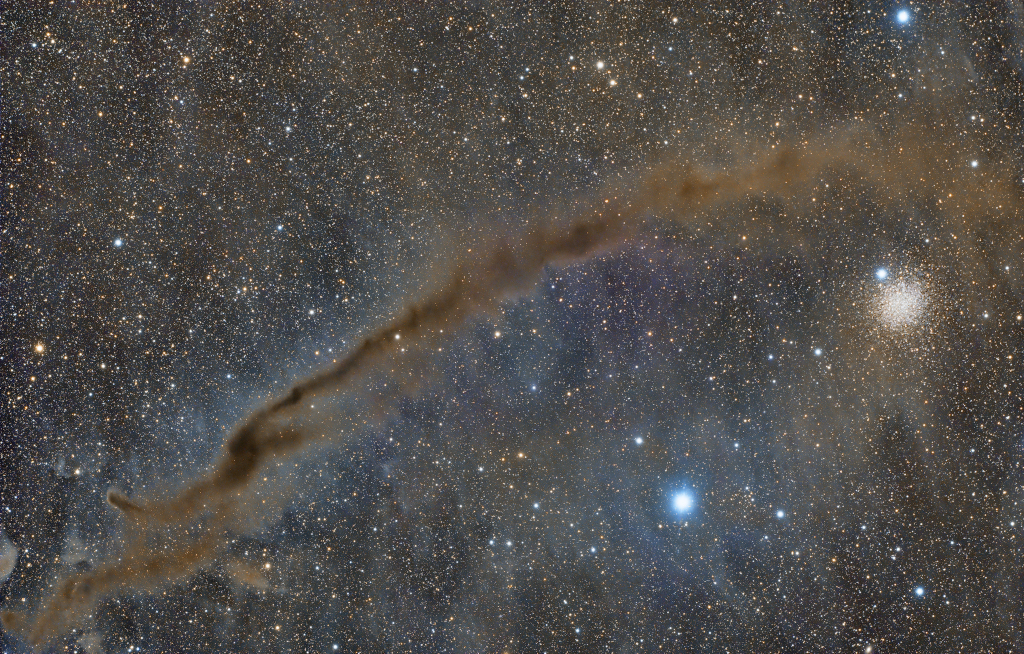
The Dark Doodad Nebula drifts through southern skies, a tantalizing target for binoculars toward the small constellation Musca, The Fly. A dusty interstellar cloud, it's seen against rich starfields just south of the Coalsack Nebula and the Southern Cross. Stretching for about 3 degrees across this telescopic field of view, the Dark Doodad is punctuated near its southern tip (upper right) by yellowish globular star cluster NGC 4372. Of course NGC 4372 roams the halo of our Milky Way galaxy, a background object some 20,000 light-years away and only by chance along our line-of-sight to the Dark Doodad. About 700 light-years distant and over 30 light-years long, the Dark Doodad's well defined silhouette belongs to the potentially star-forming Musca molecular cloud. The dusty Dark Doodad's delightfully alliterative moniker was first coined by astro-imager and writer Dennis di Cicco in 1986 while observing Comet Halley from the Australian outback.
© Alessandro Cipolat Bares — used with the credit NASA publishes

2025
A long time ago in a galaxy 50 million light-years away, a star exploded. Light from that supernova was first detected by telescopes on planet Earth on July 14th though, and the extragalactic transient is now known to astronomers as supernova 2025rbs. Presently the brightest supernova in planet Earth's sky, 2025rbs is a Type Ia supernova, likely caused by the thermonuclear detonation of a white dwarf star that accreted material from a companion in a binary star system. Type Ia supernovae are used as standard candles to establish the distance scale of the universe. The host galaxy of 2025rbs is NGC 7331. Itself a bright spiral galaxy in the northern constellation Pegasus, NGC 7331 is often touted as an analog to our own Milky Way.
NASA · public domain
2024
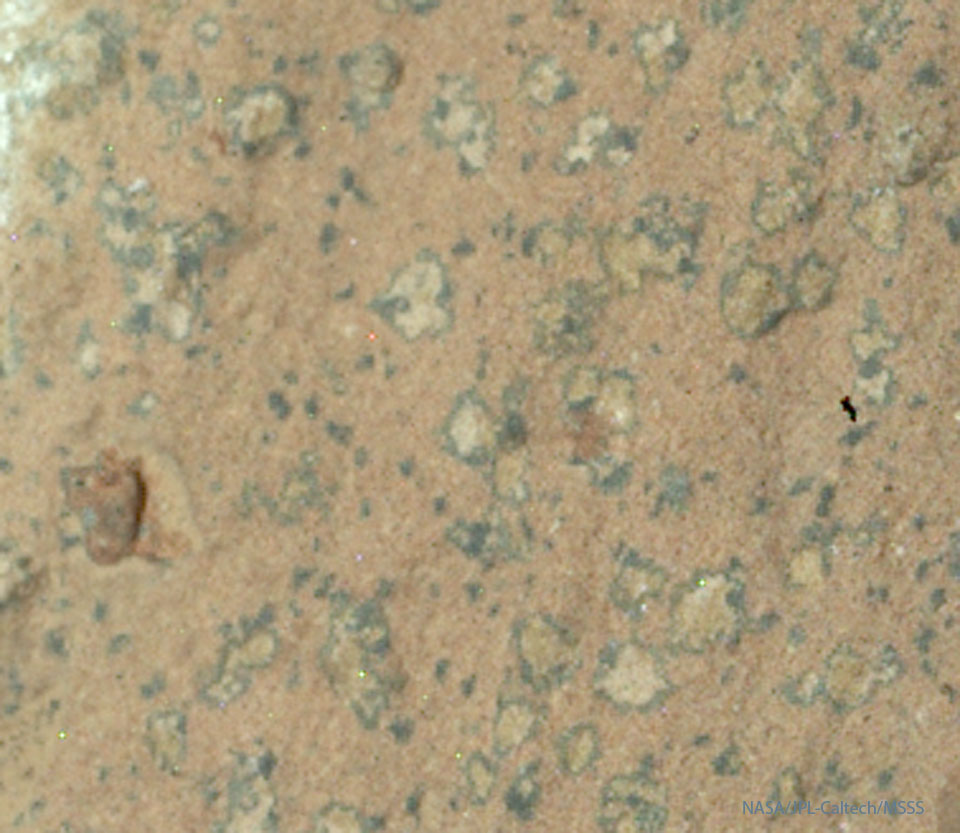
What is creating these unusual spots? Light-colored spots on Martian rocks, each surrounded by a dark border, were discovered earlier this month by NASA's Perseverance Rover currently exploring Mars. Dubbed leopard spots because of their seemingly similarity to markings on famous Earth-bound predators, these curious patterns are being studied with the possibility they were created by ancient Martian life. The pictured spots measure only millimeters across and were discovered on a larger rock named Cheyava Falls. The exciting but unproven speculation is that long ago, microbes generated energy with chemical reactions that turned rock from red to white while leaving a dark ring, like some similarly appearing spots on Earth rocks. Although other non-biological explanations may ultimately prevail, speculation focusing on this potential biological origin is causing much intrigue. New Mirror: APOD is now available from Brazil in Portuguese
NASA · public domain
2023
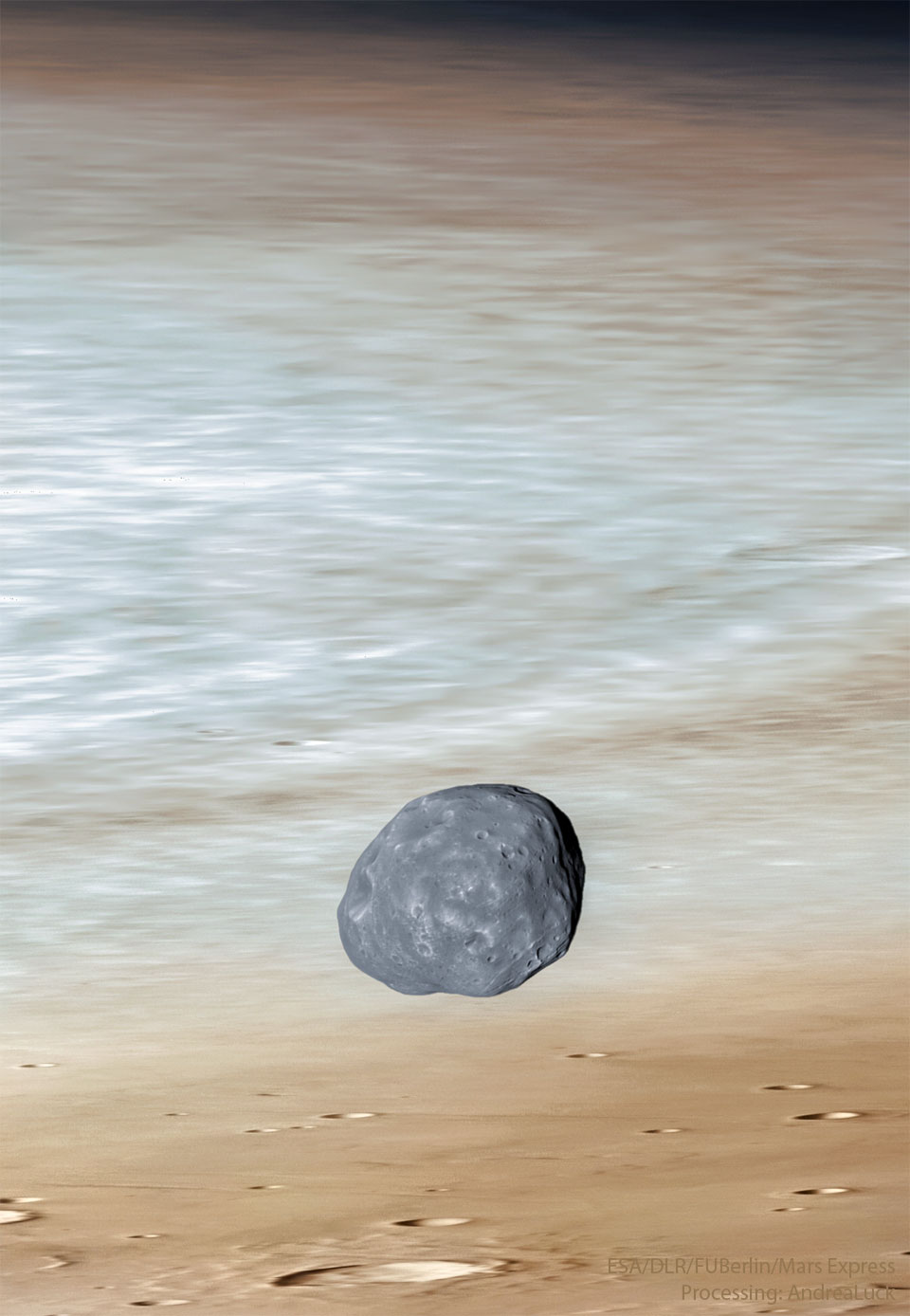
Why is Phobos so dark? Phobos, the largest and innermost of the two Martian moons, is the darkest moon in the entire Solar System. Its unusual orbit and color indicate that it may be a captured asteroid composed of a mixture of ice and dark rock. The featured assigned-color picture of Phobos near the edge of Mars was captured in late 2021 by ESA's robot spacecraft Mars Express, currently orbiting Mars. Phobos is a heavily cratered and barren moon, with its largest crater located on the far side. From images like this, Phobos has been determined to be covered by perhaps a meter of loose dust. Phobos orbits so close to Mars that from some places it would appear to rise and set twice a day, while from other places it would not be visible at all. Phobos' orbit around Mars is continually decaying -- it will likely break up with pieces crashing to the Martian surface in about 50 million years. Your Sky Surprise: What picture did APOD feature on your birthday? (post 1995)
NASA · public domain
2022
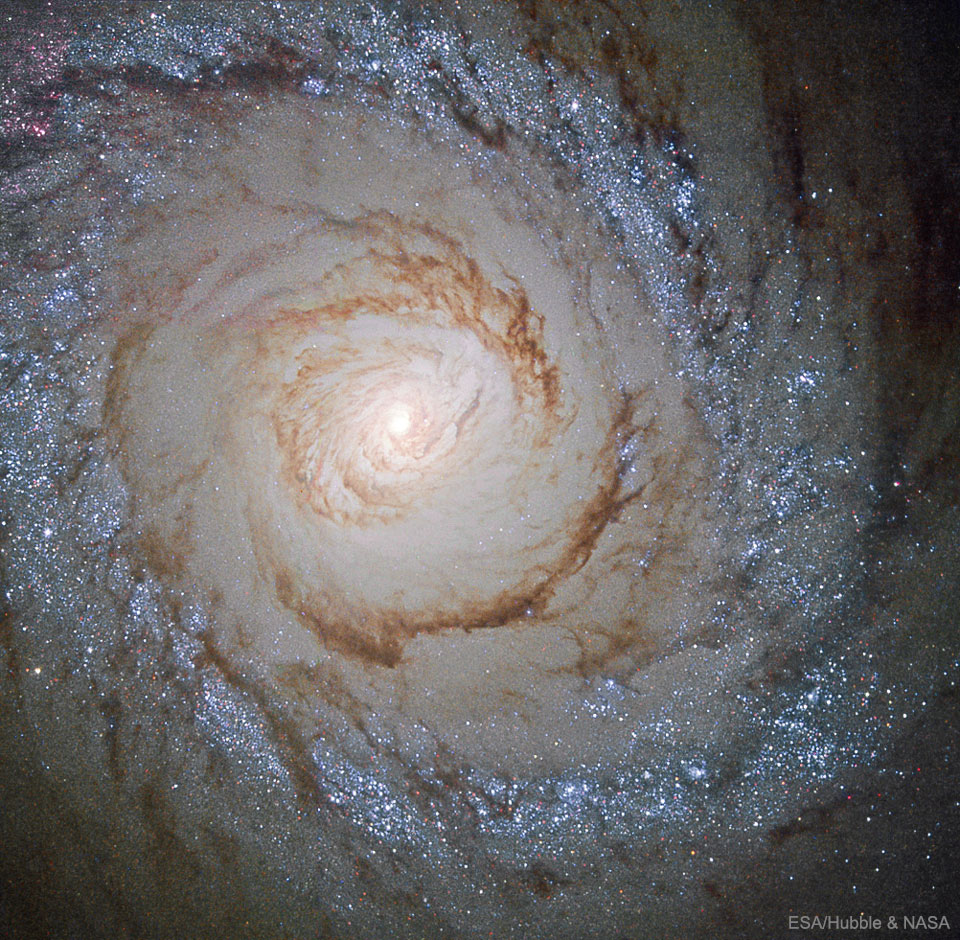
Why does this galaxy have a ring of bright blue stars? Beautiful island universe Messier 94 lies a mere 15 million light-years distant in the northern constellation of the Hunting Dogs (Canes Venatici). A popular target for Earth-based astronomers, the face-on spiral galaxy is about 30,000 light-years across, with spiral arms sweeping through the outskirts of its broad disk. But this Hubble Space Telescope field of view spans about 7,000 light-years across M94's central region. The featured close-up highlights the galaxy's compact, bright nucleus, prominent inner dust lanes, and the remarkable bluish ring of young massive stars. The ring stars are all likely less than 10 million years old, indicating that M94 is a starburst galaxy that is experiencing an epoch of rapid star formation from inspiraling gas. The circular ripple of blue stars is likely a wave propagating outward, having been triggered by the gravity and rotation of a oval matter distributions. Because M94 is relatively nearby, astronomers can better explore details of its starburst ring.
NASA · public domain
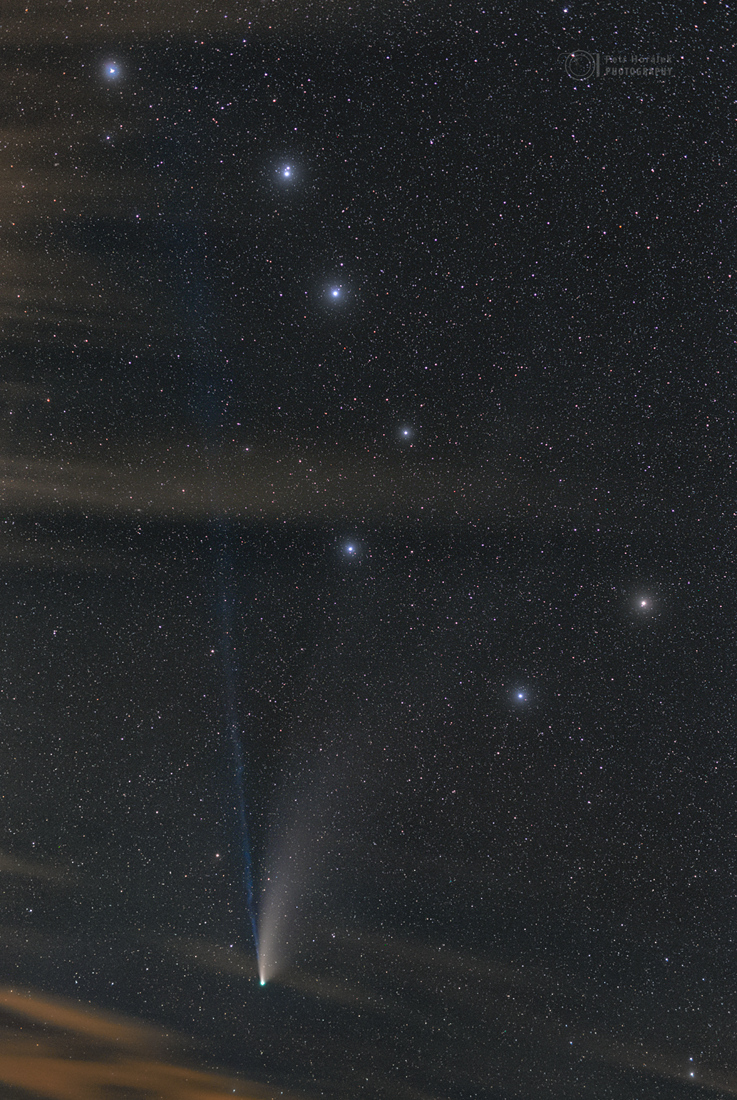
2021
It was just last July. If you could see the stars of the Big Dipper, you could find Comet NEOWISE in your evening sky. After sunset denizens of the north could look for the naked-eye comet below the bowl of that famous celestial kitchen utensil and above the northwestern horizon. The comet looked like a fuzzy 'star' with a tail, though probably not so long a tail as in this memorable skyview recorded from the Czech Republic on July 23th, 2020, near the comet's closest approach to planet Earth. Photographs of C/2020 F3 (NEOWISE) often did show the comet's broad dust tail and fainter but separate bluish ion tail extending farther than the eye could follow. Skygazers around the world were delighted to witness Comet NEOWISE, surprise visitor from the outer Solar System. Notable Comet NEOWISE Images 2020: July 31 30, 29, 28, 27, 26, 25, 24
© Petr Horalek — used with the credit NASA publishes

1964
Ranger program: Ranger 7 sends back the first close-up photographs of the moon, with images 1,000 times clearer than anything ever seen from earth-bound telescopes.
Ranger program ↗
1971
Apollo program: The Apollo 15 astronauts become the first to ride in a lunar rover.
Apollo program ↗
1992
Space Shuttle program: Atlantis is launched on STS-46 to deploy the European Retrievable Carrier and the Tethered Satellite System.
Space Shuttle program ↗
1999
Discovery Program: Lunar Prospector: NASA intentionally crashes the spacecraft into the Moon, thus ending its mission to detect frozen water on the Moon's surface.
Discovery Program ↗Event text and thumbnails come from Wikipedia and are used under CC BY-SA 4.0. Images are drawn only from Wikimedia Commons, which does not accept non-free content — each thumbnail links to its file page, where its licence and author are recorded.
Launch records are from The Space Devs’ Launch Library 2. This archive is still being mirrored, so some days are incomplete. Pictures are NASA’s Astronomy Picture of the Day; NASA imagery is generally not subject to copyright, but individual APOD entries are frequently the property of the photographer, and each caption says which applies.
General-audience astronomy and spaceflight — none of it a textbook.
As an Amazon Associate I earn from qualifying purchases. Links here cost you nothing extra.
LISTING
Still the best single argument for why any of this matters, and it leaves the arithmetic in. For a reader who wants the science, not just the awe.
LISTING
The case for leaving Earth, written by someone unsentimental about how hard that is. Suits readers who want the argument rather than the poster.
LISTING
Hard-SF problem solving in The Martian's key — for anyone who liked the engineering more than the peril. The only novel on this list.
BROWSE opens an Amazon search, not a specific recommendation.
LINKS AMAZON.COM