Launches
NO DATA0MISSIONS
The launch archive is still being mirrored, so this day has no launches listed yet.
ARCHIVE // DAY OF YEAR
Wikipedia records 2 spaceflight and astronomy events on July 27. Below are the pictures NASA published on July 27 in 6 different years — each one taken or released on this exact date.
0MISSIONS
The launch archive is still being mirrored, so this day has no launches listed yet.
2ENTRIES
Spaceflight and astronomy entries from Wikipedia's record of this date, oldest first — from 1949 onward.
6IMAGES
NASA's Astronomy Picture of the Day for July 27, one per year. Some are public domain and some belong to the photographer — each says which.
NASA’s Astronomy Picture of the Day, for this calendar date in each of the last several years.
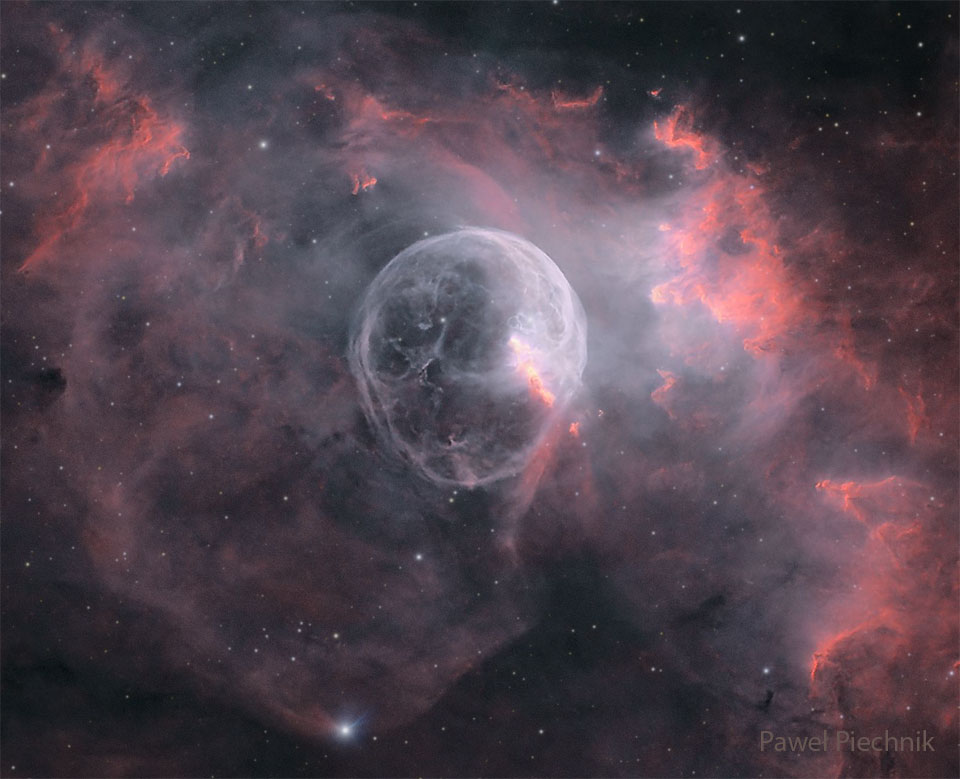
2026
What created this huge space bubble? Blown by the wind from a star, this tantalizing, head-like apparition is cataloged as NGC 7635, but known simply as the Bubble Nebula. Taken from Krakow, Poland, the featured view utilizes a long exposure to reveal the intricate details of this cosmic bubble and its environment. Although it looks delicate, the 10 light-year diameter bubble offers evidence of violent processes at work. Seen here right of the Bubble's center, a bright hot star is embedded in the nebula's reflecting dust. A fierce stellar wind and intense radiation from the star, which likely has a mass 10 to 20 times that of the Sun, has blasted out the structure of glowing gas against denser material in a surrounding molecular cloud. The intriguing Bubble Nebula lies a mere 11,000 light-years away toward the boastful constellation Cassiopeia.
© Paweł Piechnik — used with the credit NASA publishes

2025
Have you ever watched a lightning storm in awe? You're not alone. Details of what causes lightning are still being researched, but it is known that inside some clouds, internal updrafts cause collisions between ice and snow that slowly separate charges between cloud tops and bottoms. The rapid electrical discharges that are lightning soon result. Lightning usually takes a jagged course, rapidly heating a thin column of air to about three times the surface temperature of the Sun. The resulting shock wave starts supersonically and decays into the loud sound known as thunder. On average, around the world, about 6,000 lightning bolts occur between clouds and the Earth every minute. Pictured in July 2019 in a two-image composite, lightning stems from communication antennas near the top of Volcán de Agua (Volcano of Water) in Guatemala. Sky Surprise: What picture did APOD feature on your birthday? (post 1995)
NASA · public domain
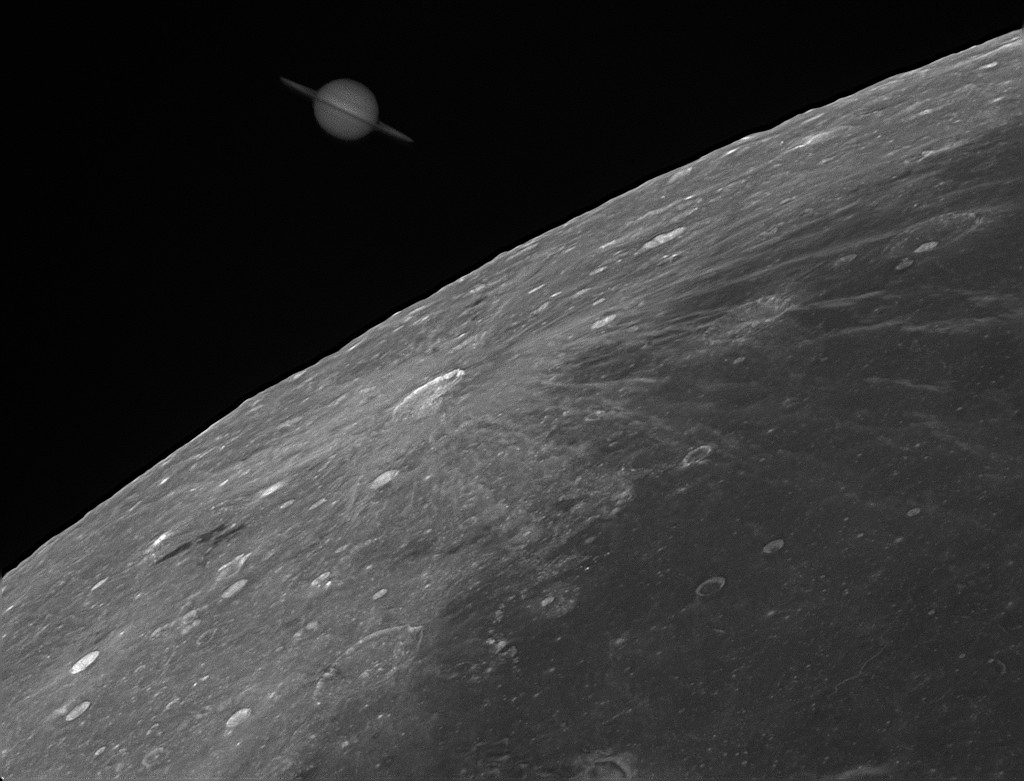
2024
Saturn now rises before midnight in planet Earth's sky. On July 24, the naked-eye planet was in close conjunction, close on the sky, to a waning gibbous Moon. But from some locations on planet Earth the ringed gas giant was occulted, disappearing behind the Moon for about an hour from skies over parts of Asia and Africa. Because the Moon and bright planets wander through the sky near the ecliptic plane, such occultation events are not uncommon, but they can be dramatic. In this telescopic view from Nanjing, Jiangsu, China, Saturn is caught moments before its disappearance behind the lunar disk. The snapshot gives the illusion that Saturn hangs just above Glushko crater, a 43 kilometer diameter, young, ray crater near the Moon's western edge. Of course, the Moon is 400 thousand kilometers away, compared to Saturn's distance of 1.4 billion kilometers.
© Chengcheng Xu — used with the credit NASA publishes
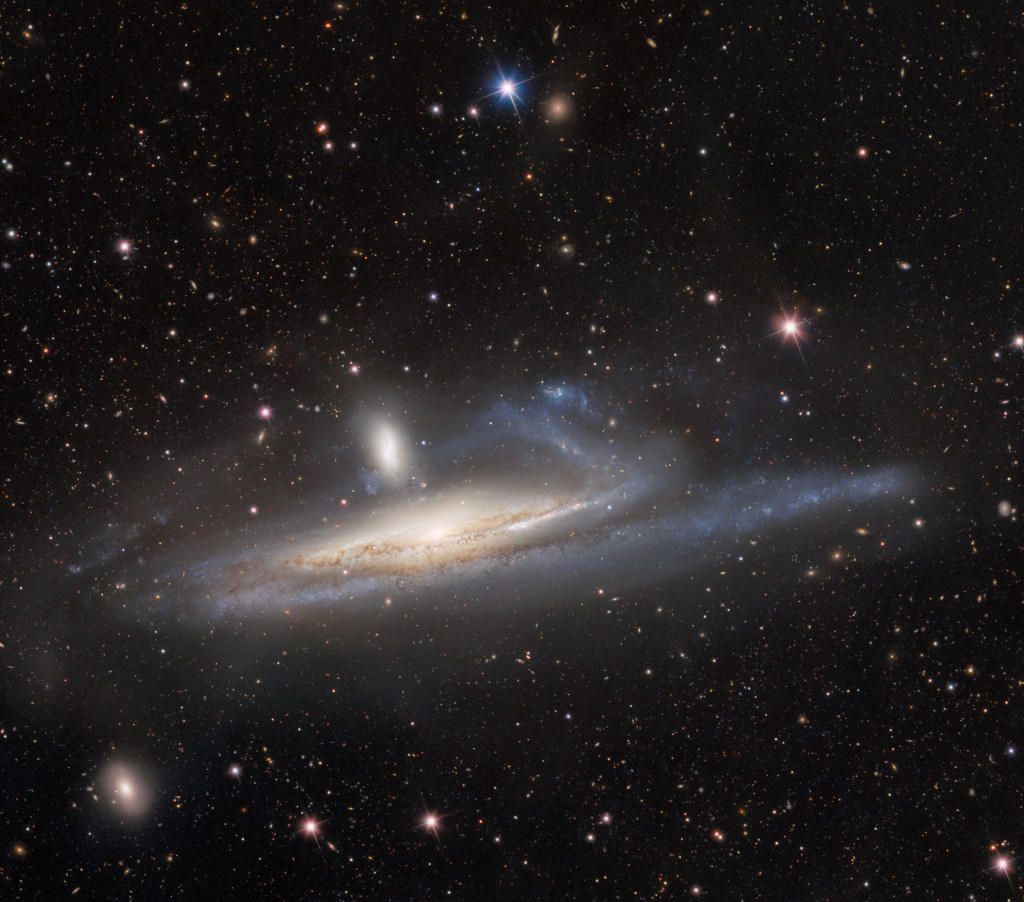
2023
Large galaxies grow by eating small ones. Even our own galaxy engages in a sort of galactic cannibalism, absorbing small galaxies that are too close and are captured by the Milky Way's gravity. In fact, the practice is common in the universe and illustrated by this striking pair of interacting galaxies from the banks of the southern constellation Eridanus, The River. Located over 50 million light years away, the large, distorted spiral NGC 1532 is seen locked in a gravitational struggle with dwarf galaxy NGC 1531, a struggle the smaller galaxy will eventually lose. Seen nearly edge-on, spiral NGC 1532 spans about 100,000 light-years. The merging galaxies are captured in this sharp image from the Dark Energy Camera mounted on the National Science Foundation’s Blanco 4-meter Telescope at Cerro Tololo Inter-American Observatory in Chile. The NGC 1532/1531 pair is thought to be similar to the well-studied system of face-on spiral and small companion known as M51.
NASA · public domain

2022
This moon made quite an entrance. Typically, a moonrise is quiet and serene. Taking a few minutes to fully peek above the horizon, Earth's largest orbital companion can remain relatively obscure until it rises high in the nighttime sky. About a week ago, however, and despite being only half lit by the Sun, this rising moon put on a show -- at least from this location. The reason was that, as seen from Limfjord in Nykøbing Mors, Denmark, the moon rose below scattered clouds near the horizon. The result, captured here in a single exposure, was that moonlight poured through gaps in the clouds to created what are called crepuscular rays. These rays can fan out dramatically across the sky when starting near the horizon, and can even appear to converge on the other side of the sky. Well behind our Moon, stars from our Milky Way galaxy dot the background, and our galaxy's largest orbital companion -- the Andromeda galaxy -- can be found on the upper left. Almost Hyperspace: Random APOD Generator
© Ruslan Merzlyakov (astrorms) — used with the credit NASA publishes
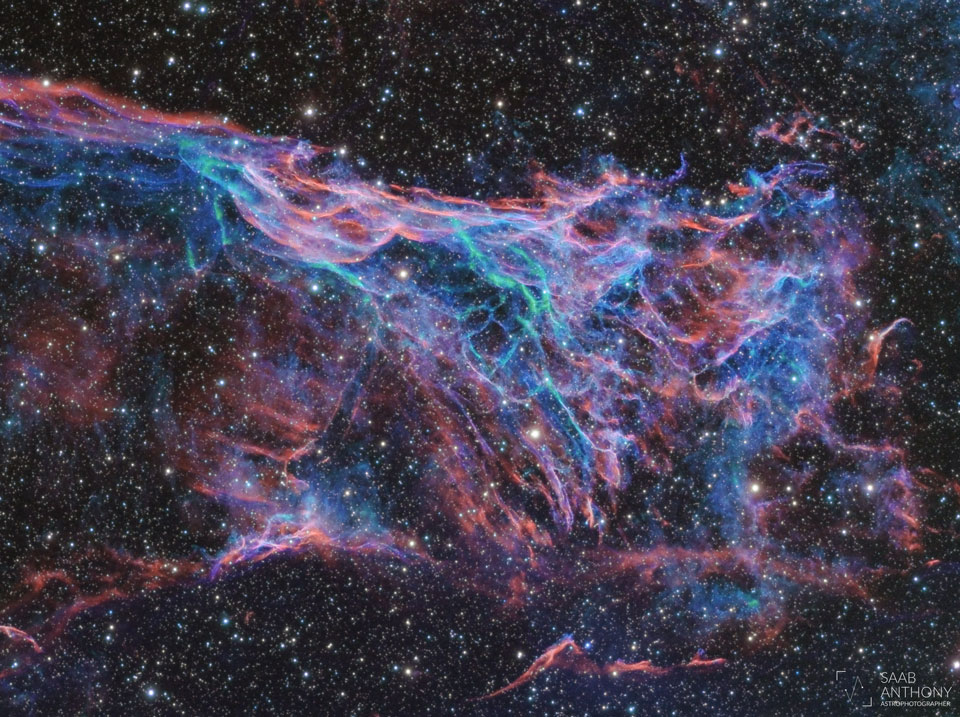
2021
Chaotic in appearance, these tangled filaments of shocked, glowing gas are spread across planet Earth's sky toward the constellation of Cygnus as part of the Veil Nebula. The Veil Nebula itself is a large supernova remnant, an expanding cloud born of the death explosion of a massive star. Light from the original supernova explosion likely reached Earth over 5,000 years ago. The glowing filaments are really more like long ripples in a sheet seen almost edge on, remarkably well separated into the glow of ionized hydrogen atoms shown in blue and oxygen in red hues. Also known as the Cygnus Loop and cataloged as NGC 6979, the Veil Nebula now spans about 6 times the diameter of the full Moon. The length of the wisp corresponds to about 30 light years, given its estimated distance of 2,400 light years. Often identified as Pickering's Triangle for a director of Harvard College Observatory, it is also named for its discoverer, astronomer Williamina Fleming, as Fleming's Triangular Wisp.
© Anthony Saab — used with the credit NASA publishes

1949
The world's first commercial jet airliner to reach production, the de Havilland Comet, had its maiden flight.
Jet airliner ↗
Event text and thumbnails come from Wikipedia and are used under CC BY-SA 4.0. Images are drawn only from Wikimedia Commons, which does not accept non-free content — each thumbnail links to its file page, where its licence and author are recorded.
Launch records are from The Space Devs’ Launch Library 2. This archive is still being mirrored, so some days are incomplete. Pictures are NASA’s Astronomy Picture of the Day; NASA imagery is generally not subject to copyright, but individual APOD entries are frequently the property of the photographer, and each caption says which applies.
General-audience astronomy and spaceflight — none of it a textbook.
As an Amazon Associate I earn from qualifying purchases. Links here cost you nothing extra.
LISTING
Still the best single argument for why any of this matters, and it leaves the arithmetic in. For a reader who wants the science, not just the awe.
LISTING
The case for leaving Earth, written by someone unsentimental about how hard that is. Suits readers who want the argument rather than the poster.
LISTING
Hard-SF problem solving in The Martian's key — for anyone who liked the engineering more than the peril. The only novel on this list.
BROWSE opens an Amazon search, not a specific recommendation.
LINKS AMAZON.COM