Launches
NO DATA0MISSIONS
The launch archive is still being mirrored, so this day has no launches listed yet.
ARCHIVE // DAY OF YEAR
Wikipedia records 4 spaceflight and astronomy events on July 19. Below are the pictures NASA published on July 19 in 6 different years — each one taken or released on this exact date.
0MISSIONS
The launch archive is still being mirrored, so this day has no launches listed yet.
4ENTRIES
Spaceflight and astronomy entries from Wikipedia's record of this date, oldest first — from 1940 onward.
6IMAGES
NASA's Astronomy Picture of the Day for July 19, one per year. Some are public domain and some belong to the photographer — each says which.
NASA’s Astronomy Picture of the Day, for this calendar date in each of the last several years.
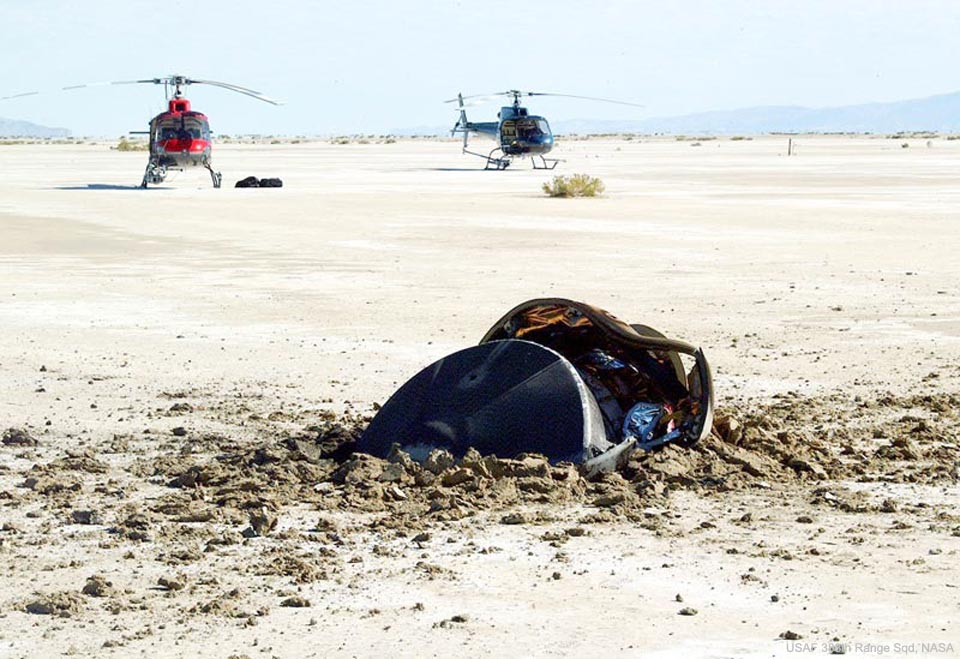
2026
A flying saucer from outer space crash-landed in the Utah desert after being tracked by radar and chased by helicopters. The year was 2004, and no space aliens were involved. The saucer, pictured here, was the Genesis sample return capsule, part of a human-made robot Genesis spaceship launched in 2001 by NASA itself to study the Sun. The unexpectedly hard landing at over 300 kilometers per hour occurred because the parachutes did not open as planned. The Genesis mission had been orbiting the Sun collecting solar wind particles that are usually deflected away by Earth's magnetic field. Despite the crash landing, many return samples remained in good enough condition to analyze. Genesis-related discoveries included new details about the composition of the Sun and how the abundance of some types of elements differ across the Solar System. These results have provided intriguing clues into details of how the Sun and planets formed billions of years ago. Almost Hyperspace: Random APOD Generator
NASA · public domain

2025
The sixth object in Charles Messier's famous catalog of things which are not comets, Messier 6 is a galactic or open star cluster. A gathering of 100 stars or so, all around 100 million years young, M6 lies some 1,600 light-years away toward the central Milky Way in the constellation Scorpius. Also cataloged as NGC 6405, the pretty star cluster's outline suggests its popular moniker, the Butterfly Cluster. Surrounded by diffuse reddish emission from the region's hydrogen gas the cluster's mostly hot and therefore blue stars are near the center of this colorful cosmic snapshot. But the brightest cluster member is a cool K-type giant star. Designated BM Scorpii it shines with a yellow-orange hue, seen near the end of one of the butterfly's antennae. This telescopic field of view spans nearly 2 Full Moons on the sky. That's 25 light-years at the estimated distance of Messier 6.
© Xinran Li — used with the credit NASA publishes
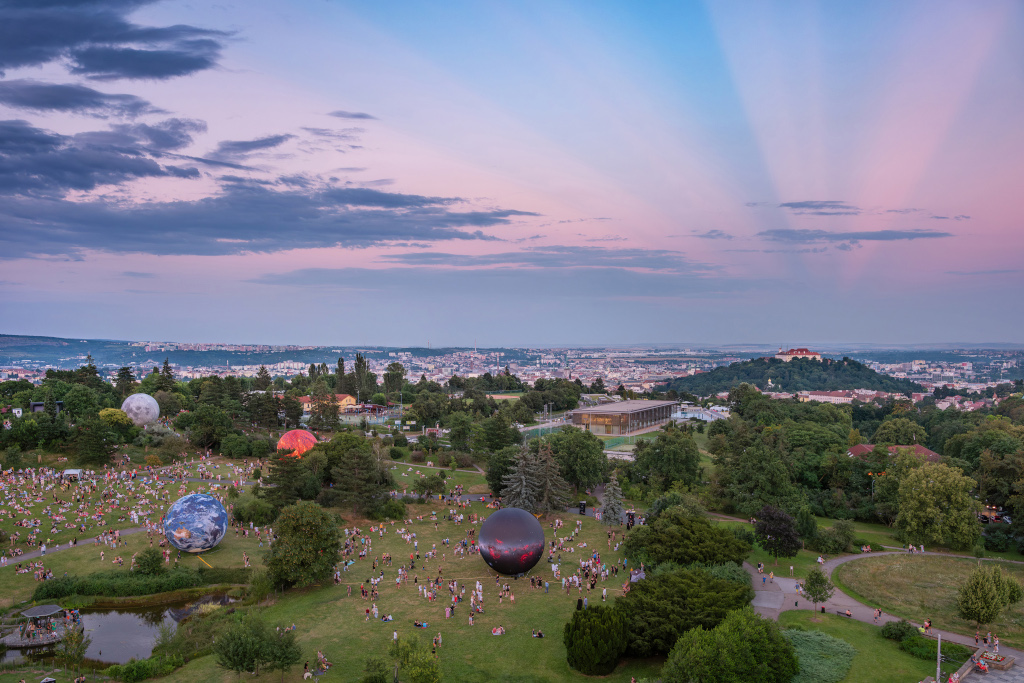
2024
For some, these subtle bands of light and shadow stretched across the sky as the Sun set on July 11. Known as anticrepuscular rays, the bands are formed as a large cloud bank near the western horizon cast long shadows through the atmosphere at sunset. Due to the camera's perspective, the bands of light and shadow seem to converge toward the eastern (opposite) horizon at a point seen just above a 14th century hilltop castle in Brno, Czech Republic. In the foreground, denizens of planet Earth are enjoying the region's annual Planet Festival in the park below the Brno Observatory and Planetarium. And while crepuscular and anticrepuscular rays are a relatively common atmospheric phenomenon, this festival's 10 meter diameter inflatable spheres representing bodies of the Solar System are less often seen on planet Earth.
© Pavel Gabzdyl — used with the credit NASA publishes
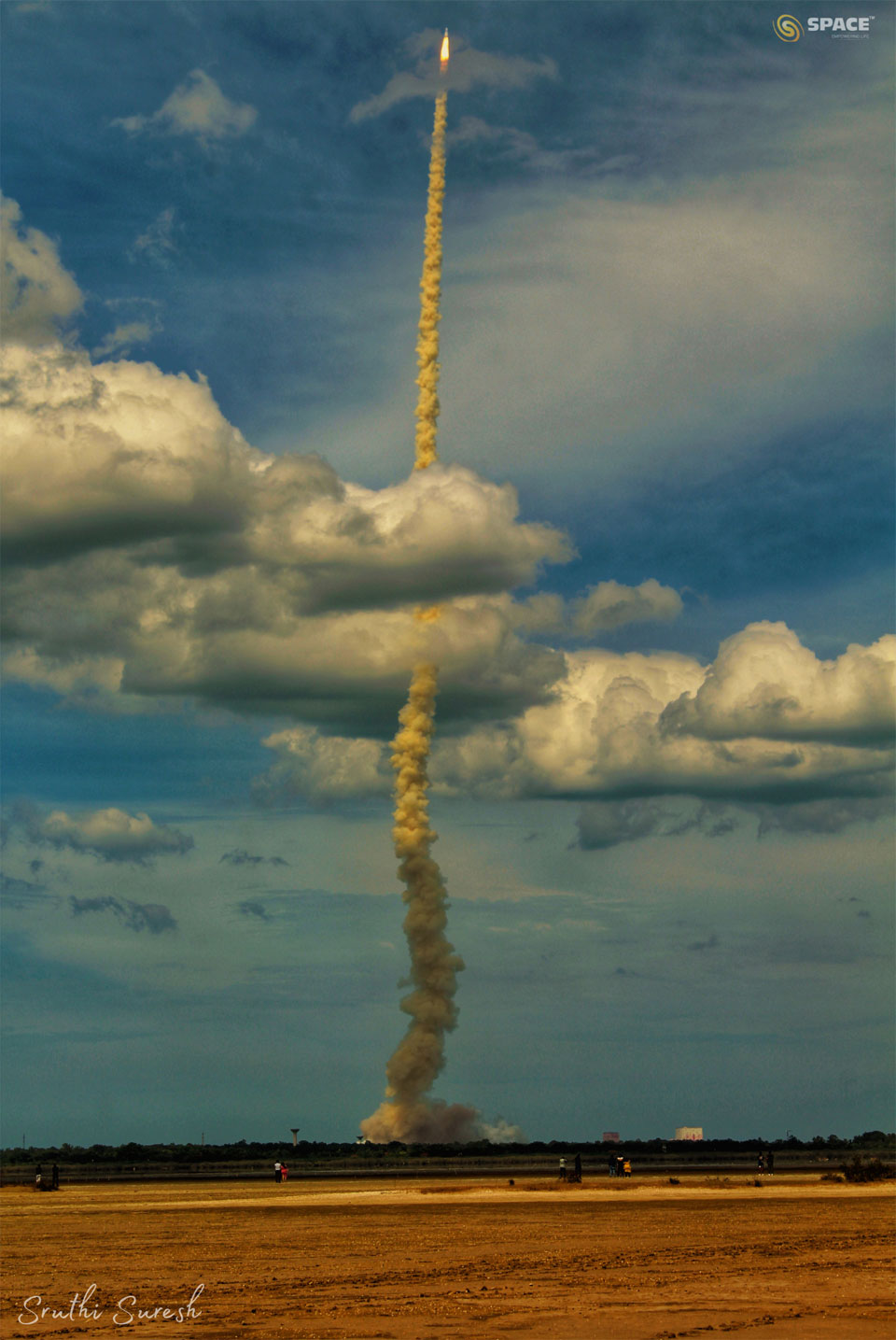
2023
Birds don't fly this high. Airplanes don't go this fast. The Statue of Liberty weighs less. No species other than human can even comprehend what is going on, nor could any human just a millennium ago. The launch of a rocket bound for space is an event that inspires awe and challenges description. Pictured here last week, the Indian Space Research Organization's LVM3 rocket blasted off from the Satish Dhawan Space Centre on Sriharikota Island, India. From a standing start, the 600,000+ kilogram rocket ship lifted the massive Chandrayaan-3 off the Earth. The Chandrayaan-3 mission is scheduled to reach the Moon in late August and land a robotic rover near the lunar South Pole. Rockets bound for space are now launched from somewhere on Earth every few days.
© Sruthi Suresh (Space Group) — used with the credit NASA publishes
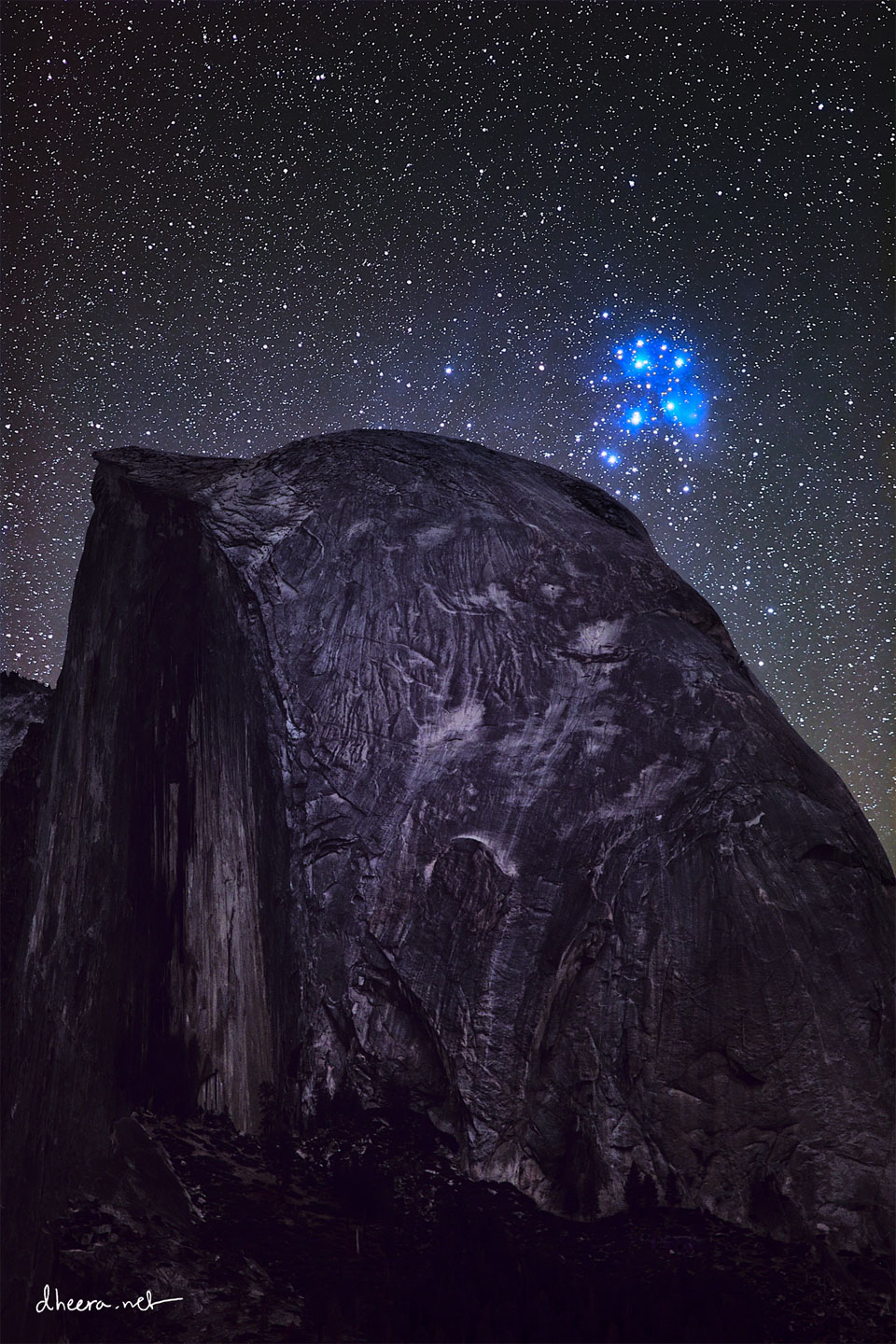
2022
Stars come in bunches. The most famous bunch of stars on the sky is the Pleiades, a bright cluster that can be easily seen with the unaided eye. The Pleiades lies only about 450 light years away, formed about 100 million years ago, and will likely last about another 250 million years. Our Sun was likely born in a star cluster, but now, being about 4.5 billion years old, its stellar birth companions have long since dispersed. The Pleiades star cluster is pictured over Half Dome, a famous rock structure in Yosemite National Park in California, USA. The featured image is a composite of 28 foreground exposures and 174 images of the stellar background, all taken from the same location and by the same camera on the same night in October 2019. After calculating the timing of a future juxtaposition of the Pleiades and Half Dome, the astrophotrographer was unexpectedly rewarded by an electrical blackout, making the background sky unusually dark.
© Dheera Venkatraman — used with the credit NASA publishes
2021
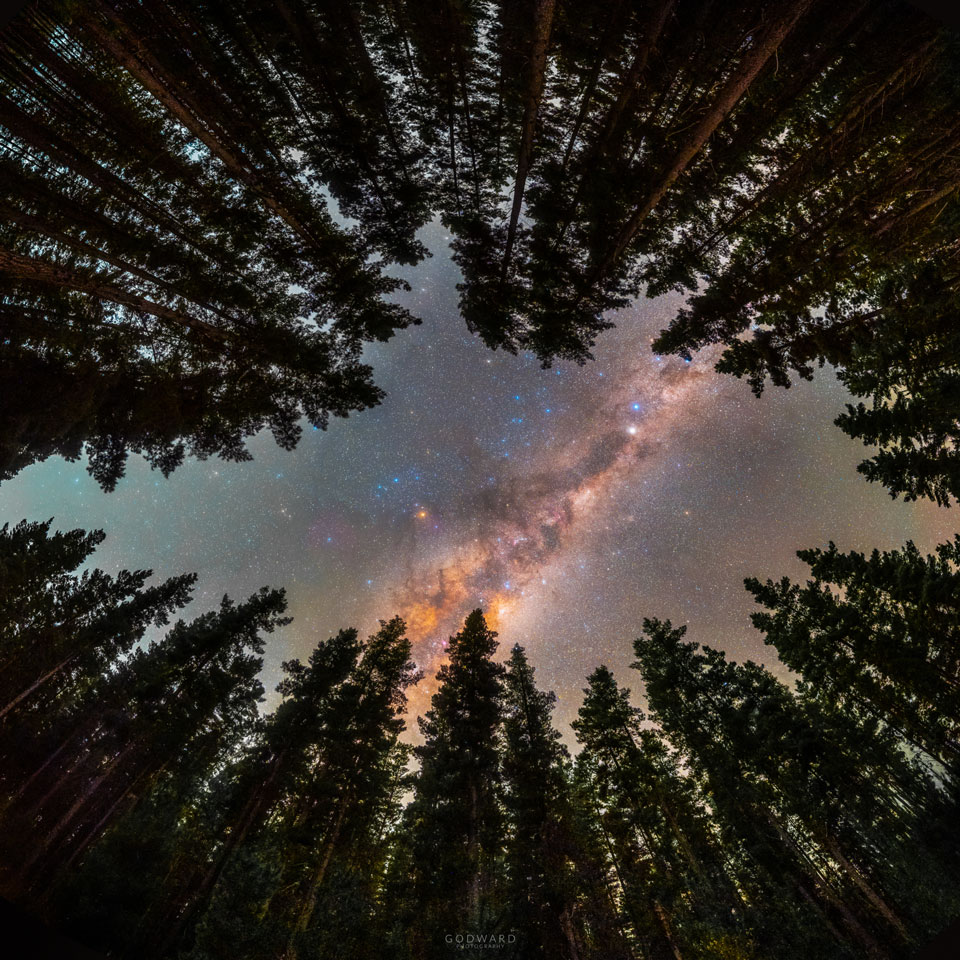
The photographer had this shot in mind for some time. He knew that objects overhead are the brightest -- since their light is scattered the least by atmospheric air. He also that knew the core of our Milky Way Galaxy was just about straight up near midnight around this time of year in South Australia. Chasing his mental picture, he ventured deep inside the Kuipto Forest where tall radiata pines blocked out much of the sky -- but not in this clearing. There, through a window framed by trees, he captured his envisioned combination of local and distant nature. Sixteen exposures of both trees and the Milky Way Galaxy were recorded. Antares is the bright orange star to left of our Galaxy's central plane, while Alpha Centauri is the bright star just to the right of the image center. The direction toward our Galaxy's center is below Antares. Although in a few hours the Earth's rotation moved the Galactic plane up and to the left -- soon invisible behind the timber, his mental image was secured forever -- and is featured here. Follow APOD on Instagram in: English, Farsi, Indonesian, Persian, Portuguese or Taiwanese
© Will Godward — used with the credit NASA publishes

1940
Field Marshal Ceremony: First occasion in World War II that Adolf Hitler appoints field marshals due to military achievements.
1940 Field Marshal Ceremony ↗
1963
Joe Walker flies a North American X-15 to a record altitude of 106,010 meters (347,800 feet) on X-15 Flight 90. Exceeding an altitude of 100 km, this flight qualifies as a human spaceflight under international convention.
Joseph A. Walker ↗
1977
The world's first Global Positioning System (GPS) signal is transmitted from Navigation Technology Satellite 2 (NTS-2) and received at Rockwell Collins in Cedar Rapids, Iowa, at 12:41 a.m. Eastern time (ET).
Global Positioning System ↗
2013
The NASA spacecraft Cassini took a photograph of Saturn with Earth in the distance (detail pictured), for which people were invited to "wave at Saturn".
NASA ↗Event text and thumbnails come from Wikipedia and are used under CC BY-SA 4.0. Images are drawn only from Wikimedia Commons, which does not accept non-free content — each thumbnail links to its file page, where its licence and author are recorded.
Launch records are from The Space Devs’ Launch Library 2. This archive is still being mirrored, so some days are incomplete. Pictures are NASA’s Astronomy Picture of the Day; NASA imagery is generally not subject to copyright, but individual APOD entries are frequently the property of the photographer, and each caption says which applies.
General-audience astronomy and spaceflight — none of it a textbook.
As an Amazon Associate I earn from qualifying purchases. Links here cost you nothing extra.
LISTING
Still the best single argument for why any of this matters, and it leaves the arithmetic in. For a reader who wants the science, not just the awe.
LISTING
The case for leaving Earth, written by someone unsentimental about how hard that is. Suits readers who want the argument rather than the poster.
LISTING
Hard-SF problem solving in The Martian's key — for anyone who liked the engineering more than the peril. The only novel on this list.
BROWSE opens an Amazon search, not a specific recommendation.
LINKS AMAZON.COM