Launches
ON RECORD16MISSIONS
16 of them reached orbit. The earliest was 1962, the most recent 2022.
ARCHIVE // DAY OF YEAR
16 orbital launches flew on July 17, the earliest of them in 1962, and 16 reached orbit. Wikipedia records 3 spaceflight and astronomy events on July 17. Below are the pictures NASA published on July 17 in 6 different years — each one taken or released on this exact date.
16MISSIONS
16 of them reached orbit. The earliest was 1962, the most recent 2022.
3ENTRIES
Spaceflight and astronomy entries from Wikipedia's record of this date, oldest first — from 1791 onward.
6IMAGES
NASA's Astronomy Picture of the Day for July 17, one per year. Some are public domain and some belong to the photographer — each says which.
NASA’s Astronomy Picture of the Day, for this calendar date in each of the last several years.
2026
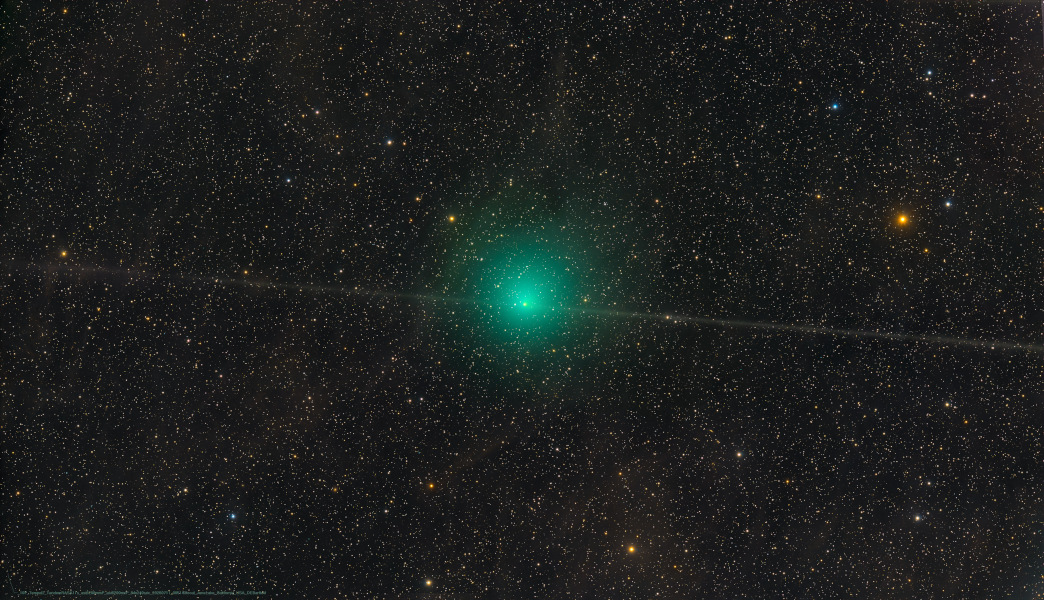
Comet 10P/Tempel 2 orbits the Sun once every 5.4 years. Currently visible in binoculars or small telescopes toward the constellation Capricornus, the periodic comet is captured in this sharp telescopic image from July 11 sporting a bright nuclear region and pretty greenish coma. Remarkably, a thin dust trail, not a typical dust tail, is also seen extending both east and west of the Tempel 2 nucleus. Unlike a comet dust tail, which tends to temporarily fan out in a direction away from the Sun, this dust trail is due to the residual dust shed during many past orbits along this ancient periodic comet's orbital plane. In fact, Tempel 2's dust trail may get a little narrower and brighter from our perspective as Earth crosses through the comet's orbital plane on July 20. Comet 10P/Tempel 2 will reach a perihelion on August 2, and make its closest approach to Earth on August 3.
© Dan Bartlett — used with the credit NASA publishes

2025
Discovered on July 1 with the NASA-funded ATLAS (Asteroid Terrestrial-impact Last Alert System) survey telescope in Rio Hurtado, Chile, 3I/ATLAS is so designated as the third known interstellar object to pass through our Solar System. It follows 1I/ʻOumuamua in 2017 and the comet 2I/Borisov in 2019. Also known as C/2025 N1, 3I/ATLAS is clearly a comet, its diffuse cometary coma, a cloud of gas and dust surrounding an icy nucleus, is easily seen in these images from the large Gemini North telescope on Maunakea, Hawai‘i. The left panel tracks the comet as it moves across the sky against fixed background stars in successive exposures. Three different filters were used, shown in red, green, and blue. In the right panel the multiple exposures are registered and combined to form a single image of the comet. The comet's interstellar origin is also clear from its orbit, determined to be an eccentric, highly hyperbolic orbit that does not loop back around the Sun and will return 3I/ATLAS to interstellar space. Not a threat to planet Earth, the inbound interstellar interloper is now within the Jupiter's orbital distance of the Sun, while its closest approach to the Sun will bring it just within the orbital distance of Mars.
NASA · public domain
2024
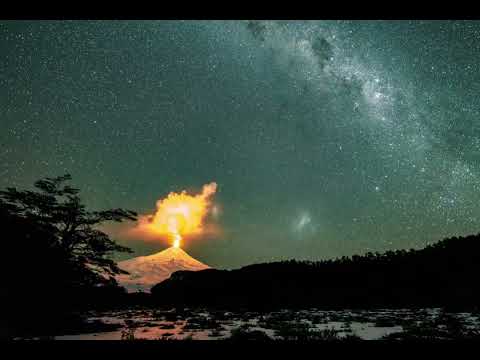
When Vulcan, the Roman god of fire, swings his blacksmith's hammer, the sky is lit on fire. A recent eruption of Chile's Villarrica volcano shows the delicate interplay between this fire -- actually glowing steam and ash from melted rock -- and the light from distant stars in our Milky Way galaxy and the Magellanic Clouds galaxies. In the featured timelapse video, the Earth rotates under the stars as Villarrica erupts. With about 1350 volcanoes, our planet Earth rivals Jupiter's moon Io as the most geologically active place in the Solar System. While both have magnificent beauty, the reasons for the existence of volcanoes on both worlds are different. Earth's volcanoes typically occur between slowly shifting outer shell plates, while Io's volcanoes are caused by gravitational flexing resulting from Jupiter's tidal gravitational pull.
© Gabriel Muñoz; Text: Natalia Lewandowska (SUNY Oswego) — used with the credit NASA publishes
2023
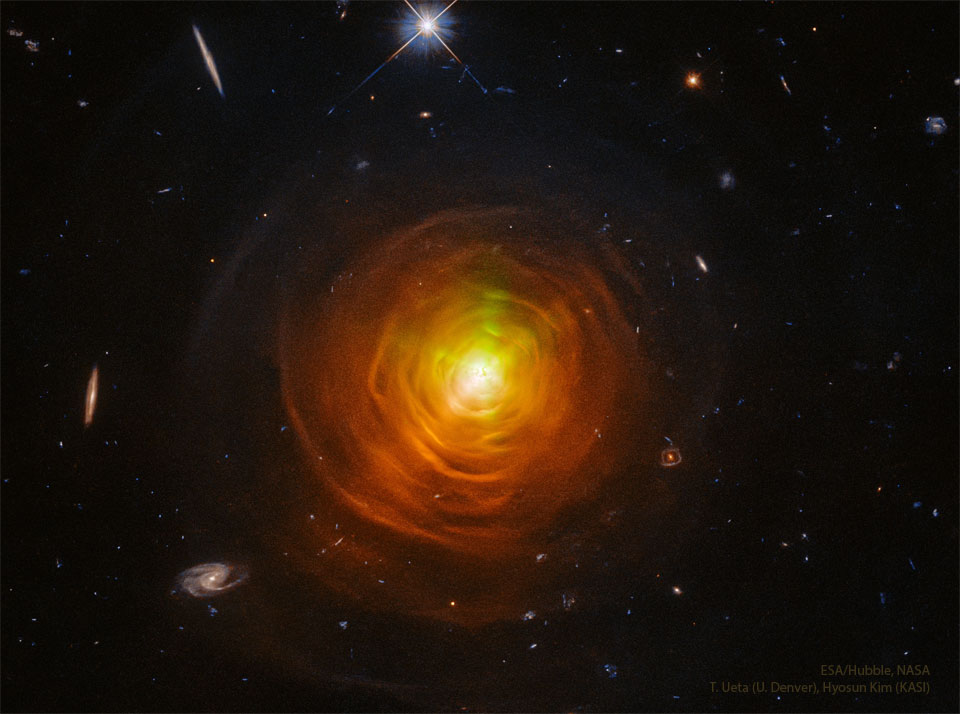
What's happening around this star? No one is sure. CW Leonis is the closest carbon star, a star that appears orange because of atmospheric carbon dispersed from interior nuclear fusion. But CW Leonis also appears engulfed in a gaseous carbon-rich nebula. What causes the nebula's complexity is unknown, but its geometry of shells and arcs are surely intriguing. The featured image by the Hubble Space Telescope details this complexity. The low surface gravity of carbon stars enhances their ability to expel carbon and carbon compounds into space. Some of this carbon ends up forming dark dust that is commonly seen in the nebulas of young star-forming regions and the disks of galaxies. Humans and all Earth-based life are carbon-based, and at least some of our carbon was likely once circulating in the atmospheres of near-death stars like carbon stars.
NASA · public domain
2022
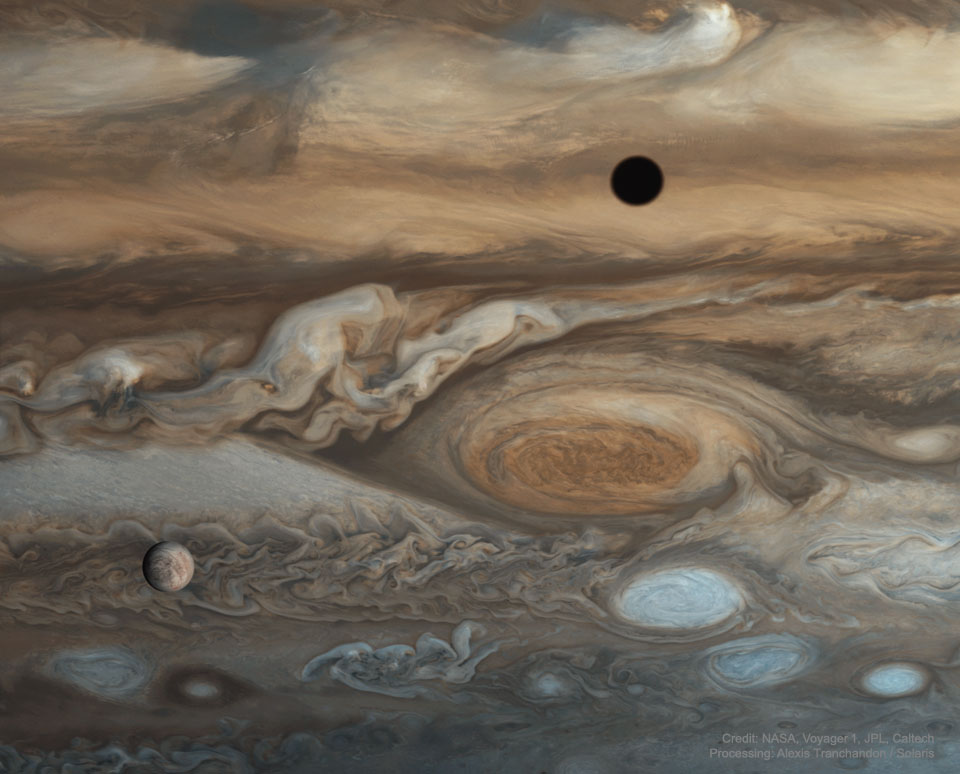
What are those spots on Jupiter? Largest and furthest, just right of center, is the Great Red Spot -- a huge storm system that has been raging on Jupiter possibly since Giovanni Cassini's likely notation of it 357 years ago. It is not yet known why this Great Spot is red. The spot toward the lower left is one of Jupiter's largest moons: Europa. Images from Voyager in 1979 bolster the modern hypothesis that Europa has an underground ocean and is therefore a good place to look for extraterrestrial life. But what about the dark spot on the upper right? That is a shadow of another of Jupiter's large moons: Io. Voyager 1 discovered Io to be so volcanic that no impact craters could be found. Sixteen frames from Voyager 1's flyby of Jupiter in 1979 were recently reprocessed and merged to create the featured image. Forty-five years ago this September, Voyager 1 launched from Earth and started one of the greatest explorations of the Solar System ever. Free Download: Voyager Posters
NASA · public domain
2021
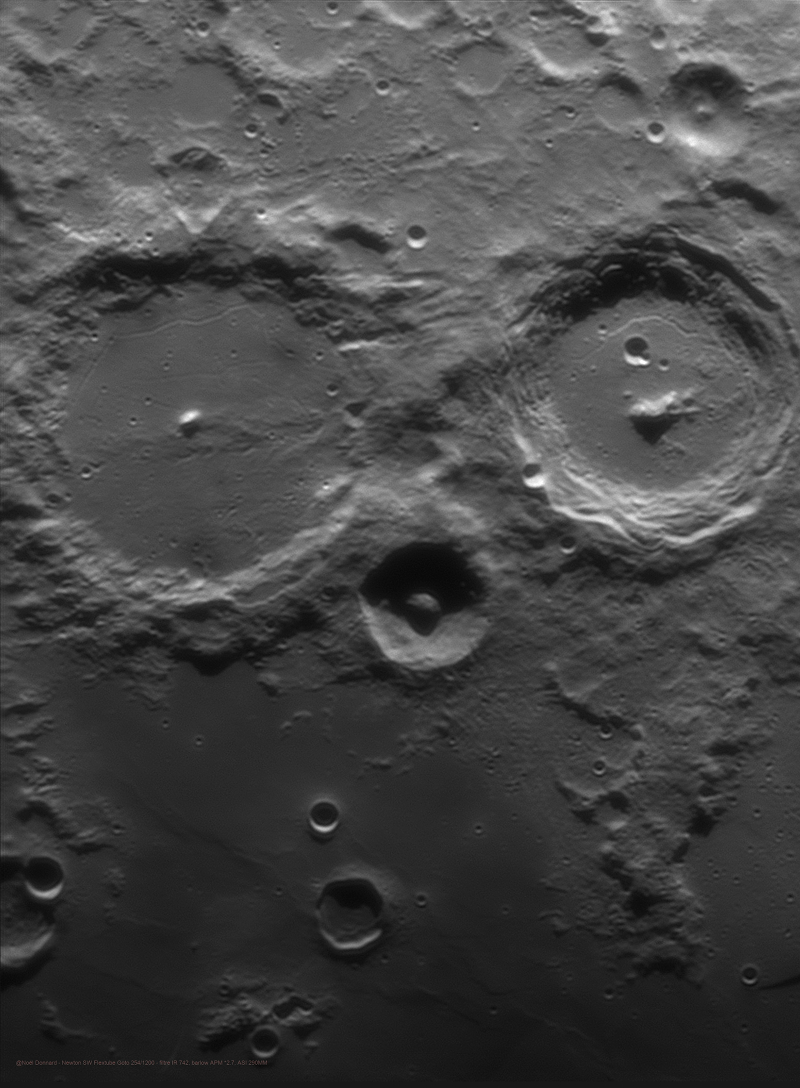
Point your telescope at tonight's first quarter Moon. Along the terminator, the shadow line between night and day, you might find these two large craters staring back at you with an owlish gaze. Alphonsus (left) and Arzachel are ancient impact craters on the north eastern shores of Mare Nubium, the lunar Sea of Clouds. The larger Alphonsus is over 100 kilometers in diameter. A low sun angle highlights the crater's sharp 1.5 kilometer high central peak in bright sunlight and dark shadow. Scouting for potential Apollo moon landing sites, the Ranger 9 spacecraft returned closeup pictures of Alphonsus before crashing in the crater just northeast (toward the upper left) of its central mountain in 1965. Alpetragius, between Alphonsus and Arzachel, is the small crater with the deeply shadowed floor and overly large central beak.
© Noel Donnard — used with the credit NASA publishes

1791
Members of the French National Guard under the command of General Lafayette open fire on a crowd of radical Jacobins at the Champ de Mars, Paris, during the French Revolution, killing scores of people.
National Guard (France) ↗
1850
William Cranch Bond and John Adams Whipple took a daguerreotype of Vega, the first astrophotograph of a star other than the Sun.
William Cranch Bond ↗
1975
Apollo–Soyuz Test Project: An American Apollo and a Soviet Soyuz spacecraft dock with each other in orbit marking the first such link-up between spacecraft from the two nations.
Apollo–Soyuz ↗Event text and thumbnails come from Wikipedia and are used under CC BY-SA 4.0. Images are drawn only from Wikimedia Commons, which does not accept non-free content — each thumbnail links to its file page, where its licence and author are recorded.
Launch records are from The Space Devs’ Launch Library 2. Pictures are NASA’s Astronomy Picture of the Day; NASA imagery is generally not subject to copyright, but individual APOD entries are frequently the property of the photographer, and each caption says which applies.
General-audience astronomy and spaceflight — none of it a textbook.
As an Amazon Associate I earn from qualifying purchases. Links here cost you nothing extra.
LISTING
Still the best single argument for why any of this matters, and it leaves the arithmetic in. For a reader who wants the science, not just the awe.
LISTING
The case for leaving Earth, written by someone unsentimental about how hard that is. Suits readers who want the argument rather than the poster.
LISTING
Hard-SF problem solving in The Martian's key — for anyone who liked the engineering more than the peril. The only novel on this list.
BROWSE opens an Amazon search, not a specific recommendation.
LINKS AMAZON.COM