Launches
NO DATA0MISSIONS
The launch archive is still being mirrored, so this day has no launches listed yet.
ARCHIVE // DAY OF YEAR
Wikipedia records 10 spaceflight and astronomy events on July 11. Below are the pictures NASA published on July 11 in 6 different years — each one taken or released on this exact date.
0MISSIONS
The launch archive is still being mirrored, so this day has no launches listed yet.
10ENTRIES
Spaceflight and astronomy entries from Wikipedia's record of this date, oldest first — from 1708 onward.
6IMAGES
NASA's Astronomy Picture of the Day for July 11, one per year. Some are public domain and some belong to the photographer — each says which.
NASA’s Astronomy Picture of the Day, for this calendar date in each of the last several years.
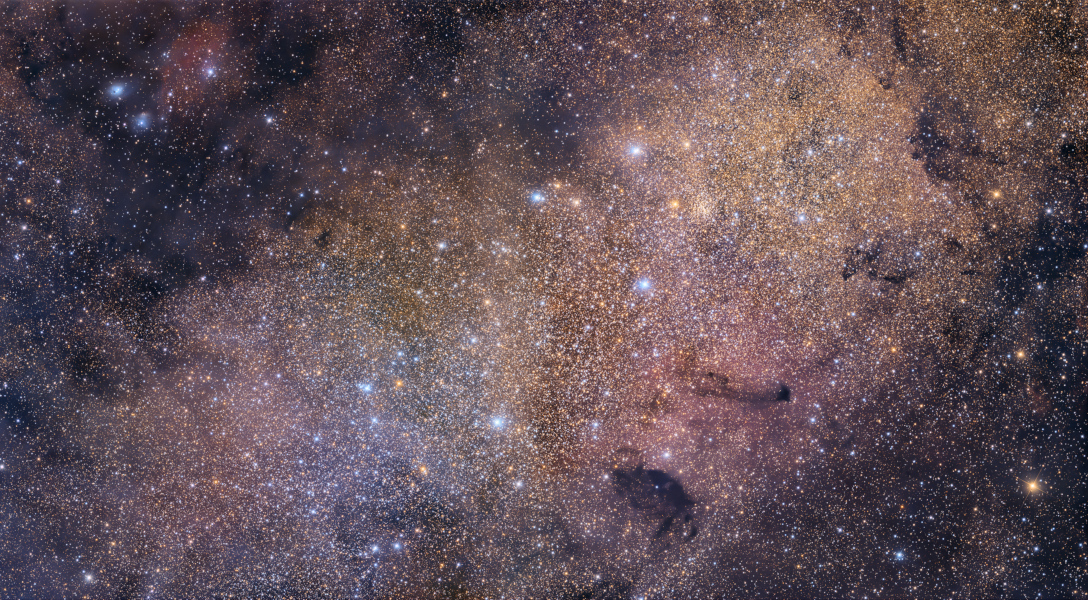
2026
Unlike most entries in Charles Messier's famous catalog of deep sky objects, M24 is not a bright galaxy, star cluster, or nebula. It's a gap in nearby, obscuring interstellar dust clouds that allows a view of the distant stars in the Sagittarius spiral arm of our Milky Way galaxy. Direct your gaze through this gap with binoculars or a small telescope and you are looking through a window over 300 light-years wide at stars some 10,000 light-years or more from Earth. Sometimes called the Small Sagittarius Star Cloud, M24's luminous stars stretch across this gorgeous interstellar scene. Spanning over four full moons on the sky toward the constellation Sagittarius, the telescopic field of view includes dark markings B92 and B93 near the center of M24, along with other clouds of dust and glowing nebulae toward the center of the Milky Way.
© Chuck Ayoub — used with the credit NASA publishes
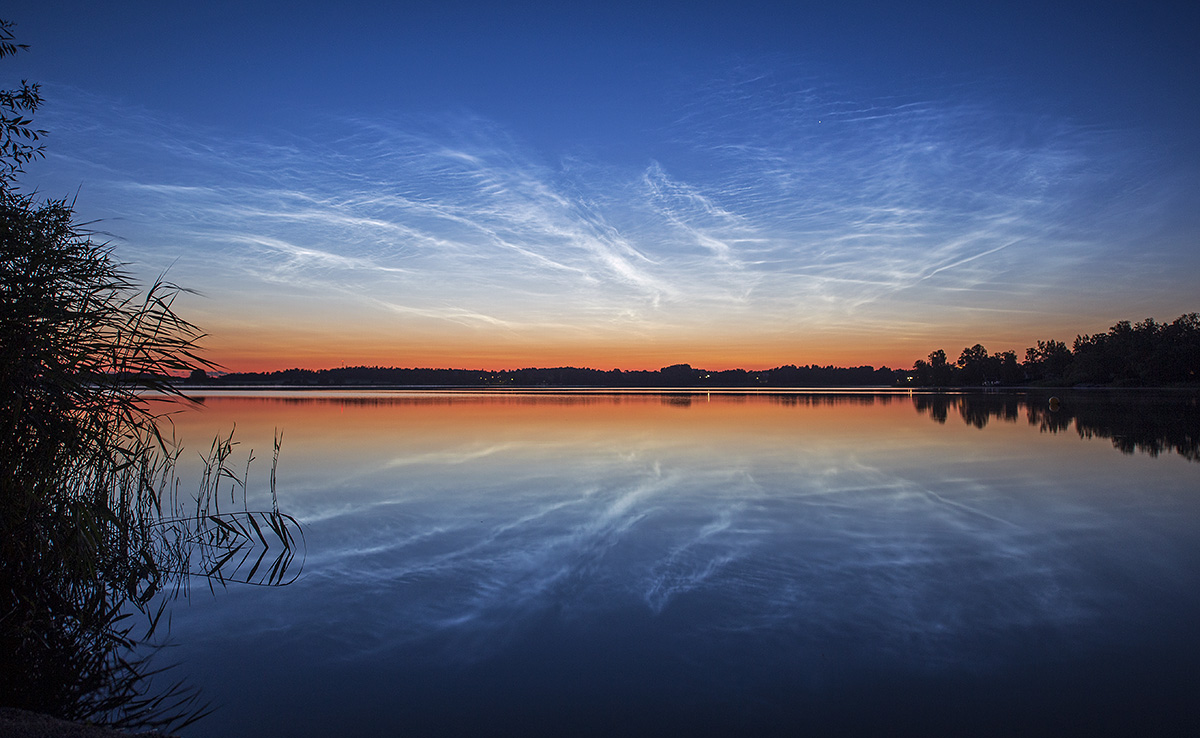
2025
Transfusing sunlight as the sky grew darker, this exceptional display of noctilucent clouds was captured on July 10, reflected in the calm waters of Vallentuna Lake near Stockholm, Sweden. From the edge of space, about 80 kilometers above Earth's surface, the icy clouds themselves still reflect sunlight, even though the Sun is below the horizon as seen from the ground. Usually spotted at high latitudes in summer months, the night shining clouds have made a strong showing so far during the short northern summer nights. Also known as polar mesopheric clouds they are understood to form as water vapor driven into the cold upper atmosphere condenses on the fine dust particles supplied by disintegrating meteors or volcanic ash.
© Clear Skies — used with the credit NASA publishes
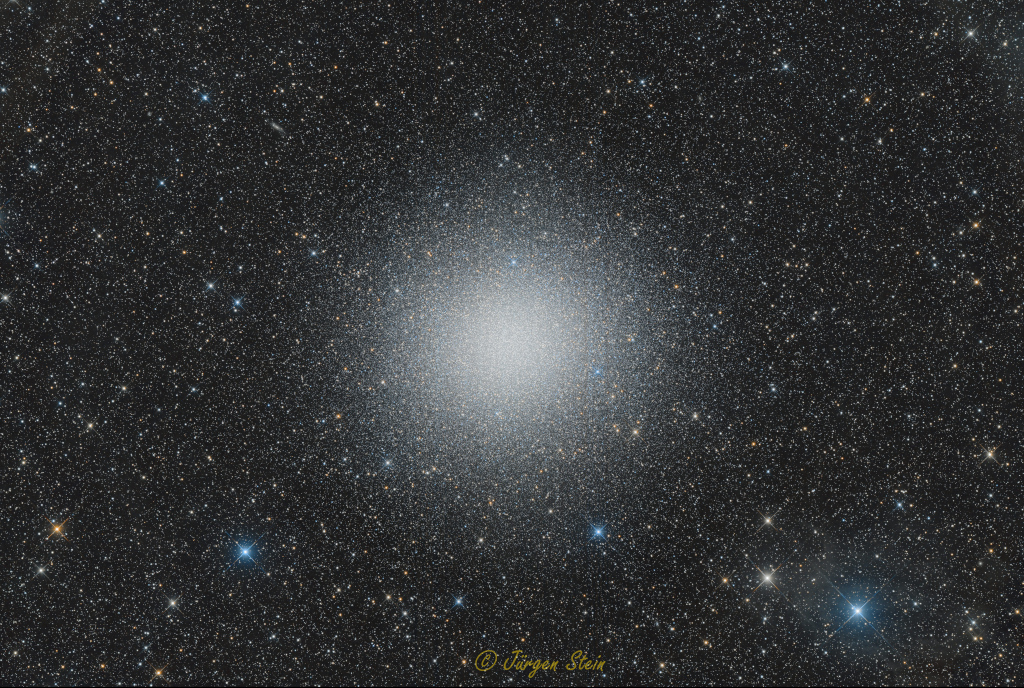
2024
Globular star cluster Omega Centauri packs about 10 million stars much older than the Sun into a volume some 150 light-years in diameter. Also known as NGC 5139, at a distance of 15,000 light-years it's the largest and brightest of 200 or so known globular clusters that roam the halo of our Milky Way galaxy. Though most star clusters consist of stars with the same age and composition, the enigmatic Omega Cen exhibits the presence of different stellar populations with a spread of ages and chemical abundances. In fact, Omega Cen may be the remnant core of a small galaxy merging with the Milky Way. With a yellowish hue, Omega Centauri's red giant stars are easy to pick out in this sharp telescopic view. A two-decade-long exploration of the dense star cluster with the Hubble Space Telescope has revealed evidence for a massive black hole near the center of Omega Centauri.
© Juergen Stein — used with the credit NASA publishes
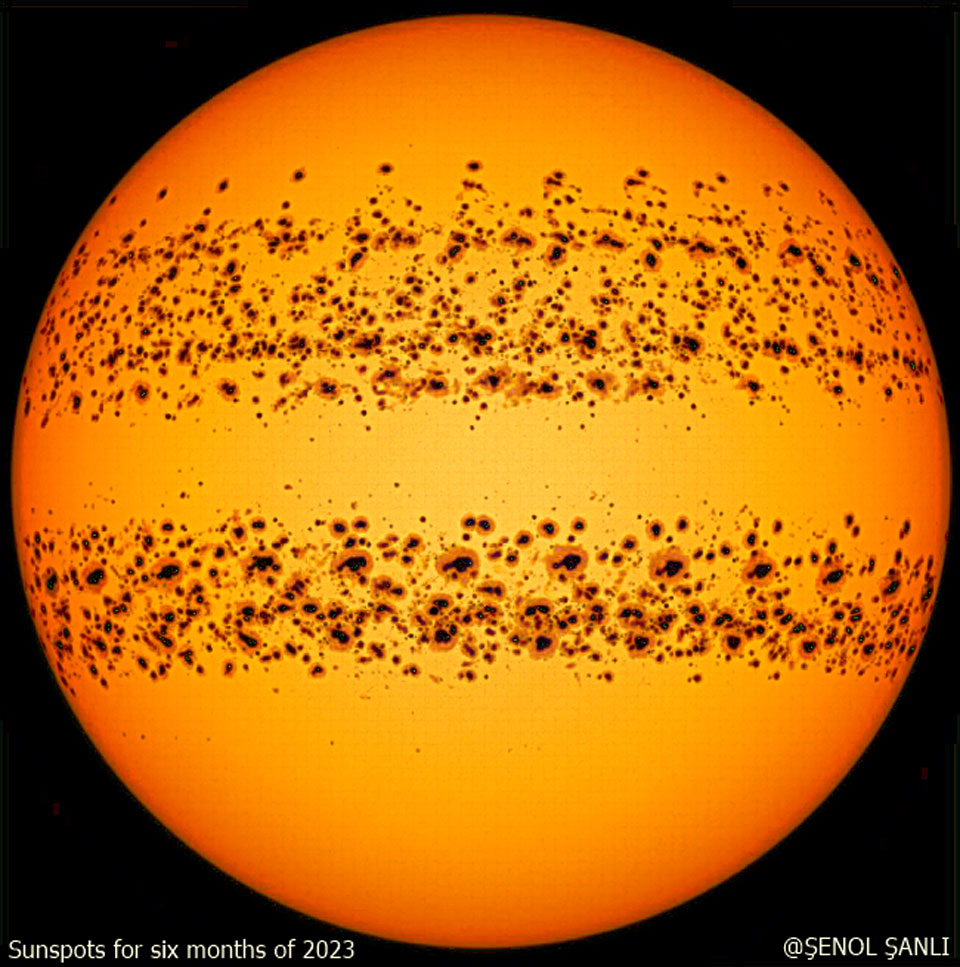
2023
Why is our Sun so active now? No one is sure. An increase in surface activity was expected because our Sun is approaching solar maximum in 2025. However, last month our Sun sprouted more sunspots than in any month during the entire previous 11-year solar cycle -- and even dating back to 2002. The featured picture is a composite of images taken every day from January to June by NASA's Solar Dynamic Observatory. Showing a high abundance of sunspots, large individual spots can be tracked across the Sun's disk, left to right, over about two weeks. As a solar cycle continues, sunspots typically appear closer to the equator. Sunspots are just one way that our Sun displays surface activity -- another is flares and coronal mass ejections (CMEs) that expel particles out into the Solar System. Since these particles can affect astronauts and electronics, tracking surface disturbances is of more than aesthetic value. Conversely, solar activity can have very high aesthetic value -- in the Earth's atmosphere when they trigger aurora.
NASA · public domain
2022
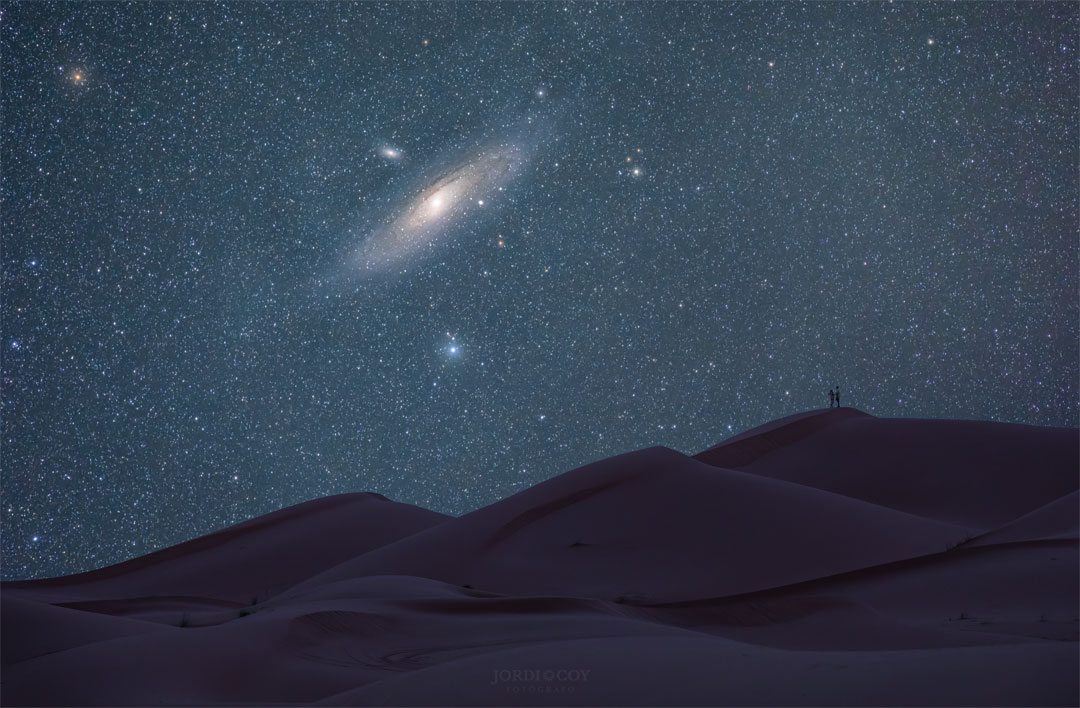
What is the oldest thing you can see? At 2.5 million light years distant, the answer for the unaided eye is the Andromeda galaxy, because its photons are 2.5 million years old when they reach you. Most other apparent denizens of the night sky -- stars, clusters, and nebulae -- appear as they were only a few hundred to a few thousand years ago, as they lie well within our own Milky Way Galaxy. Given its distance, light from Andromeda is likely also the farthest object that you can see. Also known as M31, the Andromeda Galaxy dominates the center of the featured zoomed image, taken from the Sahara Desert in Morocco last month. The featured image is a combination of three background and one foreground exposure -- all taken with the same camera and from the same location and on the same calendar day -- with the foreground image taken during the evening blue hour. M110, a satellite galaxy of Andromenda is visible just above and to the left of M31's core. As cool as it may be to see this neighboring galaxy to our Milky Way with your own eyes, long duration camera exposures can pick up many faint and breathtaking details. Recent data indicates that our Milky Way Galaxy will collide and combine with the similarly-sized Andromeda galaxy in a few billion years.
© Jordi Coy — used with the credit NASA publishes
2021
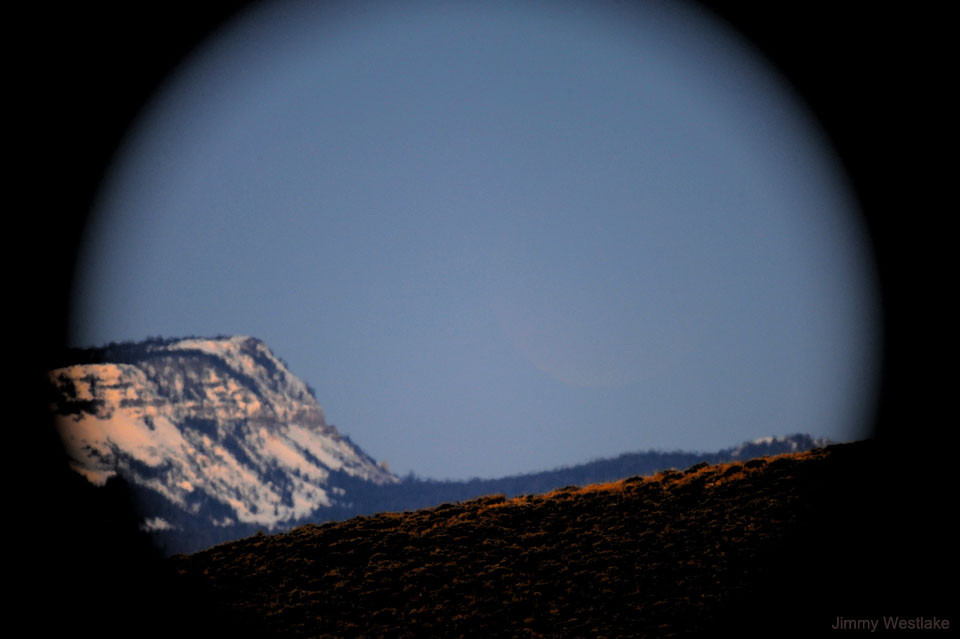
Where's the Moon? Somewhere in this image, the Earth's Moon is hiding. The entire Moon is visible, in its completely full phase, in plain sight. Even the photographer's keen eye couldn't find it even though he knew exactly where to look -- only the long exposure of his camera picked it up -- barely. Although by now you might be congratulating yourself on finding it, why was it so difficult to see? For one reason, this photograph was taken during a total lunar eclipse, when the Earth's shadow made the Moon much dimmer than a normal full Moon. For another, the image, taken in Colorado, USA, was captured just before sunrise. With the Moon on the exact opposite side of the sky from the Sun, this meant that the Sun was just below the horizon, but still slightly illuminating the sky. Last, as the Moon was only about two degrees above the horizon, the large volume of air between the camera and the horizon scattered a lot of light away from the background Moon. Twelve minutes after this image was acquired in 2012, the Sun peeked over the horizon and the Moon set.
© Jimmy Westlake (Colorado Mountain College) — used with the credit NASA publishes

1708
A coalition army of Dutch, English and German troops under the duke of Marlborough defeats a French army under the duke of Burgundy and the Marshal Vendome in the battle of Oudenarde.
John Churchill, 1st Duke of Marlborough ↗
1735
Mathematical calculations suggest that it is on this day that dwarf planet Pluto moved inside the orbit of Neptune for the last time before 1979.
Dwarf planet ↗
1801
French astronomer Jean-Louis Pons co-discovered the first of his 37 comets, more than any other person in history.
Jean-Louis Pons ↗1801
French astronomer Jean-Louis Pons makes his first comet discovery. In the next 27 years he discovers another 36 comets, more than any other person in history.
Jean-Louis Pons ↗
1836
The Fly-fisher's Entomology is published by Alfred Ronalds. The book transformed the sport and went to many editions.
The Fly-fisher's Entomology ↗
1934
Engelbert Zaschka of Germany flies his large human-powered aircraft, the Zaschka Human-Power Aircraft, about 20 meters at Berlin Tempelhof Airport without assisted take-off.
Engelbert Zaschka ↗

1962
Project Apollo: At a press conference, NASA announces lunar orbit rendezvous as the means to land astronauts on the Moon, and return them to Earth.
Apollo program ↗
1979
America's first space station, Skylab, is destroyed as it re-enters the Earth's atmosphere over the Indian Ocean.
Skylab ↗2021
Virgin Galactic launches its founder, Richard Branson, into space, the first company ever to do so.
Virgin Galactic ↗Event text and thumbnails come from Wikipedia and are used under CC BY-SA 4.0. Images are drawn only from Wikimedia Commons, which does not accept non-free content — each thumbnail links to its file page, where its licence and author are recorded.
Launch records are from The Space Devs’ Launch Library 2. This archive is still being mirrored, so some days are incomplete. Pictures are NASA’s Astronomy Picture of the Day; NASA imagery is generally not subject to copyright, but individual APOD entries are frequently the property of the photographer, and each caption says which applies.
General-audience astronomy and spaceflight — none of it a textbook.
As an Amazon Associate I earn from qualifying purchases. Links here cost you nothing extra.
LISTING
Still the best single argument for why any of this matters, and it leaves the arithmetic in. For a reader who wants the science, not just the awe.
LISTING
The case for leaving Earth, written by someone unsentimental about how hard that is. Suits readers who want the argument rather than the poster.
LISTING
Hard-SF problem solving in The Martian's key — for anyone who liked the engineering more than the peril. The only novel on this list.
BROWSE opens an Amazon search, not a specific recommendation.
LINKS AMAZON.COM