Launches
NO DATA0MISSIONS
The launch archive is still being mirrored, so this day has no launches listed yet.
ARCHIVE // DAY OF YEAR
Wikipedia records 2 spaceflight and astronomy events on July 9. Below are the pictures NASA published on July 9 in 6 different years — each one taken or released on this exact date.
0MISSIONS
The launch archive is still being mirrored, so this day has no launches listed yet.
2ENTRIES
Spaceflight and astronomy entries from Wikipedia's record of this date, oldest first — from 1962 onward.
6IMAGES
NASA's Astronomy Picture of the Day for July 9, one per year. Some are public domain and some belong to the photographer — each says which.
NASA’s Astronomy Picture of the Day, for this calendar date in each of the last several years.
2026
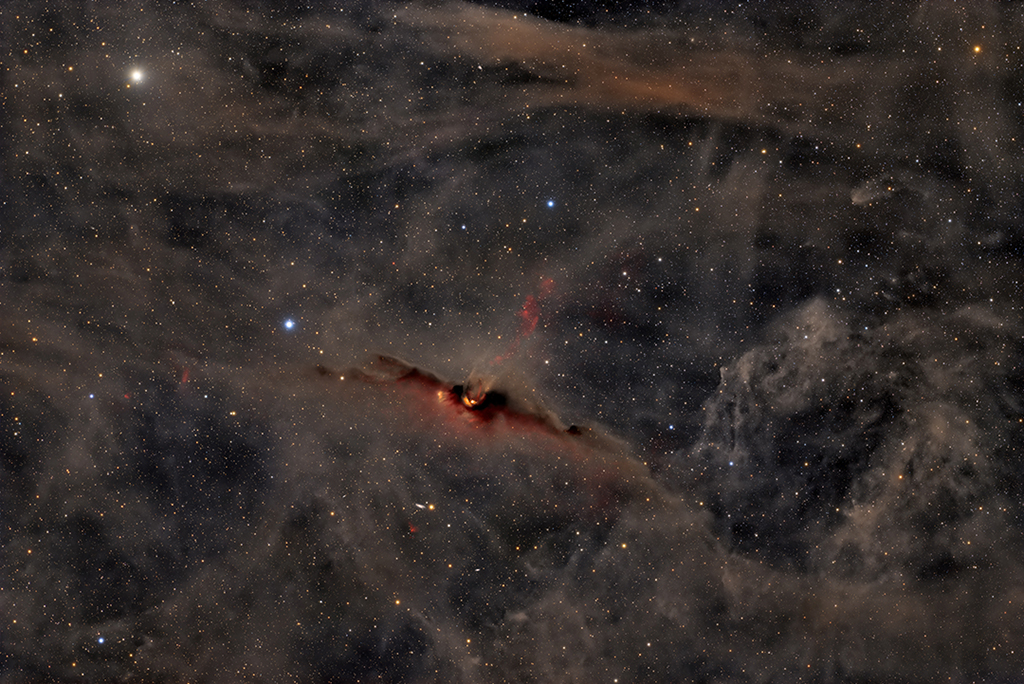
This Cosmic Bat wishes you a happy Summerween! This mid-year celebration of Halloween transcends hemispheres, even though summer in the Northern hemisphere is winter in the South. Contrary to its eery aura, the Cosmic Bat Nebula (LDN 43), not to be confused with the Bat Nebula (NGC 6995), is a vibrant birthplace for stars. A bit of young starlight peeks through the dense clouds of gas and dust that make up the Cosmic Bat’s 12 lightyear wingspan. The ultraviolet light from the young stars energizes the nebula’s hydrogen gas, causing it to glow an ominous red. The jet of glowing hydrogen gas emerging from the bat’s head hints at the star formation hidden within.
© Humbert Cédric Text: Keighley Rockcliffe (NASA GSFC, UMBC CSST, CRESST II) — used with the credit NASA publishes

2025
The beautiful Trifid Nebula is a cosmic study in contrasts. Also known as M20, it lies about 5,000 light-years away toward the nebula rich constellation Sagittarius. A star forming region in the plane of our galaxy, the Trifid does illustrate three different types of astronomical nebulae; red emission nebulae dominated by light from hydrogen atoms, blue reflection nebulae produced by dust reflecting starlight, and dark nebulae where dense dust clouds appear in silhouette. But, the red emission region roughly separated into three parts by obscuring dust lanes is what lends the Trifid its popular name. Pillars and jets sculpted by newborn stars, above and right of the emission nebula's center, appear in famous Hubble Space Telescope close-up images of the region. The Trifid Nebula is about 40 light-years across. Too faint to be seen by the unaided eye, in this deep telescopic view it almost covers the area of a full moon on planet Earth's sky.
© Alessandro Cipolat Bares — used with the credit NASA publishes
2024
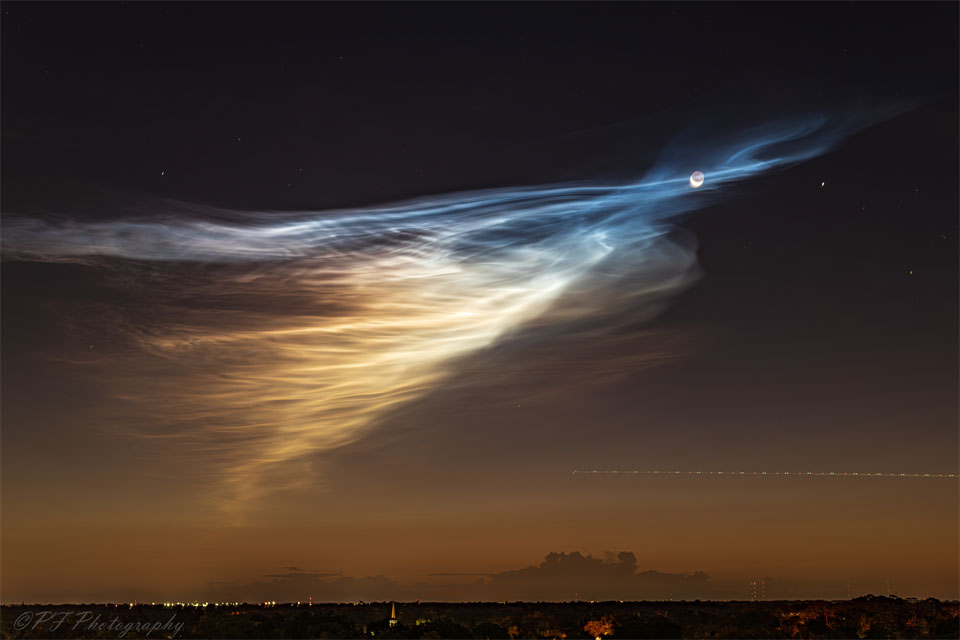
These clouds are doubly unusual. First, they are rare noctilucent clouds, meaning that they are visible at night -- but only just before sunrise or just after sunset. Second, the source of these noctilucent clouds is actually known. In this rare case, the source of the sunlight-reflecting ice-crystals in the upper atmosphere can be traced back to the launch of a nearby SpaceX rocket about 30 minutes earlier. Known more formally as polar mesospheric clouds, the vertex of these icy wisps happens to converge just in front of a rising crescent Moon. The featured image -- and accompanying video -- were captured over Orlando, Florida, USA about a week ago. The bright spot to the right of the Moon is the planet Jupiter, while the dotted lights above the horizon on the right are from an airplane.
© Pascal Fouquet — used with the credit NASA publishes
2023
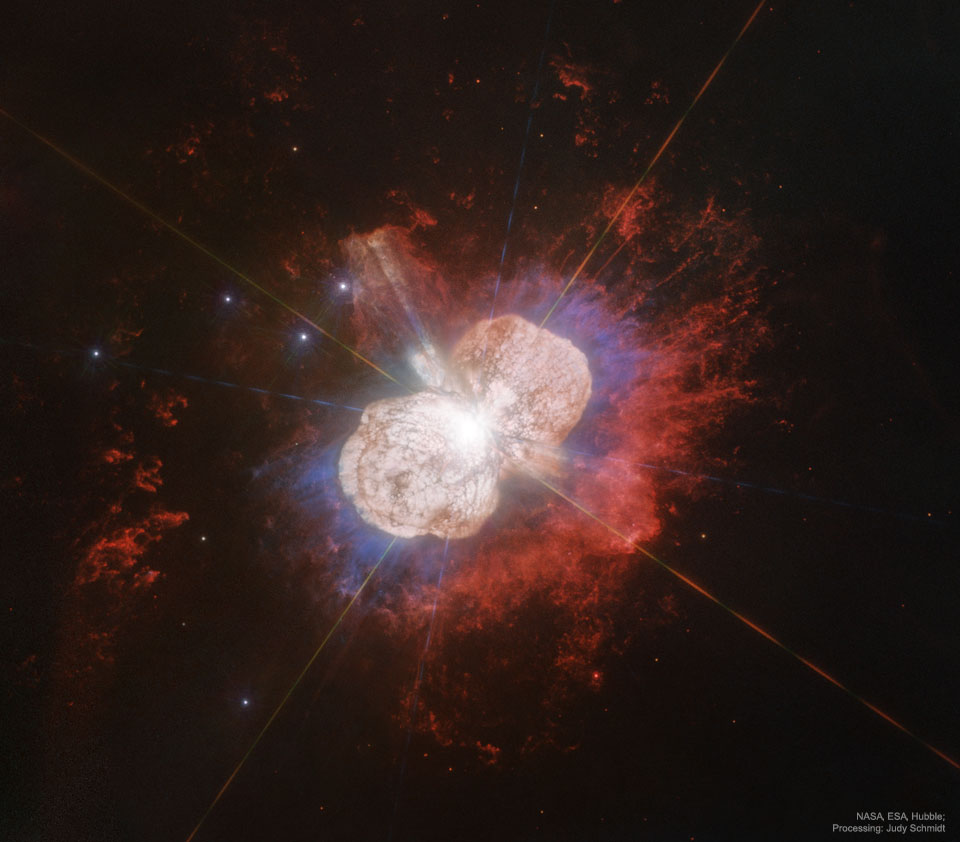
Carinae may be about to explode. But no one knows when - it may be next year, it may be one million years from now. Eta Carinae's mass - about 100 times greater than our Sun - makes it an excellent candidate for a full blown supernova. Historical records do show that about 170 years ago Eta Carinae underwent an unusual outburst that made it one of the brightest stars in the southern sky. Eta Carinae, in the Keyhole Nebula, is the only star currently thought to emit natural LASER light. This featured image brings out details in the unusual nebula that surrounds this rogue star. Diffraction spikes, caused by the telescope, are visible as bright multi-colored streaks emanating from Eta Carinae's center. Two distinct lobes of the Homunculus Nebula encompass the hot central region, while some strange radial streaks are visible in red extending toward the image right. The lobes are filled with lanes of gas and dust which absorb the blue and ultraviolet light emitted near the center. The streaks, however, remain unexplained.
© NASA, ESA, Hubble; Processing & License: Judy Schmidt — used with the credit NASA publishes

2022
Soaring high in skies around planet Earth, bright planet Saturn was a star of June's morning planet parade. But very briefly on June 24 it posed with a bright object in low Earth orbit, the International Space Station. On that date from a school parking lot in Temecula, California the ringed-planet and International Space Station were both caught in this single high-speed video frame. Though Saturn was shining at +0.5 stellar magnitude the space station was an even brighter -3 on the magnitude scale. That difference in brightness is faithfully represented in the video capture frame. In the challenging image, the orbiting ISS was at a range of 602 kilometers. Saturn was about 1.4 billion kilometers from the school parking lot.
© Tom Glenn — used with the credit NASA publishes
2021
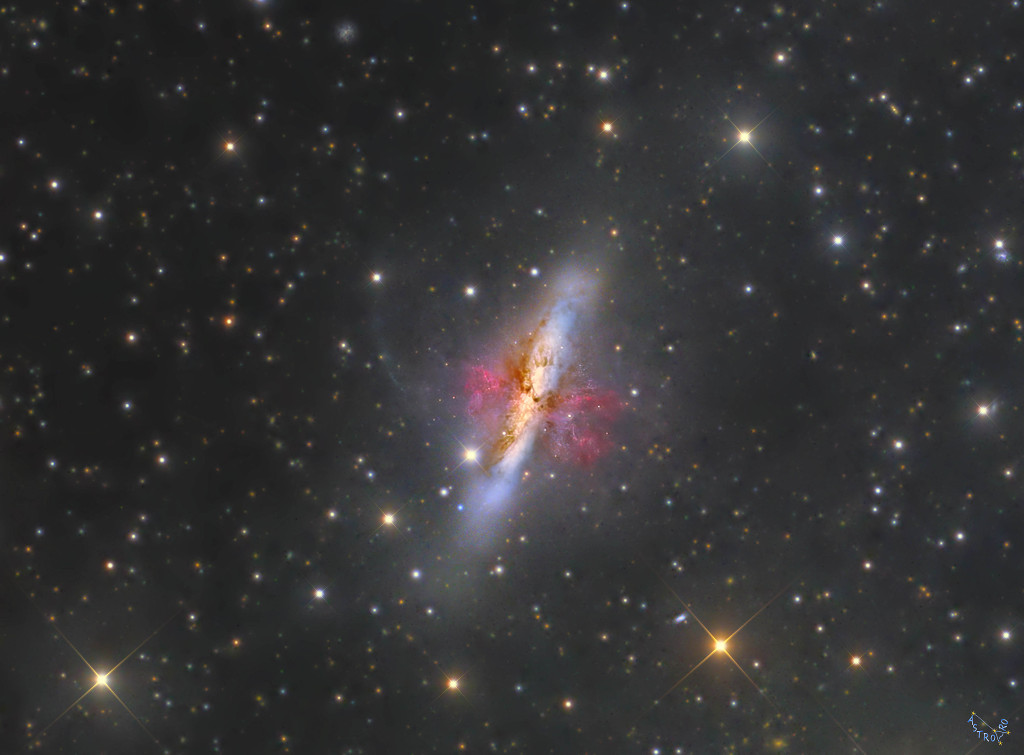
M82 is a starburst galaxy with a superwind. In fact, through ensuing supernova explosions and powerful winds from massive stars, the burst of star formation in M82 is driving a prodigious outflow. Evidence for the superwind from the galaxy's central regions is clear in sharp telescopic snapshot. The composite image highlights emission from long outflow filaments of atomic hydrogen gas in reddish hues. Some of the gas in the superwind, enriched in heavy elements forged in the massive stars, will eventually escape into intergalactic space. Triggered by a close encounter with nearby large galaxy M81, the furious burst of star formation in M82 should last about 100 million years or so. Also known as the Cigar Galaxy for its elongated visual appearance, M82 is about 30,000 light-years across. It lies 12 million light-years away near the northern boundary of Ursa Major.
© Team ARO — used with the credit NASA publishes

1962
The United States conducted the Starfish Prime high-altitude nuclear test, the largest nuclear explosion in outer space.
Starfish Prime ↗Event text and thumbnails come from Wikipedia and are used under CC BY-SA 4.0. Images are drawn only from Wikimedia Commons, which does not accept non-free content — each thumbnail links to its file page, where its licence and author are recorded.
Launch records are from The Space Devs’ Launch Library 2. This archive is still being mirrored, so some days are incomplete. Pictures are NASA’s Astronomy Picture of the Day; NASA imagery is generally not subject to copyright, but individual APOD entries are frequently the property of the photographer, and each caption says which applies.
General-audience astronomy and spaceflight — none of it a textbook.
As an Amazon Associate I earn from qualifying purchases. Links here cost you nothing extra.
LISTING
Still the best single argument for why any of this matters, and it leaves the arithmetic in. For a reader who wants the science, not just the awe.
LISTING
The case for leaving Earth, written by someone unsentimental about how hard that is. Suits readers who want the argument rather than the poster.
LISTING
Hard-SF problem solving in The Martian's key — for anyone who liked the engineering more than the peril. The only novel on this list.
BROWSE opens an Amazon search, not a specific recommendation.
LINKS AMAZON.COM