Launches
NO DATA0MISSIONS
The launch archive is still being mirrored, so this day has no launches listed yet.
ARCHIVE // DAY OF YEAR
Wikipedia records 1 spaceflight and astronomy event on June 23. Below are the pictures NASA published on June 23 in 5 different years — each one taken or released on this exact date.
0MISSIONS
The launch archive is still being mirrored, so this day has no launches listed yet.
1ENTRY
Spaceflight and astronomy entries from Wikipedia's record of this date, oldest first — from 1994 onward.
5IMAGES
NASA's Astronomy Picture of the Day for June 23, one per year. Some are public domain and some belong to the photographer — each says which.
NASA’s Astronomy Picture of the Day, for this calendar date in each of the last several years.

2025
How do stars form? Images of the star forming region W5 like those in the infrared by NASA's Wide Field Infrared Survey Explorer (WISE, later NEOWISE) satellite provide clear clues with indications that massive stars near the center of empty cavities are older than stars near the edges. A likely reason for this is that the older stars in the center are actually triggering the formation of the younger edge stars. The triggered star formation occurs when hot outflowing gas compresses cooler gas into knots dense enough to gravitationally contract into stars. In the featured scientifically colored infrared image, spectacular pillars left slowly evaporating from the hot outflowing gas provide further visual clues. W5 is also known as Westerhout 5 (W5) and IC 1848. Together with IC 1805, the nebulas form a complex region of star formation popularly dubbed the Heart and Soul Nebulas. The featured image highlights a part of W5 spanning about 2,000 light years that is rich in star forming pillars. W5 lies about 6,500 light years away toward the constellation of Cassiopeia. APOD Turns 30!: Free public lecture in Cork, Ireland tomorrow (Tuesday) at 7 pm
© : Francesco Antonucci — used with the credit NASA publishes
2024
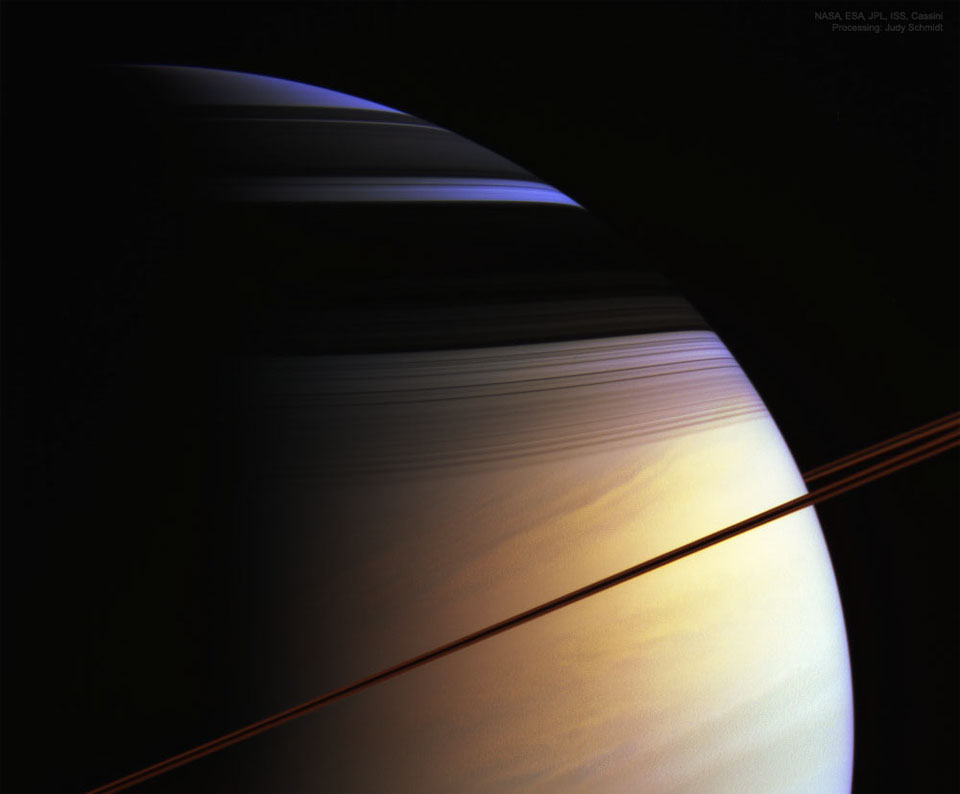
What creates Saturn's colors? The featured picture of Saturn only slightly exaggerates what a human would see if hovering close to the giant ringed world. The image was taken in 2005 by the robot Cassini spacecraft that orbited Saturn from 2004 to 2017. Here Saturn's majestic rings appear directly only as a curved line, appearing brown, in part from its infrared glow. The rings best show their complex structure in the dark shadows they create across the upper part of the planet. The northern hemisphere of Saturn can appear partly blue for the same reason that Earth's skies can appear blue -- molecules in the cloudless portions of both planet's atmospheres are better at scattering blue light than red. When looking deep into Saturn's clouds, however, the natural gold hue of Saturn's clouds becomes dominant. It is not known why southern Saturn does not show the same blue hue -- one hypothesis holds that clouds are higher there. It is also not known why some of Saturn's clouds are colored gold.
NASA · public domain
2023
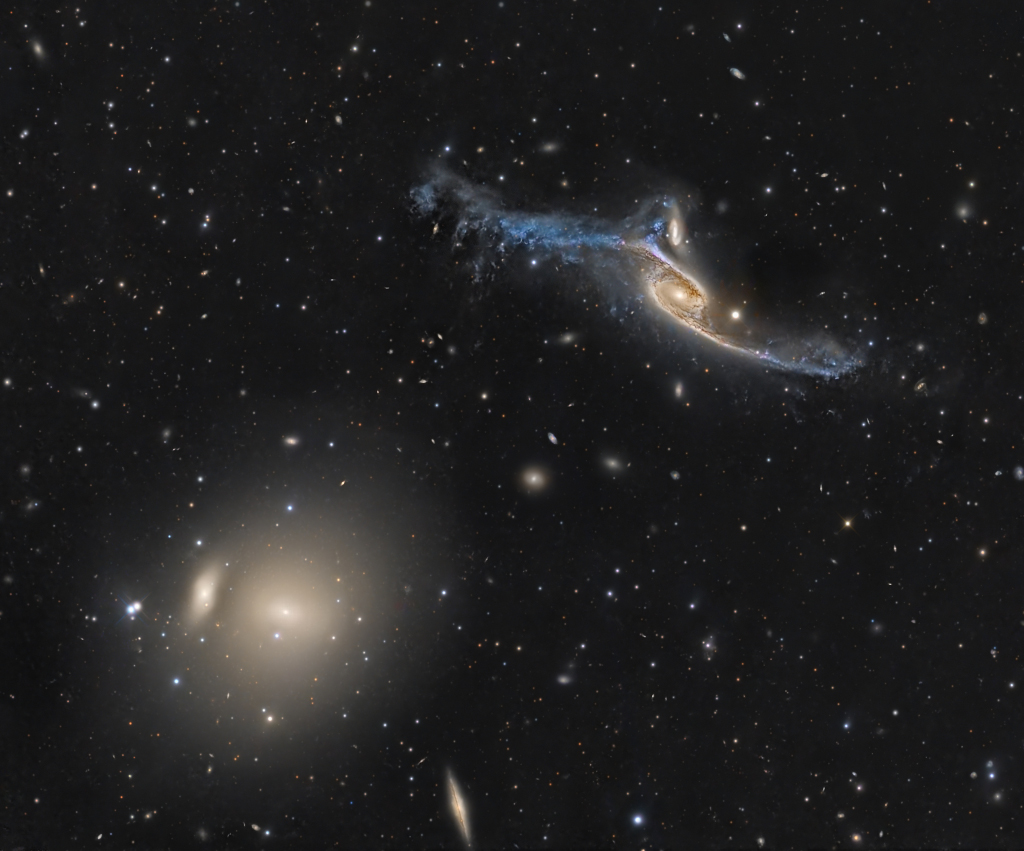
Over 500,000 light years across, NGC 6872 (top right) is a truly enormous barred spiral galaxy, at least 5 times the size of our own very large Milky Way. The appearance of this giant galaxy's distorted and stretched out spiral arms suggests the magnificent wings of a giant bird. Of course its popular moniker is the Condor galaxy. It lies about 200 million light-years distant toward the southern constellation Pavo, the Peacock. Lined with star-forming regions, the distorted spiral arms are due to NGC 6872's gravitational interaction with the nearby smaller galaxy IC 4970, seen just above the giant galaxy's core. The Pavo galaxy group's dominant giant elliptical galaxy, NGC 6876 is below and left of the soaring Condor galaxy.
© Mike Selby — used with the credit NASA publishes
2022
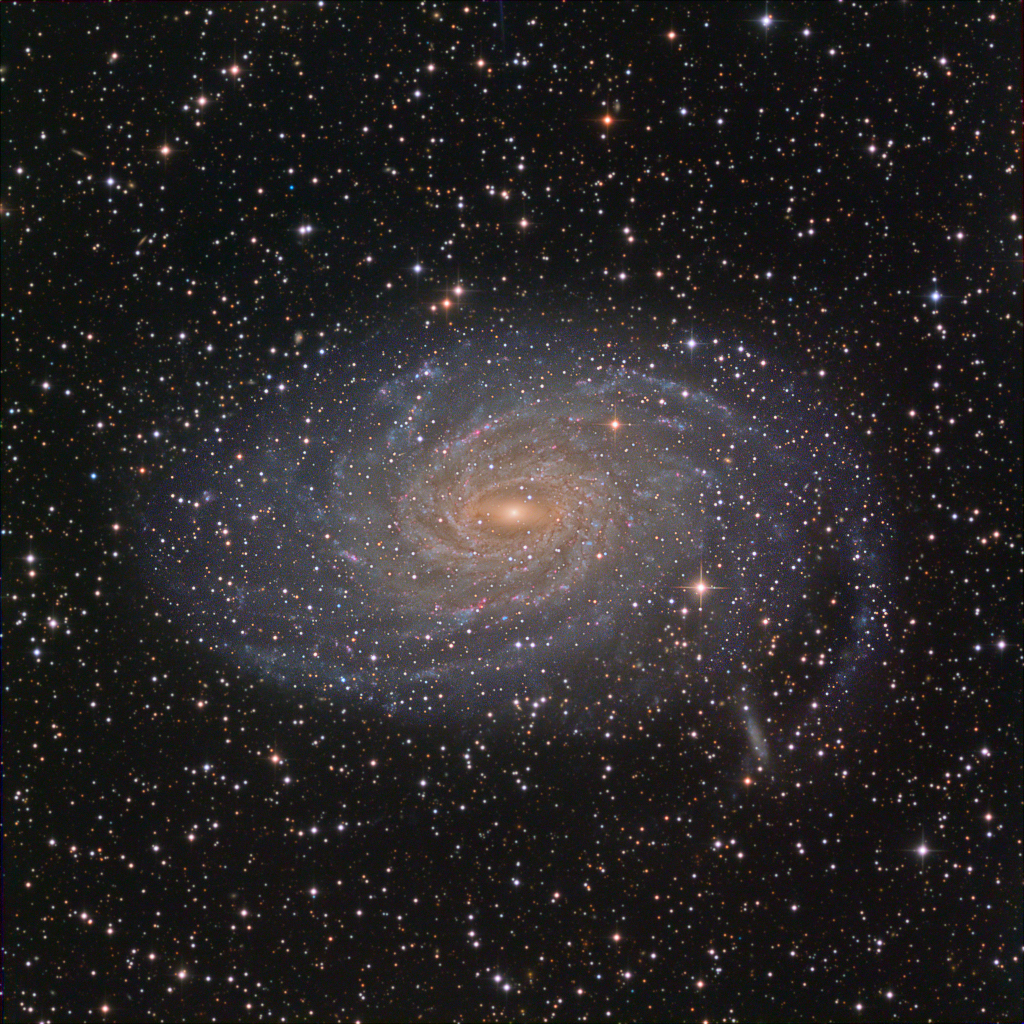
Beautiful spiral galaxy NGC 6744 is nearly 175,000 light-years across, larger than our own Milky Way. It lies some 30 million light-years distant in the southern constellation Pavo but appears as only a faint, extended object in small telescopes. We see the disk of the nearby island universe tilted towards our line of sight in this remarkably detailed galaxy portrait, a telescopic view that spans an area about the angular size of a full moon. In it, the giant galaxy's elongated yellowish core is dominated by the light from old, cool stars. Beyond the core, grand spiral arms are filled with young blue star clusters and speckled with pinkish star forming regions. An extended arm sweeps past smaller satellite galaxy NGC 6744A at the lower right. NGC 6744's galactic companion is reminiscent of the Milky Way's satellite galaxy the Large Magellanic Cloud.
© Basudeb Chakrabarti — used with the credit NASA publishes

2021
How do stars form? Most form in giant molecular clouds located in the central disk of a galaxy. The process is started, influenced, and limited by the stellar winds, jets, high energy starlight, and supernova explosions of previously existing stars. The featured video shows these complex interactions as computed by the STARFORGE simulation of a gas cloud 20,000 times the mass of our Sun. In the time-lapse visualization, lighter regions indicate denser gas, color encodes the gas speed (purple is slow, orange is fast), while dots indicate the positions of newly formed stars. As the video begins, a gas cloud spanning about 50 light years begins to condense under its own gravity. Within 2 million years, the first stars form, while newly formed massive stars are seen to expel impressive jets. The simulation is frozen after 4.3 million years, and the volume then rotated to gain a three-dimensional perspective. Much remains unknown about star formation, including the effect of the jets in limiting the masses of subsequently formed stars. Portal Universe: Random APOD Generator
NASA · public domain

1994
NASA's Space Station Processing Facility, a new state-of-the-art manufacturing building for the International Space Station, officially opens at Kennedy Space Center.
NASA ↗Event text and thumbnails come from Wikipedia and are used under CC BY-SA 4.0. Images are drawn only from Wikimedia Commons, which does not accept non-free content — each thumbnail links to its file page, where its licence and author are recorded.
Launch records are from The Space Devs’ Launch Library 2. This archive is still being mirrored, so some days are incomplete. Pictures are NASA’s Astronomy Picture of the Day; NASA imagery is generally not subject to copyright, but individual APOD entries are frequently the property of the photographer, and each caption says which applies.
General-audience astronomy and spaceflight — none of it a textbook.
As an Amazon Associate I earn from qualifying purchases. Links here cost you nothing extra.
LISTING
Still the best single argument for why any of this matters, and it leaves the arithmetic in. For a reader who wants the science, not just the awe.
LISTING
The case for leaving Earth, written by someone unsentimental about how hard that is. Suits readers who want the argument rather than the poster.
LISTING
Hard-SF problem solving in The Martian's key — for anyone who liked the engineering more than the peril. The only novel on this list.
BROWSE opens an Amazon search, not a specific recommendation.
LINKS AMAZON.COM