Launches
NO DATA0MISSIONS
The launch archive is still being mirrored, so this day has no launches listed yet.
ARCHIVE // DAY OF YEAR
Wikipedia records 5 spaceflight and astronomy events on June 20. Below are the pictures NASA published on June 20 in 5 different years — each one taken or released on this exact date.
0MISSIONS
The launch archive is still being mirrored, so this day has no launches listed yet.
5ENTRIES
Spaceflight and astronomy entries from Wikipedia's record of this date, oldest first — from 1943 onward.
5IMAGES
NASA's Astronomy Picture of the Day for June 20, one per year. Some are public domain and some belong to the photographer — each says which.
NASA’s Astronomy Picture of the Day, for this calendar date in each of the last several years.
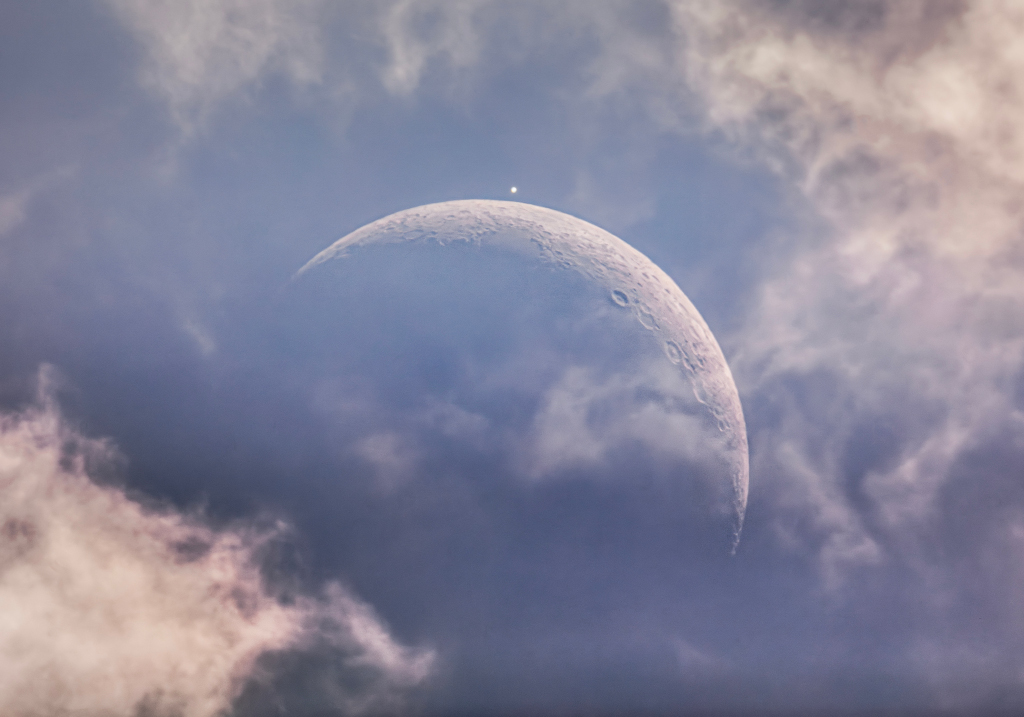
2026
Venus is now appearing on the celestial stage as Earth's brilliant evening star, performing with the Moon, other wandering planets, and bright stars in western skies. For evening sky gazers on June 17, the celestial beacon rose after sunset close by a young, slender, crescent Moon. But from some locations the Moon could be seen to occult or pass in front of Venus. And from a backyard observatory in southern British Columbia, Canada, the lunar occultation was played out in daylight. This stunning telescopic snapshot captured a scene in dramatically cloudy skies, following Venus' hour long disappearance, as the evening star emerged beyond the bright lunar limb.
© Debra Ceravolo — used with the credit NASA publishes

2025
dmonton, Alberta, Canada, planet Earth lies on the horizon in this stack of panoramic composite images. In a monthly time series arranged vertically top to bottom the ambitious photographic project follows the annual north-south swing of sunrise points, from June solstice to December solstice and back again. It also follows the corresponding, but definitely harder to track, Full Moon rise. Of course, the north-south swing of moonrise runs opposite sunrise along the horizon. But these rising Full Moons also span a wider range on the horizon than the sunrises. That's because the well-planned project (as shown in this video) covers the period June 2024 to June 2025, centered on a major lunar standstill. Major lunar standstills represent extremes in the north-south range of moonrise driven by the 18.6 year precession period of the lunar orbit.
© Luca Vanzella — used with the credit NASA publishes
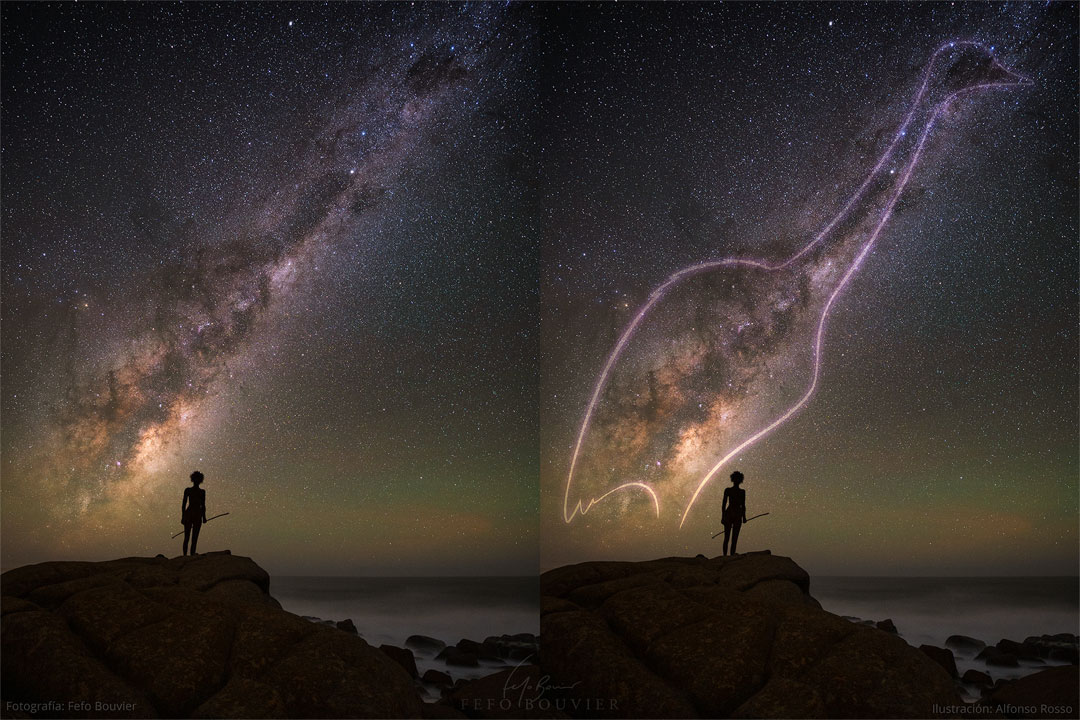
2023
Have you seen the bird in the Milky Way? Beyond the man in the Moon, the night sky is filled with stories, and cultures throughout history have projected some of their most enduring legends onto the stars and dust above. Generations of people see these celestial icons, hear their associated stories, and pass them down. Pictured here is not only a segment of the central band of our Milky Way galaxy, but, according to folklore of several native peoples of Uruguay, the outline of a great bird called Ñandú. Furthermore, Ñandú's footprint is associated with the Southern Cross asterism. In the foreground, in silhouette, is a statue of María Micaela Guyunusa, an indigenous woman of the Charrúa people who lived in the 1800s and endures as a symbol of colonial resistance. The composite image was taken in mid-April in Cabo Polonio, Uruguay, with the Atlantic Ocean in the background.
© Fefo Bouvier; Line Drawing: Alfonso Rosso — used with the credit NASA publishes
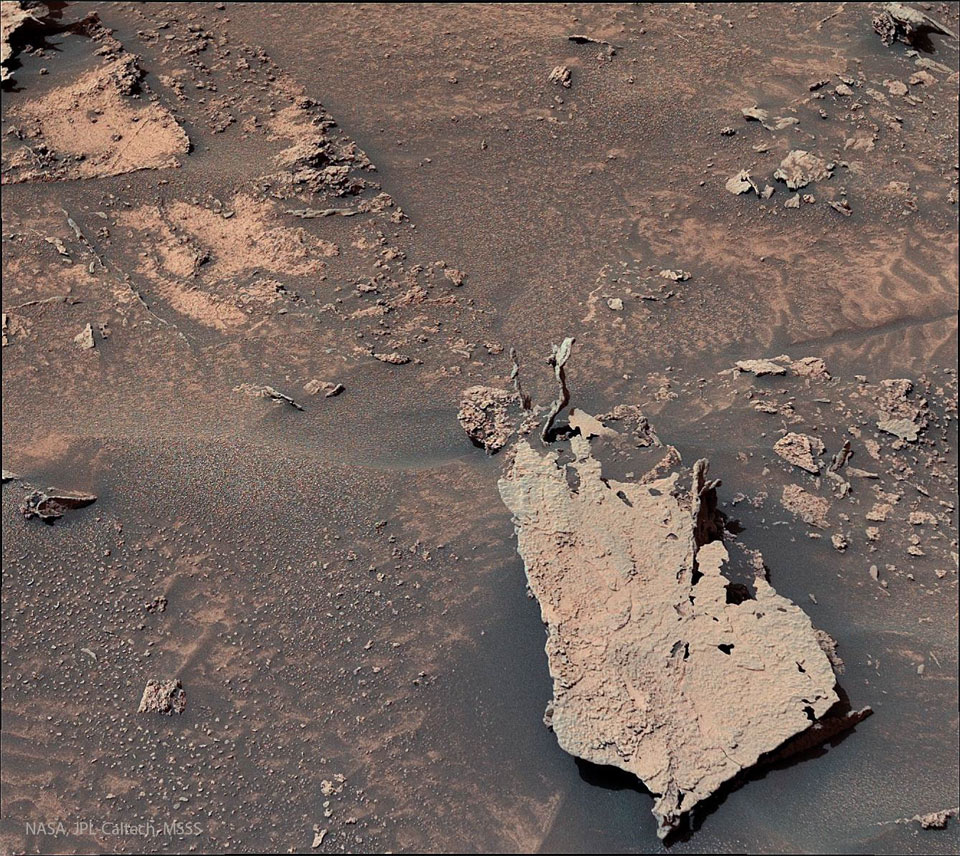
2022
There, just right of center, what is that? The surface of Mars keeps revealing new surprises with the recent discovery of finger-like rock spires. The small nearly-vertical rock outcrops were imaged last month by the robotic Curiosity rover on Mars. Although similar in size and shape to small snakes, the leading explanation for their origin is as conglomerations of small minerals left by water flowing through rock crevices. After these relatively dense minerals filled the crevices, they were left behind when the surrounding rock eroded away. Famous rock outcrops on Earth with a similar origin are called hoodoos. NASA's Curiosity Rover continues to search for new signs of ancient water in Gale Crater on Mars, while also providing a geologic background important for future human exploration. Explore Your Universe: Random APOD Generator
NASA · public domain
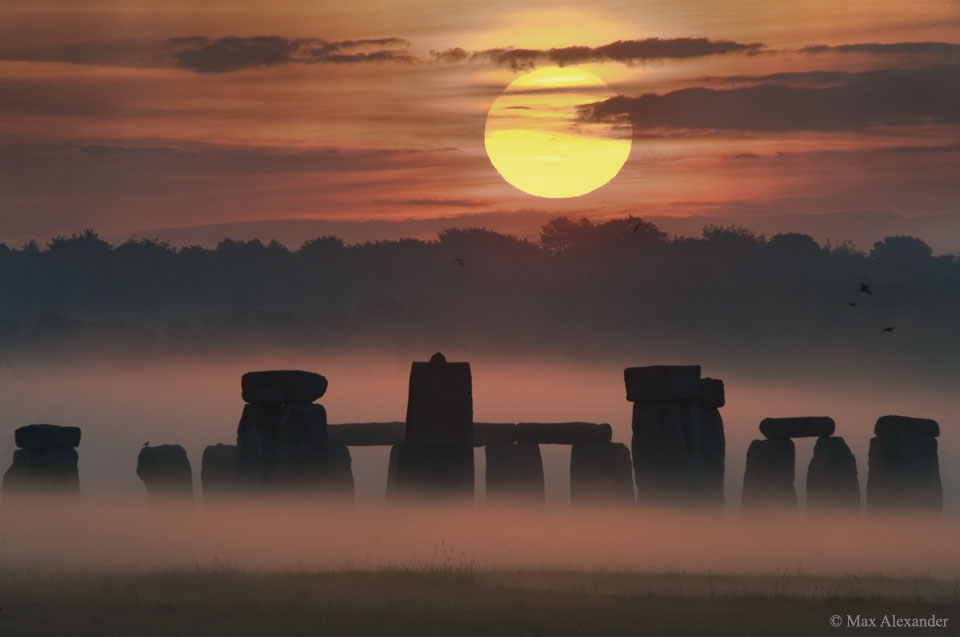
2021
Today the Sun reaches its northernmost point in planet Earth's sky. Called a solstice, many cultures mark this date as a change of seasons -- from spring to summer in Earth's Northern Hemisphere and from fall to winter in Earth's Southern Hemisphere. Precisely, the single time of solstice occurs today for some parts of the world, but tomorrow for other regions. The featured image was taken during the week of the 2008 summer solstice at Stonehenge in United Kingdom, and captures a picturesque sunrise involving fog, trees, clouds, stones placed about 4,500 years ago, and a 4.5 billion year old large glowing orb. Even given the precession of the Earth's rotational axis over the millennia, the Sun continues to rise over Stonehenge in an astronomically significant way.
© Max Alexander, STFC, SPL — used with the credit NASA publishes

1943
World War II: The Royal Air Force launches Operation Bellicose, the first shuttle bombing raid of the war. Avro Lancaster bombers damage the V-2 rocket production facilities at the Zeppelin Works while en route to an air base in Algeria.
World War II ↗1944
The experimental MW 18014 V-2 rocket reaches an altitude of 176 km, becoming the first man-made object to reach outer space.
MW 18014 ↗
1945
The United States Secretary of State approves the transfer of Wernher von Braun and his team of Nazi rocket scientists to the U.S. under Operation Paperclip.
United States Secretary of State ↗

1996
Space Shuttle Columbia launches on STS-78 to conduct life science and microgravity research aboard the Spacelab module.
Space Shuttle Columbia ↗Event text and thumbnails come from Wikipedia and are used under CC BY-SA 4.0. Images are drawn only from Wikimedia Commons, which does not accept non-free content — each thumbnail links to its file page, where its licence and author are recorded.
Launch records are from The Space Devs’ Launch Library 2. This archive is still being mirrored, so some days are incomplete. Pictures are NASA’s Astronomy Picture of the Day; NASA imagery is generally not subject to copyright, but individual APOD entries are frequently the property of the photographer, and each caption says which applies.
General-audience astronomy and spaceflight — none of it a textbook.
As an Amazon Associate I earn from qualifying purchases. Links here cost you nothing extra.
LISTING
Still the best single argument for why any of this matters, and it leaves the arithmetic in. For a reader who wants the science, not just the awe.
LISTING
The case for leaving Earth, written by someone unsentimental about how hard that is. Suits readers who want the argument rather than the poster.
LISTING
Hard-SF problem solving in The Martian's key — for anyone who liked the engineering more than the peril. The only novel on this list.
BROWSE opens an Amazon search, not a specific recommendation.
LINKS AMAZON.COM