Launches
NO DATA0MISSIONS
The launch archive is still being mirrored, so this day has no launches listed yet.
ARCHIVE // DAY OF YEAR
Wikipedia records 6 spaceflight and astronomy events on June 14. Below are the pictures NASA published on June 14 in 6 different years — each one taken or released on this exact date.
0MISSIONS
The launch archive is still being mirrored, so this day has no launches listed yet.
6ENTRIES
Spaceflight and astronomy entries from Wikipedia's record of this date, oldest first — from 1658 onward.
6IMAGES
NASA's Astronomy Picture of the Day for June 14, one per year. Some are public domain and some belong to the photographer — each says which.
NASA’s Astronomy Picture of the Day, for this calendar date in each of the last several years.
2026
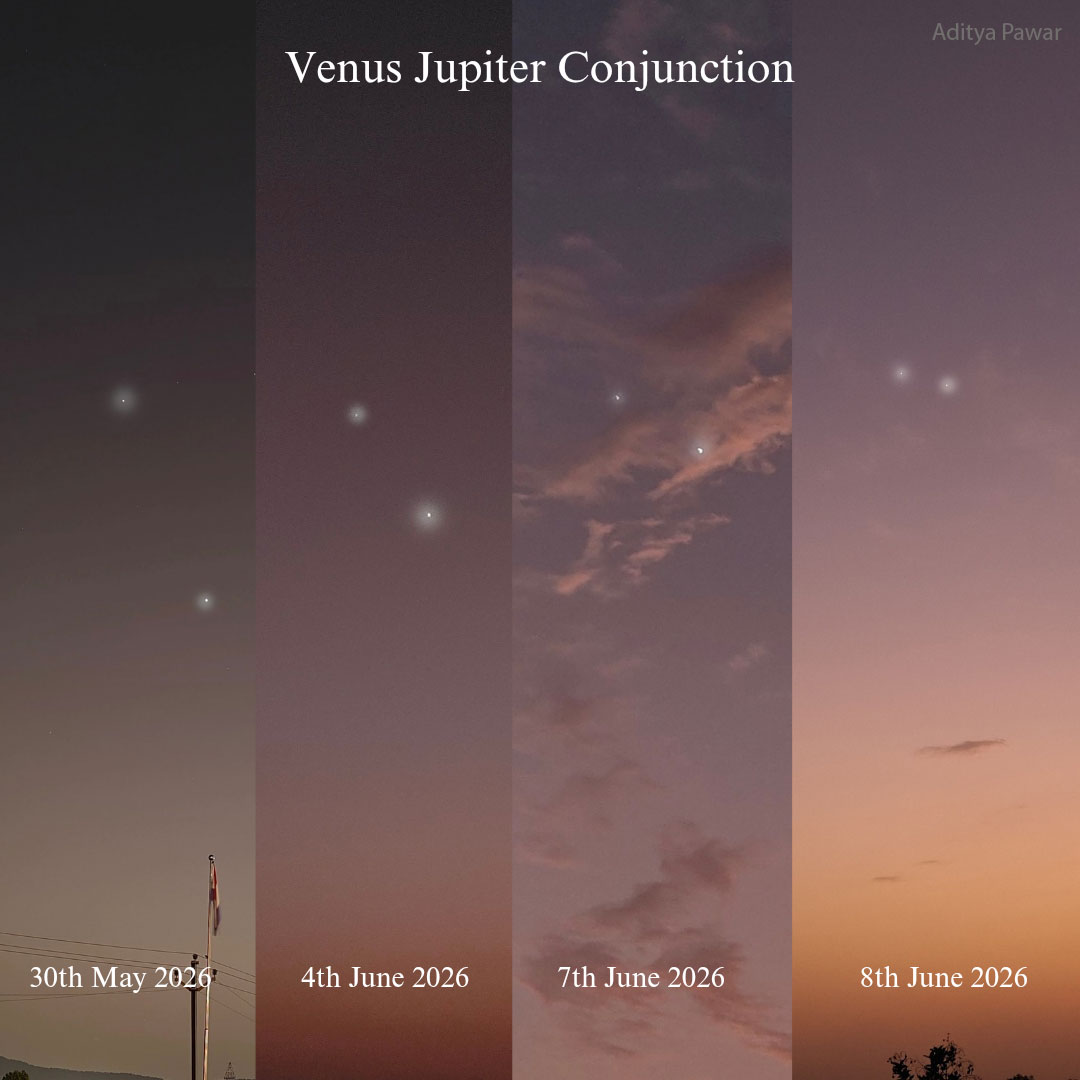
Venus and Jupiter may have caught your attention lately. The recent close conjunction of the two brightest planets in recent evening skies has been hard to miss. With Jupiter at the top, starting on May 30 and ending on June 8, their close approach was chronicled daily, left to right, in the featured panels from Maharashtra, India. Near the western horizon, the evening sky colors and exposures used for each panel depend on the local conditions near sunset. At their closest on June 9, the celestial pair appeared to be only about three times the width of a full moon apart. Of course, on that date, the two planets were physically separated by over 600 million kilometers in their orbits around the Sun. In the coming days, Jupiter will slowly settle into the sunset glare, but Venus will continue to move farther from the Sun in the western sky to excel in its current role as the brilliant evening star. Gallery: Venus - Jupiter Conjunction of 2026 June
© Aditya Pawar — used with the credit NASA publishes

2025
What are all those streaks in the sky? A galaxy, many satellite trails, and a few meteors. First, far in the distance, the majestic band of our Milky Way Galaxy runs down the left. Mirroring it on the right are several parallel trails of Earth-orbiting Starlink satellites. Many fainter satellite trails also crisscross the image. The two short and bright streaks are meteors — likely members of the annual Eta Aquariids meteor shower. The planet Venus shines on the lower right. Venus and the satellites shine by reflected sunlight. The featured picture is a composite of exposures all taken in a few hours on May 4 over the Limay River in Argentina.
© Martín Moliné — used with the credit NASA publishes
2024
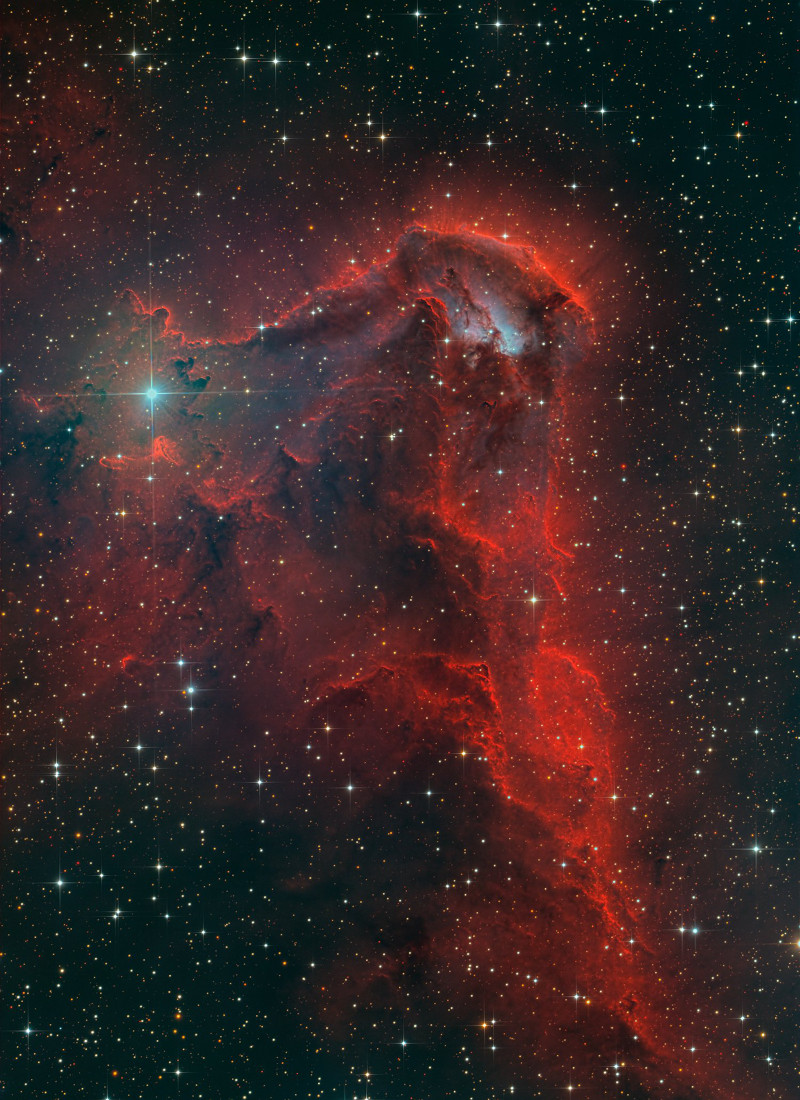
From the 1960 astronomical catalog of Rodgers, Campbell and Whiteoak, emission region RCW 85 shines in southern night skies between bright stars Alpha and Beta Centauri. About 5,000 light years distant, the hazy interstellar cloud of glowing hydrogen gas and dust is faint. But detailed structures along well-defined rims within RCW 85 are traced in this cosmic skyscape composed of 28 hours of narrow and broadband exposures. Suggestive of dramatic shapes in other stellar nurseries where natal clouds of gas and dust are sculpted by energetic winds and radiation from newborn stars, the tantalizing nebula has been called the Devil's Tower. This telescopic frame would span around 100 light-years at the estimated distance of RCW 85.
© Martin Pugh — used with the credit NASA publishes
2023
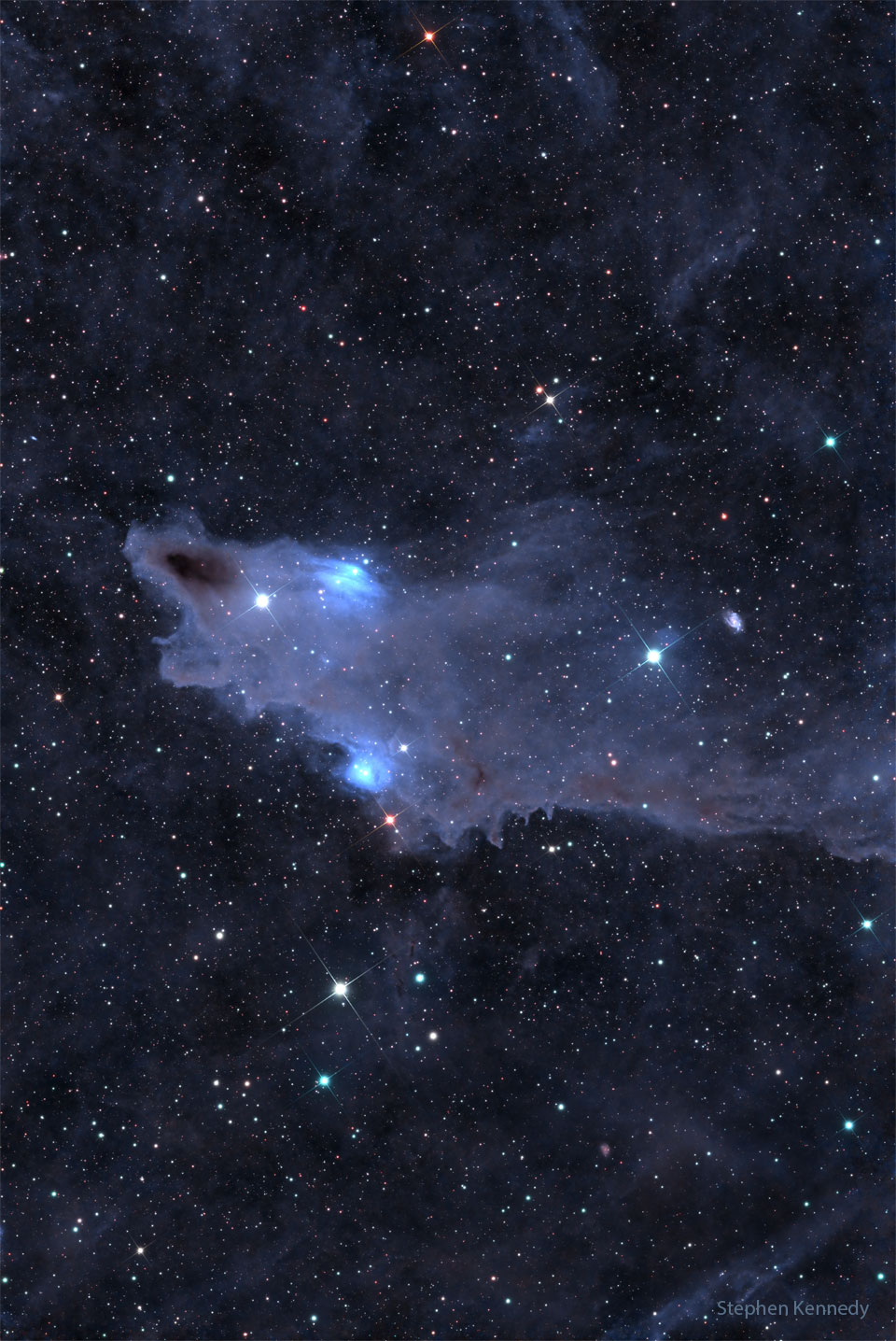
There is no sea on Earth large enough to contain the Shark nebula. This predator apparition poses us no danger as it is composed only of interstellar gas and dust. Dark dust like that featured here is somewhat like cigarette smoke and created in the cool atmospheres of giant stars. After being expelled with gas and gravitationally recondensing, massive stars may carve intricate structures into their birth cloud using their high energy light and fast stellar winds as sculpting tools. The heat they generate evaporates the murky molecular cloud as well as causing ambient hydrogen gas to disperse and glow red. During disintegration, we humans can enjoy imagining these great clouds as common icons, like we do for water clouds on Earth. Including smaller dust nebulae such as Lynds Dark Nebula 1235 and Van den Bergh 149 & 150, the Shark nebula spans about 15 light years and lies about 650 light years away toward the constellation of the King of Aethiopia (Cepheus).
© Stephen Kennedy — used with the credit NASA publishes
2022
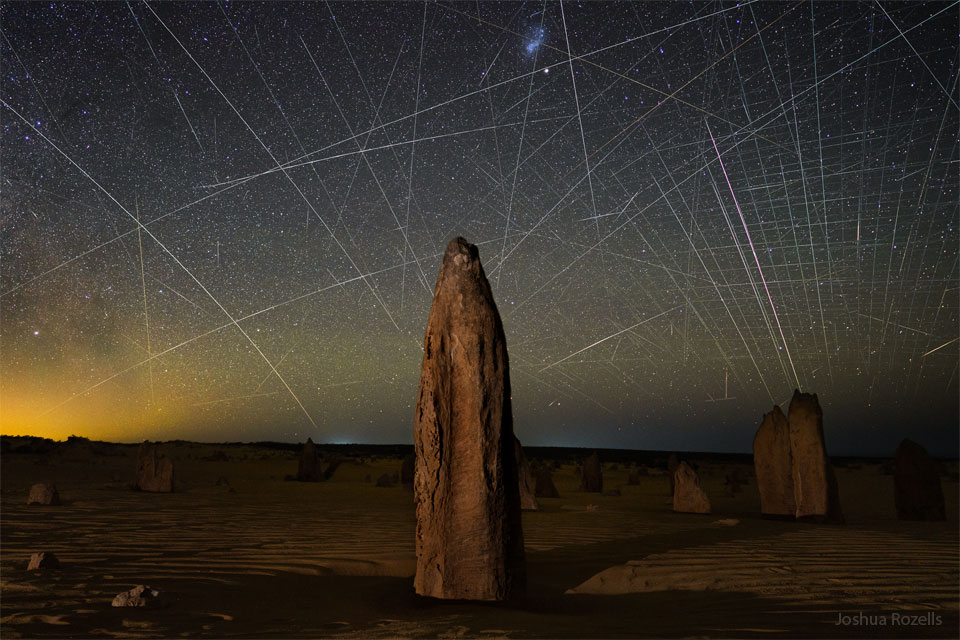
What are all those streaks across the background? Satellite trails. First, the foreground features picturesque rock mounds known as Pinnacles. Found in the Nambung National Park in Western Australia, these human-sized spires are made by unknown processes from ancient sea shells (limestone). Perhaps more eye-catching, though, is the sky behind. Created by low-Earth orbit satellites reflecting sunlight, all of these streaks were captured in less than two hours and digitally combined onto the single featured image, with the foreground taken consecutively by the same camera and from the same location. Most of the streaks were made by the developing Starlink constellation of communication satellites, but some are not. In general, the streaks are indicative of an increasing number of satellites nearly continuously visible above the Earth after dusk and before dawn. Understanding and removing the effects of satellite trails on images from Earth's ground-based cameras and telescopes is now important not only for elegant astrophotography, but for humanity's scientific understanding of the distant universe. Astrophysicists: Browse 2,800+ codes in the Astrophysics Source Code Library
© Joshua Rozells — used with the credit NASA publishes
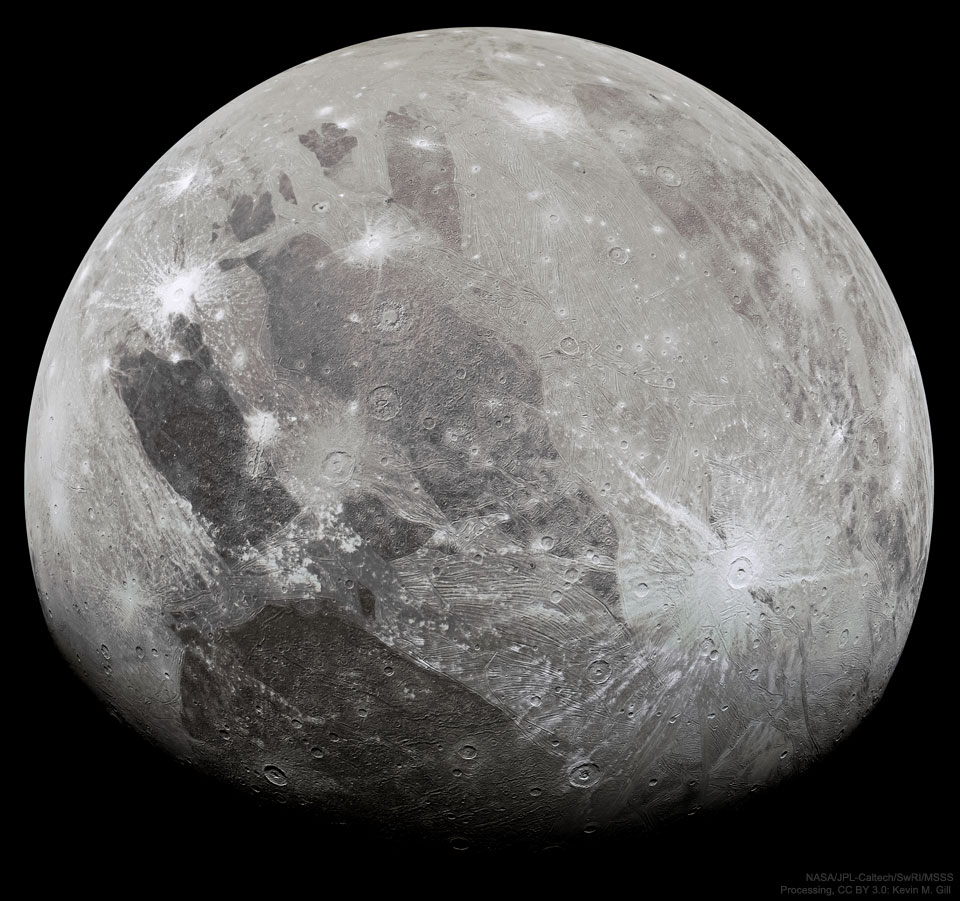
2021
What does the largest moon in the Solar System look like? Jupiter's moon Ganymede, larger than even Mercury and Pluto, has an icy surface speckled with bright young craters overlying a mixture of older, darker, more cratered terrain laced with grooves and ridges. The cause of the grooved terrain remains a topic of research, with a leading hypothesis relating it to shifting ice plates. Ganymede is thought to have an ocean layer that contains more water than Earth -- and might contain life. Like Earth's Moon, Ganymede keeps the same face towards its central planet, in this case Jupiter. The featured image was captured last week by NASA's robotic Juno spacecraft as it passed only about 1000 kilometers above the immense moon. The close pass reduced Juno's orbital period around Jupiter from 53 days to 43 days. Juno continues to study the giant planet's high gravity, unusual magnetic field, and complex cloud structures. Last week's solar eclipse: Notable images submitted to APOD
NASA · public domain

1658
Franco-Spanish War: Turenne and the French army win a decisive victory over the Spanish at the battle of the Dunes.
Franco-Spanish War (1635–1659) ↗
1949
Albert II, a rhesus monkey, rides a V-2 rocket to an altitude of 134 km (83 mi), thereby becoming the first mammal and first monkey in space.
Albert II (monkey) ↗1962
The European Space Research Organisation is established in Paris – later becoming the European Space Agency.
European Space Research Organisation ↗
1986
The Mindbender derails, killing three riders and severely injuring one at the Fantasyland (known today as Galaxyland) indoor amusement park at West Edmonton Mall in Edmonton, Alberta.
Mindbender (Galaxyland) ↗
2002
Near-Earth asteroid 2002 MN misses the Earth by 75,000 miles (121,000 km), about one-third of the distance between the Earth and the Moon.
Near-Earth object ↗Event text and thumbnails come from Wikipedia and are used under CC BY-SA 4.0. Images are drawn only from Wikimedia Commons, which does not accept non-free content — each thumbnail links to its file page, where its licence and author are recorded.
Launch records are from The Space Devs’ Launch Library 2. This archive is still being mirrored, so some days are incomplete. Pictures are NASA’s Astronomy Picture of the Day; NASA imagery is generally not subject to copyright, but individual APOD entries are frequently the property of the photographer, and each caption says which applies.
General-audience astronomy and spaceflight — none of it a textbook.
As an Amazon Associate I earn from qualifying purchases. Links here cost you nothing extra.
LISTING
Still the best single argument for why any of this matters, and it leaves the arithmetic in. For a reader who wants the science, not just the awe.
LISTING
The case for leaving Earth, written by someone unsentimental about how hard that is. Suits readers who want the argument rather than the poster.
LISTING
Hard-SF problem solving in The Martian's key — for anyone who liked the engineering more than the peril. The only novel on this list.
BROWSE opens an Amazon search, not a specific recommendation.
LINKS AMAZON.COM