Launches
NO DATA0MISSIONS
The launch archive is still being mirrored, so this day has no launches listed yet.
ARCHIVE // DAY OF YEAR
Wikipedia records 1 spaceflight and astronomy event on May 27. Below are the pictures NASA published on May 27 in 6 different years — each one taken or released on this exact date.
0MISSIONS
The launch archive is still being mirrored, so this day has no launches listed yet.
1ENTRY
Spaceflight and astronomy entries from Wikipedia's record of this date, oldest first — from 1999 onward.
6IMAGES
NASA's Astronomy Picture of the Day for May 27, one per year. Some are public domain and some belong to the photographer — each says which.
NASA’s Astronomy Picture of the Day, for this calendar date in each of the last several years.
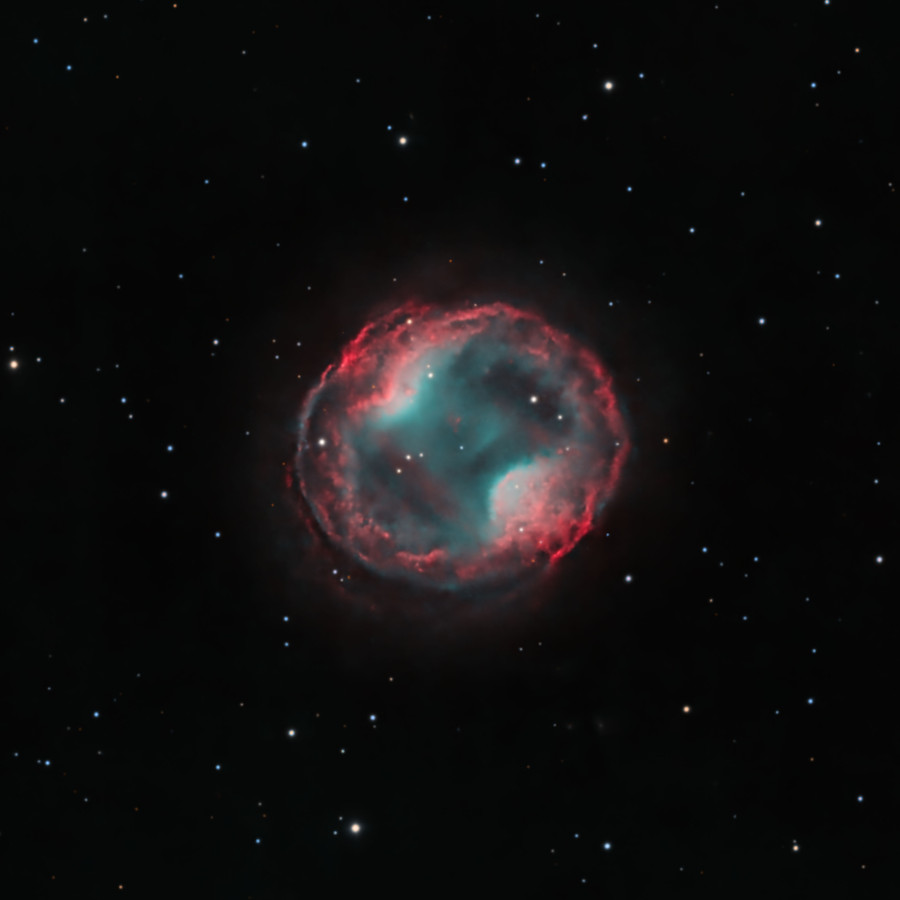
2026
What is a pair of headphones doing in the sky? Today’s image features the Headphone Nebula, also known as PK 164 +31.1 or Jones-Emberson 1. This planetary nebula, the remnant of a dying Sun-like star, faintly occupies an angular region of the Lynx constellation about 1/5th the diameter of the full moon. The red and blue-ish green colors trace hydrogen and oxygen atoms, respectively, that have been excited and ionized by the nebula's central white dwarf. The headphone shape, where two lobes of hydrogen puncture the inner region of oxygen, adds this object to a long list of oddly shaped nebulae. The morphology of such strange nebulae hint at the presence of a stellar or planetary companion, which can stir the material flowing out from the dying star. You can listen to Hubble and JWST sonifications of planetary nebulae through your very own headphones!
© Bernard Miller Text: Keighley Rockcliffe (NASA GSFC, UMBC CSST, CRESST II) — used with the credit NASA publishes
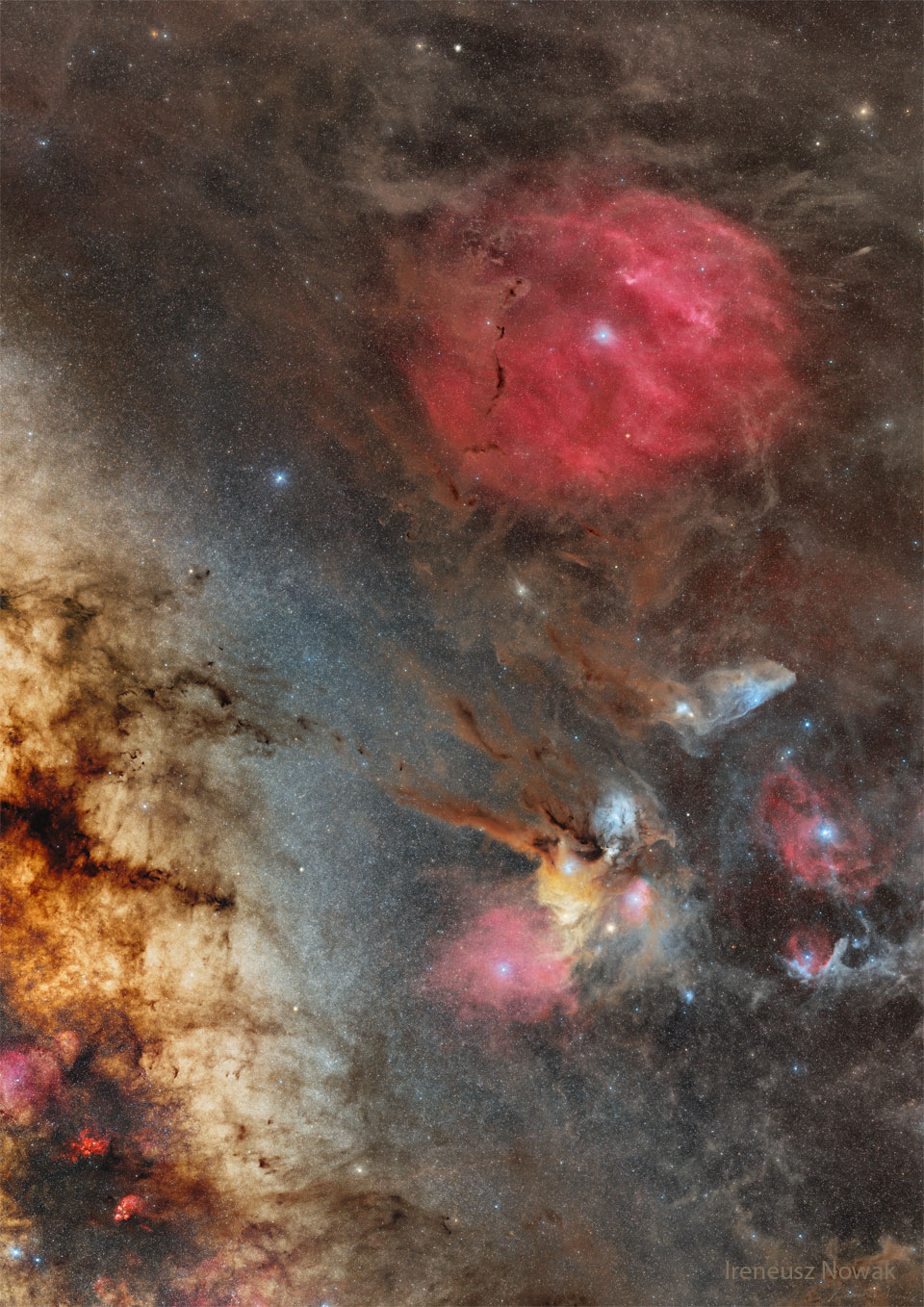
2025
Behold one of the most photogenic regions of the night sky, captured impressively. Featured, the band of our Milky Way Galaxy runs diagonally along the bottom-left corner, while the colorful Rho Ophiuchi cloud complex is visible just right of center and the large red circular Zeta Ophiuchi Nebula appears near the top. In general, red emanates from nebulas glowing in the light of excited hydrogen gas, while blue marks interstellar dust preferentially reflecting the light of bright young stars. Thick dust usually appears dark brown. Many iconic objects of the night sky appear, including (can you find them?) the bright star Antares, the globular star cluster M4, and the Blue Horsehead nebula. This wide field composite, taken over 17 hours, was captured from South Africa last June. Explore Your Universe: Random APOD Generator
© Ireneusz Nowak — used with the credit NASA publishes
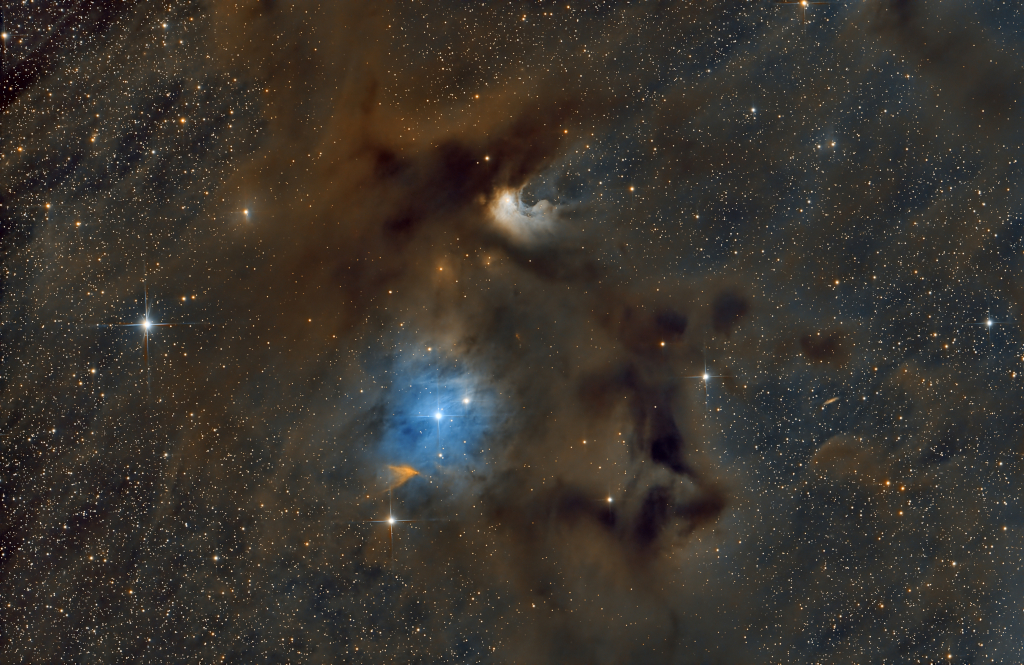
2024
Dark markings and bright nebulae in this telescopic southern sky view are telltale signs of young stars and active star formation. They lie a mere 650 light-years away, at the boundary of the local bubble and the Chamaeleon molecular cloud complex. Regions with young stars identified as dusty reflection nebulae from the 1946 Cederblad catalog include the C-shaped Ced 110 just above and right of center, and bluish Ced 111 below it. Also a standout in the frame, the orange tinted V-shape of the Chamaeleon Infrared Nebula (Cha IRN) was carved by material streaming from a newly formed low-mass star. The well-composed image spans 1.5 degrees. That's about 17 light-years at the estimated distance of the nearby Chamaeleon I molecular cloud.
© Amiel Contuliano — used with the credit NASA publishes
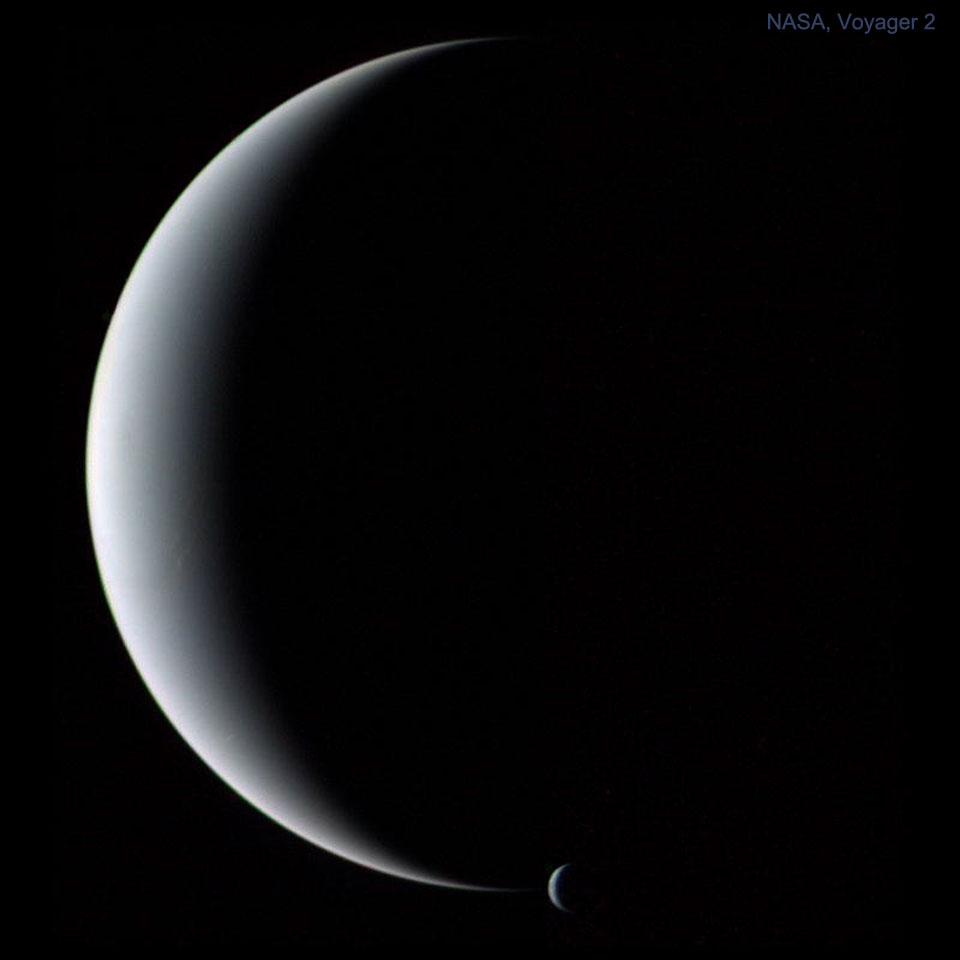
2023
Gliding through the outer Solar System, in 1989 the Voyager 2 spacecraft looked toward the Sun to find this view of most distant planet Neptune and its moon Triton together in a crescent phase. The elegant image of ice-giant planet and largest moon was taken from behind just after Voyager's closest approach. It could not have been taken from Earth because the most distant planet never shows a crescent phase to sunward eyes. Heading for the heliopause and beyond, the spacecraft's parting vantage point also robs Neptune of its familiar blue hue.
NASA · public domain
2022
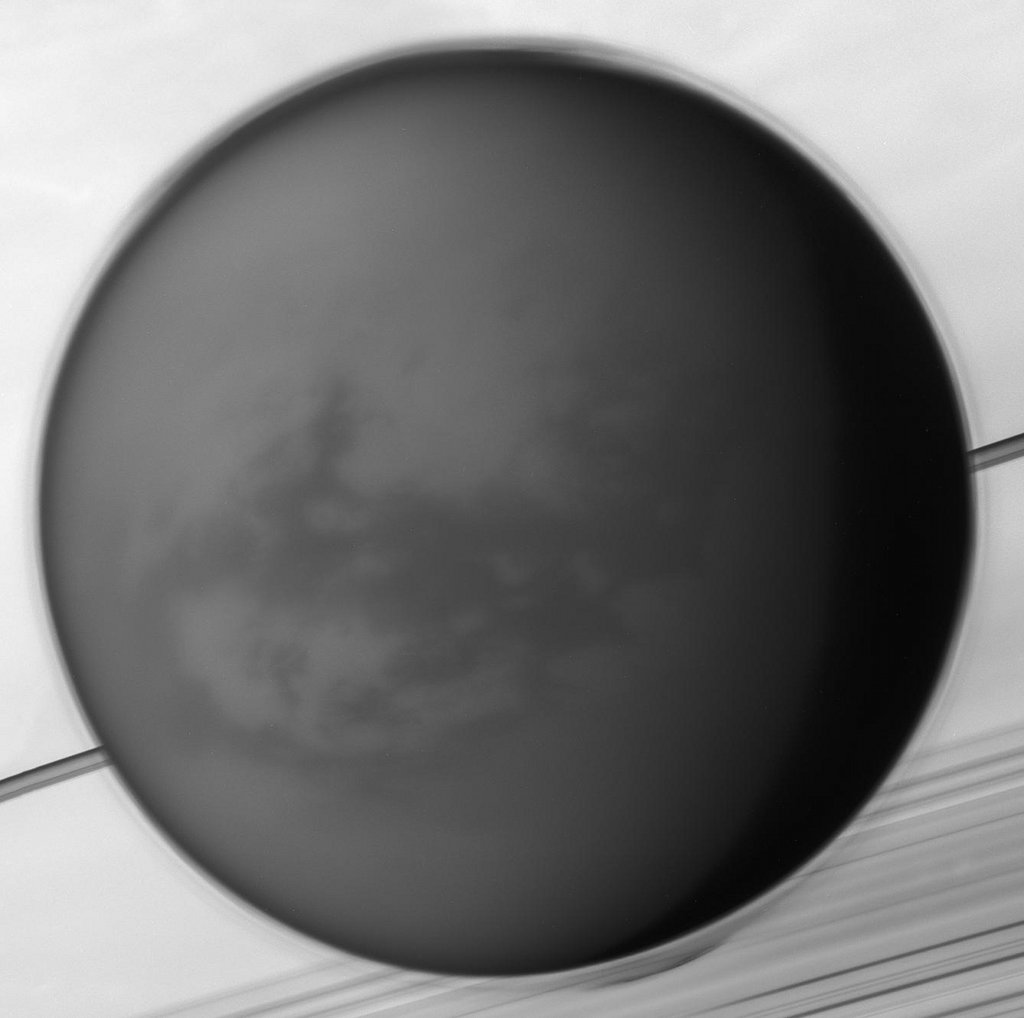
Like Earth's moon, Saturn's largest moon Titan is locked in synchronous rotation. This mosaic of images recorded by the Cassini spacecraft in May of 2012 shows its anti-Saturn side, the side always facing away from the ringed gas giant. The only moon in the solar system with a dense atmosphere, Titan is the only solar system world besides Earth known to have standing bodies of liquid on its surface and an earthlike cycle of liquid rain and evaporation. Its high altitude layer of atmospheric haze is evident in the Cassini view of the 5,000 kilometer diameter moon over Saturn's rings and cloud tops. Near center is the dark dune-filled region known as Shangri-La. The Cassini-delivered Huygens probe rests below and left of center, after the most distant landing for a spacecraft from Earth.
NASA · public domain
2021
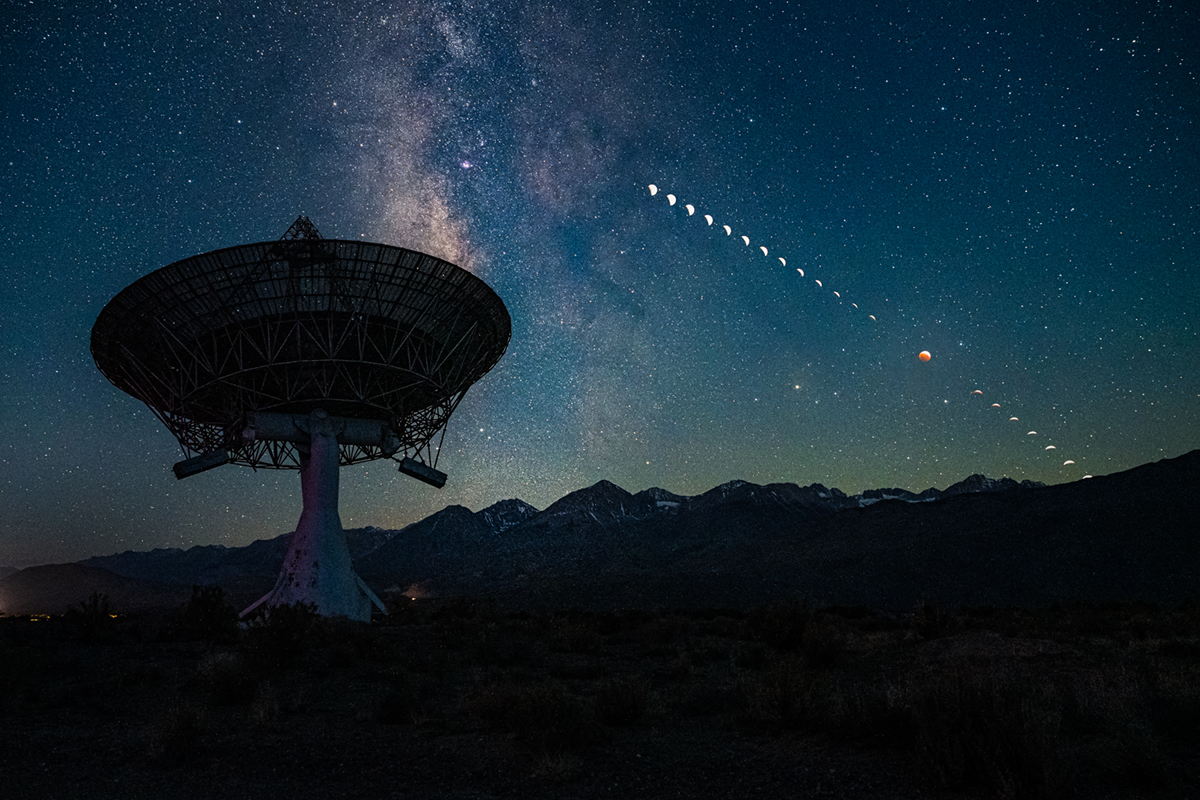
May's perigee Full Moon slid through Earth's shadow yesterday entertaining night skygazers in regions around the Pacific. Seen from western North America, it sinks toward the rugged Sierra Nevada mountain range in this time-lapse series of the total lunar eclipse. Low on the western horizon the Moon was captured at mid-eclipse with two separate exposures. Combined they reveal the eclipsed Moon's reddened color against the dark night sky and the diffuse starlight band of the Milky Way. Frames taken every five minutes from the fixed camera follow the surrounding progression of the eclipse partial phases. In the foreground a radio telescope dish at California's Owens Valley Radio Observatory points skyward.
© John Kraus — used with the credit NASA publishes

1999
Space Shuttle Discovery is launched on STS-96, the first shuttle mission to dock with the International Space Station.
Space Shuttle Discovery ↗Event text and thumbnails come from Wikipedia and are used under CC BY-SA 4.0. Images are drawn only from Wikimedia Commons, which does not accept non-free content — each thumbnail links to its file page, where its licence and author are recorded.
Launch records are from The Space Devs’ Launch Library 2. This archive is still being mirrored, so some days are incomplete. Pictures are NASA’s Astronomy Picture of the Day; NASA imagery is generally not subject to copyright, but individual APOD entries are frequently the property of the photographer, and each caption says which applies.
General-audience astronomy and spaceflight — none of it a textbook.
As an Amazon Associate I earn from qualifying purchases. Links here cost you nothing extra.
LISTING
Still the best single argument for why any of this matters, and it leaves the arithmetic in. For a reader who wants the science, not just the awe.
LISTING
The case for leaving Earth, written by someone unsentimental about how hard that is. Suits readers who want the argument rather than the poster.
LISTING
Hard-SF problem solving in The Martian's key — for anyone who liked the engineering more than the peril. The only novel on this list.
BROWSE opens an Amazon search, not a specific recommendation.
LINKS AMAZON.COM