Launches
NO DATA0MISSIONS
The launch archive is still being mirrored, so this day has no launches listed yet.
ARCHIVE // DAY OF YEAR
Wikipedia records 3 spaceflight and astronomy events on May 24. Below are the pictures NASA published on May 24 in 5 different years — each one taken or released on this exact date.
0MISSIONS
The launch archive is still being mirrored, so this day has no launches listed yet.
3ENTRIES
Spaceflight and astronomy entries from Wikipedia's record of this date, oldest first — from 1940 onward.
5IMAGES
NASA's Astronomy Picture of the Day for May 24, one per year. Some are public domain and some belong to the photographer — each says which.
NASA’s Astronomy Picture of the Day, for this calendar date in each of the last several years.

2025
Deimos takes 30 hours and 18 minutes to complete one orbit around the Red Planet. That's a little more than one Martian day or sol which is about 24 hours and 40 minutes long, so Deimos drifts westward across the Martian sky. About 15 kilometers across at its widest, the smallest of Mars' two moons is bright though. In fact Deimos is the brightest celestial object in this Martian skyscape captured before sunrise by Perseverance on March 1, the 1,433rd sol of the Mars rover's mission. The image is a composed of 16 exposures recorded by one of the rover's navigation cameras. The individual exposures were combined into a single image for an enhanced low light view. Regulus and Algieba, bright stars in the constellation Leo, are also visible in the dark Martian predawn sky.
NASA · public domain
2024
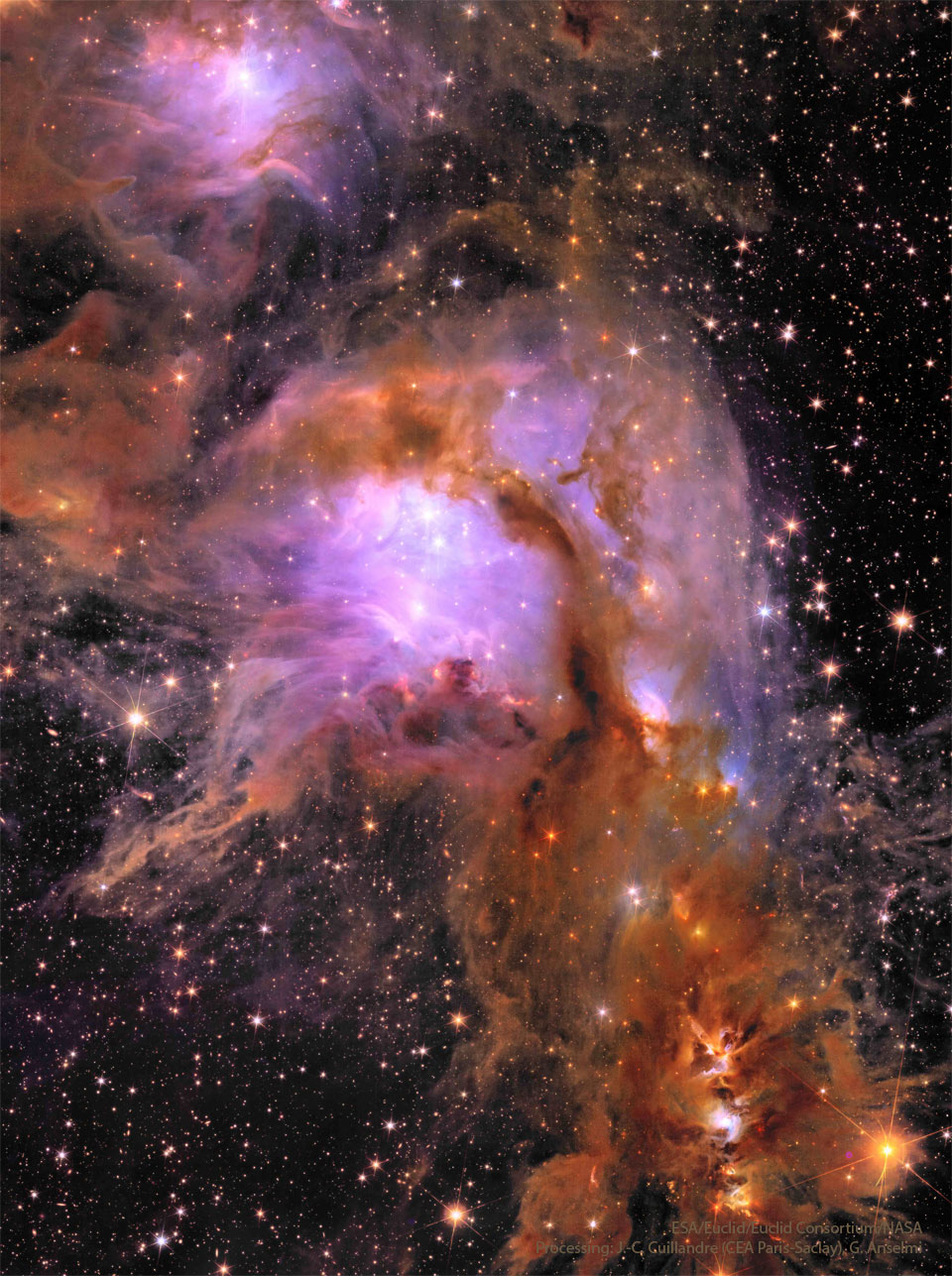
Star formation can be messy. To help find out just how messy, ESA's new Sun-orbiting Euclid telescope recently captured the most detailed image ever of the bright star forming region M78. Near the image center, M78 lies at a distance of only about 1,300 light-years away and has a main glowing core that spans about 5 light-years. The featured image was taken in both visible and infrared light. The purple tint in M78's center is caused by dark dust preferentially reflecting the blue light of hot, young stars. Complex dust lanes and filaments can be traced through this gorgeous and revealing skyscape. On the upper left is associated star forming region NGC 2071, while a third region of star formation is visible on the lower right. These nebulas are all part of the vast Orion Molecular Cloud Complex which can be found with even a small telescope just north of Orion's belt. More Euclid Sky Candy: Recent images released from Euclid
NASA · public domain
2023
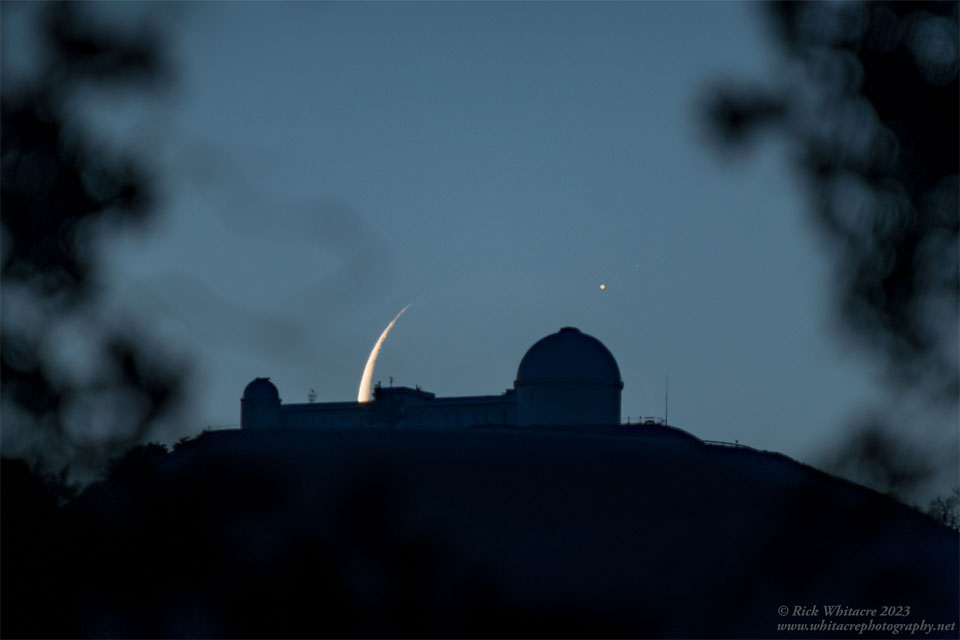
Sometimes we witness the Moon moving directly in front of -- called occulting -- one of the planets in our Solar System. Earlier this month that planet was Jupiter. Captured here was the moment when Jupiter re-appeared from behind the surface of our Moon. The Moon was in its third quarter, two days before the dark New Moon. Now, our Moon is continuously half lit by the Sun, but when in its third quarter, relatively little of that half can be seen from the Earth. Pictured, the Moon itself was aligned behind the famous Lick Observatory in California, USA, on the summit of Mount Hamilton. Coincidentally, Lick enabled the discovery of a moon of Jupiter: Amalthea, the last visually detected moon of Jupiter after Galileo's observations. Gallery: Moon Occults Jupiter in 2023 May: Notable Submissions to APOD
© Rick Whitacre; Text: Natalia Lewandowska (SUNY Oswego) — used with the credit NASA publishes
2022
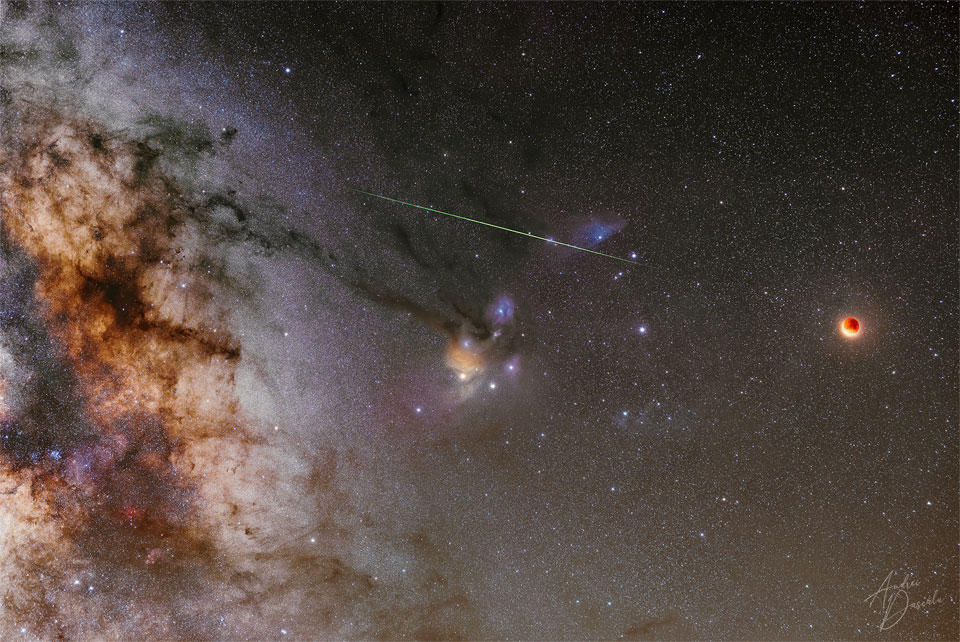
The plan was to capture a picturesque part of the sky that was hosting an unusual guest. The result included a bonus — an additional and unexpected guest. The beautiful background features part of the central band of our Milky Way galaxy on the far left, and the colorful clouds of Rho Ophiuchi in the image center. The unusual guest, a dimmed and reddened Moon on the right, was expected because the image was taken during last week’s total lunar eclipse. The timing had to be right because the Moon — both before and after eclipse — would be so bright it would overwhelm the background. The unexpected guest was the bright meteor across the image center. The fleeting meteor streak was captured on only one of the 10 consecutively-captured deep-field images from La Palma in the Spanish Canary Islands, while the eclipsed Moon image was taken immediately afterwards with the same camera and from the same location. The next total lunar eclipse — also quite expected — will occur in early November. Notable Submissions to APOD: Total Lunar Eclipse of 2022 May
© Andrei Ionut Dascalu — used with the credit NASA publishes
2021
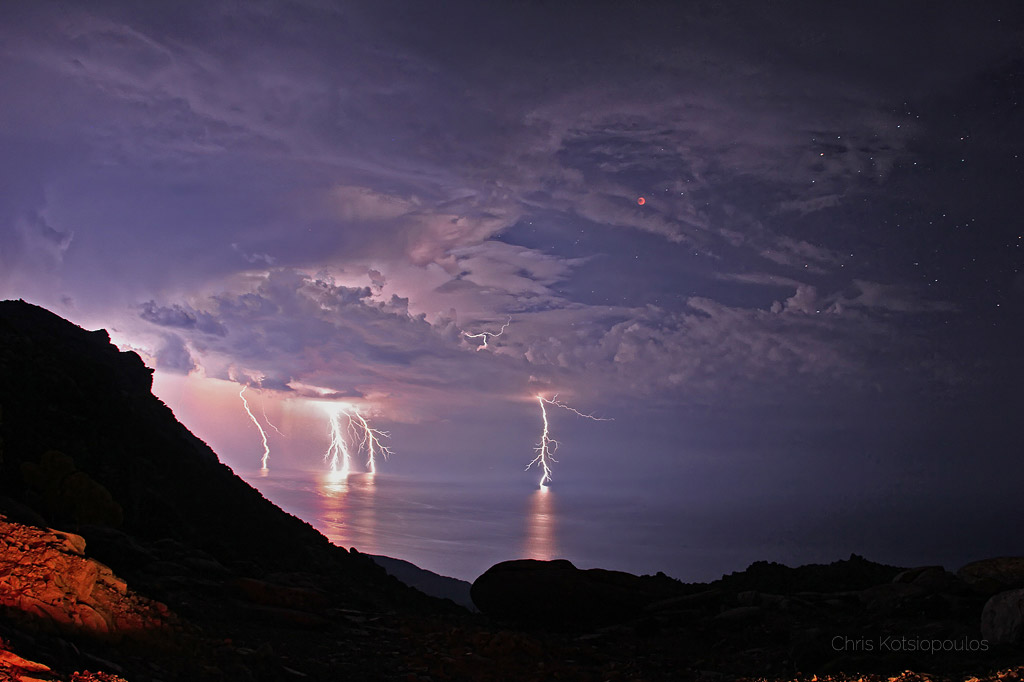
Thunderstorms almost spoiled this view of the spectacular 2011 June 15 total lunar eclipse. Instead, storm clouds parted for 10 minutes during the total eclipse phase and lightning bolts contributed to the dramatic sky. Captured with a 30-second exposure the scene also inspired one of the more memorable titles (thanks to the astrophotographer) in APOD's now 25-year history. Of course, the lightning reference clearly makes sense, and the shadow play of the dark lunar eclipse was widely viewed across planet Earth in Europe, Africa, Asia, and Australia. The picture itself, however, was shot from the Greek island of Ikaria at Pezi. That area is known as "the planet of the goats" because of the rough terrain and strange looking rocks. The next total lunar eclipse will occur on Wednesday. Details: Total Lunar Eclipse on 2021 May 26
© Chris Kotsiopoulos (GreekSky) — used with the credit NASA publishes


1962
Project Mercury: American astronaut Scott Carpenter orbited the Earth three times in the Aurora 7 space capsule.
Project Mercury ↗1962
Project Mercury: American astronaut Scott Carpenter orbits the Earth three times in the Aurora 7 space capsule.
Project Mercury ↗Event text and thumbnails come from Wikipedia and are used under CC BY-SA 4.0. Images are drawn only from Wikimedia Commons, which does not accept non-free content — each thumbnail links to its file page, where its licence and author are recorded.
Launch records are from The Space Devs’ Launch Library 2. This archive is still being mirrored, so some days are incomplete. Pictures are NASA’s Astronomy Picture of the Day; NASA imagery is generally not subject to copyright, but individual APOD entries are frequently the property of the photographer, and each caption says which applies.
General-audience astronomy and spaceflight — none of it a textbook.
As an Amazon Associate I earn from qualifying purchases. Links here cost you nothing extra.
LISTING
Still the best single argument for why any of this matters, and it leaves the arithmetic in. For a reader who wants the science, not just the awe.
LISTING
The case for leaving Earth, written by someone unsentimental about how hard that is. Suits readers who want the argument rather than the poster.
LISTING
Hard-SF problem solving in The Martian's key — for anyone who liked the engineering more than the peril. The only novel on this list.
BROWSE opens an Amazon search, not a specific recommendation.
LINKS AMAZON.COM