Launches
NO DATA0MISSIONS
The launch archive is still being mirrored, so this day has no launches listed yet.
ARCHIVE // DAY OF YEAR
Wikipedia records 2 spaceflight and astronomy events on May 13. Below are the pictures NASA published on May 13 in 6 different years — each one taken or released on this exact date.
0MISSIONS
The launch archive is still being mirrored, so this day has no launches listed yet.
2ENTRIES
Spaceflight and astronomy entries from Wikipedia's record of this date, oldest first — from 1861 onward.
6IMAGES
NASA's Astronomy Picture of the Day for May 13, one per year. Some are public domain and some belong to the photographer — each says which.
NASA’s Astronomy Picture of the Day, for this calendar date in each of the last several years.
2026
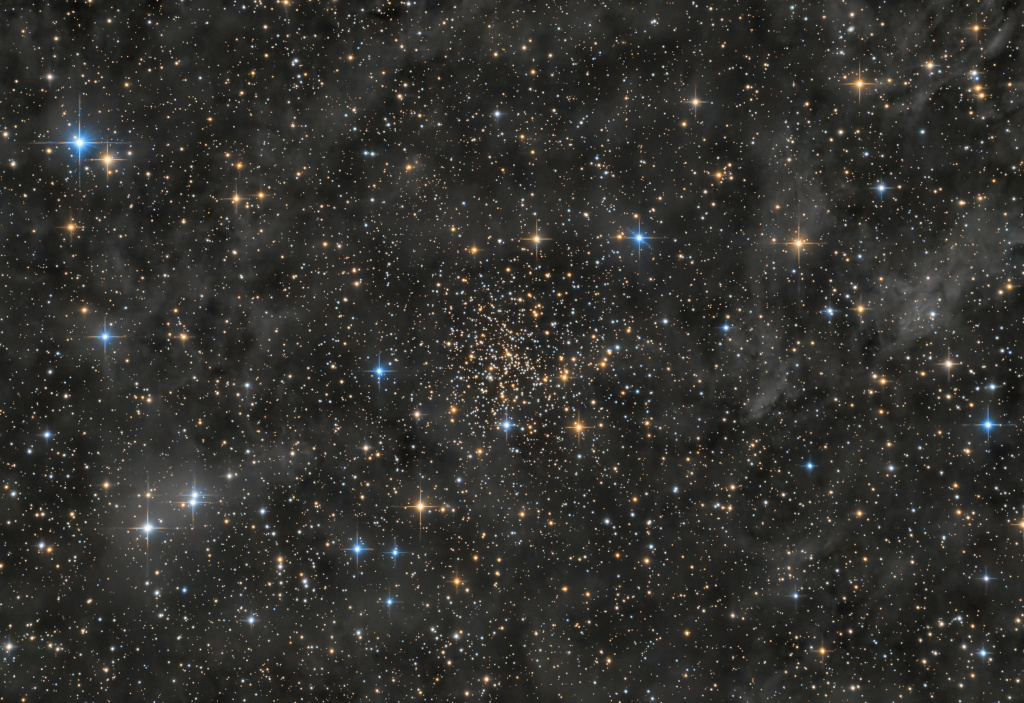
The New General Catalog of star clusters and nebulae really isn't so new. In fact, it was published in 1888 - an effort by J. L. E. Dreyer to consolidate the work of astronomers William, Caroline, and John Herschel along with others into a useful single, complete catalog of astronomical discoveries and measurements. Dreyer's work was largely successful and is still important today, as this famous catalog continues to lend its "NGC" to bright clusters, galaxies, and nebulae. Take for example the star cluster known as NGC 188 (item number 188 in the NGC compilation). It lies about 6,000 light-years distant in the northern constellation Cepheus and represents a galactic or open star cluster. With an age of about 7 billion years, NGC 188 is old for an open cluster. Its old, evolved red giant stars have yellowish hues in this colorful, deep sky view. NGC 188 also enjoys the designation Caldwell 1 in a modern compilation of deep sky objects. Located well above the plane of the Milky Way and seen in the direction of planet Earth's north celestial pole, the ancient stellar group is known to some as the Polarissima Cluster.
© Neven Krcmarek — used with the credit NASA publishes

2025
What does our Milky Way Galaxy look like from the top? Because we are on the inside, humanity can’t get an actual picture. Recently, however, just such a map has been made using location data for over a billion stars from ESA’s Gaia mission. The resulting featured illustration shows that just like many other spiral galaxies, our Milky Way has distinct spiral arms. Our Sun and most of the bright stars we see at night are in just one arm: Orion. Gaia data bolsters previous indications that our Milky Way has more than two spiral arms. Our Galaxy's center sports a prominent bar. The colors of our Galaxy's thin disk derive mostly from dark dust, bright blue stars, and red emission nebula. Although data analysis is ongoing, Gaia was deactivated in March after a successful mission. Jigsaw Challenge: Astronomy Puzzle of the Day
NASA · public domain
2024
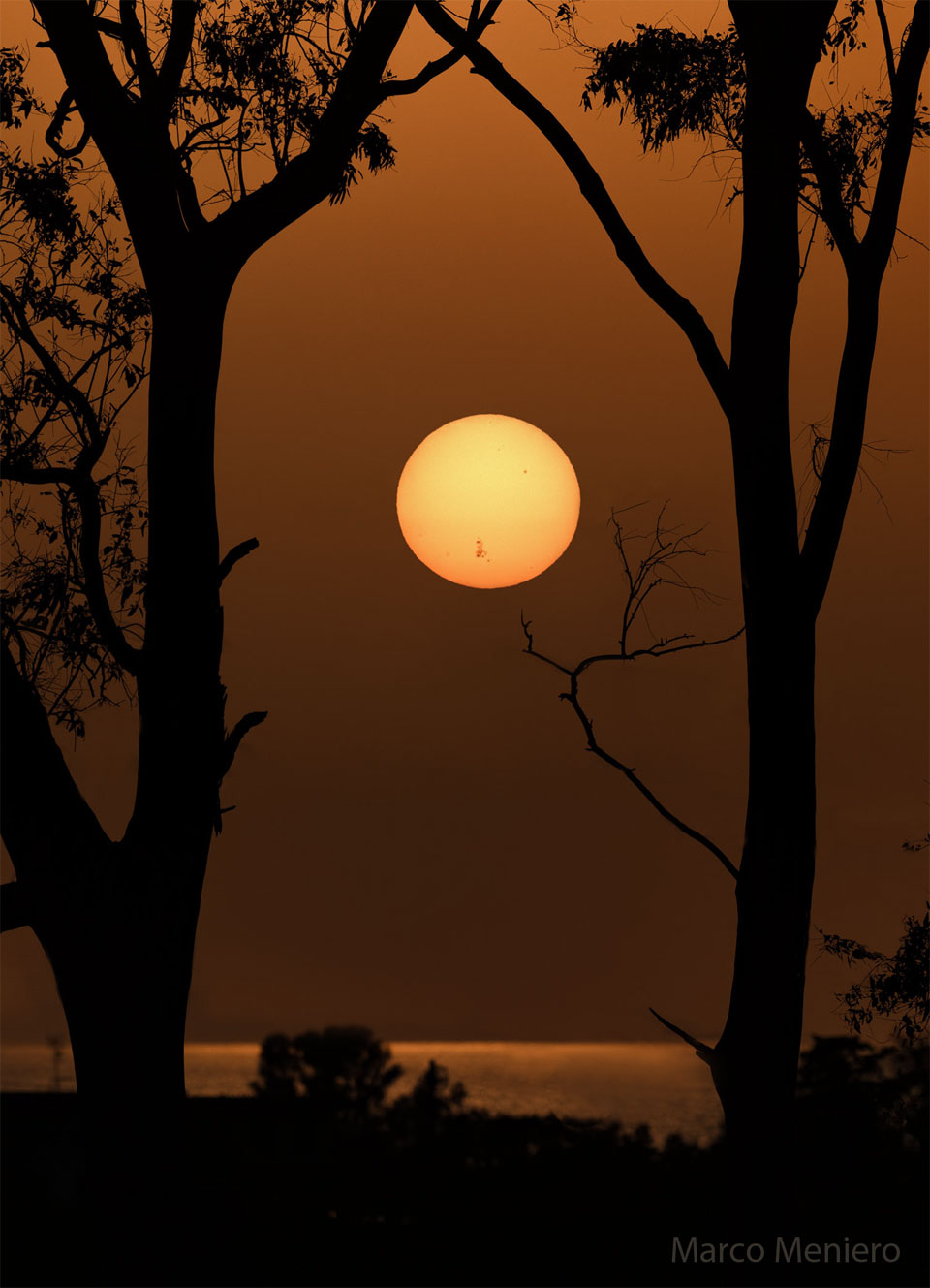
It was larger than the Earth. It was so big you could actually see it on the Sun's surface without magnification. It contained powerful and tangled magnetic fields as well as numerous dark sunspots. Labelled AR 3664, it developed into one of the most energetic areas seen on the Sun in recent years, unleashing a series of explosions that led to a surge of energetic particles striking the Earth, which created beautiful auroras. And might continue. Although active regions on the Sun like AR 3664 can be quite dangerous, this region's Coronal Mass Ejections have not done, as yet, much damage to Earth-orbiting satellites or Earth-surface electrical grids. Pictured, the enormous active region was captured on the setting Sun a few days ago from Civitavecchia, Rome, Italy. The composite image includes a very short exposure taken of just the Sun's surface, but mimics what was actually visible. Finally, AR 3664 is now rotating away from the Earth, although the region may survive long enough to come around again. Gallery: Earth Aurora from Solar Active Region 3664
© Marco Meniero — used with the credit NASA publishes
2023
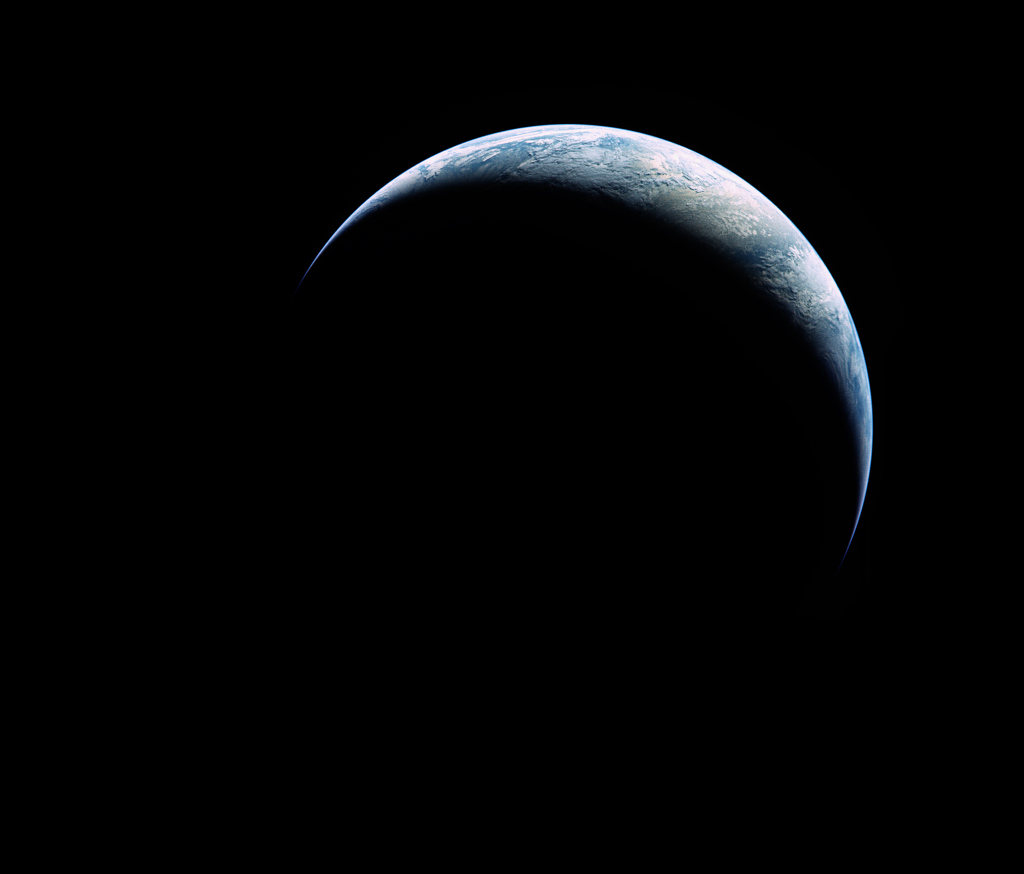
Our fair planet sports a curved, sunlit crescent against the black backdrop of space in this stunning photograph. From the unfamiliar perspective, the Earth is small and, like a telescopic image of a distant planet, the entire horizon is completely within the field of view. Enjoyed by crews on board the International Space Station, only much closer views of the planet are possible from low Earth orbit. Orbiting the planet once every 90 minutes, a spectacle of clouds, oceans, and continents scrolls beneath them with the partial arc of the planet's edge in the distance. But this digitally restored image presents a view so far only achieved by 24 humans, Apollo astronauts who traveled to the Moon and back again between 1968 and 1972. The original photograph, AS17-152-23420, was taken by the homeward bound crew of Apollo 17, on December 17, 1972. For now it is the last picture of Earth from this planetary perspective taken by human hands.
NASA · public domain
2022
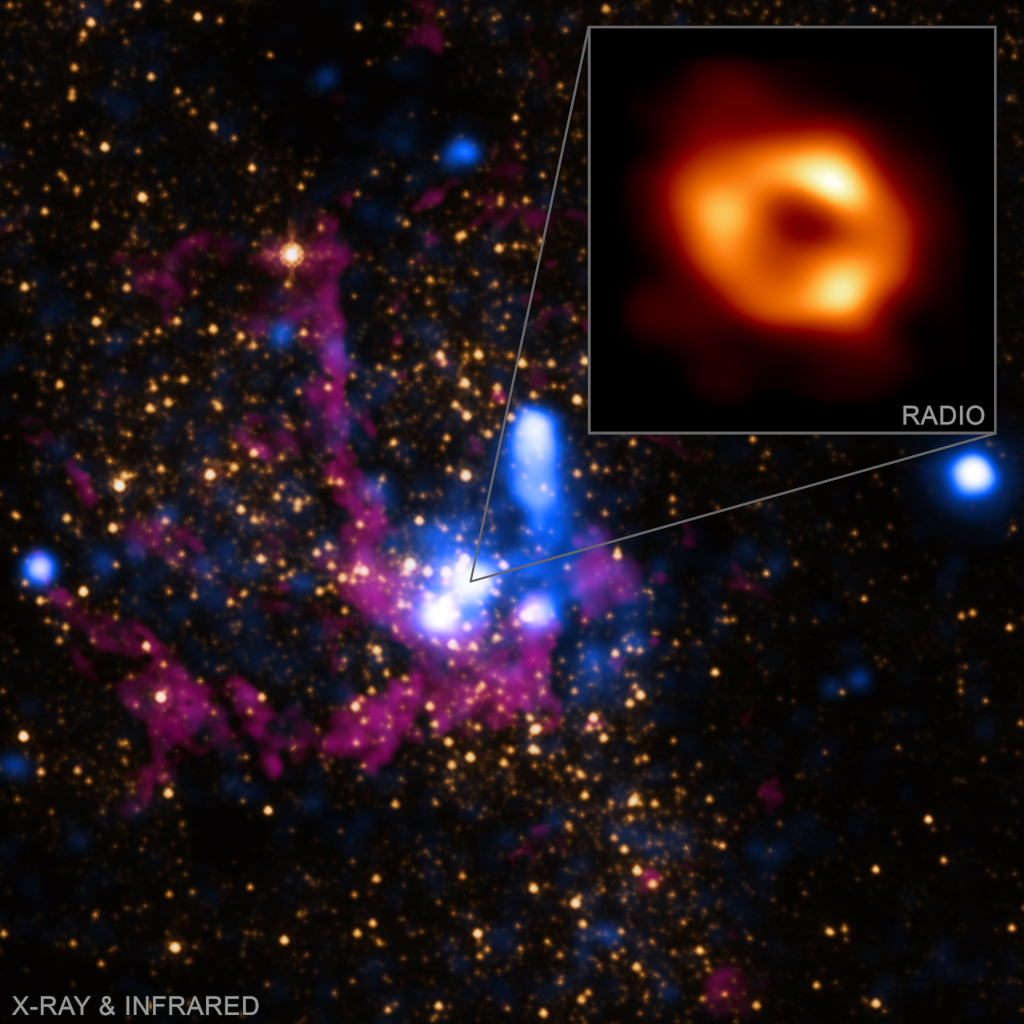
There's a black hole at the center of the Milky Way. Stars are observed to orbit a very massive and compact object there known as Sgr A* (say "sadge-ay-star"). But this just released radio image (inset) from planet Earth's Event Horizon Telescope is the first direct evidence of the Milky Way's central black hole. As predicted by Einstein's Theory of General Relativity, the four million solar mass black hole's strong gravity is bending light and creating a shadow-like dark central region surrounded by a bright ring-like structure. Supporting observations made by space-based telescopes and ground-based observatories provide a wider view of the galactic center's dynamic environment and an important context for the Event Horizon Telescope's black hole image. The main panel image shows the X-ray data from Chandra and infrared data from Hubble. While the main panel is about 7 light-years across, the Event Horizon Telescope inset image itself spans a mere 10 light-minutes at the center of our galaxy, some 27,000 light-years away.
NASA · public domain
2021
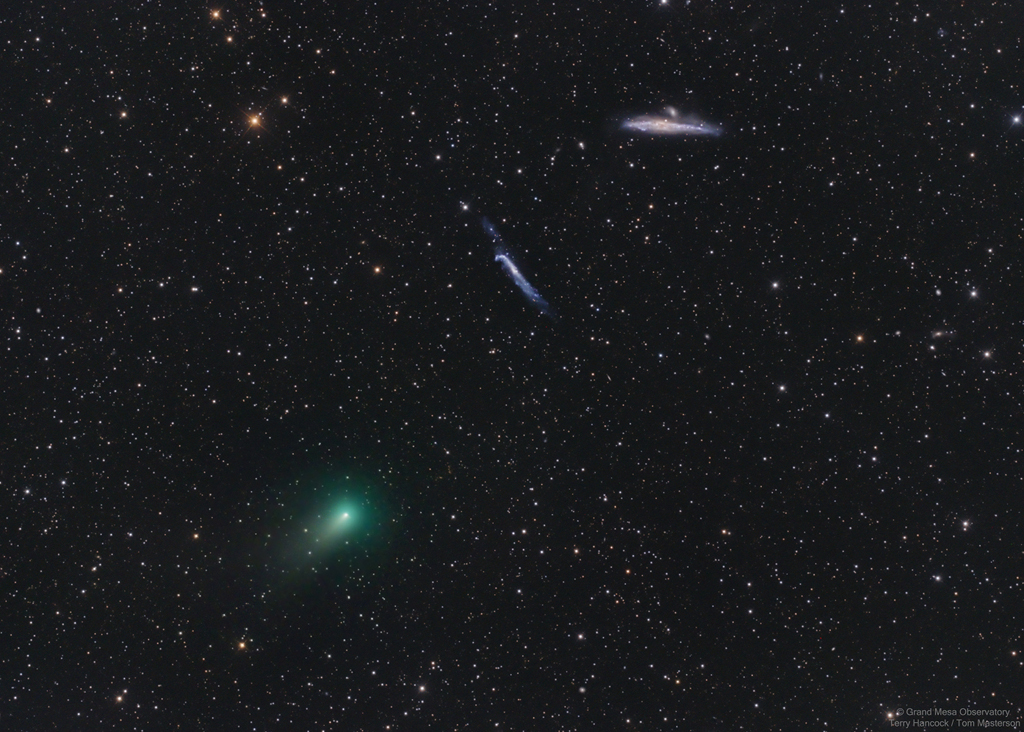
Closest to the Sun on March 1, and closest to planet Earth on April 23, this Comet ATLAS (C/2020 R4) shows a faint greenish coma and short tail in this pretty, telescopic field of view. Captured at its position on May 5, the comet was within the boundaries of northern constellation Canes Venatici (the Hunting Dogs), and near the line-of-sight to intriguing background galaxies popularly known as the Whale and the Hockey Stick. Cetacean in appearance but Milky Way sized, NGC 4631 is a spiral galaxy seen edge-on at the top right, some 25 million light-years away. NGC 4656/7 sports the bent-stick shape of interacting galaxies below and left of NGC 4631. In fact, the distortions and mingling trails of gas detected at other wavelengths suggest the cosmic Whale and Hockey Stick have had close encounters with each other in their distant past. Outbound and only about 7 light-minutes from Earth this Comet ATLAS should revisit the inner solar system in just under 1,000 years.
© Grand Mesa Observatory — used with the credit NASA publishes

1861
The Great Comet of 1861 is discovered by John Tebbutt of Windsor, New South Wales, Australia.
C/1861 J1 (Tebbutt) ↗
1913
The Russian inventor Igor Sikorsky flew the self-designed Russky Vityaz, the world's first four-engine fixed-wing aircraft.
Igor Sikorsky ↗Event text and thumbnails come from Wikipedia and are used under CC BY-SA 4.0. Images are drawn only from Wikimedia Commons, which does not accept non-free content — each thumbnail links to its file page, where its licence and author are recorded.
Launch records are from The Space Devs’ Launch Library 2. This archive is still being mirrored, so some days are incomplete. Pictures are NASA’s Astronomy Picture of the Day; NASA imagery is generally not subject to copyright, but individual APOD entries are frequently the property of the photographer, and each caption says which applies.
General-audience astronomy and spaceflight — none of it a textbook.
As an Amazon Associate I earn from qualifying purchases. Links here cost you nothing extra.
LISTING
Still the best single argument for why any of this matters, and it leaves the arithmetic in. For a reader who wants the science, not just the awe.
LISTING
The case for leaving Earth, written by someone unsentimental about how hard that is. Suits readers who want the argument rather than the poster.
LISTING
Hard-SF problem solving in The Martian's key — for anyone who liked the engineering more than the peril. The only novel on this list.
BROWSE opens an Amazon search, not a specific recommendation.
LINKS AMAZON.COM