Launches
NO DATA0MISSIONS
The launch archive is still being mirrored, so this day has no launches listed yet.
ARCHIVE // DAY OF YEAR
Wikipedia records 5 spaceflight and astronomy events on May 3. Below are the pictures NASA published on May 3 in 6 different years — each one taken or released on this exact date.
0MISSIONS
The launch archive is still being mirrored, so this day has no launches listed yet.
5ENTRIES
Spaceflight and astronomy entries from Wikipedia's record of this date, oldest first — from 1715 onward.
6IMAGES
NASA's Astronomy Picture of the Day for May 3, one per year. Some are public domain and some belong to the photographer — each says which.
NASA’s Astronomy Picture of the Day, for this calendar date in each of the last several years.
2026
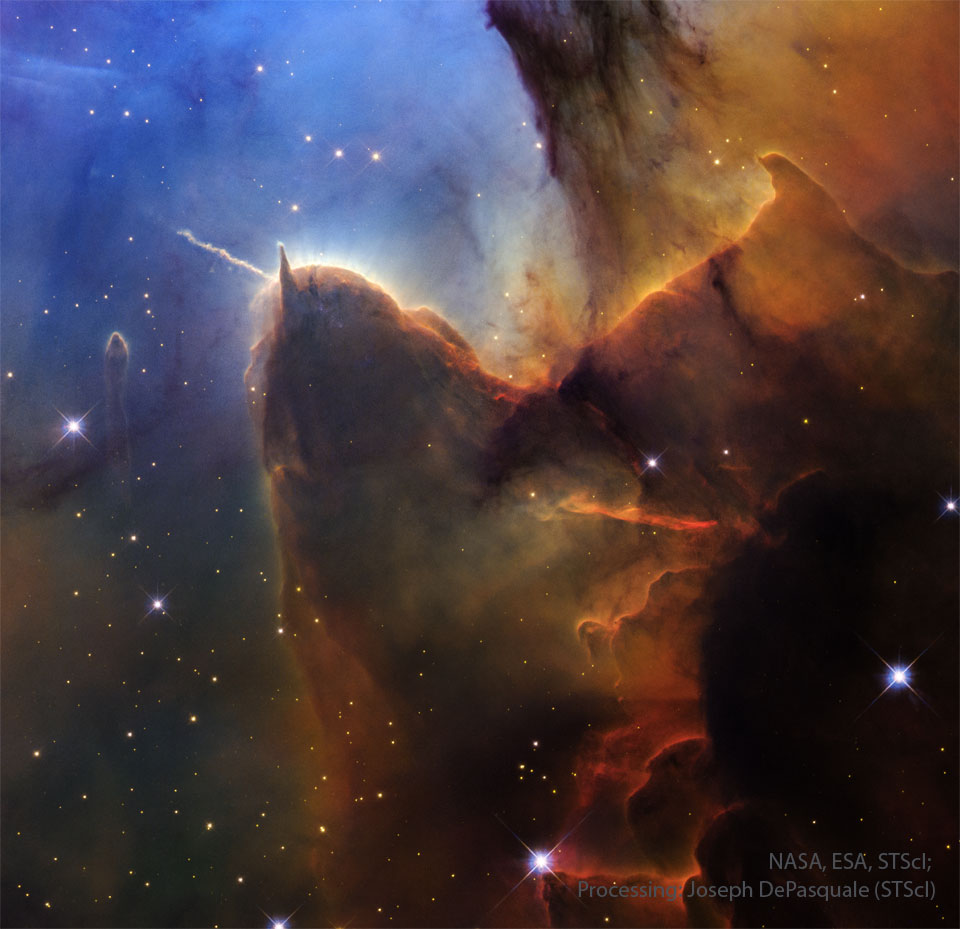
Dust pillars are like interstellar mountains. They survive because they are more dense than their surroundings, but they are slowly being eroded away by a hostile environment. Visible in the featured picture by the Hubble Space Telescope is the end of a huge gas and dust pillar in the Trifid Nebula (M20), punctuated by a smaller pillar pointing up and an unusual jet pointing to the upper left. Many of the bright dots are newly formed stars. A star near the small pillar's end is slowly being stripped of its accreting gas by radiation from a tremendously brighter star situated off the top of the image. The jet extends nearly a light-year and would not be visible without external illumination. As gas and dust evaporate from the pillars, the hidden stellar source of this jet will likely be uncovered, possibly over the next 20,000 years. Explore the Universe: Random APOD Generator
NASA · public domain
2025
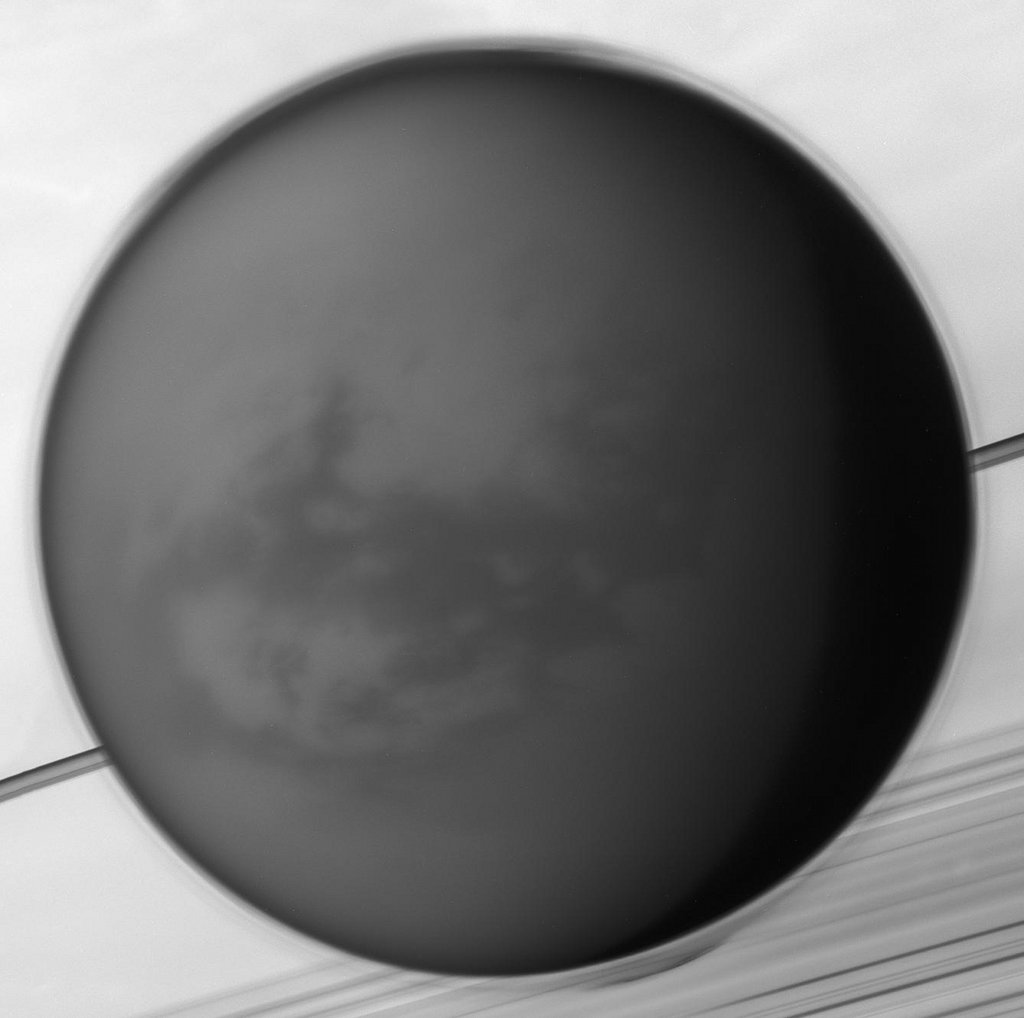
Like Earth's moon, Saturn's largest moon Titan is locked in synchronous rotation with its planet. This mosaic of images recorded by the Cassini spacecraft in May of 2012 shows its anti-Saturn side, the side always facing away from the ringed gas giant. The only moon in the solar system with a dense atmosphere, Titan is the only solar system world besides Earth known to have standing bodies of liquid on its surface and an earthlike cycle of liquid rain and evaporation. Its high altitude layer of atmospheric haze is evident in the Cassini view of the 5,000 kilometer diameter moon over Saturn's rings and cloud tops. Near center is the dark dune-filled region known as Shangri-La. The Cassini-delivered Huygens probe rests below and left of center, after the most distant landing for a spacecraft from Earth.
NASA · public domain
2024
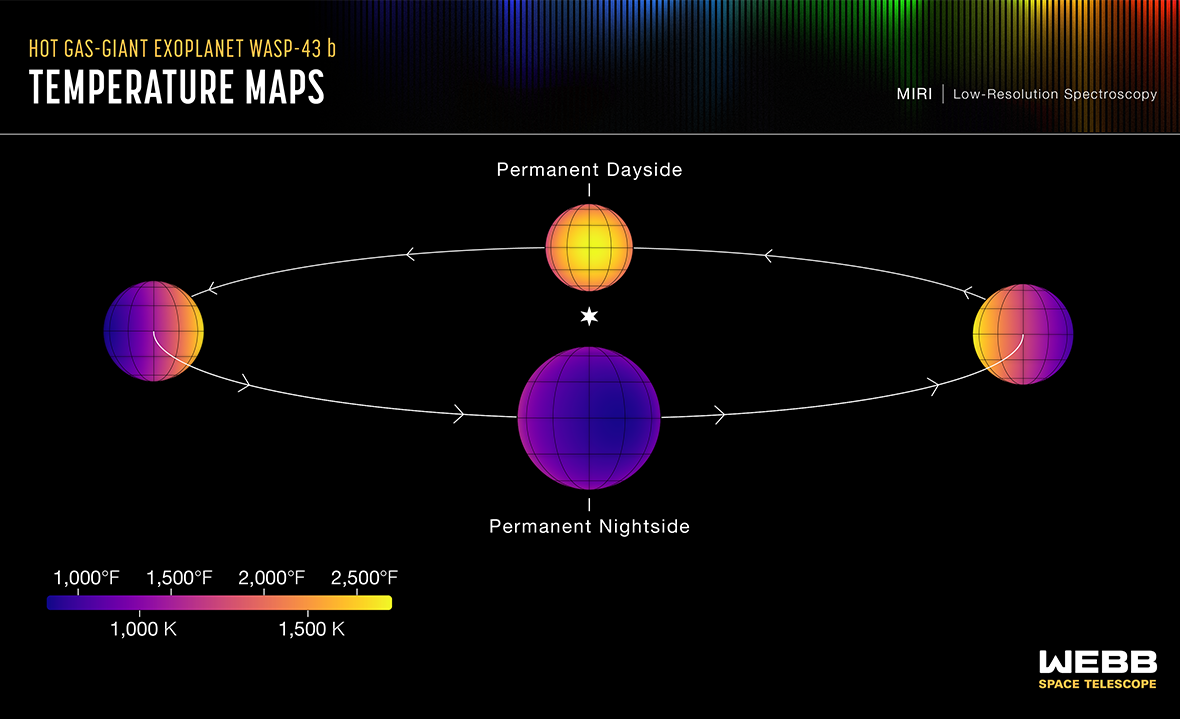
A mere 280 light-years from Earth, tidally locked, Jupiter-sized exoplanet WASP-43b orbits its parent star once every 0.8 Earth days. That puts it about 2 million kilometers (less than 1/25th the orbital distance of Mercury) from a small, cool sun. Still, on a dayside always facing its parent star, temperatures approach a torrid 2,500 degrees F as measured at infrared wavelengths by the MIRI instrument on board the James Webb Space Telescope. In this illustration of the hot exoplanet's orbit, Webb measurements also show nightside temperatures remain above 1,000 degrees F. That suggests that strong equatorial winds circulate the dayside atmospheric gases to the nightside before they can completely cool off. Exoplanet WASP-43b is now formally known as Astrolábos, and its K-type parent star has been christened Gnomon. Webb's infrared spectra indicate water vapor is present on the nightside as well as the dayside of the planet, providing information about cloud cover on Astrolábos.
NASA · public domain
2023
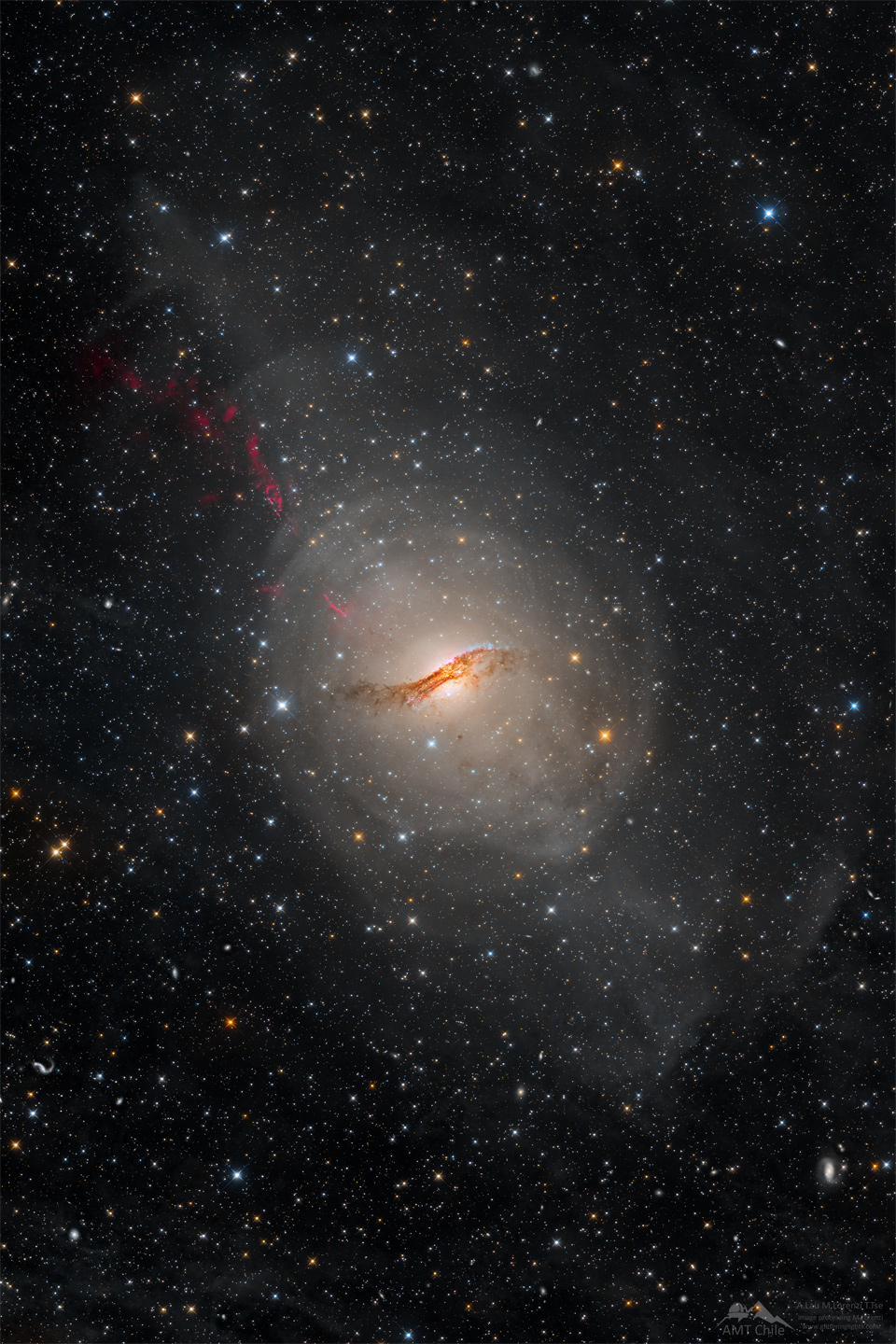
Galaxies are fascinating. In galaxies, gravity alone holds together massive collections of stars, dust, interstellar gas, stellar remnants and dark matter. Pictured is NGC 5128, better known as Centaurus A. Cen A is the fifth brightest galaxy on the sky and is located at a distance of about 12 million light years from Earth. The warped shape of Cen A is the result of a merger between an elliptical and a spiral galaxy. Its active galactic nucleus harbors a supermassive black hole that is about 55 million times more massive than our Sun. This central black hole ejects a fast jet visible in both radio and X-ray light. Filaments of the jet are visible in red in the upper left. New observations by the Event Horizon Telescope have revealed a brightening of the jet only towards its edges -- but for reasons that are currently unknown and an active topic of research. At NASA it's: Black Hole Week
© Marco Lorenzi, Angus Lau & Tommy Tse; Text: Natalia Lewandowska (SUNY Oswego) — used with the credit NASA publishes
2022
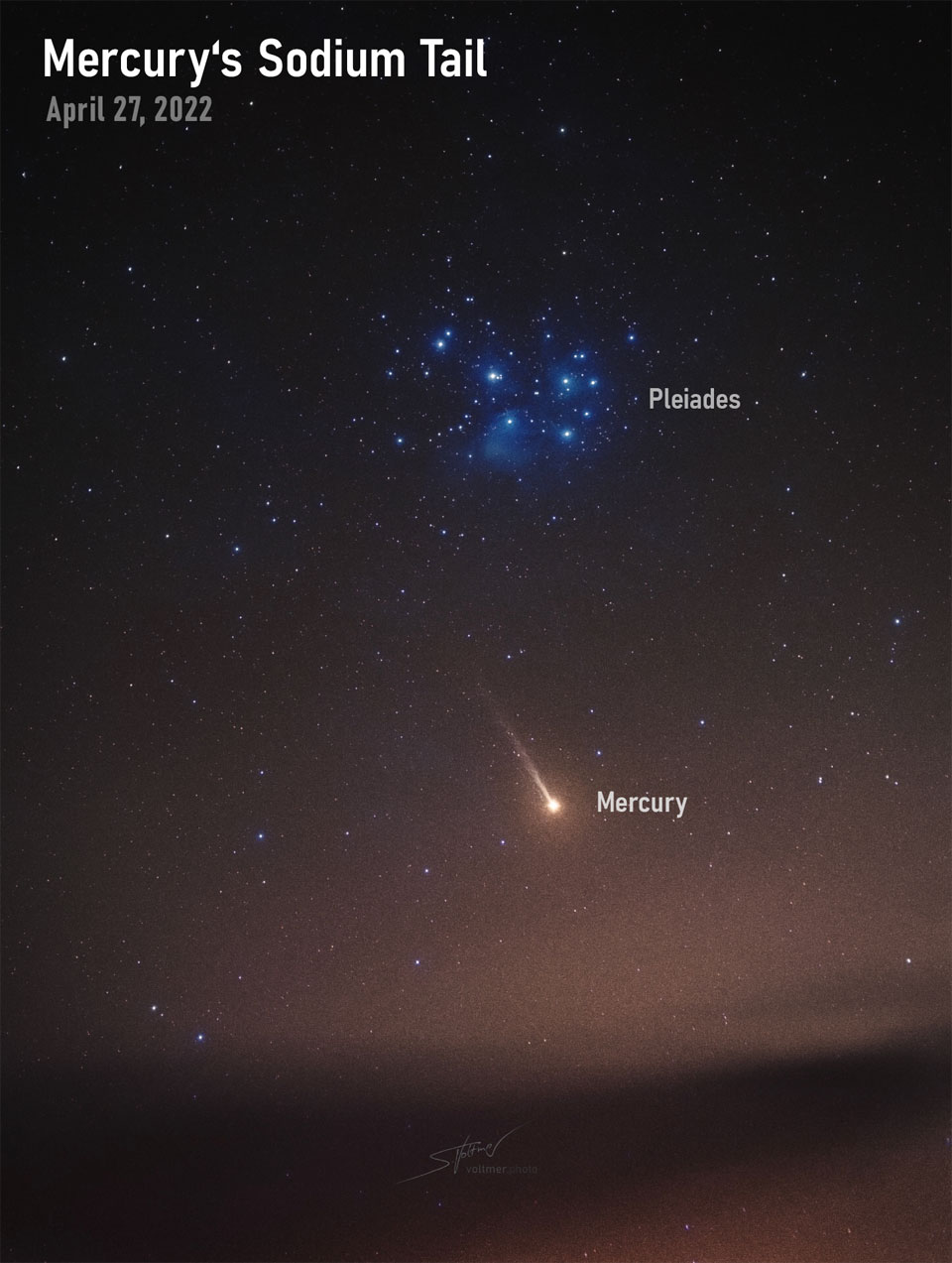
That's no comet. Below the Pleiades star cluster is actually a planet: Mercury. Long exposures of our Solar System's innermost planet may reveal something unexpected: a tail. Mercury's thin atmosphere contains small amounts of sodium that glow when excited by light from the Sun. Sunlight also liberates these atoms from Mercury's surface and pushes them away. The yellow glow from sodium, in particular, is relatively bright. Pictured, Mercury and its sodium tail are visible in a deep image taken last week from La Palma, Spain through a filter that primarily transmits yellow light emitted by sodium. First predicted in the 1980s, Mercury's tail was first discovered in 2001. Many tail details were revealed in multiple observations by NASA's robotic MESSENGER spacecraft that orbited Mercury between 2011 and 2015. Tails, of course, are usually associated with comets.
© Sebastian Voltmer — used with the credit NASA publishes
2021
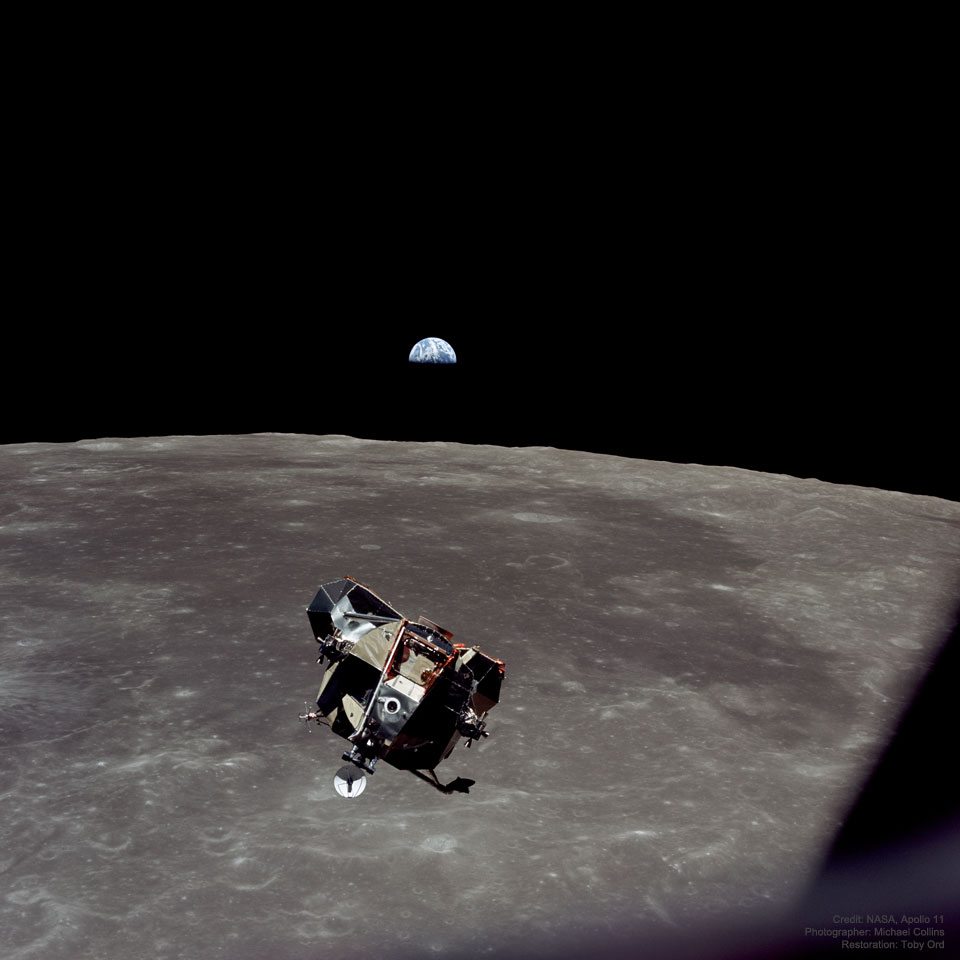
After the most famous voyage of modern times, it was time to go home. After proving that humanity has the ability to go beyond the confines of planet Earth, the first humans to walk on another world -- Neil Armstrong and Buzz Aldrin -- flew the ascent stage of their Lunar Module back to meet Michael Collins in the moon-orbiting Command and Service Module. Pictured here on 1969 July 21 and recently digitally restored, the ascending spaceship was captured by Collins making its approach, with the Moon below, and Earth far in the distance. The smooth, dark area on the lunar surface is Mare Smythii located just below the equator on the extreme eastern edge of the Moon's near side. It is said of this iconic image that every person but one was in front of the camera. - NASA Remembers Michael Collins -
NASA · public domain

1715
A total solar eclipse is visible across northern Europe and northern Asia, as predicted by Edmond Halley to within four minutes accuracy.
Solar eclipse of May 3, 1715 ↗
1811
The Anglo-Portuguese army under Lord Wellington tries to halt a larger French army under Marshal Masséna marching to relieve Almeida in the Battle of Fuentes de Oñoro. After intense fighting, the French are repulsed.
Arthur Wellesley, 1st Duke of Wellington ↗
1939
Subhas Chandra Bose formed the All India Forward Bloc, a faction within the Indian National Congress, in opposition to Gandhi's tactics of nonviolence.
Subhas Chandra Bose ↗

2000
The sport of geocaching begins, with the first cache placed and the coordinates from a GPS posted on Usenet.
Geocaching ↗Event text and thumbnails come from Wikipedia and are used under CC BY-SA 4.0. Images are drawn only from Wikimedia Commons, which does not accept non-free content — each thumbnail links to its file page, where its licence and author are recorded.
Launch records are from The Space Devs’ Launch Library 2. This archive is still being mirrored, so some days are incomplete. Pictures are NASA’s Astronomy Picture of the Day; NASA imagery is generally not subject to copyright, but individual APOD entries are frequently the property of the photographer, and each caption says which applies.
General-audience astronomy and spaceflight — none of it a textbook.
As an Amazon Associate I earn from qualifying purchases. Links here cost you nothing extra.
LISTING
Still the best single argument for why any of this matters, and it leaves the arithmetic in. For a reader who wants the science, not just the awe.
LISTING
The case for leaving Earth, written by someone unsentimental about how hard that is. Suits readers who want the argument rather than the poster.
LISTING
Hard-SF problem solving in The Martian's key — for anyone who liked the engineering more than the peril. The only novel on this list.
BROWSE opens an Amazon search, not a specific recommendation.
LINKS AMAZON.COM