Launches
NO DATA0MISSIONS
The launch archive is still being mirrored, so this day has no launches listed yet.
ARCHIVE // DAY OF YEAR
Below are the pictures NASA published on April 27 in 6 different years — each one taken or released on this exact date.
0MISSIONS
The launch archive is still being mirrored, so this day has no launches listed yet.
0ENTRIES
Wikipedia records no spaceflight or astronomy event on this date.
6IMAGES
NASA's Astronomy Picture of the Day for April 27, one per year. Some are public domain and some belong to the photographer — each says which.
NASA’s Astronomy Picture of the Day, for this calendar date in each of the last several years.
2026
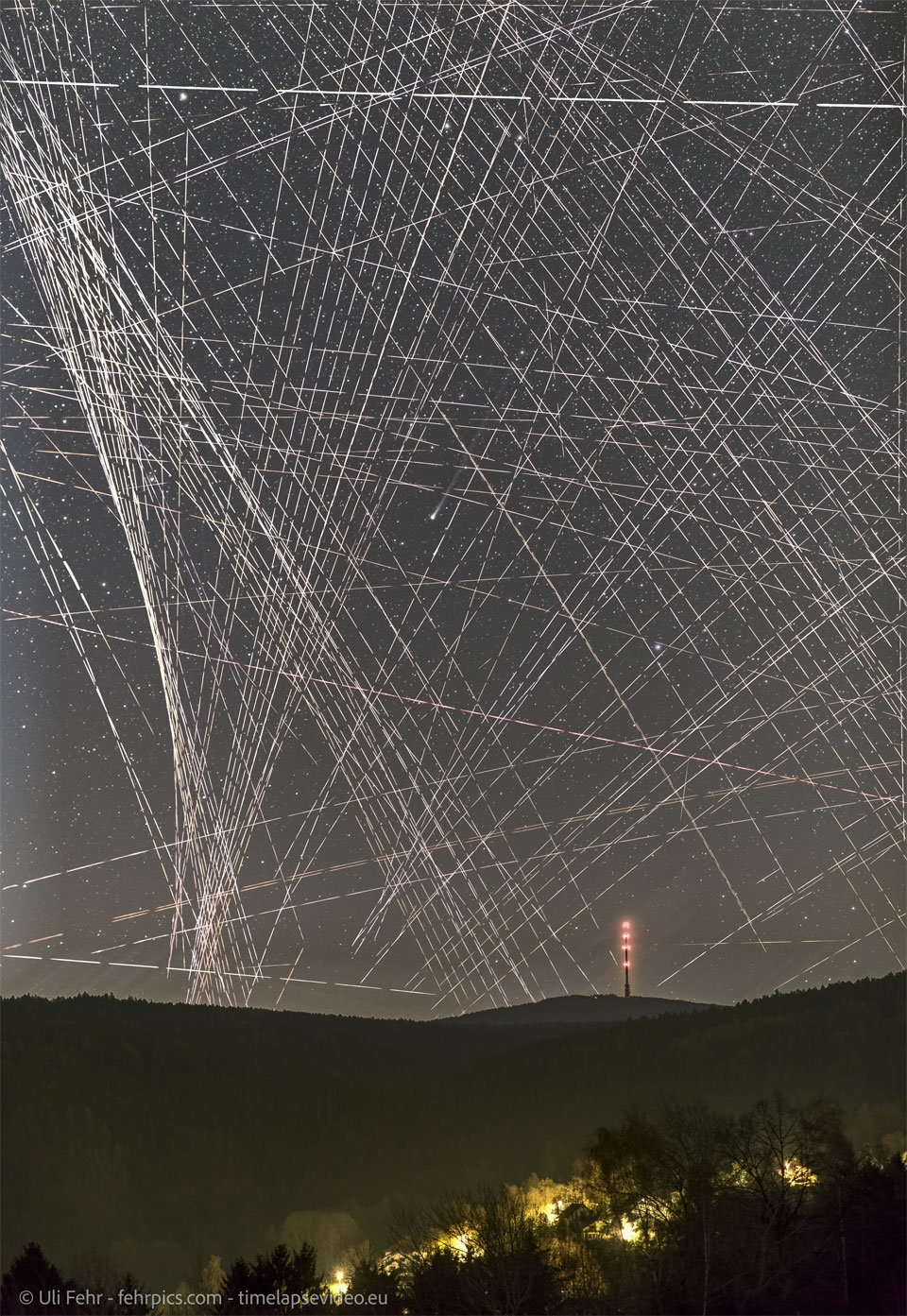
Can you find the comet? Somewhere through this web of satellite trails is Comet C/2025 R3 (PanSTARRS), a bright visitor passing through the inner Solar System. Now, the orbiting satellites themselves only appear as streaks because of the long camera exposure, over 10 minutes in this case. On the contrary, to the eye, satellites appear as points that drift slowly across the night sky and shine by reflecting sunlight -- primarily just after sunset and before sunrise. The featured image was taken just before sunrise two weeks ago from Bavaria, Germany. Presently, Comet R3 PanSTARRS is hard to see for even another reason -- because it is so (angularly) close to the Sun. As the comet rounds the Sun, it will be best seen in coming weeks from southern hemispheree skies, although then it will be heading out to interstellar space and fading. If you haven't yet found the comet, don't despair; please take a closer look just above the image center.
© Uli Fehr — used with the credit NASA publishes

2025
What is creating the strange texture of IC 418? Dubbed the Spirograph Nebula for its resemblance to drawings from a cyclical drawing tool, planetary nebula IC 418 shows patterns that are not well understood. Perhaps they are related to chaotic winds from the variable central star, which changes brightness unpredictably in just a few hours. By contrast, evidence indicates that only a few million years ago, IC 418 was probably a well-understood star similar to our Sun. Only a few thousand years ago, IC 418 was probably a common red giant star. Since running out of nuclear fuel, though, the outer envelope has begun expanding outward leaving a hot remnant core destined to become a white-dwarf star, visible in the image center. The light from the central core excites surrounding atoms in the nebula causing them to glow. IC 418 lies about 2000 light-years away and spans 0.3 light-years across. This false-color image taken from the Hubble Space Telescope reveals the unusual details.
NASA · public domain
2024
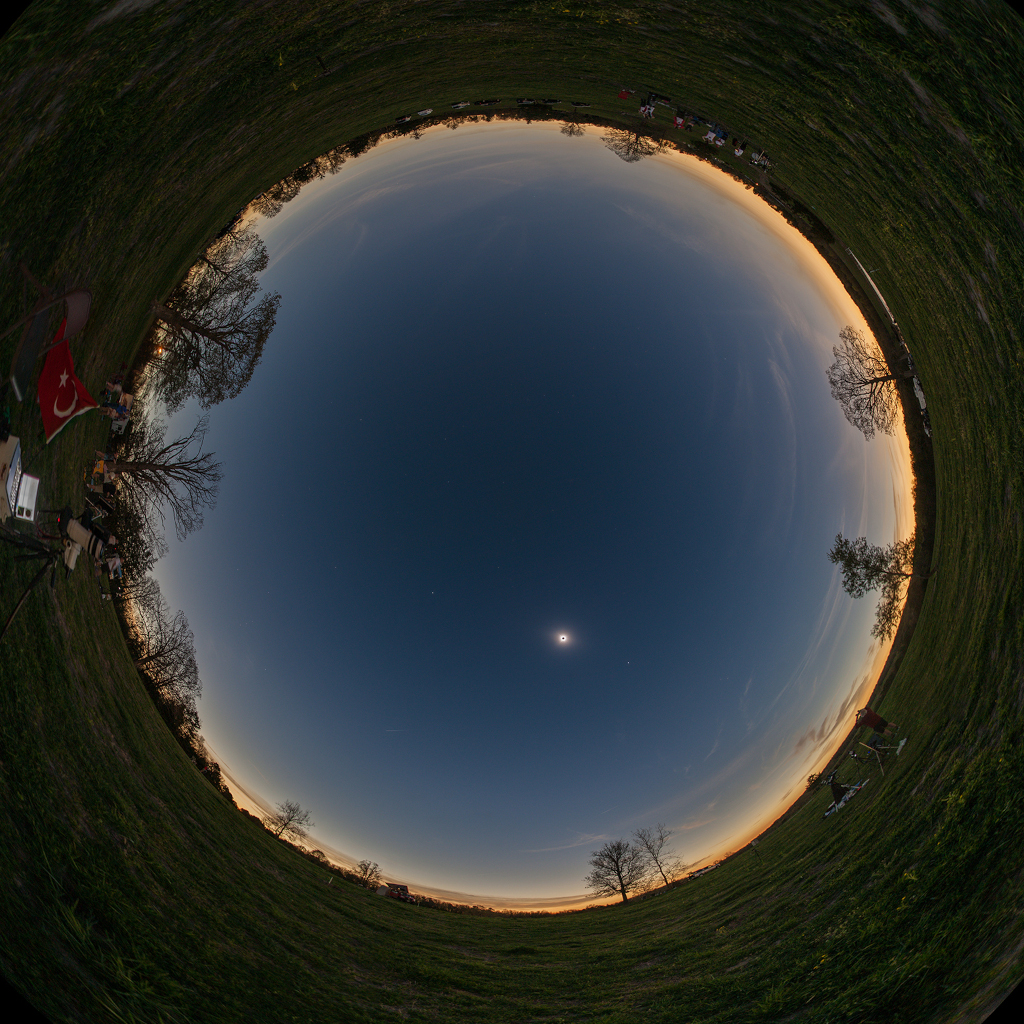
If the Sun is up but the sky is dark and the horizon is bright all around, you might be standing in the Moon's shadow during a total eclipse of the Sun. In fact, the all-sky Moon shadow shown in this composited panoramic view was captured from a farm near Shirley, Arkansas, planet Earth. The exposures were made under clear skies during the April 8 total solar eclipse. For that location near the center line of the Moon's shadow track, totality lasted over 4 minutes. Along with the solar corona surrounding the silhouette of the Moon planets and stars were visible during the total eclipse phase. Easiest to see here are bright planets Venus and Jupiter, to the lower right and upper left of the eclipsed Sun.
© Tunc Tezel — used with the credit NASA publishes
2023
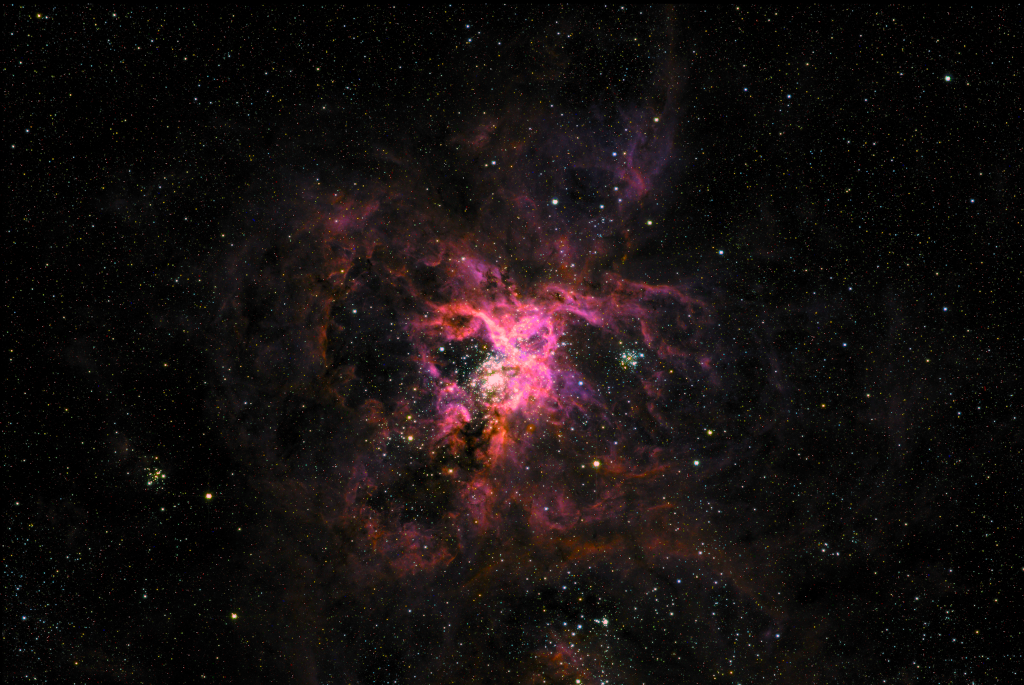
The Tarantula Nebula, also known as 30 Doradus, is more than a thousand light-years in diameter, a giant star forming region within nearby satellite galaxy the Large Magellanic Cloud. About 160 thousand light-years away, it's the largest, most violent star forming region known in the whole Local Group of galaxies. The cosmic arachnid is near the center of this spectacular image taken during the flight of SuperBIT (Super Pressure Balloon Imaging Telescope), NASA's balloon-borne 0.5 meter telescope now floating near the edge of space. Within the well-studied Tarantula (NGC 2070), intense radiation, stellar winds and supernova shocks from the central young cluster of massive stars, cataloged as R136, energize the nebular glow and shape the spidery filaments. Around the Tarantula are other star forming regions with young star clusters, filaments, and blown-out bubble-shaped clouds. SuperBIT's field of view spans about 1/3 of a degree in the southern constellation Dorado.
NASA · public domain
2022
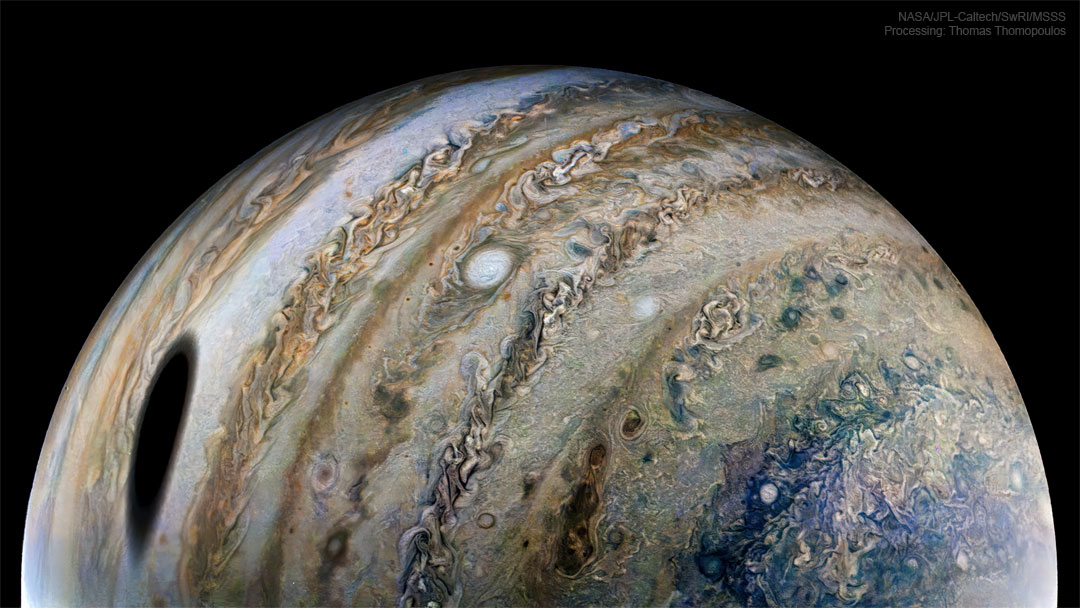
What is that large dark spot on Jupiter? It's the shadow of Ganymede, Jupiter's largest moon. When Jupiter's moons cross between the Jovian giant and the Sun, they created shadows just like when the Earth's moon crosses between the Earth and the Sun. Also like on Earth, if you were in a dark shadow on Jupiter, you would see a moon completely eclipse the Sun. Unlike on Earth, moon shadows occur most days on Jupiter -- what's more unusual is that a spacecraft was close enough to record one with a high-resolution image. That spacecraft, Juno, was passing so close to Jupiter in late February that nearby clouds and the dark eclipse shadow appear relatively large. Juno has made many discoveries about our Solar System's largest planet, including, recently, rapidly expanding circular auroras. Explore Your Universe: Random APOD Generator
NASA · public domain

2021
What happens if a star gets too close to a black hole? The black hole can rip it apart -- but how? It's not the high gravitational attraction itself that's the problem -- it's the difference in gravitational pull across the star that creates the destruction. In the featured animated video illustrating this disintegration, you first see a star approaching the black hole. Increasing in orbital speed, the star's outer atmosphere is ripped away during closest approach. Much of the star's atmosphere disperses into deep space, but some continues to orbit the black hole and forms an accretion disk. The animation then takes you into the accretion disk while looking toward the black hole. Including the strange visual effects of gravitational lensing, you can even see the far side of the disk. Finally, you look along one of the jets being expelled along the spin axis. Theoretical models indicate that these jets not only expel energetic gas, but create energetic neutrinos -- one of which may have been seen recently on Earth.
NASA · public domain
Event text and thumbnails come from Wikipedia and are used under CC BY-SA 4.0. Images are drawn only from Wikimedia Commons, which does not accept non-free content — each thumbnail links to its file page, where its licence and author are recorded.
Launch records are from The Space Devs’ Launch Library 2. This archive is still being mirrored, so some days are incomplete. Pictures are NASA’s Astronomy Picture of the Day; NASA imagery is generally not subject to copyright, but individual APOD entries are frequently the property of the photographer, and each caption says which applies.
General-audience astronomy and spaceflight — none of it a textbook.
As an Amazon Associate I earn from qualifying purchases. Links here cost you nothing extra.
LISTING
Still the best single argument for why any of this matters, and it leaves the arithmetic in. For a reader who wants the science, not just the awe.
LISTING
The case for leaving Earth, written by someone unsentimental about how hard that is. Suits readers who want the argument rather than the poster.
LISTING
Hard-SF problem solving in The Martian's key — for anyone who liked the engineering more than the peril. The only novel on this list.
BROWSE opens an Amazon search, not a specific recommendation.
LINKS AMAZON.COM