Launches
ON RECORD22MISSIONS
22 of them reached orbit. The earliest was 1969, the most recent 2026.
ARCHIVE // DAY OF YEAR
22 orbital launches flew on April 11, the earliest of them in 1969, and 22 reached orbit. Wikipedia records 2 spaceflight and astronomy events on April 11. Below are the pictures NASA published on April 11 in 6 different years — each one taken or released on this exact date.
22MISSIONS
22 of them reached orbit. The earliest was 1969, the most recent 2026.
2ENTRIES
Spaceflight and astronomy entries from Wikipedia's record of this date, oldest first — from 1964 onward.
6IMAGES
NASA's Astronomy Picture of the Day for April 11, one per year. Some are public domain and some belong to the photographer — each says which.
NASA’s Astronomy Picture of the Day, for this calendar date in each of the last several years.
2026
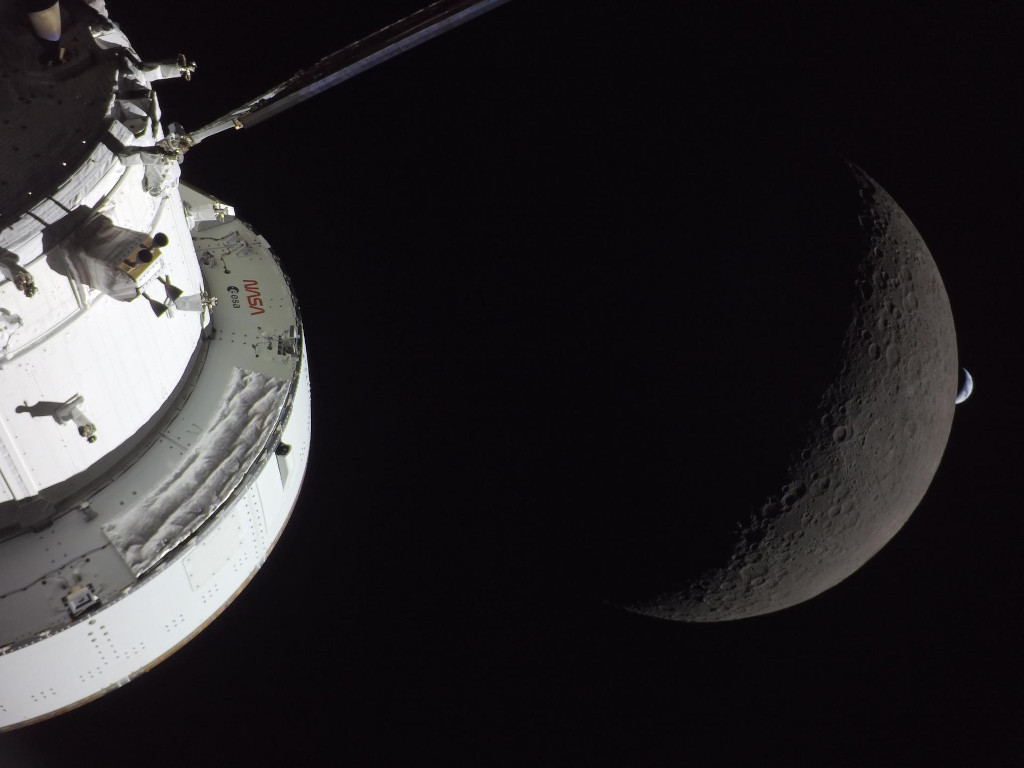
On flight day 6 (April 6) the Artemis II mission achieved a historic lunar flyby. Rounding the lunar far side, the deep space maneuver marked humanity's first venture to the Moon since Apollo 17 in 1972. The Orion spacecraft Integrity reached a maximum distance of nearly 407,000 kilometers, and the Artemis II crew, Reid Wiseman, Victor Glover, and Christina Koch, and Jeremy Hansen, set the record for the farthest distance from Earth traveled by any human since the Apollo 13 crew in 1970. From behind the Moon on flight day 6, a solar array wing camera recorded this space age selfie, framing the spacecraft and lunar far side. Planet Earth, home to the Artemis II crew, is the small, bright crescent beyond the lunar limb. The crew safely returned home on Artemis II mission flight day 10. Artemis II: Splashdown
NASA · public domain

2025
Made with a telescope shaded from bright sunlight by an umbrella, on April 5 a well-planned video captured a crescent Venus shining in clear daytime skies from Shoreline, Washington, USA at 11:57AM Pacific Time. It also caught the International Space Station in this single video frame. In close conjunction with the bright planet, the faint outline of the orbital outpost seen at a range of about 400 kilometers appears to be similar in size to the slender planetary crescent. Of course the ISS is much smaller than Venus. Now appearing as planet Earth's brilliant morning star and climbing above the eastern horizon in predawn skies, inner planet Venus was nearly 45 million kilometers from Shoreline.
© A.J. Smadi — used with the credit NASA publishes
2024
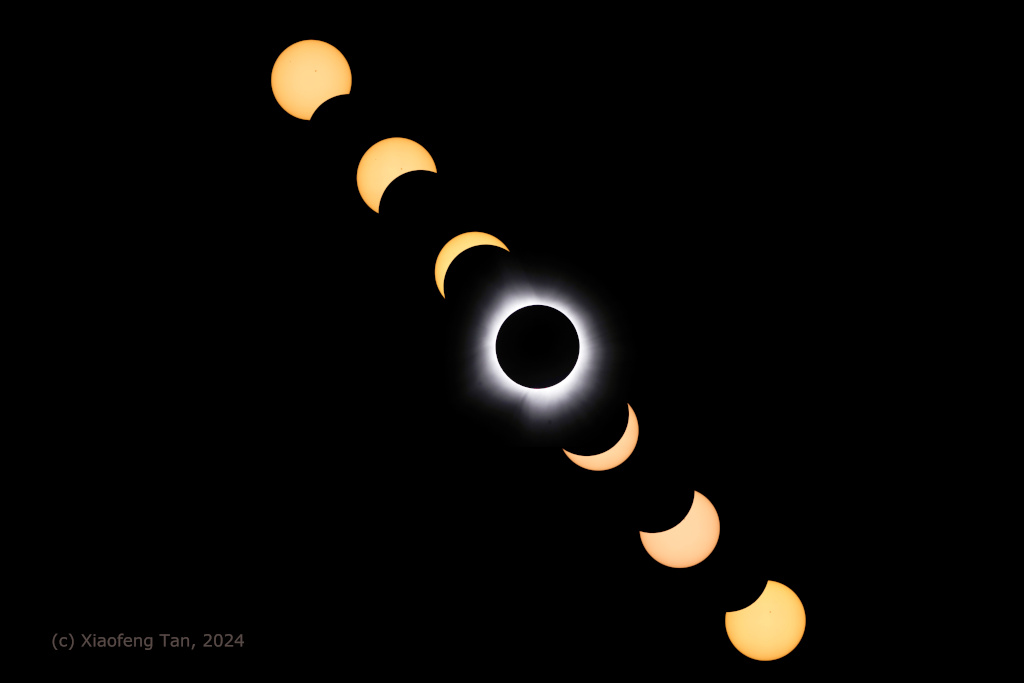
Start at the upper left above and you can follow the progress of April 8's total eclipse of the Sun in seven sharp, separate exposures. The image sequence was recorded with a telescope and camera located within the narrow path of totality as the Moon's shadow swept across Newport, Vermont, USA. At center is a spectacular view of the solar corona. The tenuous outer atmosphere of the Sun is only easily visible to the eye in clear dark skies during the total eclipse phase. Seen from Newport, the total phase for this solar eclipse lasted about 3 minutes and 26 seconds. Monday's Eclipse Imagery: Notable Submissions to APOD
© April 8's — used with the credit NASA publishes
2023
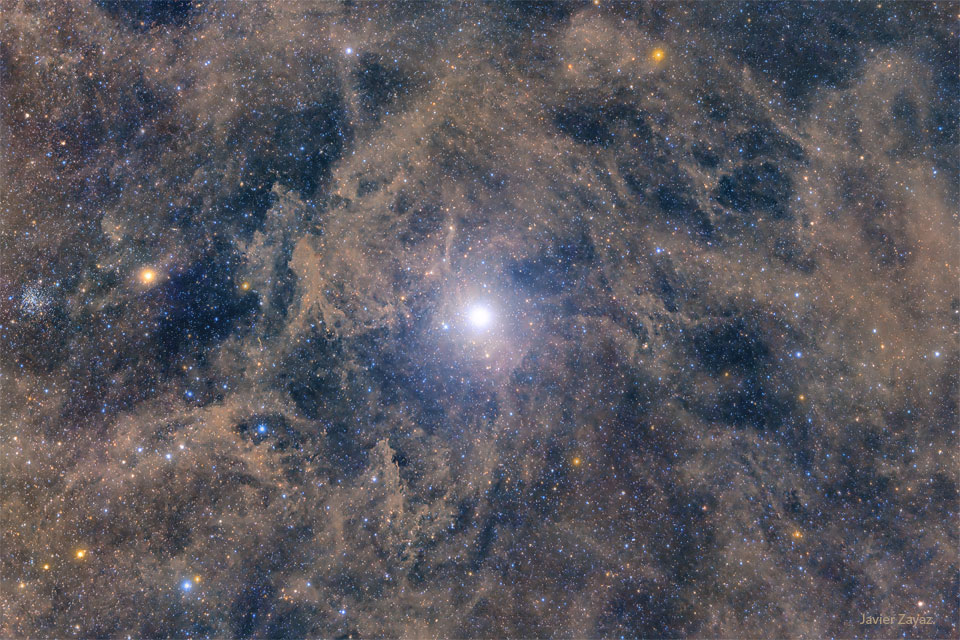
Why is Polaris called the North Star? First, Polaris is the nearest bright star toward the north spin axis of the Earth. Therefore, as the Earth turns, stars appear to revolve around Polaris, but Polaris itself always stays in the same northerly direction -- making it the North Star. Since no bright star is near the south spin axis of the Earth, there is currently no bright South Star. Thousands of years ago, Earth's spin axis pointed in a slightly different direction so that Vega was the North Star. Although Polaris is not the brightest star on the sky, it is easily located because it is nearly aligned with two stars in the cup of the Big Dipper. Polaris is near the center of the eight-degree wide featured image, a digital composite of hundreds of exposures that brings out faint gas and dust of the Integrated Flux Nebula (IFN) all over the frame as well as the globular star cluster NGC 188 on the far left. The surface of Cepheid Polaris slowly pulsates, causing the famous star to change its brightness by a few percent over the course of a few days. Explore Your Universe: Random APOD Generator
© Javier Zayaz — used with the credit NASA publishes
2022
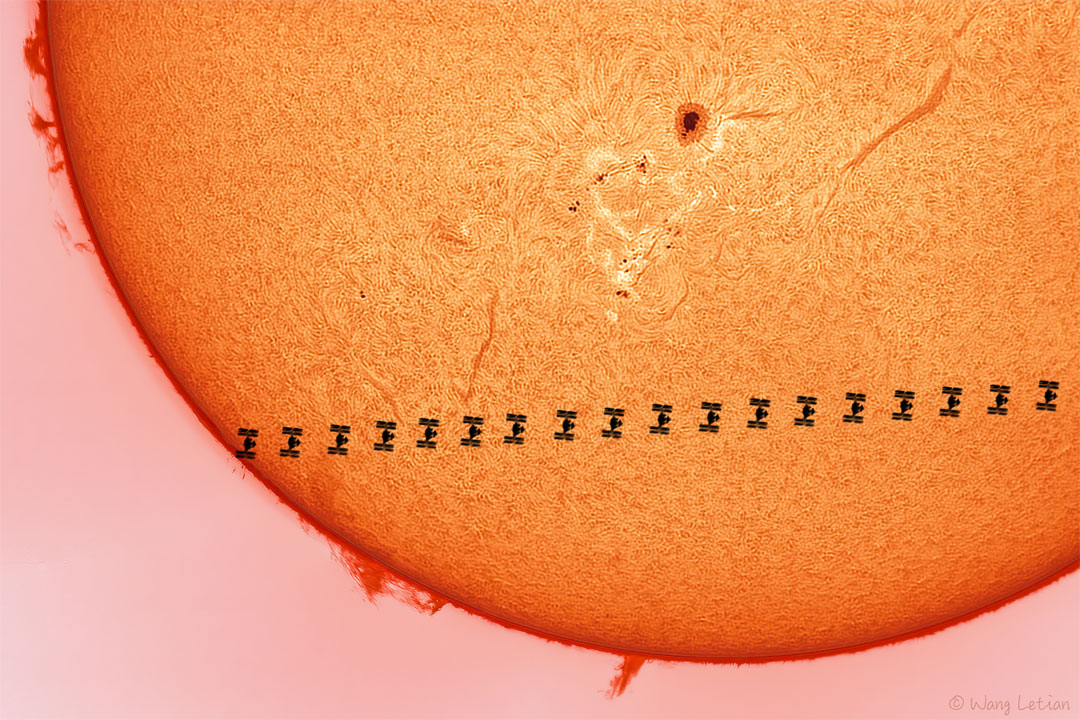
Typically, the International Space Station is visible only at night. Slowly drifting across the night sky as it orbits the Earth, the International Space Station (ISS) can be seen as a bright spot several times a year from many locations. The ISS is then visible only just after sunset or just before sunrise because it shines by reflected sunlight -- once the ISS enters the Earth's shadow, it will drop out of sight. The only occasion when the ISS is visible during the day is when it passes right in front of the Sun. Then, it passes so quickly that only cameras taking short exposures can visually freeze the ISS's silhouette onto the background Sun. The featured picture did exactly that -- it is actually a series of images taken earlier this month from Beijing, China with perfect timing. This image series was later combined with separate images taken at nearly the same time but highlighting the texture and activity on the busy Sun. The solar activity included numerous gaseous prominences seen around the edge, highlighted in red, filaments seen against the Sun's face, and a dark sunspot.
© Wang Letian (Eyes at Night) — used with the credit NASA publishes

2021
What happens when two black holes collide? This extreme scenario occurs in the centers of many merging galaxies and multiple star systems. The featured video shows a computer animation of the final stages of such a merger, while highlighting the gravitational lensing effects that would appear on a background starfield. The black regions indicate the event horizons of the dynamic duo, while a surrounding ring of shifting background stars indicates the position of their combined Einstein ring. All background stars not only have images visible outside of this Einstein ring, but also have one or more companion images visible on the inside. Eventually the two black holes coalesce. The end stages of such a merger is now known to produce a strong blast of gravitational radiation, providing a new way to see our universe. This Week is: Black Hole Week at NASA
© Simulating Extreme Spacetimes Collaboration — used with the credit NASA publishes

1964
Brazilian Marshal Humberto de Alencar Castelo Branco is elected president by the National Congress.
Humberto de Alencar Castelo Branco ↗
Event text and thumbnails come from Wikipedia and are used under CC BY-SA 4.0. Images are drawn only from Wikimedia Commons, which does not accept non-free content — each thumbnail links to its file page, where its licence and author are recorded.
Launch records are from The Space Devs’ Launch Library 2. Pictures are NASA’s Astronomy Picture of the Day; NASA imagery is generally not subject to copyright, but individual APOD entries are frequently the property of the photographer, and each caption says which applies.
General-audience astronomy and spaceflight — none of it a textbook.
As an Amazon Associate I earn from qualifying purchases. Links here cost you nothing extra.
LISTING
Still the best single argument for why any of this matters, and it leaves the arithmetic in. For a reader who wants the science, not just the awe.
LISTING
The case for leaving Earth, written by someone unsentimental about how hard that is. Suits readers who want the argument rather than the poster.
LISTING
Hard-SF problem solving in The Martian's key — for anyone who liked the engineering more than the peril. The only novel on this list.
BROWSE opens an Amazon search, not a specific recommendation.
LINKS AMAZON.COM