Launches
NO DATA0MISSIONS
The launch archive is still being mirrored, so this day has no launches listed yet.
ARCHIVE // DAY OF YEAR
Wikipedia records 5 spaceflight and astronomy events on April 3. Below are the pictures NASA published on April 3 in 6 different years — each one taken or released on this exact date.
0MISSIONS
The launch archive is still being mirrored, so this day has no launches listed yet.
5ENTRIES
Spaceflight and astronomy entries from Wikipedia's record of this date, oldest first — from 1885 onward.
6IMAGES
NASA's Astronomy Picture of the Day for April 3, one per year. Some are public domain and some belong to the photographer — each says which.
NASA’s Astronomy Picture of the Day, for this calendar date in each of the last several years.
2026
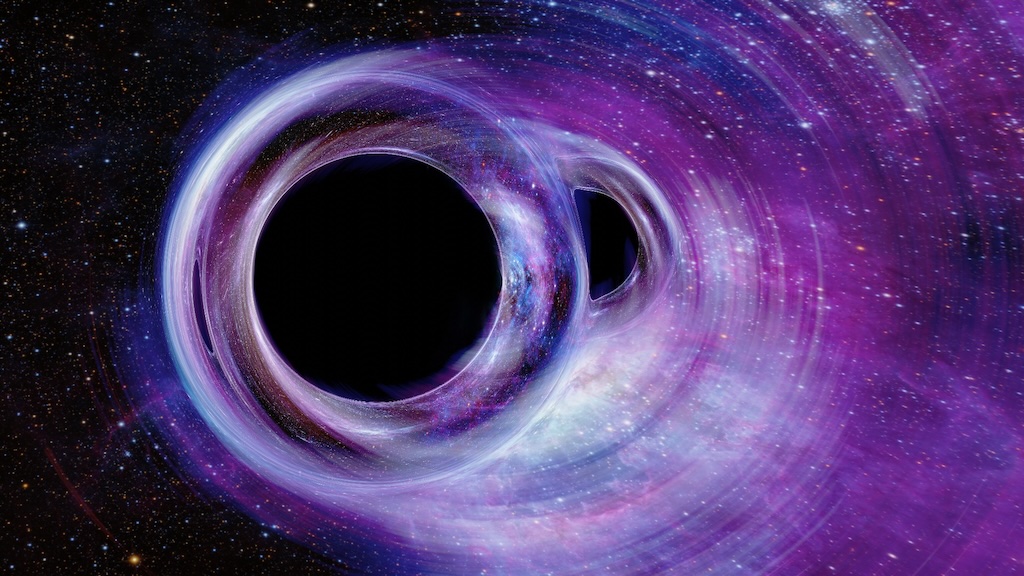
How can we see what is invisible? Black holes are not easy to see in the dark cosmic night, but astronomers can find them by analyzing their gravitational effects on matter, light and spacetime. The featured image shows an illustration that combines a simulation of a black hole binary system in its final "death-dance" with an astrophotography image of the Tarantula Nebula in the background. Even though black holes don't emit light, they distort the path of light rays, acting like a gravitational lens. As a result, the nebula appears extremely distorted, forming Einstein rings and multiple images. Tarantula Nebula lies in the Large Magellanic Cloud, a dwarf galaxy that is one of the satellite galaxies of the Milky Way, 160,000 light-years away. That is more than 1,000 times closer than any of the binary black hole mergers detected so far. We'll probably never detect a merger so close to home!
© Carl Knox — used with the credit NASA publishes

2025
A 26 hour old Moon poses behind the craggy outline of the Italian Dolomites in this twilight mountain and skyscape. The one second long exposure was captured near moonset on March 30. And while only a a sliver of its sunlit surface is visible, most of the Moon's disk can be seen by earthshine as light reflected from a bright planet Earth illuminates the lunar nearside. Also known as the Moon's ashen glow, a description of earthshine in terms of sunlight reflected by Earth's oceans illuminating the Moon's dark surface was written over 500 years ago by Leonardo da Vinci. Of course earthshine is just the most familiar example of planetshine, the faint illumination of the dark portion of a moon by light reflected from its planet.
© Giorgia Hofer — used with the credit NASA publishes
2024
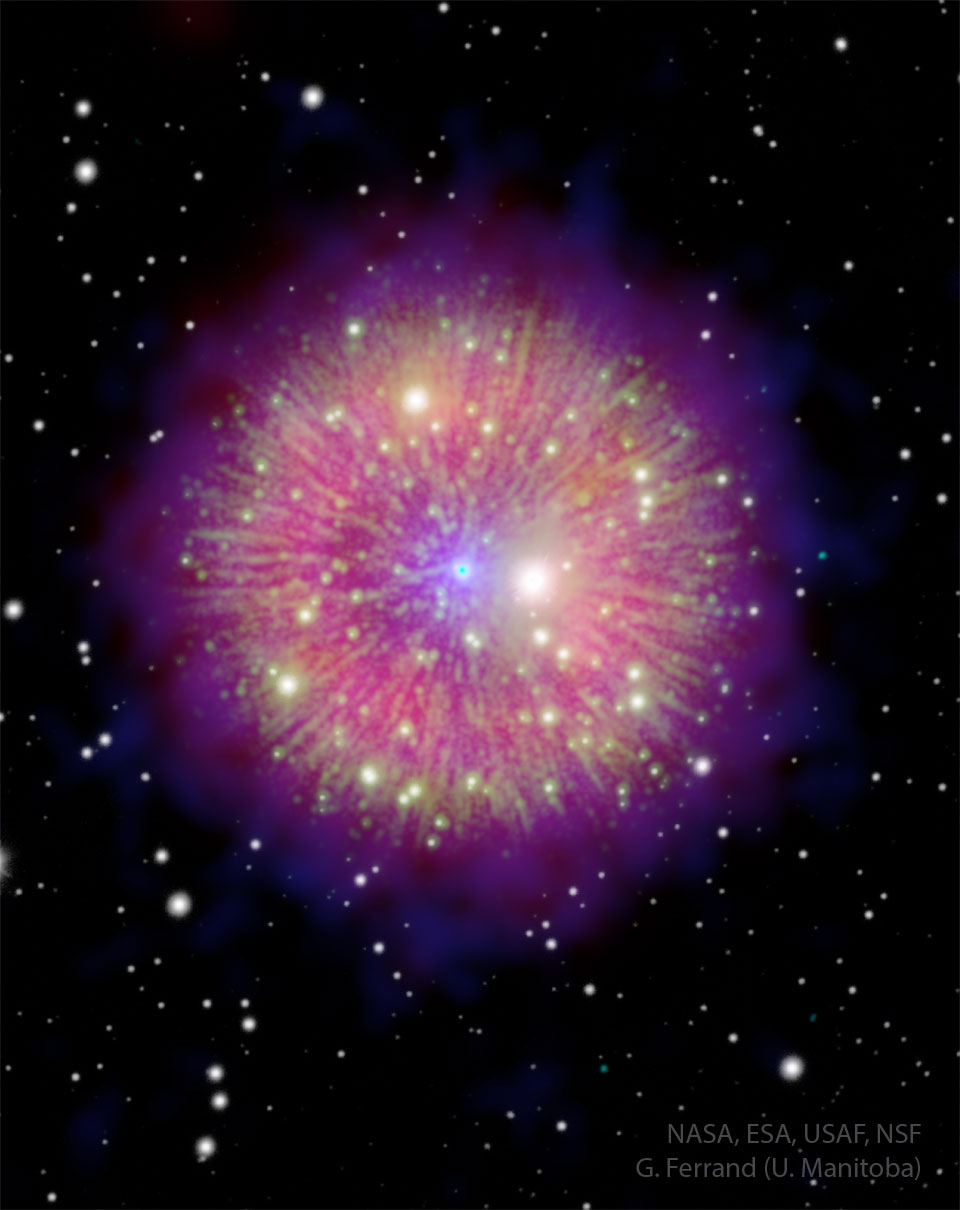
What created this unusual celestial firework? The nebula, dubbed Pa 30, appears in the same sky direction now as a bright "guest star" did in the year 1181. Although Pa 30's filaments look similar to that created by a nova (for example GK Per), and a planetary nebula (for example NGC 6751), some astronomers now propose that it was created by a rare type of supernova: a thermonuclear Type Iax, and so is (also) named SN 1181. In this model, the supernova was not the result of the detonation of a single star, but rather a blast that occurred when two white dwarf stars spiraled together and merged. The blue dot in the center is hypothesized to be a zombie star, the remnant white dwarf that somehow survived this supernova-level explosion. The featured image combines images and data obtained with infrared (WISE), visible (MDM, Pan-STARRS), and X-ray (Chandra, XMM) telescopes. Future observations and analyses may tell us more. NASA Coverage: Total Solar Eclipse of 2024 April 8
NASA · public domain
2023
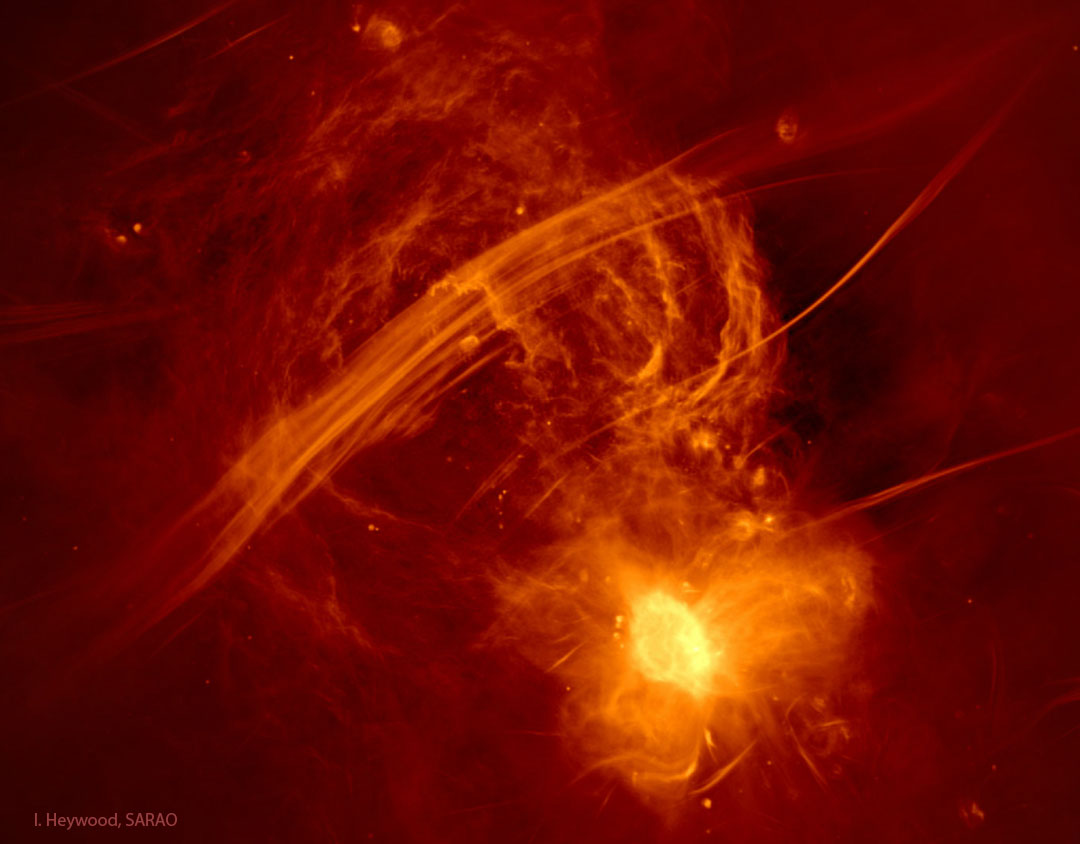
What causes this unusual curving structure near the center of our Galaxy? The long parallel rays slanting across the top of the featured radio image are known collectively as the Galactic Center Radio Arc and point out from the Galactic plane. The Radio Arc is connected to the Galactic Center by strange curving filaments known as the Arches. The bright radio structure at the bottom right surrounds a black hole at the Galactic Center and is known as Sagittarius A*. One origin hypothesis holds that the Radio Arc and the Arches have their geometry because they contain hot plasma flowing along lines of a constant magnetic field. Images from NASA's Chandra X-ray Observatory appear to show this plasma colliding with a nearby cloud of cold gas.
NASA · public domain
2022
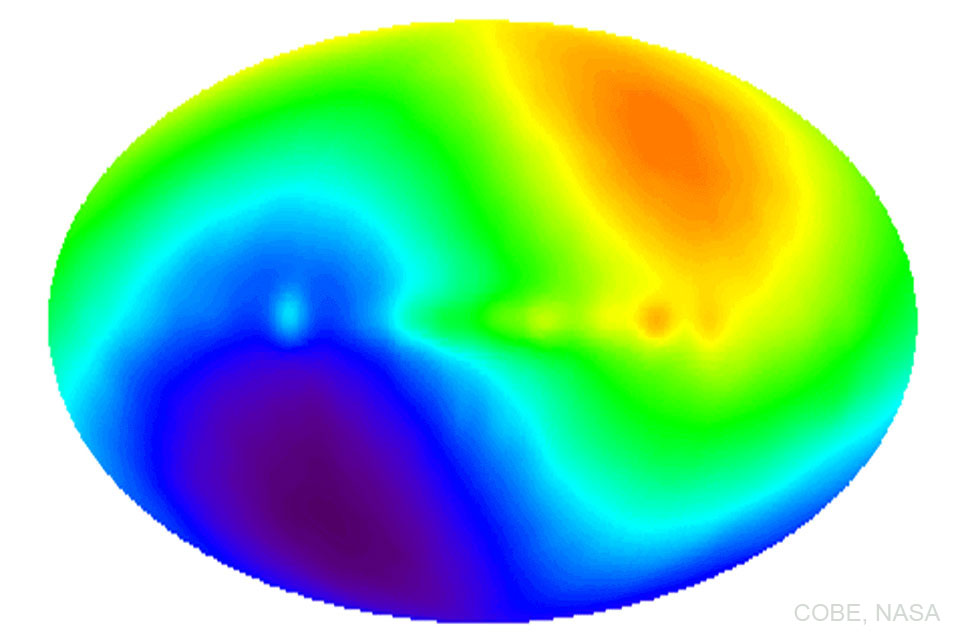
Our Earth is not at rest. The Earth moves around the Sun. The Sun orbits the center of the Milky Way Galaxy. The Milky Way Galaxy orbits in the Local Group of Galaxies. The Local Group falls toward the Virgo Cluster of Galaxies. But these speeds are less than the speed that all of these objects together move relative to the cosmic microwave background radiation (CMBR). In the featured all-sky map from the COBE satellite in 1993, microwave light in the Earth's direction of motion appears blueshifted and hence hotter, while microwave light on the opposite side of the sky is redshifted and colder. The map indicates that the Local Group moves at about 600 kilometers per second relative to this primordial radiation. This high speed was initially unexpected and its magnitude is still unexplained. Why are we moving so fast? What is out there?
NASA · public domain
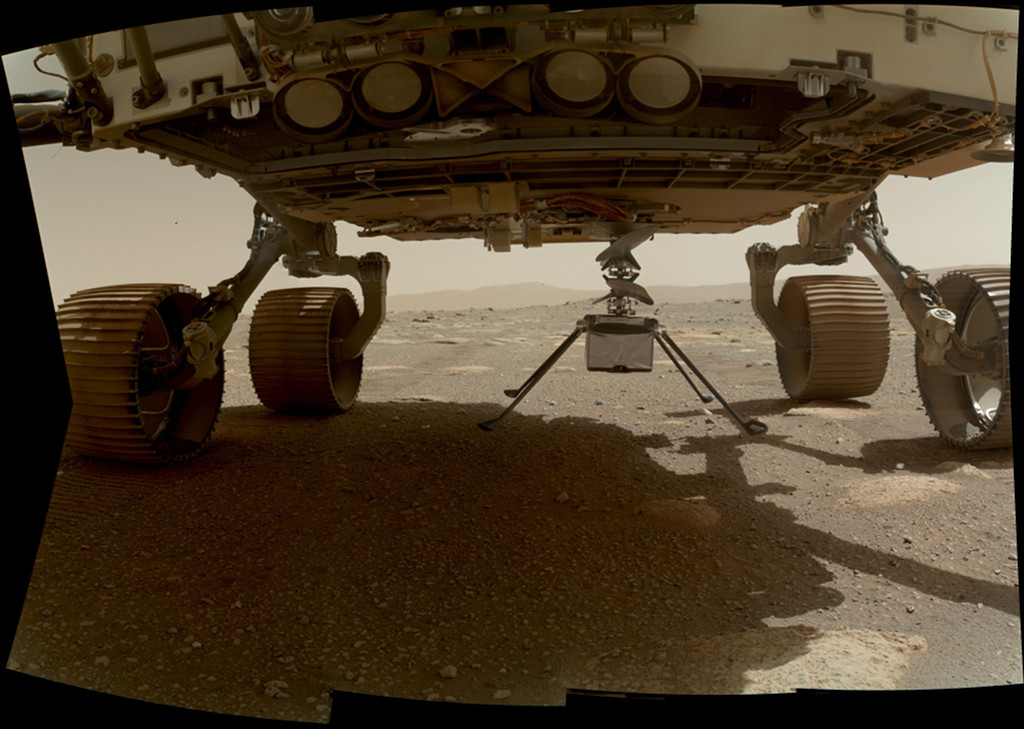
2021
The Mars Ingenuity Helicopter, all four landing legs down, was captured here on sol 39 (March 30) slung beneath the belly of the Perseverance rover. The near ground level view is a mosaic of images from the WATSON camera on the rover's SHERLOC robotic arm. Near the center of the frame the experimental helicopter is suspended just a few centimeters above the martian surface. Tracks from Perseverance extend beyond the rover's wheels with the rim of Jezero crater visible about 2 kilometers in the distance. Ingenuity has a weight of 1.8 kilograms or 4 pounds on Earth. That corresponds to a weight of 0.68 kilograms or 1.5 pounds on Mars. With rotor blades spanning 1.2 meters it will attempt to make the first powered flight of an aircraft on another planet in the thin martian atmosphere, 1 percent as dense as Earth's, no earlier than April 11.
NASA · public domain

1885
Gottlieb Daimler is granted a German patent for a light, high-speed, four-stroke engine, which he uses seven months later to create the world's first motorcycle, the Daimler Reitwagen.
Gottlieb Daimler ↗
1948
The Marshall Plan, an economic recovery program established by U.S. Secretary of State George Marshall to assist the post-World War II re-building of Europe, was signed into law.
Marshall Plan ↗
1948
Cold War: U.S. President Harry S. Truman signs the Marshall Plan, authorizing $5 billion in aid for 16 countries.
Cold War ↗1966
Luna 10 (replica pictured) entered orbit around the Moon, becoming the first space probe to orbit an astronomical body other than Earth or the Sun.
Luna 10 ↗
Event text and thumbnails come from Wikipedia and are used under CC BY-SA 4.0. Images are drawn only from Wikimedia Commons, which does not accept non-free content — each thumbnail links to its file page, where its licence and author are recorded.
Launch records are from The Space Devs’ Launch Library 2. This archive is still being mirrored, so some days are incomplete. Pictures are NASA’s Astronomy Picture of the Day; NASA imagery is generally not subject to copyright, but individual APOD entries are frequently the property of the photographer, and each caption says which applies.
General-audience astronomy and spaceflight — none of it a textbook.
As an Amazon Associate I earn from qualifying purchases. Links here cost you nothing extra.
LISTING
Still the best single argument for why any of this matters, and it leaves the arithmetic in. For a reader who wants the science, not just the awe.
LISTING
The case for leaving Earth, written by someone unsentimental about how hard that is. Suits readers who want the argument rather than the poster.
LISTING
Hard-SF problem solving in The Martian's key — for anyone who liked the engineering more than the peril. The only novel on this list.
BROWSE opens an Amazon search, not a specific recommendation.
LINKS AMAZON.COM