Launches
NO DATA0MISSIONS
The launch archive is still being mirrored, so this day has no launches listed yet.
ARCHIVE // DAY OF YEAR
Wikipedia records 3 spaceflight and astronomy events on March 7. Below are the pictures NASA published on March 7 in 6 different years — each one taken or released on this exact date.
0MISSIONS
The launch archive is still being mirrored, so this day has no launches listed yet.
3ENTRIES
Spaceflight and astronomy entries from Wikipedia's record of this date, oldest first — from 1814 onward.
6IMAGES
NASA's Astronomy Picture of the Day for March 7, one per year. Some are public domain and some belong to the photographer — each says which.
NASA’s Astronomy Picture of the Day, for this calendar date in each of the last several years.
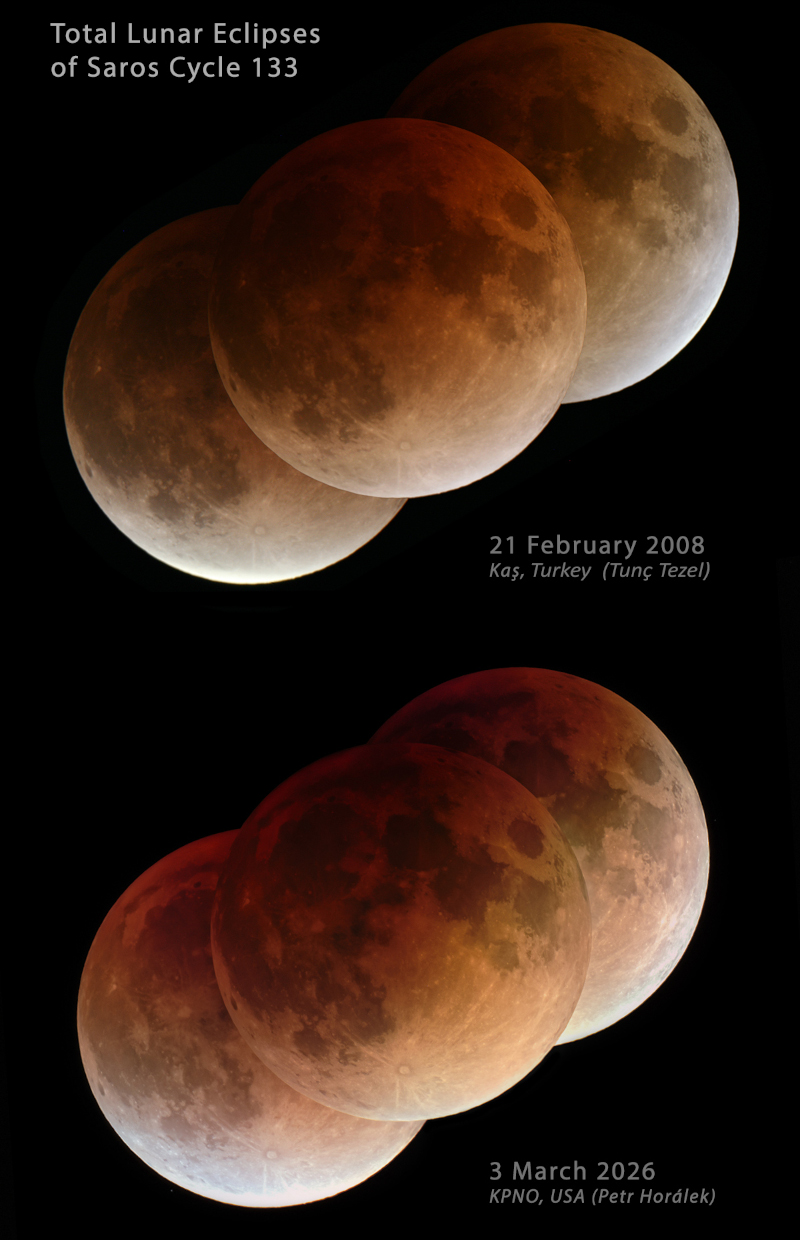
2026
Centered on maximum eclipse, these two total lunar eclipse sequences look almost identical. Yet the one shown on top is composed of images recorded in February 2008, while at the bottom is the recent March 2026 total eclipse of the Moon. Why are they so similar? Because these two total lunar eclipses are from the same Saros cycle. The Saros cycle was discovered historically from observations of the Moon's orbit. With a period of 18 years, 11 and 1/3 days, the cycle predicts when the Sun, Earth, and Moon all return to the same relative geometry for a lunar (or solar) eclipse. Eclipses separated by one Saros period belong to the same numbered Saros series, in this case Saros 133. So expect the next lunar eclipse in Saros 133 to be a repeat of this year's March 3 eclipse. You can watch the next Saros 133 total lunar eclipse on March 13, 2044. Growing Gallery: Total Lunar Eclipse of March 3
© Tunc Tezel — used with the credit NASA publishes

2025
Very faint planetary nebula Abell 7 is about 1,800 light-years distant. It lies just south of Orion in planet Earth's skies toward the constellation Lepus, The Hare. Surrounded by Milky Way stars and near the line-of-sight to distant background galaxies its generally simple spherical shape, about 8 light-years in diameter, is revealed in this deep telescopic image. Within the cosmic cloud are beautiful and complex structures though, enhanced by the use of long exposures and narrowband filters that capture emission from hydrogen, sulfur, and oxygen atoms. Otherwise Abell 7 would be much too faint to be appreciated by eye. A planetary nebula represents a very brief final phase in stellar evolution that our own Sun will experience 5 billion years hence, as the nebula's central, once sun-like star shrugs off its outer layers. Abell 7 itself is estimated to be 20,000 years old. But its central star, seen here as a fading white dwarf, is some 10 billion years old.
© Vikas Chander — used with the credit NASA publishes
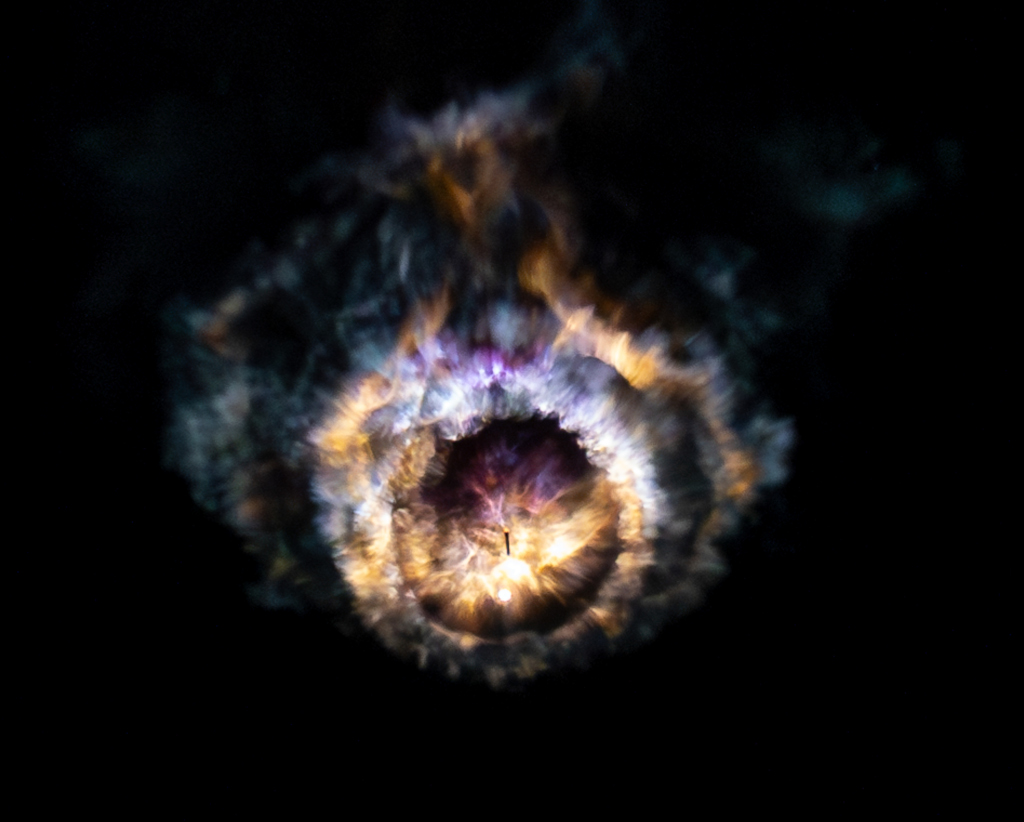
2024
Not the James Webb Space Telescope's latest view of a distant galactic nebula, this cloud of gas and dust dazzled spacecoast skygazers on March 3. The telephoto snapshot was taken minutes after the launch of a Falcon 9 rocket on the SpaceX Crew-8 mission to the International Space Station. It captures plumes and exhaust from the separated first and second stages, a drifting Rorschach pattern in dark evening skies. The bright spot near bottom center within the stunning terrestrial nebulosity is the second stage engine firing to carry 4 humans to space in the Crew Dragon spacecraft Endeavour. In sharp silhouette just above it is the Falcon 9 first stage booster orienting itself for return to a landing zone at Cape Canaveral, planet Earth. This reuseable first stage booster was making its first flight. But the Crew Dragon Endeavour capsule has flown humans to low Earth orbit and back again 4 times before. Endeavour, as a name for a spacecraft, has also seen reuse, christening retired Space Shuttle Endeavour and the Apollo 15 command module.
© Michael Seeley — used with the credit NASA publishes
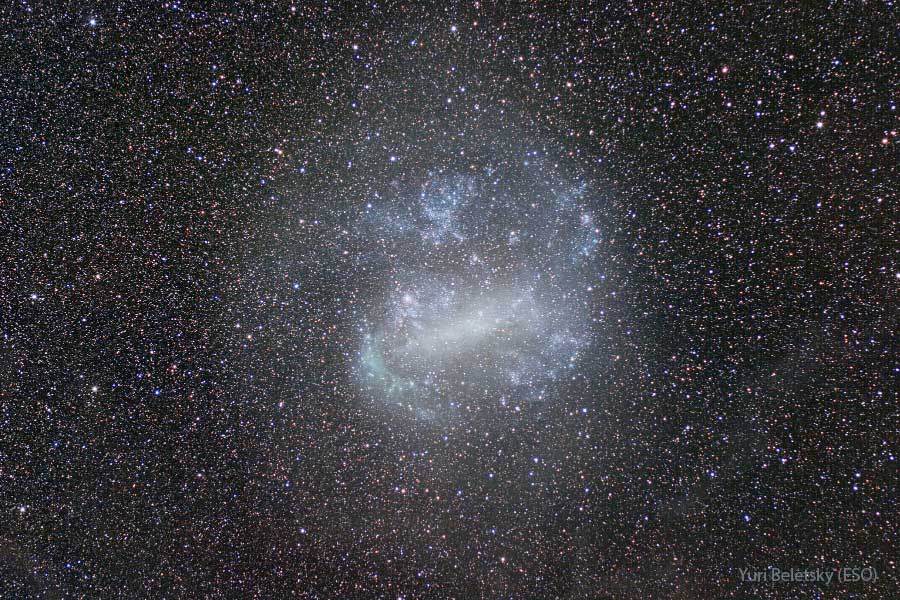
2023
Is this a spiral galaxy? No. Actually, it is the Large Magellanic Cloud (LMC), the largest satellite galaxy of our own Milky Way Galaxy. The LMC is classified as a dwarf irregular galaxy because of its normally chaotic appearance. In this deep and wide exposure, however, the full extent of the LMC becomes visible. Surprisingly, during longer exposures, the LMC begins to resemble a barred spiral galaxy. The Large Magellanic Cloud lies only about 180,000 light-years distant towards the constellation of the Dolphinfish (Dorado). Spanning about 15,000 light-years, the LMC was the site of SN1987A, the brightest and closest supernova in modern times. Together with the Small Magellanic Cloud (SMC), the LMC can be seen in Earth's southern hemisphere with the unaided eye. Your Sky Surprise: What picture did APOD feature on your birthday? (post 1995)
© Yuri Beletsky (Carnegie Las Campanas Observatory, TWAN) — used with the credit NASA publishes
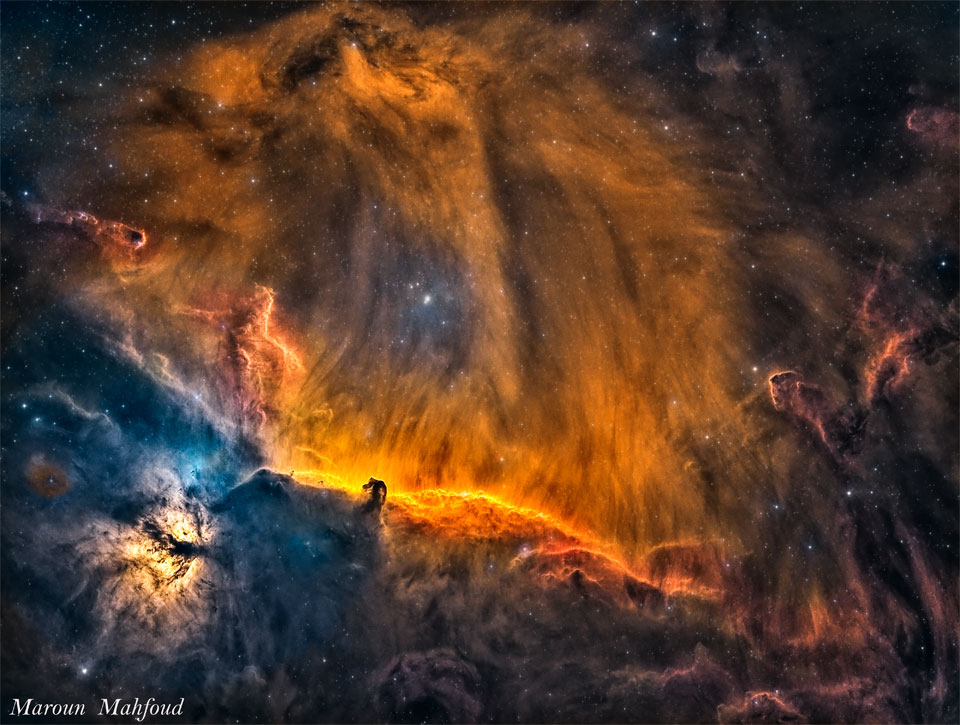
2022
Yes, but can you see the lion? A deep exposure shows the famous dark indentation that looks like a horse's head, visible just left and below center, and known unsurprisingly as the Horsehead Nebula. The Horsehead Nebula (Barnard 33) is part of a vast complex of dark absorbing dust and bright glowing gas. To bring out details of the Horsehead's pasture, an astrophotographer artistically combined light accumulated for over 20 hours in hydrogen (orange), oxygen (blue), and sulfur (green). The resulting spectacular picture captured from Raachine, Lebanon, details an intricate tapestry of gaseous wisps and dust-laden filaments that were created and sculpted over eons by stellar winds and ancient supernovas. The featured composition brings up another pareidolic animal icon -- that of a lion's head -- in the expansive orange colored gas above the horse's head. The Flame Nebula is visible just to the left of the Horsehead. The Horsehead Nebula lies 1,500 light years distant towards the constellation of Orion.
© Maroun Mahfoud — used with the credit NASA publishes
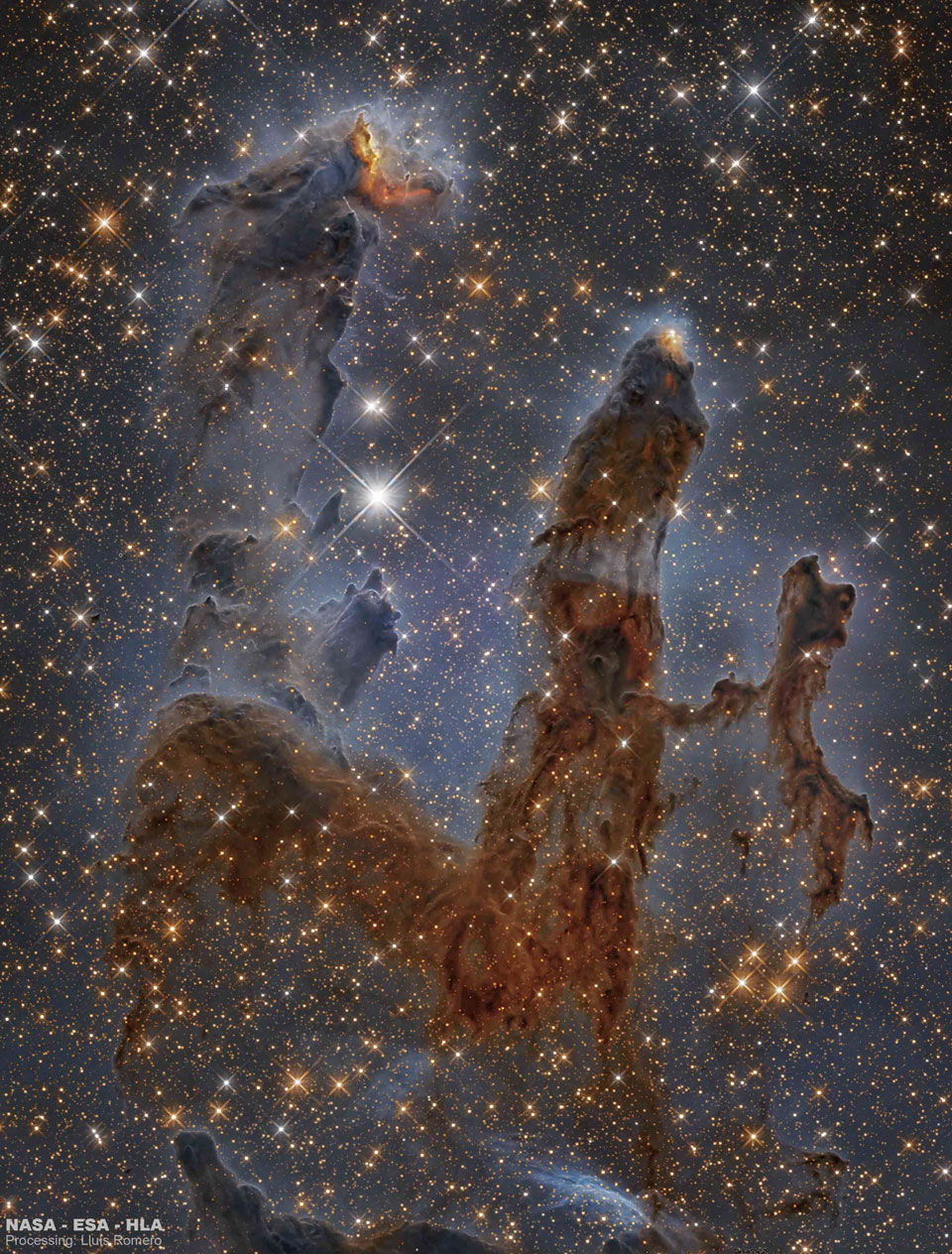
2021
Newborn stars are forming in the Eagle Nebula. Gravitationally contracting in pillars of dense gas and dust, the intense radiation of these newly-formed bright stars is causing surrounding material to boil away. This image, taken with the Hubble Space Telescope in near infrared light, allows the viewer to see through much of the thick dust that makes the pillars opaque in visible light. The giant structures are light years in length and dubbed informally the Pillars of Creation. Associated with the open star cluster M16, the Eagle Nebula lies about 6,500 light years away. The Eagle Nebula is an easy target for small telescopes in a nebula-rich part of the sky toward the split constellation Serpens Cauda (the tail of the snake).
NASA · public domain

1814
War of the Sixth Coalition: Napoleon's army forced Mikhail Semyonovich Vorontsov's Russian troops to withdraw from the Chemin des Dames, but French casualties exceeded Russian losses.
War of the Sixth Coalition ↗
1986
Challenger Disaster: Divers from the USS Preserver locate the crew cabin of Challenger on the ocean floor.
Space Shuttle Challenger disaster ↗
2009
The Kepler space telescope (depicted), designed to discover Earth-like planets orbiting other stars, was launched.
Kepler space telescope ↗Event text and thumbnails come from Wikipedia and are used under CC BY-SA 4.0. Images are drawn only from Wikimedia Commons, which does not accept non-free content — each thumbnail links to its file page, where its licence and author are recorded.
Launch records are from The Space Devs’ Launch Library 2. This archive is still being mirrored, so some days are incomplete. Pictures are NASA’s Astronomy Picture of the Day; NASA imagery is generally not subject to copyright, but individual APOD entries are frequently the property of the photographer, and each caption says which applies.
General-audience astronomy and spaceflight — none of it a textbook.
As an Amazon Associate I earn from qualifying purchases. Links here cost you nothing extra.
LISTING
Still the best single argument for why any of this matters, and it leaves the arithmetic in. For a reader who wants the science, not just the awe.
LISTING
The case for leaving Earth, written by someone unsentimental about how hard that is. Suits readers who want the argument rather than the poster.
LISTING
Hard-SF problem solving in The Martian's key — for anyone who liked the engineering more than the peril. The only novel on this list.
BROWSE opens an Amazon search, not a specific recommendation.
LINKS AMAZON.COM