Launches
ON RECORD21MISSIONS
19 of them reached orbit. The earliest was 1965, the most recent 2026.
ARCHIVE // DAY OF YEAR
21 orbital launches flew on March 2, the earliest of them in 1965, and 19 reached orbit. Wikipedia records 5 spaceflight and astronomy events on March 2. Below are the pictures NASA published on March 2 in 5 different years — each one taken or released on this exact date.
21MISSIONS
19 of them reached orbit. The earliest was 1965, the most recent 2026.
5ENTRIES
Spaceflight and astronomy entries from Wikipedia's record of this date, oldest first — from 1972 onward.
5IMAGES
NASA's Astronomy Picture of the Day for March 2, one per year. Some are public domain and some belong to the photographer — each says which.
NASA’s Astronomy Picture of the Day, for this calendar date in each of the last several years.
2026
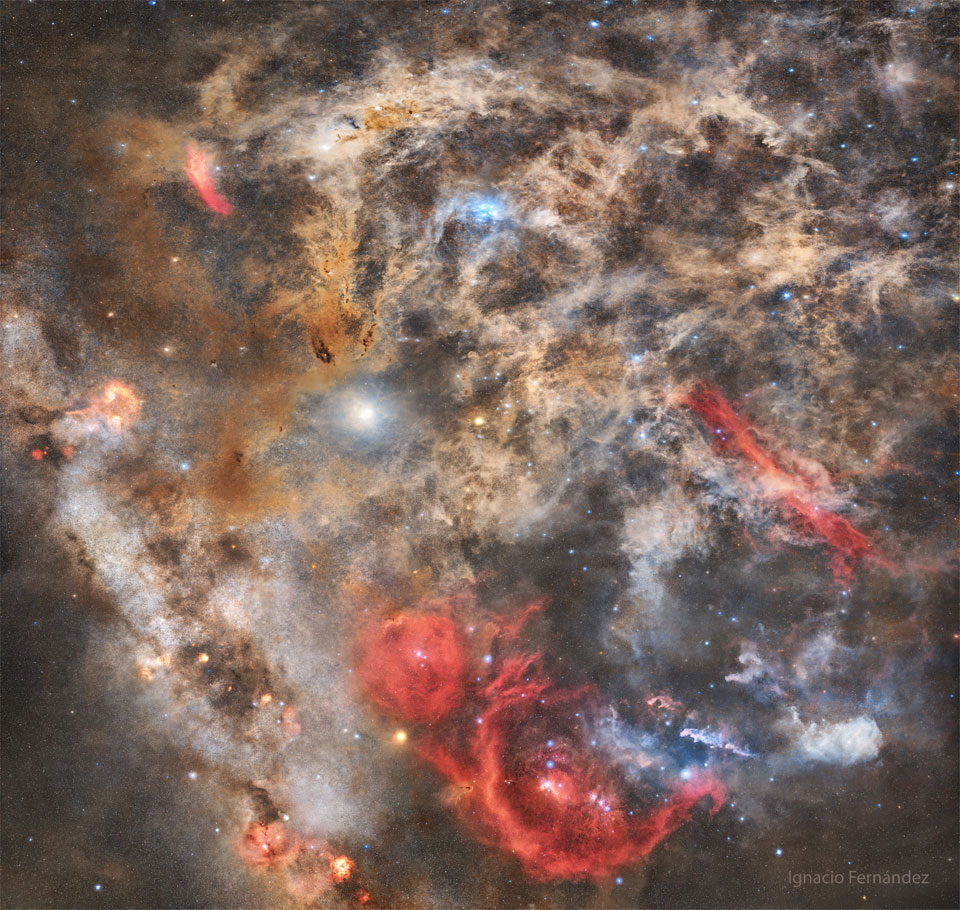
How well do you know the night sky? OK, but how well can you identify famous sky objects in a very deep image? Either way, here is a test: see if you can find some well-known night-sky icons in a deep image filled with filaments of normally faint dust and gas. This image contains the Pleiades star cluster, Barnard's Loop, Orion Nebula, Aldebaran, Betelgeuse, Witch Head Nebula, Eridanus Loop, and the California Nebula. To find their real locations, here is an annotated image version. The reason this task might be difficult is similar to the reason it is initially hard to identify familiar constellations in a very dark sky: the tapestry of our night sky has an extremely deep hidden complexity. The featured composite reveals some of this complexity in a 16 hours of sky exposure in dark skies over Granada, Spain. Tonight: Total Lunar Eclipse
© Ignacio Fernández — used with the credit NASA publishes
2024
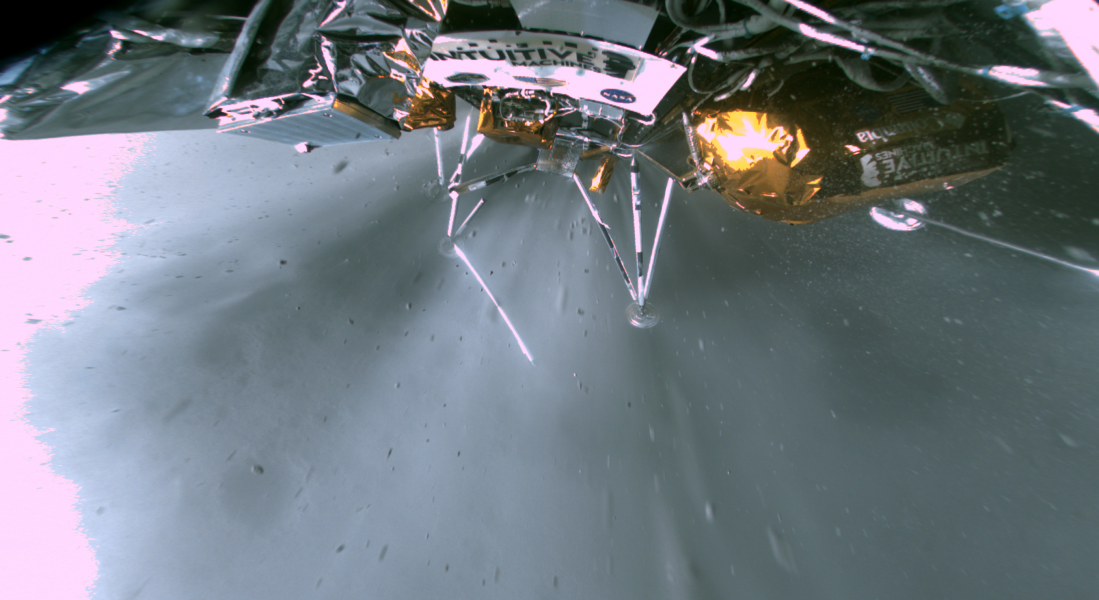
Methalox rocket engine firing, Odysseus' landing legs absorb first contact with the lunar surface in this wide-angle snapshot from a camera on board the robotic Intuitive Machines Nova-C moon lander. Following the landing on February 22, broken landing legs, visible in the image, ultimately left the lander at rest but tilted. Odysseus' gentle lean into a sloping lunar surface preserved the phone booth-sized lander's ability to operate, collect solar power, and return images and data to Earth. Its exact landing site in the Moon's far south polar region was imaged by NASA's Lunar Reconnaissance Orbiter. Donated by NASA, the American flag seen on the lander's central panel is 1970 Apollo program flight hardware.
NASA · public domain
2023
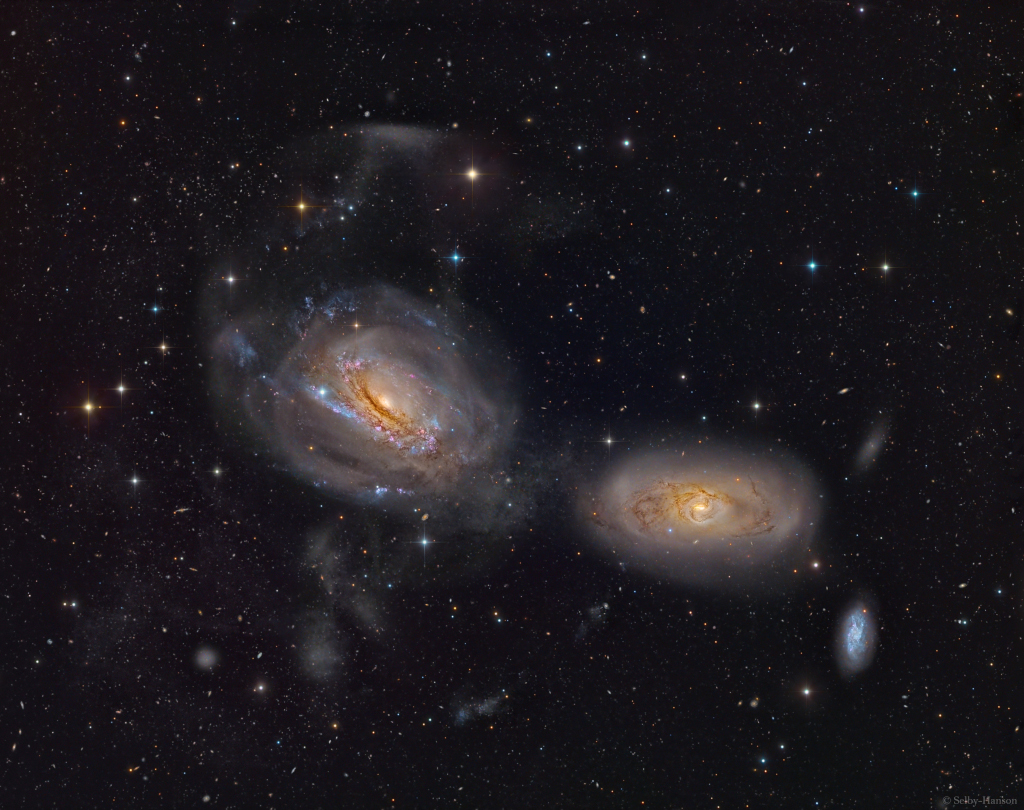
Spiral galaxy NGC 3169 looks to be unraveling like a ball of cosmic yarn. It lies some 70 million light-years away, south of bright star Regulus toward the faint constellation Sextans. Wound up spiral arms are pulled out into sweeping tidal tails as NGC 3169 (left) and neighboring NGC 3166 interact gravitationally. Eventually the galaxies will merge into one, a common fate even for bright galaxies in the local universe. Drawn out stellar arcs and plumes are clear indications of the ongoing gravitational interactions across the deep and colorful galaxy group photo. The telescopic frame spans about 20 arc minutes or about 400,000 light-years at the group's estimated distance, and includes smaller, bluish NGC 3165 at the right. NGC 3169 is also known to shine across the spectrum from radio to X-rays, harboring an active galactic nucleus that is the site of a supermassive black hole.
© Mike Selby — used with the credit NASA publishes
2022
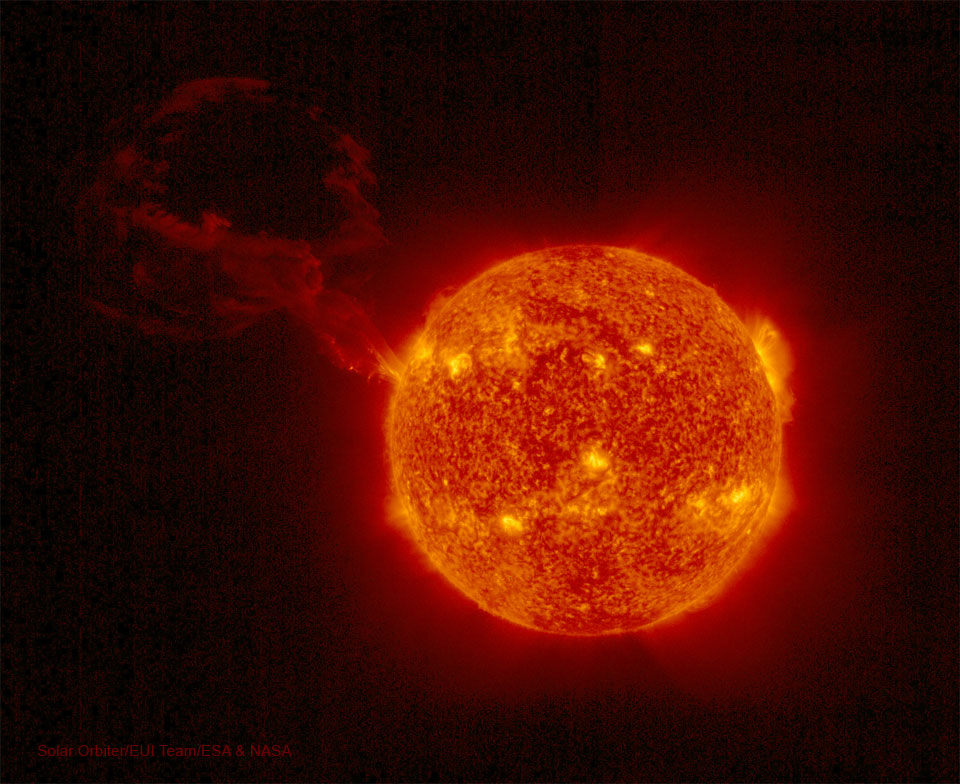
What's happened to our Sun? Last month, it produced the largest prominence ever imaged together with a complete solar disk. The record image, featured, was captured in ultraviolet light by the Sun-orbiting Solar Orbiter spacecraft. A quiescent solar prominence is a cloud of hot gas held above the Sun's surface by the Sun's magnetic field. This solar prominence was huge -- spanning a length rivaling the diameter of the Sun itself. Solar prominences may erupt unpredictably and expel hot gas into the Solar System via a Coronal Mass Ejection (CME). When a CME strikes the Earth and its magnetosphere, bright auroras may occur. This prominence did produce a CME, but it was directed well away from the Earth. Although surely related to the Sun's changing magnetic field, the energy mechanism that creates and sustains a solar prominence remains a topic of research.
NASA · public domain

2021
What if you could fly around Mars? NASA may have achieved that capability last month with the landing of Perseverance, a rover which included a small flight-worthy companion called Ingenuity, nicknamed Ginny. Even though Ginny is small -- a toaster-sized helicopter with four long legs and two even-longer (1.2-meter) rotors, she is the first of her kind -- there has never been anything like her before. After being deployed, possibly in April, the car-sized Perseverance ("Percy") will back away to give Ginny ample room to attempt her unprecedented first flight. In the featured artistic illustration, Ginny's long rotors are depicted giving her the lift she needs to fly into the thin Martian atmosphere and explore the area near Perseverance. Although Ingenuity herself will not fly very far, she is a prototype for all future airborne Solar-System robots that may fly far across not only Mars, but Titan.
NASA · public domain

1972
The Pioneer 10 space probe is launched from Cape Canaveral, Florida with a mission to explore the outer planets.
Pioneer 10 ↗
1978
As a cosmonaut on Soyuz 28, Czechoslovak military pilot Vladimír Remek (pictured) became the first person from outside the Soviet Union or the United States to go into space.
Astronaut ↗
1978
Czech Vladimír Remek becomes the first non-Soviet or non-American to go into space, when he is launched aboard Soyuz 28.
Czechoslovakia ↗
1995
Space Shuttle Endeavour launches from the Kennedy Space Center on STS-67, carrying the ASTRO-2 spacelab observatory.
Space Shuttle Endeavour ↗
1998
Data sent from the Galileo spacecraft indicates that Jupiter's moon Europa has a liquid ocean under a thick crust of ice.
Galileo (spacecraft) ↗Event text and thumbnails come from Wikipedia and are used under CC BY-SA 4.0. Images are drawn only from Wikimedia Commons, which does not accept non-free content — each thumbnail links to its file page, where its licence and author are recorded.
Launch records are from The Space Devs’ Launch Library 2. Pictures are NASA’s Astronomy Picture of the Day; NASA imagery is generally not subject to copyright, but individual APOD entries are frequently the property of the photographer, and each caption says which applies.
General-audience astronomy and spaceflight — none of it a textbook.
As an Amazon Associate I earn from qualifying purchases. Links here cost you nothing extra.
LISTING
Still the best single argument for why any of this matters, and it leaves the arithmetic in. For a reader who wants the science, not just the awe.
LISTING
The case for leaving Earth, written by someone unsentimental about how hard that is. Suits readers who want the argument rather than the poster.
LISTING
Hard-SF problem solving in The Martian's key — for anyone who liked the engineering more than the peril. The only novel on this list.
BROWSE opens an Amazon search, not a specific recommendation.
LINKS AMAZON.COM