Launches
NO DATA0MISSIONS
The launch archive is still being mirrored, so this day has no launches listed yet.
ARCHIVE // DAY OF YEAR
Wikipedia records 6 spaceflight and astronomy events on February 28. Below are the pictures NASA published on February 28 in 6 different years — each one taken or released on this exact date.
0MISSIONS
The launch archive is still being mirrored, so this day has no launches listed yet.
6ENTRIES
Spaceflight and astronomy entries from Wikipedia's record of this date, oldest first — from 1959 onward.
6IMAGES
NASA's Astronomy Picture of the Day for February 28, one per year. Some are public domain and some belong to the photographer — each says which.
NASA’s Astronomy Picture of the Day, for this calendar date in each of the last several years.

2026
Fans of the western sky after sunset have lately enjoyed this month's remarkable array of bright planets. Witnessed from some locations, on February 18 planet Mercury even appeared to slide behind the Moon, an event known as a lunar occultation. These two snapshots, taken in early evening skies show before and after telescopic views of the rare disappearance of innermost planet behind young Moon. The top panel finds bright Mercury just visible at the northern (right) edge of the earthshine-illuminated lunar disk. In the bottom panel the bright planet has emerged in darker skies beyond the Moon's sunlit crescent. As seen south of Sallisaw, Oklahoma, planet Earth, this lunar occultation of Mercury lasted only about 3 minutes (video). But you can still check out a parade of planets tonight. March 3: Total Lunar Eclipse
© Fabrizio Melandri — used with the credit NASA publishes

2025
Planet Earth hangs in the background of this space age selfie. The snapshot was captured by the IM-2 Nova-C lander Athena, just after stage separation following its February 26 launch to the Moon. A tall robotic lander, Athena is scheduled to touch down on Thursday, March 6, in Mons Mouton, a plateau near the Moon’s South Pole. The intended landing site is in the central portion of one of the Artemis 3 potential landing regions. Athena carries rovers and experiments as part of NASA's Commercial Lunar Payload Services program, including a drill intended to explore beneath the lunar surface in a search for evidence of frozen water. It also carries a propulsive drone dubbed the Micro Nova Hopper. After release to the lunar surface, the autonomous drone is intended to hop into a nearby crater and send science data back to the lander.
NASA · public domain
2024
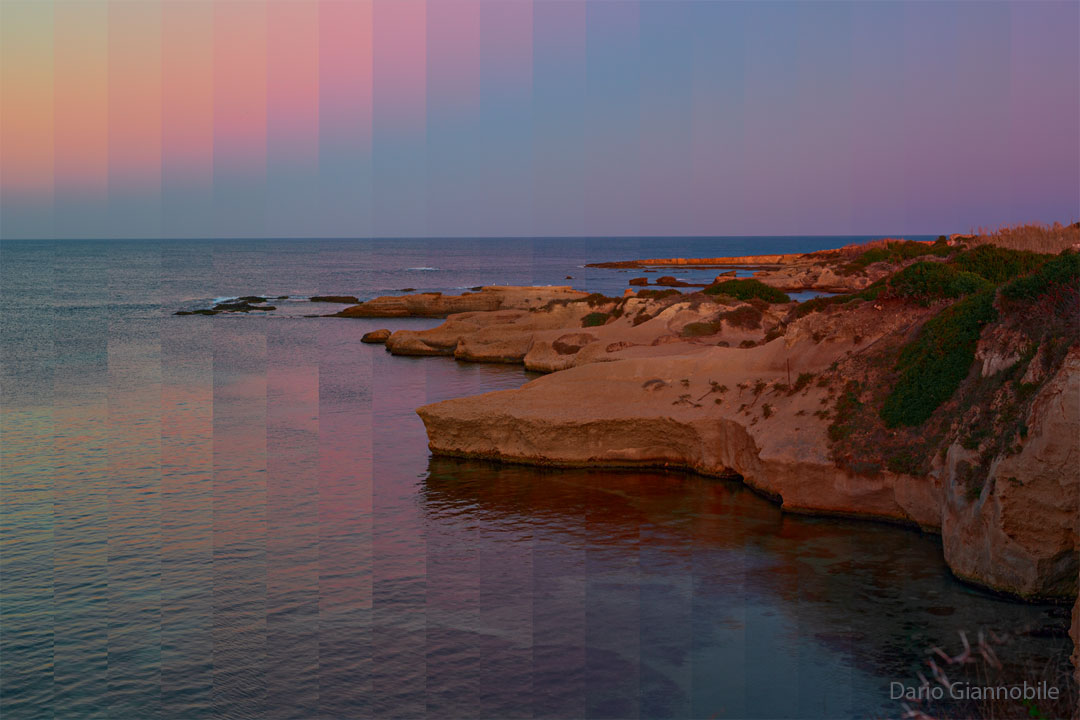
How does the sky turn dark at night? In stages, and with different characteristic colors rising from the horizon. The featured image shows, left to right, increasingly late twilight times after sunset in 20 different vertical bands. The picture was taken last month in Syracuse, Sicily, Italy, in the direction opposite the Sun. On the far left is the pre-sunset upper sky. Toward the right, prominent bands include the Belt of Venus, the Blue Band, the Horizon Band, and the Red Band. As the dark shadow of the Earth rises, the colors in these bands are caused by direct sunlight reflecting from air and aerosols in the Earth's atmosphere, multiple reflections sometimes involving a reddened sunset, and refraction. In practice, these bands can be diffuse and hard to discern, and their colors can depend on colors near the setting Sun. Finally, the Sun completely sets and the sky becomes dark. Don't despair -- the whole thing will happen in reverse when the Sun rises again in the morning.
© Dario Giannobile — used with the credit NASA publishes
2023
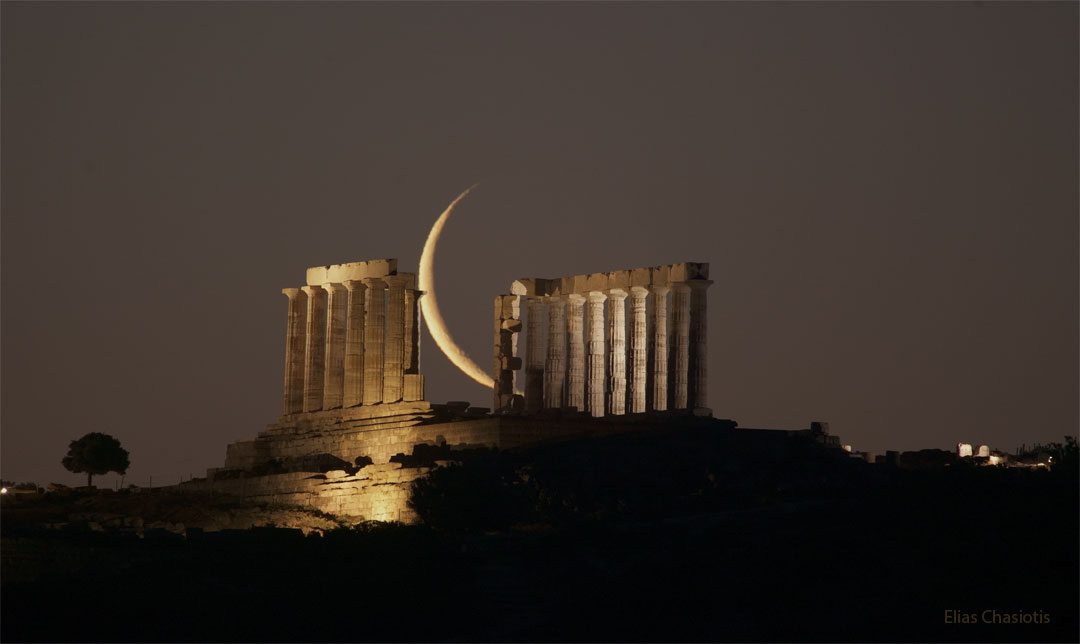
Why is a thin crescent moon never seen far from a horizon? Because the only geometry that gives a thin crescent lunar phase occurs when the Moon appears close to the Sun in the sky. The crescent is not caused by the shadow of the Earth, but by seeing only a small part of the Moon directly illuminated by the Sun. Moreover, the thickest part of the crescent always occurs in the direction of the Sun. In the evening, a thin crescent Moon will set shortly after the Sun and not be seen for the rest of the night. Alternatively, in the morning, a crescent Moon will rise shortly before the Sun after not being seen for most of the night. Pictured two weeks ago, a crescent moon was captured near the horizon, just before sunrise, far behind remnants of the ancient Temple of Poseidon in Greece.
© Elias Chasiotis — used with the credit NASA publishes
2022
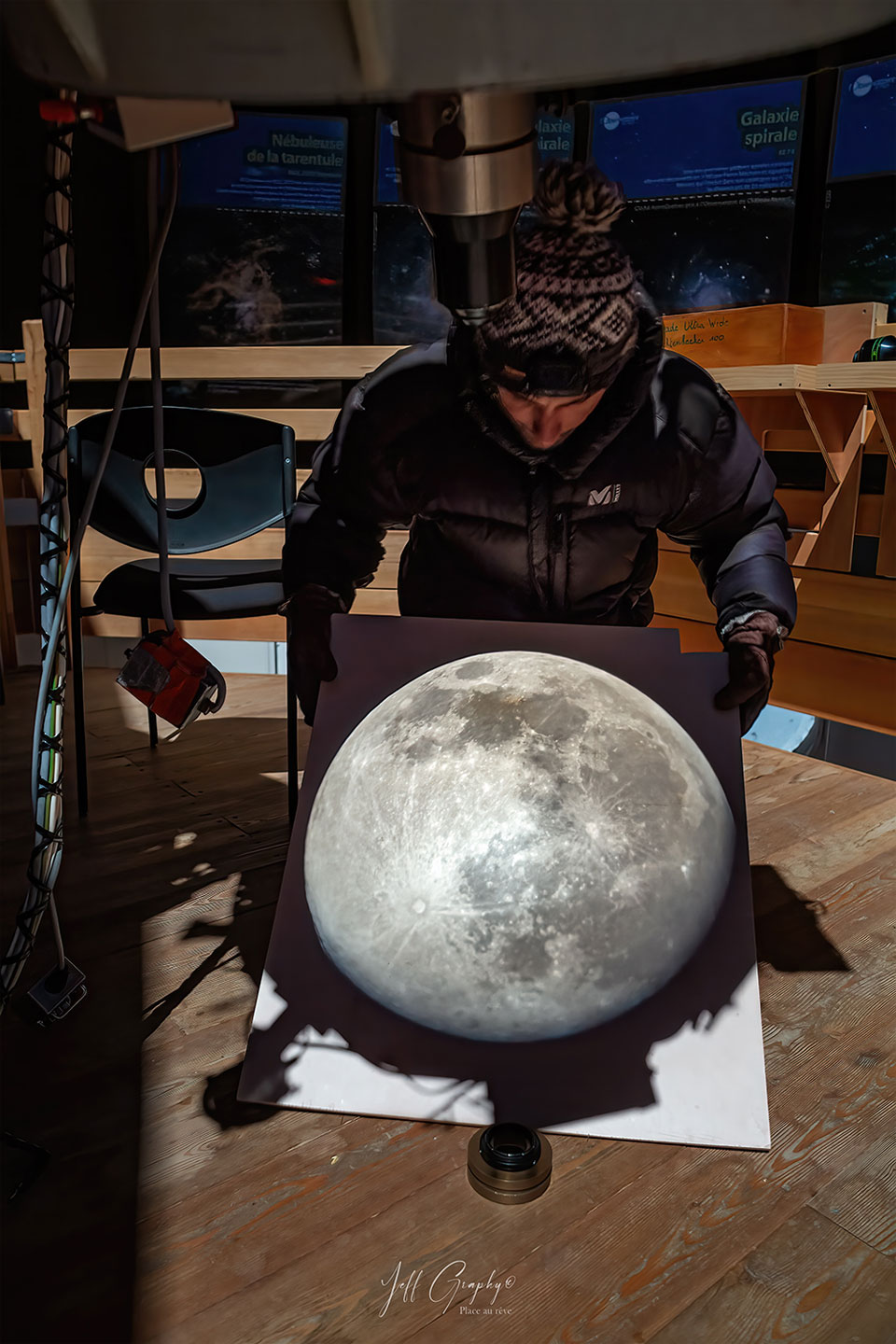
You don't have to look through a telescope to know where it's pointing. Allowing the telescope to project its image onto a large surface can be useful because it dilutes the intense brightness of very bright sources. Such dilution is useful for looking at the Sun, for example during a solar eclipse. In the featured single-exposure image, though, it is a too-bright full moon that is projected. This February full moon occurred two weeks ago and is called the Snow Moon by some northern cultures. The projecting instrument is the main 62-centimeter telescope at the Saint-Véran Observatory high in the French Alps. Seeing a full moon directly is easier because it is not too bright, although you won't see this level of detail. Your next chance will occur on March 17.
© Jeff Graphy — used with the credit NASA publishes
2021
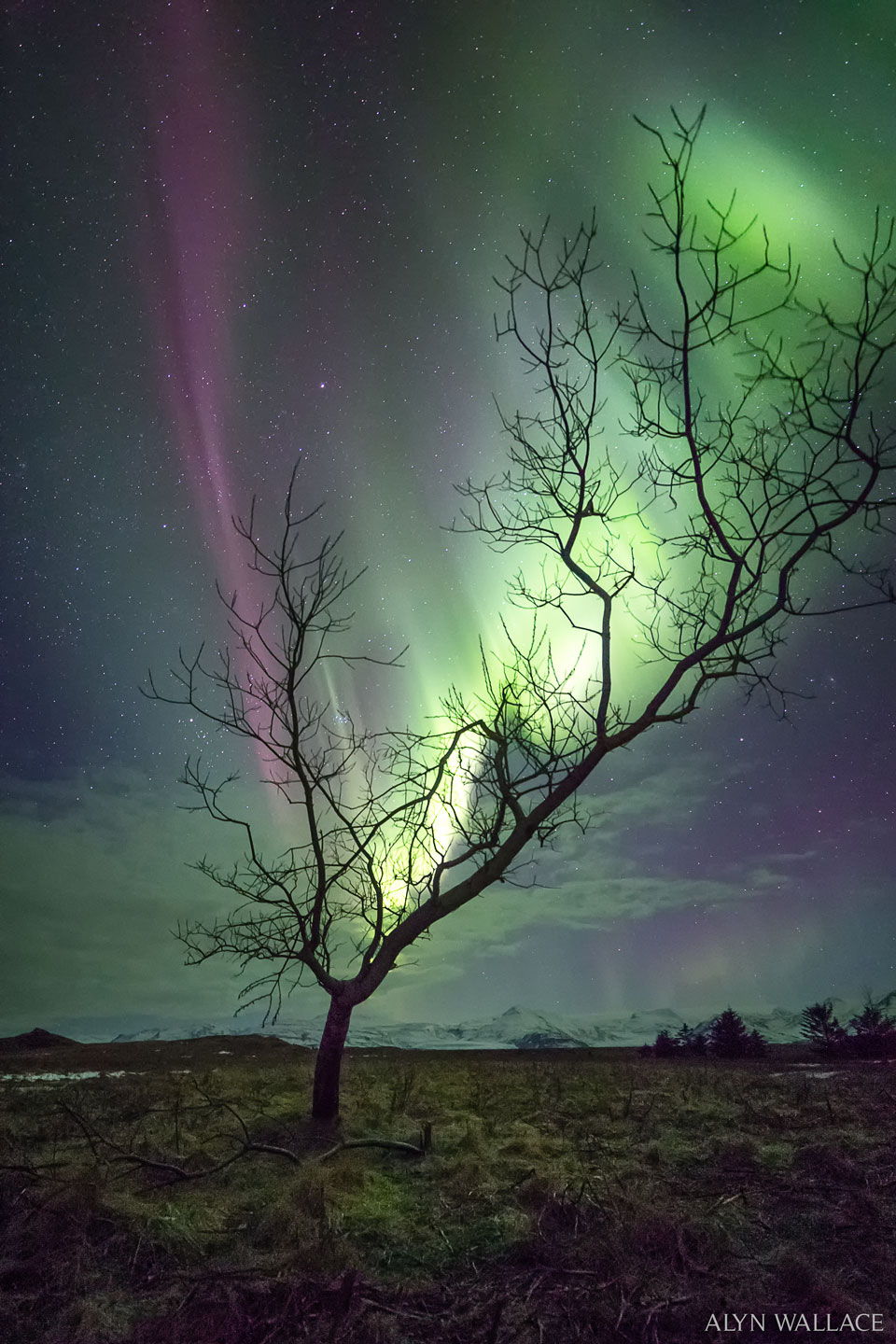
Yes, but can your tree do this? Pictured is a visual coincidence between the dark branches of a nearby tree and bright glow of a distant aurora. The beauty of the aurora -- combined with how it seemed to mimic a tree right nearby -- mesmerized the photographer to such a degree that he momentarily forgot to take pictures. When viewed at the right angle, it seemed that this tree had aurora for leaves. Fortunately, before the aurora morphed into a different overall shape, he came to his senses and capture the awe-inspiring momentary coincidence. Typically triggered by solar explosions, aurora are caused by high energy electrons impacting the Earth's atmosphere around 150 kilometers up. The unusual Earth-sky collaboration was witnessed in March of 2017 in Iceland. Almost Hyperspace: Random APOD Generator
© Alyn Wallace — used with the credit NASA publishes

1959
Discoverer 1, an American spy satellite that is the first object intended to achieve a polar orbit, is launched but fails to achieve orbit.
Discoverer 1 ↗
1966
American test pilots Charles Bassett and Elliot See die in a plane crash in St. Louis, Missouri.
Charles Bassett ↗
1966
A NASA T-38 Talon crashes into the McDonnell Aircraft factory while attempting a poor-visibility landing at Lambert Field, St. Louis, killing astronauts Elliot See and Charles Bassett.
Northrop T-38 Talon ↗

1997
GRB 970228, a highly luminous 80-second flash of gamma rays, was detected on Earth, providing early evidence that gamma-ray bursts occur well beyond the Milky Way.
GRB 970228 ↗
2024
Prime Minister Modi of India inaugurates the 2nd Space Port of India - Kulasekarapattinam Spaceport.
Prime minister ↗Event text and thumbnails come from Wikipedia and are used under CC BY-SA 4.0. Images are drawn only from Wikimedia Commons, which does not accept non-free content — each thumbnail links to its file page, where its licence and author are recorded.
Launch records are from The Space Devs’ Launch Library 2. This archive is still being mirrored, so some days are incomplete. Pictures are NASA’s Astronomy Picture of the Day; NASA imagery is generally not subject to copyright, but individual APOD entries are frequently the property of the photographer, and each caption says which applies.
General-audience astronomy and spaceflight — none of it a textbook.
As an Amazon Associate I earn from qualifying purchases. Links here cost you nothing extra.
LISTING
Still the best single argument for why any of this matters, and it leaves the arithmetic in. For a reader who wants the science, not just the awe.
LISTING
The case for leaving Earth, written by someone unsentimental about how hard that is. Suits readers who want the argument rather than the poster.
LISTING
Hard-SF problem solving in The Martian's key — for anyone who liked the engineering more than the peril. The only novel on this list.
BROWSE opens an Amazon search, not a specific recommendation.
LINKS AMAZON.COM