Launches
NO DATA0MISSIONS
The launch archive is still being mirrored, so this day has no launches listed yet.
ARCHIVE // DAY OF YEAR
Wikipedia records 2 spaceflight and astronomy events on February 24. Below are the pictures NASA published on February 24 in 6 different years — each one taken or released on this exact date.
0MISSIONS
The launch archive is still being mirrored, so this day has no launches listed yet.
2ENTRIES
Spaceflight and astronomy entries from Wikipedia's record of this date, oldest first — from 2007 onward.
6IMAGES
NASA's Astronomy Picture of the Day for February 24, one per year. Some are public domain and some belong to the photographer — each says which.
NASA’s Astronomy Picture of the Day, for this calendar date in each of the last several years.
2026
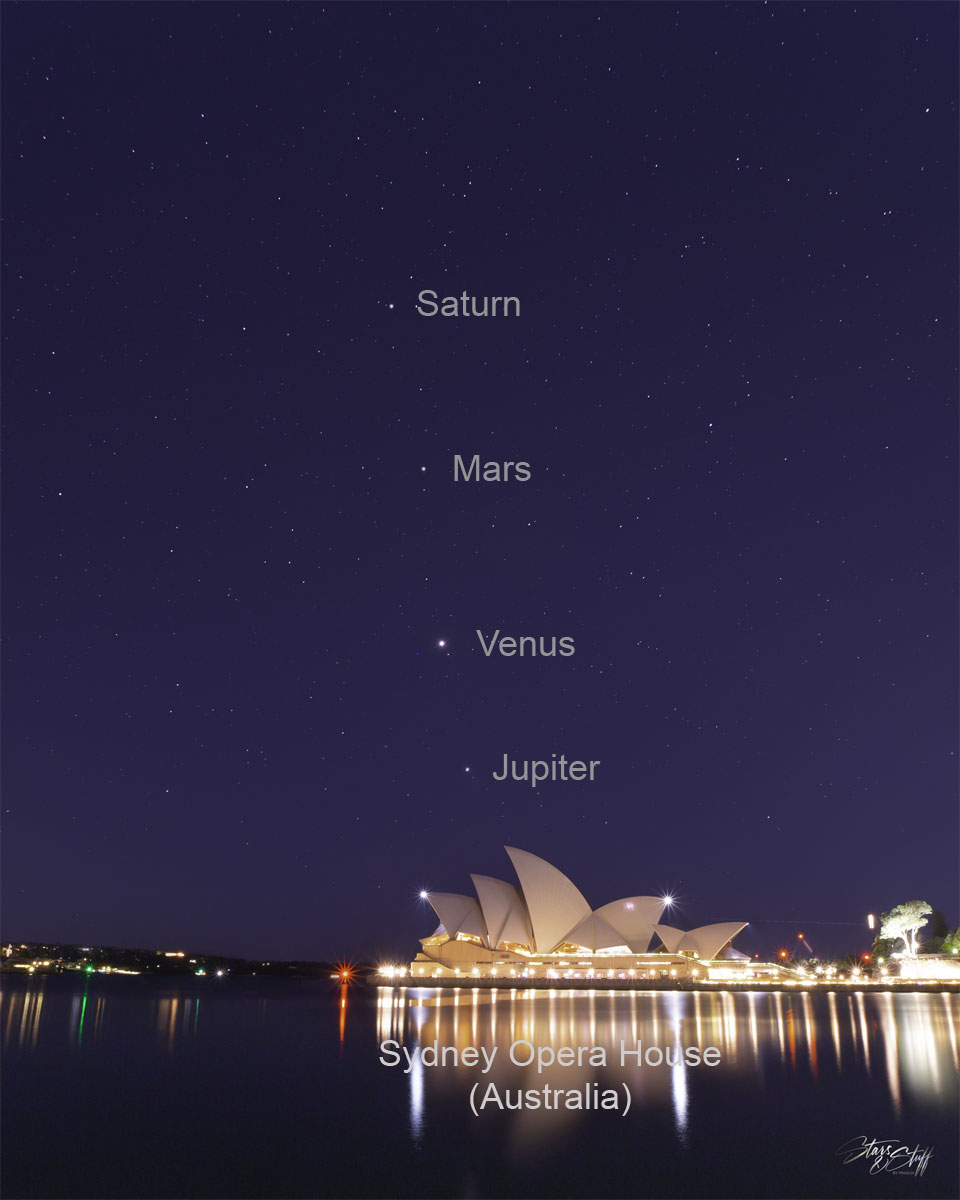
Look up this week and see a whole bunch of planets. Just after sunset, looking west (mostly), planets Mercury, Venus, Saturn, and Jupiter will all be visible to the unaided eye simultaneously. If you have a telescope, planets Uranus and Neptune can also be seen. In order up from the horizon, the lineup this week will be Venus (the brightest), Mercury, Saturn, Neptune, Uranus, and Jupiter (second brightest). It doesn't matter where on Earth you live because this early evening planet parade will be visible through clear skies all around the globe. The planets will appear to be nearly in a line because they all orbit the Sun in nearly the same plane: the ecliptic. The featured image shows a similar planet parade that occurred in 2022, captured over the Sydney Opera House in southern Australia. Although visible all week, the planets will be most easily seen together this weekend.
© Prasun Agrawal — used with the credit NASA publishes

2025
Can a lava flow extend into the sky? No, but light from the lava flow can. One effect is something quite unusual -- a volcanic light pillar. More typically, light pillars are caused by sunlight and so appear as a bright column that extends upward above a rising or setting Sun. Alternatively, other light pillars -- some quite colorful -- have been recorded above street and house lights. This light pillar, though, was illuminated by the red light emitted by the glowing magma of an erupting volcano. The volcano is Italy's Mount Etna, and the featured image was captured with a single shot during an early morning in mid-February. Freezing temperatures above the volcano's lava flow created ice-crystals either in the air above the volcano or in condensed water vapor expelled by Mount Etna. These ice crystals -- mostly flat toward the ground but fluttering -- then reflected away light from the volcano's caldera.
© Davide Caliò — used with the credit NASA publishes
2024
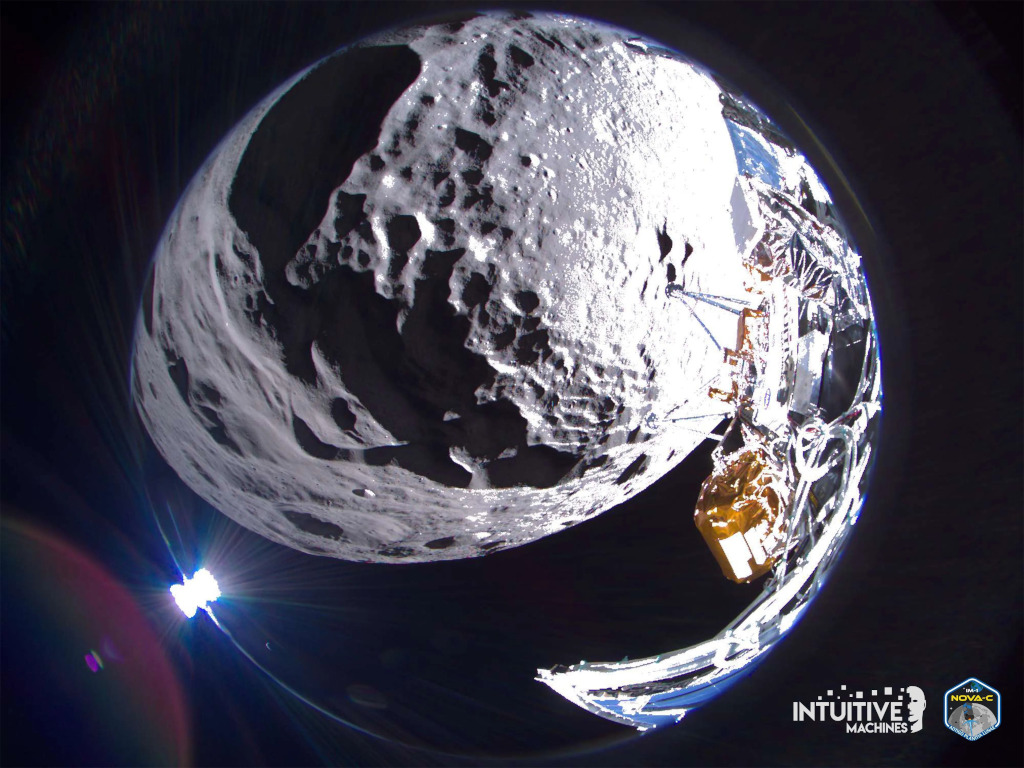
Intuitive Machines' robotic lander Odysseus has accomplished the first U.S. landing on the Moon since the Apollo 17 mission in 1972. Launched on a SpaceX rocket on February 15, the phone booth sized lander reached lunar orbit on the 21st and touched down on the lunar surface at 6:23 pm ET on February 22nd. Its landing region is about 300 kilometers north of the Moon's south pole, near a crater designated Malapert A. Resting on its side, the lander is presently collecting solar power and transmitting data back to the Intuitive Machines' mission control center in Houston. The mission marks the first commercial uncrewed landing on the Moon. Prior to landing, Odysseus’ camera captured this extreme wide angle image (landing legs visible at right) as it flew over Schomberger crater some 200 kilometers from its landing site. Odysseus was still about 10 kilometers above the lunar surface.
NASA · public domain
2023
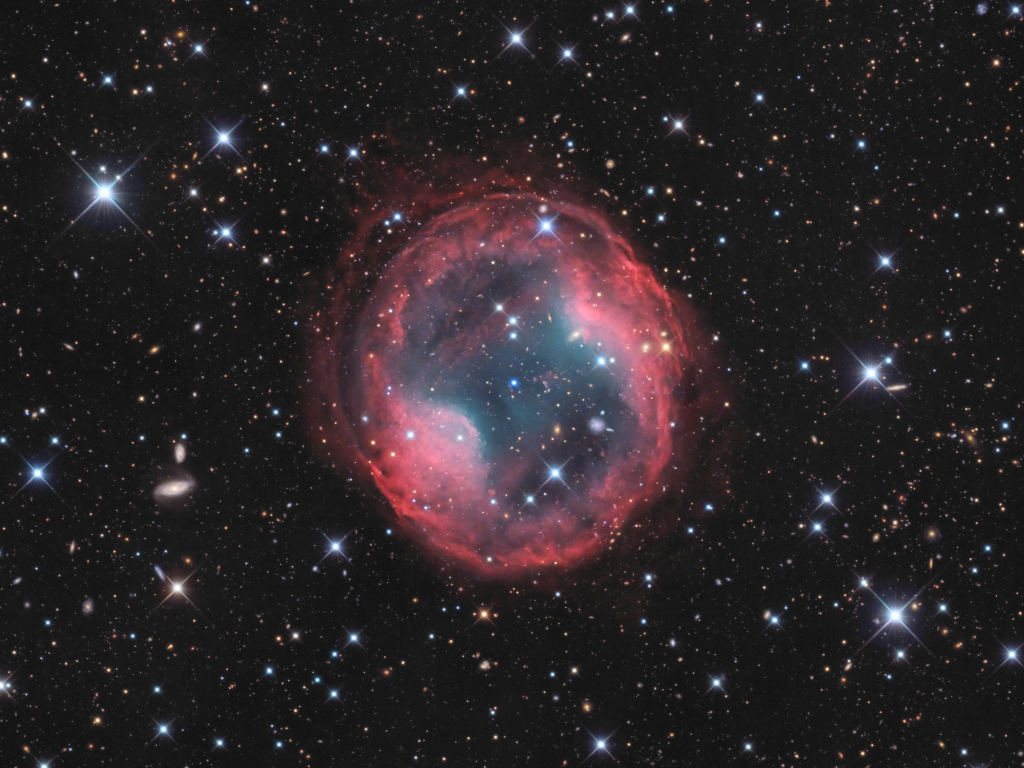
Planetary nebula Jones-Emberson 1 is the death shroud of a dying Sun-like star. It lies some 1,600 light-years from Earth toward the sharp-eyed constellation Lynx. About 4 light-years across, the expanding remnant of the dying star's atmosphere was shrugged off into interstellar space, as the star's central supply of hydrogen and then helium for fusion was finally depleted after billions of years. Visible near the center of the planetary nebula is what remains of the stellar core, a blue-hot white dwarf star. Also known as PK 164 +31.1, the nebula is faint and very difficult to glimpse at a telescope's eyepiece. But this deep broadband image combining 22 hours of exposure time does show it off in exceptional detail. Stars within our own Milky Way galaxy as well as background galaxies across the universe are scattered through the clear field of view. Ephemeral on the cosmic stage, Jones-Emberson 1 will fade away over the next few thousand years. Its hot, central white dwarf star will take billions of years to cool.
© Serge Brunier, Jean-François Bax, David Vernet — used with the credit NASA publishes
2022
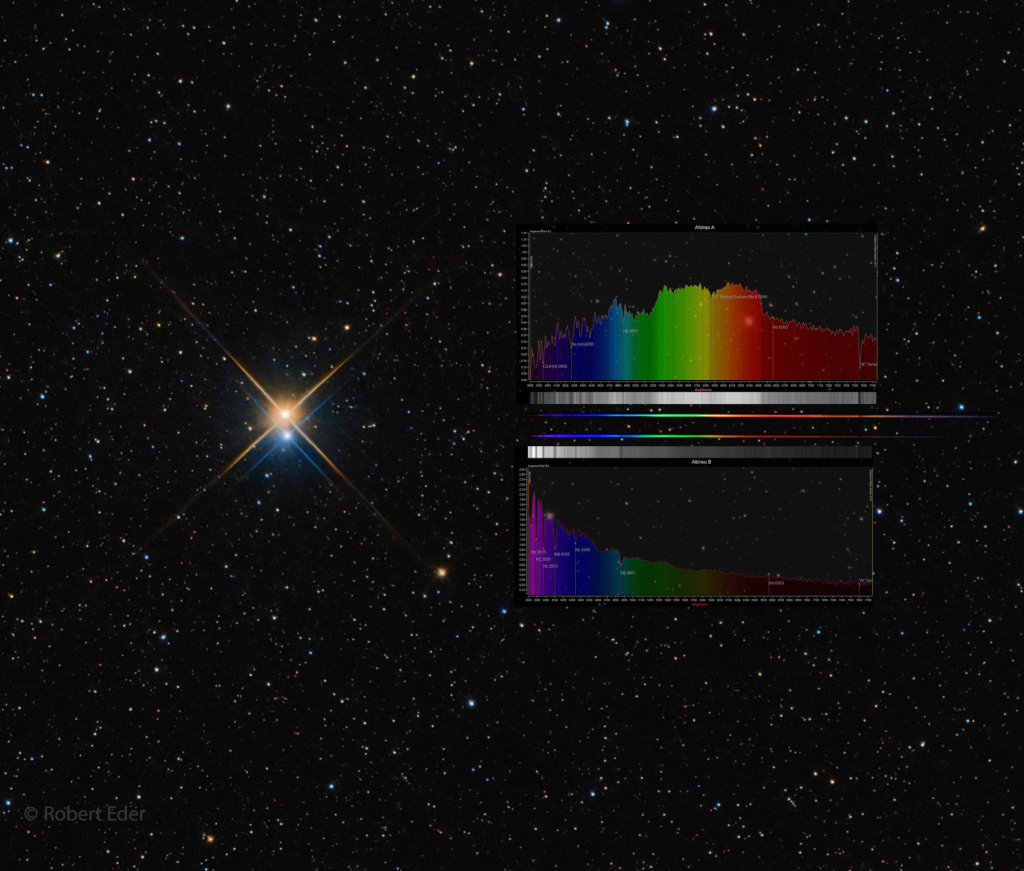
Beta Cygni is a single bright star to the naked eye. About 420 light-years away it marks the foot of the Northern Cross, famous asterism in the constellation Cygnus. But a view through the eyepiece of a small telescope will transform it into a beautiful double star, a treasure of the night sky in blue and gold. Beta Cygni is also known as Albireo, designated Albireo AB to indicate its two bright component stars. Their visually striking color difference is illustrated in this telescopic snapshot, along with their associated visible spectrum of starlight shown in insets to the right. Albireo A, top inset, shows the spectrum of a K-type giant star, cooler than the Sun and emitting most of its energy at yellow and red wavelengths. Below, Albireo B has the spectrum of a main sequence star much hotter than the Sun, emitting more energy in blue and violet. Albireo A is known to be a binary star, two stars together orbiting a common center of mass, though the two stars are too close together to be seen separately with a small telescope. Well-separated Albireo A and B most likely represent an optical double star and not a physical binary system because the two components have clearly different measured motions through space.
© Robert Eder — used with the credit NASA publishes
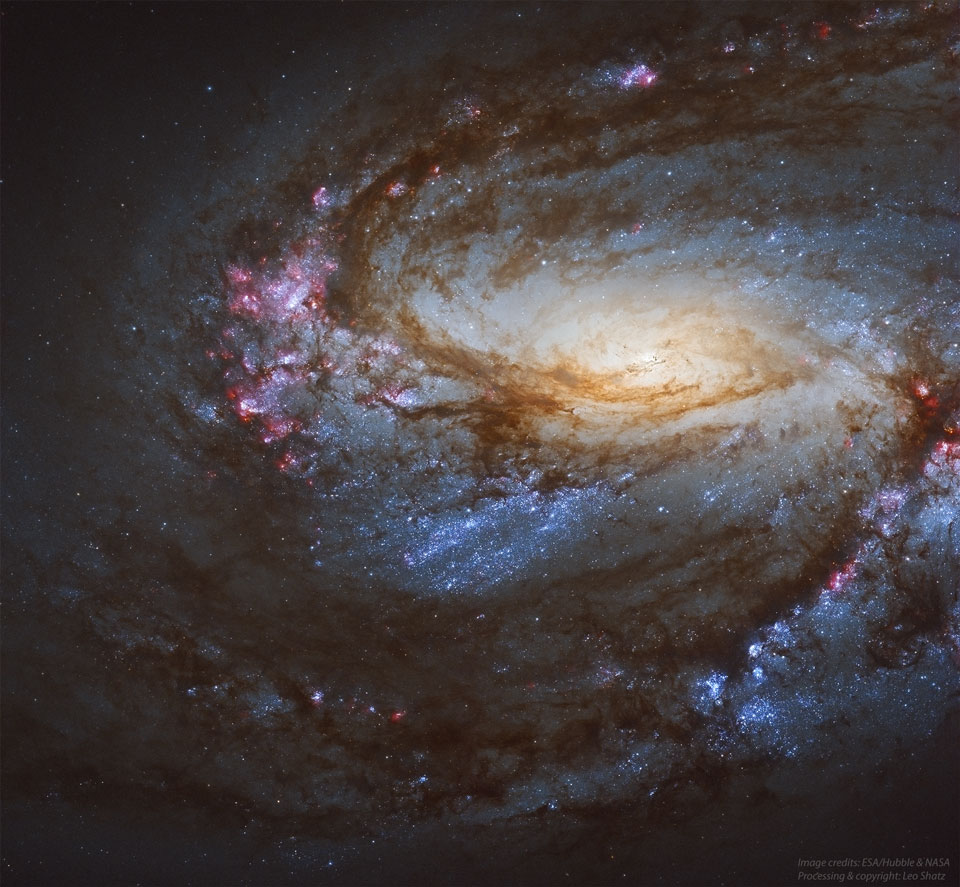
2021
It’s always nice to get a new view of an old friend. This stunning Hubble Space Telescope image of nearby spiral galaxy M66 is just that. A spiral galaxy with a small central bar, M66 is a member of the Leo Galaxy Triplet, a group of three galaxies about 30 million light years from us. The Leo Triplet is a popular target for relatively small telescopes, in part because M66 and its galactic companions M65 and NGC 3628 all appear separated by about the angular width of a full moon. The featured image of M66 was taken by Hubble to help investigate the connection between star formation and molecular gas clouds. Clearly visible are bright blue stars, pink ionized hydrogen clouds -- sprinkled all along the outer spiral arms, and dark dust lanes in which more star formation could be hiding.
NASA · public domain

2007
Japan launches its fourth spy satellite, stepping up its ability to monitor potential threats such as North Korea.
Reconnaissance satellite ↗
Event text and thumbnails come from Wikipedia and are used under CC BY-SA 4.0. Images are drawn only from Wikimedia Commons, which does not accept non-free content — each thumbnail links to its file page, where its licence and author are recorded.
Launch records are from The Space Devs’ Launch Library 2. This archive is still being mirrored, so some days are incomplete. Pictures are NASA’s Astronomy Picture of the Day; NASA imagery is generally not subject to copyright, but individual APOD entries are frequently the property of the photographer, and each caption says which applies.
General-audience astronomy and spaceflight — none of it a textbook.
As an Amazon Associate I earn from qualifying purchases. Links here cost you nothing extra.
LISTING
Still the best single argument for why any of this matters, and it leaves the arithmetic in. For a reader who wants the science, not just the awe.
LISTING
The case for leaving Earth, written by someone unsentimental about how hard that is. Suits readers who want the argument rather than the poster.
LISTING
Hard-SF problem solving in The Martian's key — for anyone who liked the engineering more than the peril. The only novel on this list.
BROWSE opens an Amazon search, not a specific recommendation.
LINKS AMAZON.COM