Launches
NO DATA0MISSIONS
The launch archive is still being mirrored, so this day has no launches listed yet.
ARCHIVE // DAY OF YEAR
Wikipedia records 5 spaceflight and astronomy events on February 7. Below are the pictures NASA published on February 7 in 5 different years — each one taken or released on this exact date.
0MISSIONS
The launch archive is still being mirrored, so this day has no launches listed yet.
5ENTRIES
Spaceflight and astronomy entries from Wikipedia's record of this date, oldest first — from 1979 onward.
5IMAGES
NASA's Astronomy Picture of the Day for February 7, one per year. Some are public domain and some belong to the photographer — each says which.
NASA’s Astronomy Picture of the Day, for this calendar date in each of the last several years.
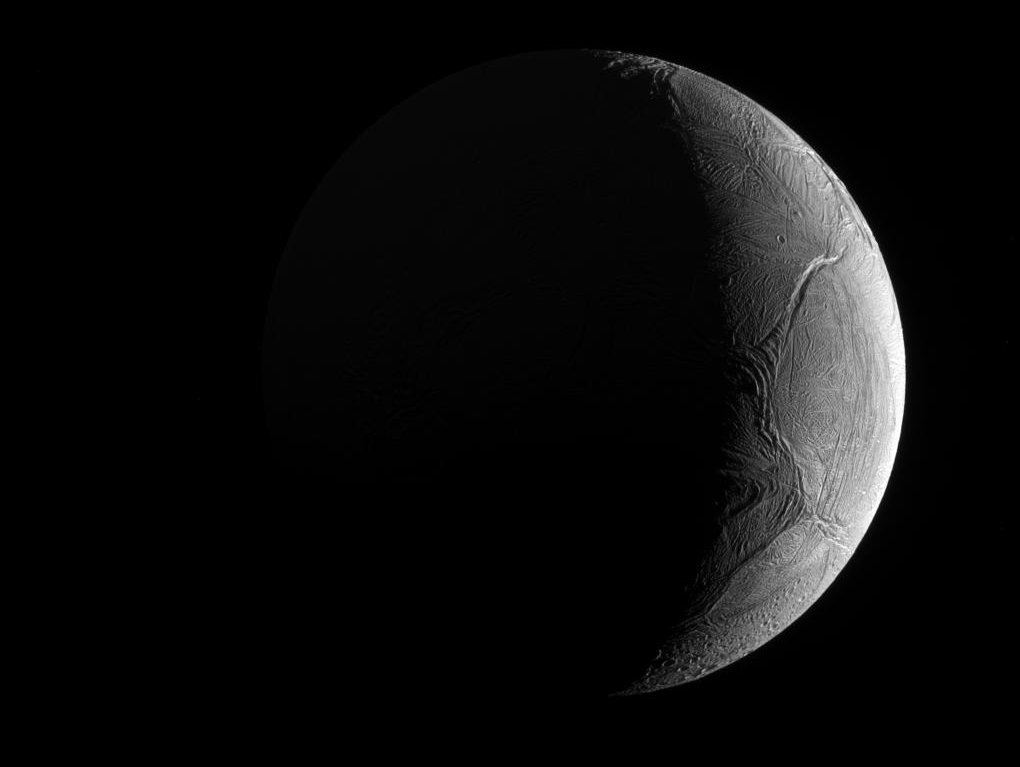
2026
Peering from the shadows, the Saturn-facing hemisphere of tantalizing inner moon Enceladus poses in this Cassini spacecraft image. North is up in the dramatic scene captured during November 2016 as Cassini's camera was pointed in a nearly sunward direction about 130,000 kilometers from the moon's bright crescent. In fact, the distant world reflects over 90 percent of the sunlight it receives, giving its surface about the same reflectivity as fresh snow. A mere 500 kilometers in diameter, Enceladus is a surprisingly active moon. Data and images collected during Cassini's flybys have revealed water vapor and ice grains spewing from south polar geysers and evidence of an ocean of liquid water hidden beneath the moon's icy crust.
NASA · public domain

2025
The giant galaxy cataloged as LEDA 1313424 is about two and a half times the size of our own Milky Way. Its remarkable appearance in this recently released Hubble Space Telescope image strongly suggests its nickname "The Bullseye Galaxy". Known as a collisional ring galaxy it has nine rings confirmed by telescopic observations, rippling from its center like waves from a pebble dropped into a pond. Of course, the pebble dropped into the Bullseye galaxy was a galaxy itself. Telescopic observations identify the blue dwarf galaxy at center-left as the likely collider, passing through the giant galaxy's center and forming concentric rings in the wake of their gravitational interaction. The Bullseye Galaxy lies some 567 million light-years away toward the constellation Pisces. At that distance, this stunning Hubble image would span about 530,000 light-years.
NASA · public domain
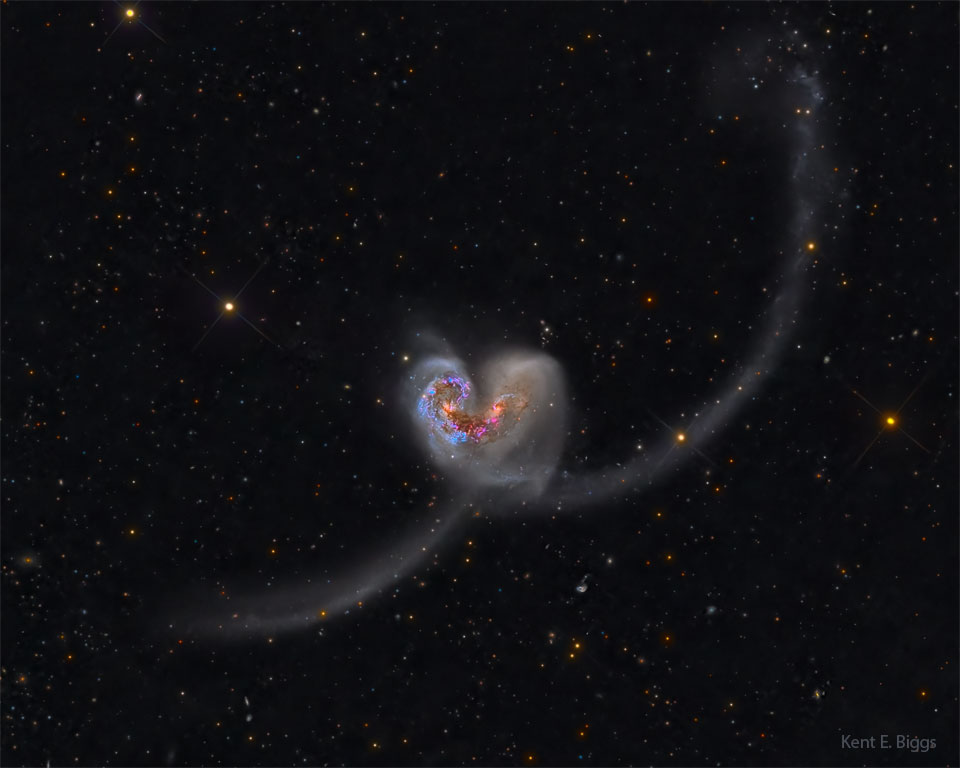
2024
Are these two galaxies really attracted to each other? Yes, gravitationally, and the result appears as an enormous iconic heart -- at least for now. Pictured is the pair of galaxies cataloged as NGC 4038 and NGC 4039,known as the Antennae Galaxies. Because they are only 60 million light years away, close by intergalactic standards, the pair is one of the best studied interacting galaxies on the night sky. Their strong attraction began about a billion years ago when they passed unusually close to each other. As the two galaxies interact, their stars rarely collide, but new stars are formed when their interstellar gases crash together. Some new stars have already formed, for example, in the long antennae seen extending out from the sides of the dancing duo. By the time the galaxy merger is complete, likely over a billion years from now, billions of new stars may have formed. Open Science: Browse 3,300+ codes in the Astrophysics Source Code Library
© Kent E. Biggs — used with the credit NASA publishes
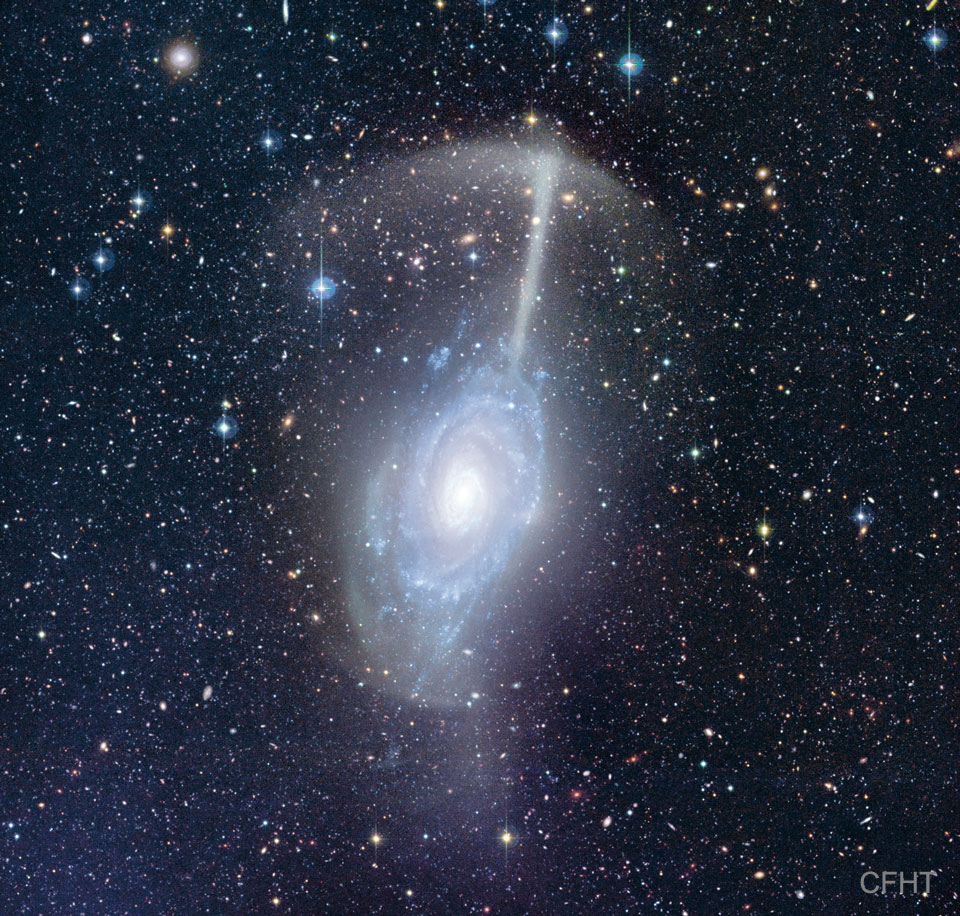
2022
It's raining stars. What appears to be a giant cosmic umbrella is now known to be a tidal stream of stars stripped from a small satellite galaxy. The main galaxy, spiral galaxy NGC 4651, is about the size of our Milky Way, while its stellar parasol appears to extend some 100 thousand light-years above this galaxy's bright disk. A small galaxy was likely torn apart by repeated encounters as it swept back and forth on eccentric orbits through NGC 4651. The remaining stars will surely fall back and become part of a combined larger galaxy over the next few million years. The featured image was captured by the Canada-France-Hawaii Telescope (CFHT) in Hawaii, USA. The Umbrella Galaxy lies about 50 million light-years distant toward the well-groomed northern constellation Coma Berenices. Almost Hyperspace: Random APOD Generator
© CFHT — used with the credit NASA publishes
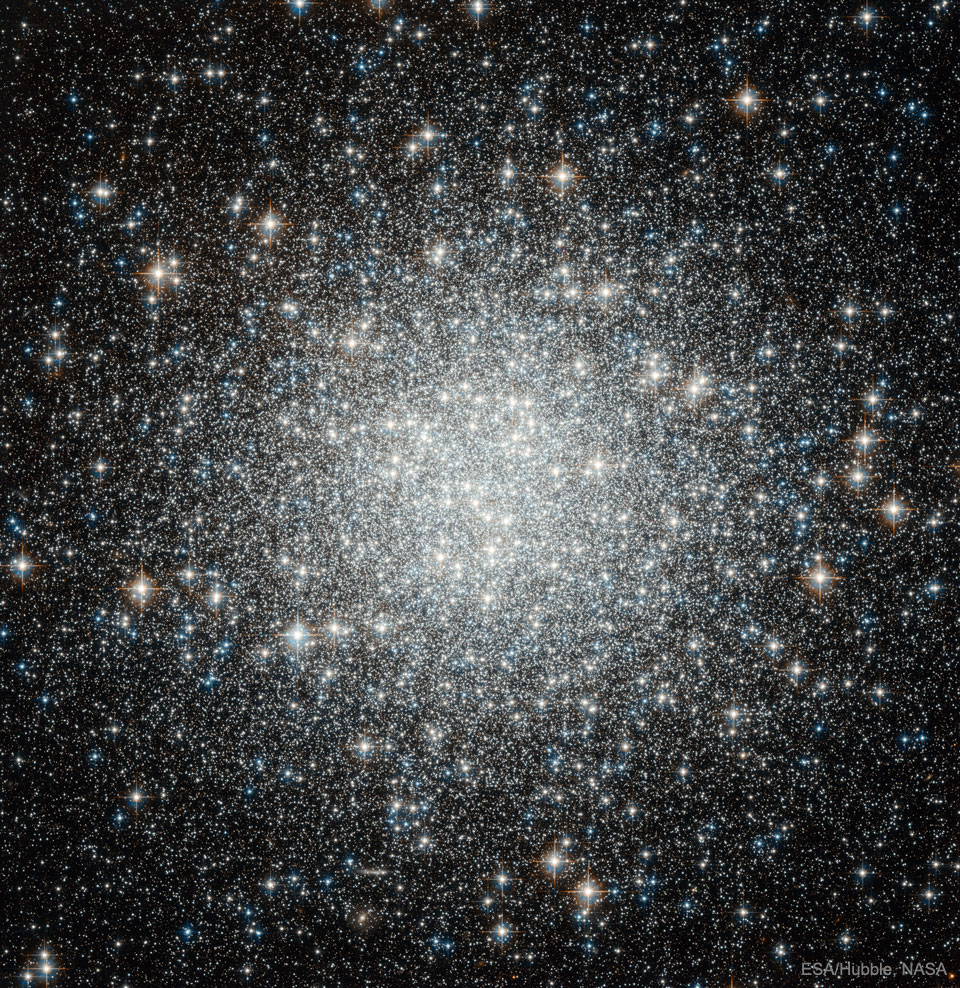
2021
If our Sun were part of this star cluster, the night sky would glow like a jewel box of bright stars. This cluster, known as M53 and cataloged as NGC 5024, is one of about 250 globular clusters that survive in our Galaxy. Most of the stars in M53 are older and redder than our Sun, but some enigmatic stars appear to be bluer and younger. These young stars might contradict the hypothesis that all the stars in M53 formed at nearly the same time. These unusual stars are known as blue stragglers and are unusually common in M53. After much debate, blue stragglers are now thought to be stars rejuvenated by fresh matter falling in from a binary star companion. By analyzing pictures of globular clusters like the featured image taken by the Hubble Space Telescope, astronomers use the abundance of stars like blue stragglers to help determine the age of the globular cluster and hence a limit on the age of the universe. M53, visible with a binoculars towards the constellation of Bernice's Hair (Coma Berenices), contains over 250,000 stars and is one of the furthest globulars from the center of our Galaxy.
NASA · public domain


1984
During the Space Shuttle Challenger mission STS-41-B, astronauts Bruce McCandless II and Robert L. Stewart performed the first untethered spacewalk (pictured).
Space Shuttle Challenger ↗
1984
Space Shuttle program: STS-41-B Mission: astronauts Bruce McCandless II and Robert L. Stewart make the first untethered space walk using the Manned Maneuvering Unit (MMU).
Space Shuttle program ↗
2001
Space Shuttle program: Space Shuttle Atlantis is launched on mission STS-98, carrying the Destiny laboratory module to the International Space Station.
Space Shuttle Atlantis ↗
2016
North Korea launches Kwangmyŏngsŏng-4 into outer space violating multiple UN treaties and prompting condemnation from around the world.
Kwangmyŏngsŏng-4 ↗Event text and thumbnails come from Wikipedia and are used under CC BY-SA 4.0. Images are drawn only from Wikimedia Commons, which does not accept non-free content — each thumbnail links to its file page, where its licence and author are recorded.
Launch records are from The Space Devs’ Launch Library 2. This archive is still being mirrored, so some days are incomplete. Pictures are NASA’s Astronomy Picture of the Day; NASA imagery is generally not subject to copyright, but individual APOD entries are frequently the property of the photographer, and each caption says which applies.
General-audience astronomy and spaceflight — none of it a textbook.
As an Amazon Associate I earn from qualifying purchases. Links here cost you nothing extra.
LISTING
Still the best single argument for why any of this matters, and it leaves the arithmetic in. For a reader who wants the science, not just the awe.
LISTING
The case for leaving Earth, written by someone unsentimental about how hard that is. Suits readers who want the argument rather than the poster.
LISTING
Hard-SF problem solving in The Martian's key — for anyone who liked the engineering more than the peril. The only novel on this list.
BROWSE opens an Amazon search, not a specific recommendation.
LINKS AMAZON.COM