Launches
NO DATA0MISSIONS
The launch archive is still being mirrored, so this day has no launches listed yet.
ARCHIVE // DAY OF YEAR
Wikipedia records 4 spaceflight and astronomy events on January 27. Below are the pictures NASA published on January 27 in 6 different years — each one taken or released on this exact date.
0MISSIONS
The launch archive is still being mirrored, so this day has no launches listed yet.
4ENTRIES
Spaceflight and astronomy entries from Wikipedia's record of this date, oldest first — from 1967 onward.
6IMAGES
NASA's Astronomy Picture of the Day for January 27, one per year. Some are public domain and some belong to the photographer — each says which.
NASA’s Astronomy Picture of the Day, for this calendar date in each of the last several years.
2026
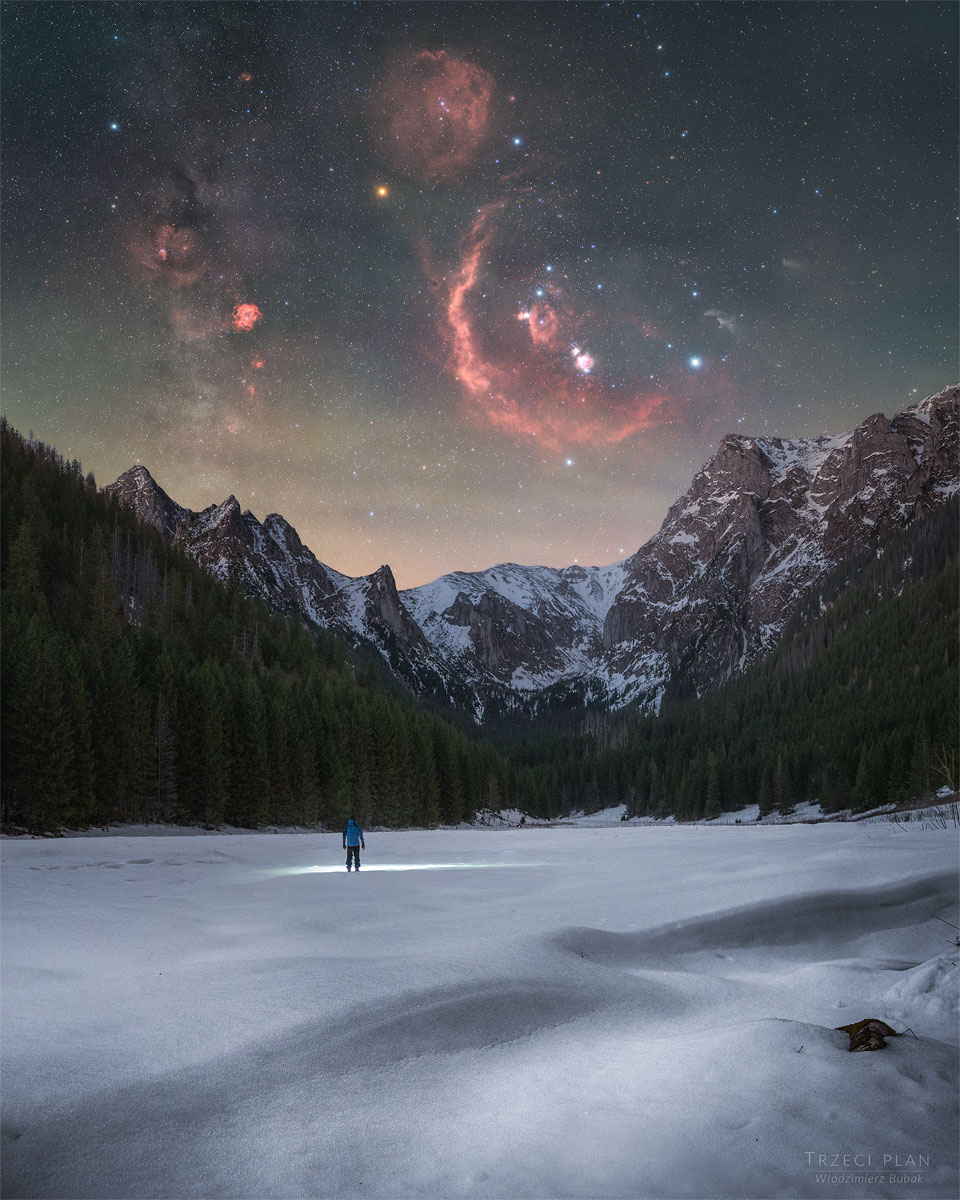
Rising over a frozen valley in the Tatra Mountains, the familiar stars and nebulas of Orion dominate this wide-field nightscape. The featured deep photo was taken in southern Poland's highest mountain range last month, where dark skies and alpine terrain combined to reveal both Earth's rugged beauty and the structure of our galaxy. Above the snowy mountains, Orion's bright belt stars anchor a region of glowing interstellar clouds. The Great Orion Nebula, a vast stellar nursery visible even to the unaided eye, shines near the center of the scene. Surrounding it is the enormous arc of Barnard's Loop, a faint shell of ionized hydrogen gas spanning much of the constellation. To the left, the round Rosette Nebula glows softly, while the grayish Witch Head Nebula hovers to the right, illuminated by nearby starlight. Near the top, the orange supergiant Betelgeuse marks the hunter's shoulder.
© Włodzimierz Bubak; Text: Ogetay Kayali (MTU) — used with the credit NASA publishes

2025
Stars come in bunches. The most famous bunch of stars on the sky is the Pleiades, a bright cluster that can be easily seen with the unaided eye. The Pleiades lies only about 450 light years away, formed about 100 million years ago, and will likely last about another 250 million years. Our Sun was likely born in a star cluster, but now, being about 4.5 billion years old, its stellar birth companions have long since dispersed. The Pleiades star cluster is pictured over Half Dome, a famous rock structure in Yosemite National Park in California, USA. The featured image is a composite of 28 foreground exposures and 174 images of the stellar background, all taken from the same location and by the same camera on the same night in October 2019. After calculating the timing of a future juxtaposition of the Pleiades and Half Dome, the astrophotographer was unexpectedly rewarded by an electrical blackout, making the background sky unusually dark. Astrophysicists: Browse 3,500+ codes in the Astrophysics Source Code Library
© Dheera Venkatraman — used with the credit NASA publishes
2024
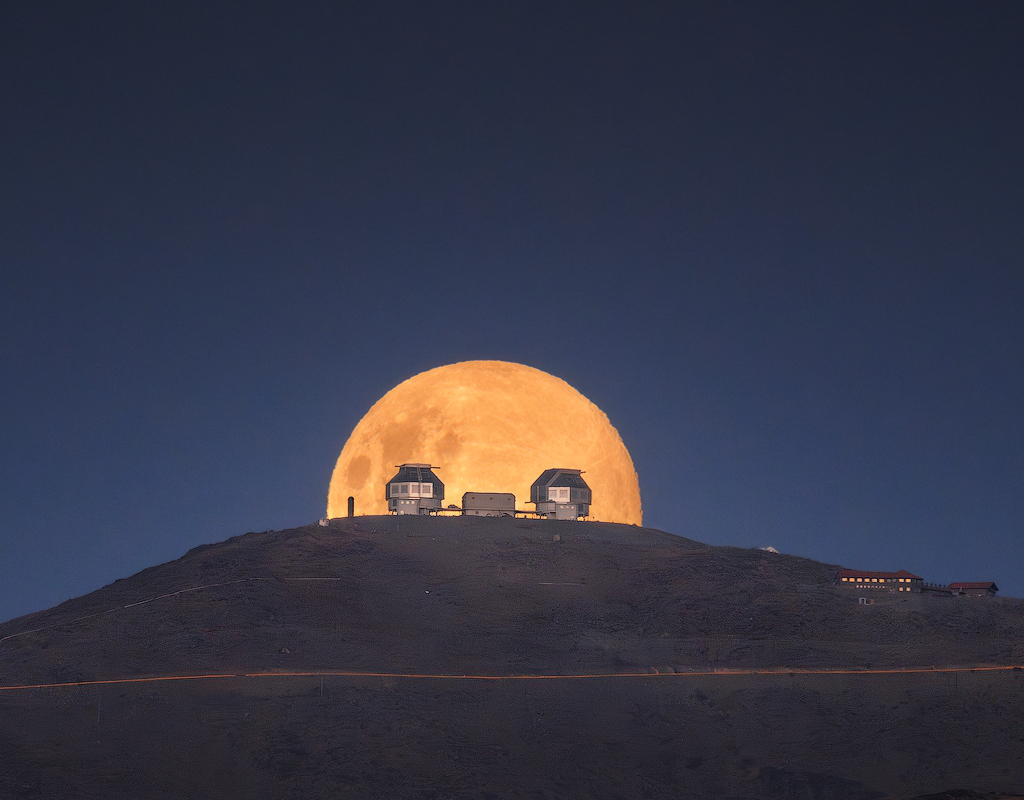
A popular name for January's full moon in the northern hemisphere is the Full Wolf Moon. As the new year's first full moon, it rises over Las Campanas Observatory in this dramatic Earth-and-moonscape. Peering from the foreground like astronomical eyes are the observatory's twin 6.5 meter diameter Magellan telescopes. The snapshot was captured with telephoto lens across rugged terrain in the Chilean Atacama Desert, taken at a distance of about 9 miles from the observatory and about 240,000 miles from the lunar surface. Of course the first full moon of the lunar new year, known to some as the Full Snow Moon, will rise on February 24.
© Yuri Beletsky — used with the credit NASA publishes
2023
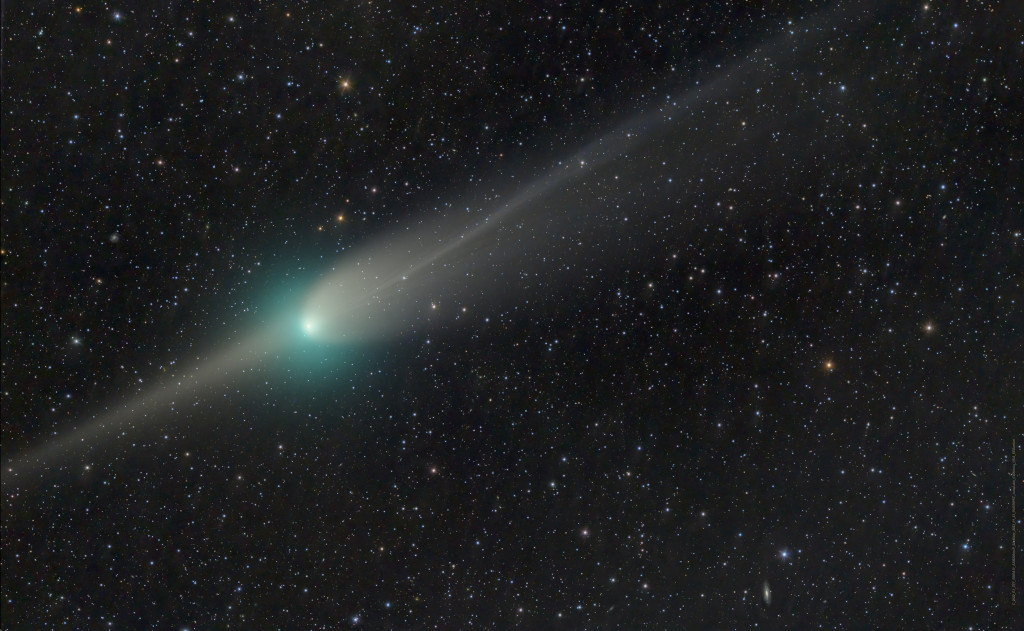
The current darling of the northern night, Comet C/2022 E3 ZTF is captured in this telescopic image from a dark sky location at June Lake, California, USA. Of course Comet ZTF has been growing brighter in recent days, headed for its closest approach to Earth on February 1. But this view was recorded on January 23, very close to the time planet Earth crossed the orbital plane of long-period Comet ZTF. The comet's broad, whitish dust tail is still curved and fanned out away from the Sun as Comet ZTF sweeps along its orbit. Due to perspective near the orbital plane crossing, components of the fanned out dust tail appear on both sides of the comet's green tinted coma though, to lend Comet ZTF a visually striking (left) anti-tail. Buffeted by solar activity the comet's narrower ion tail also streams away from the coma diagonally to the right, across the nearly three degree wide field of view. Comet ZTF Gallery: Notable Submissions to APOD
© Dan Bartlett — used with the credit NASA publishes
2022
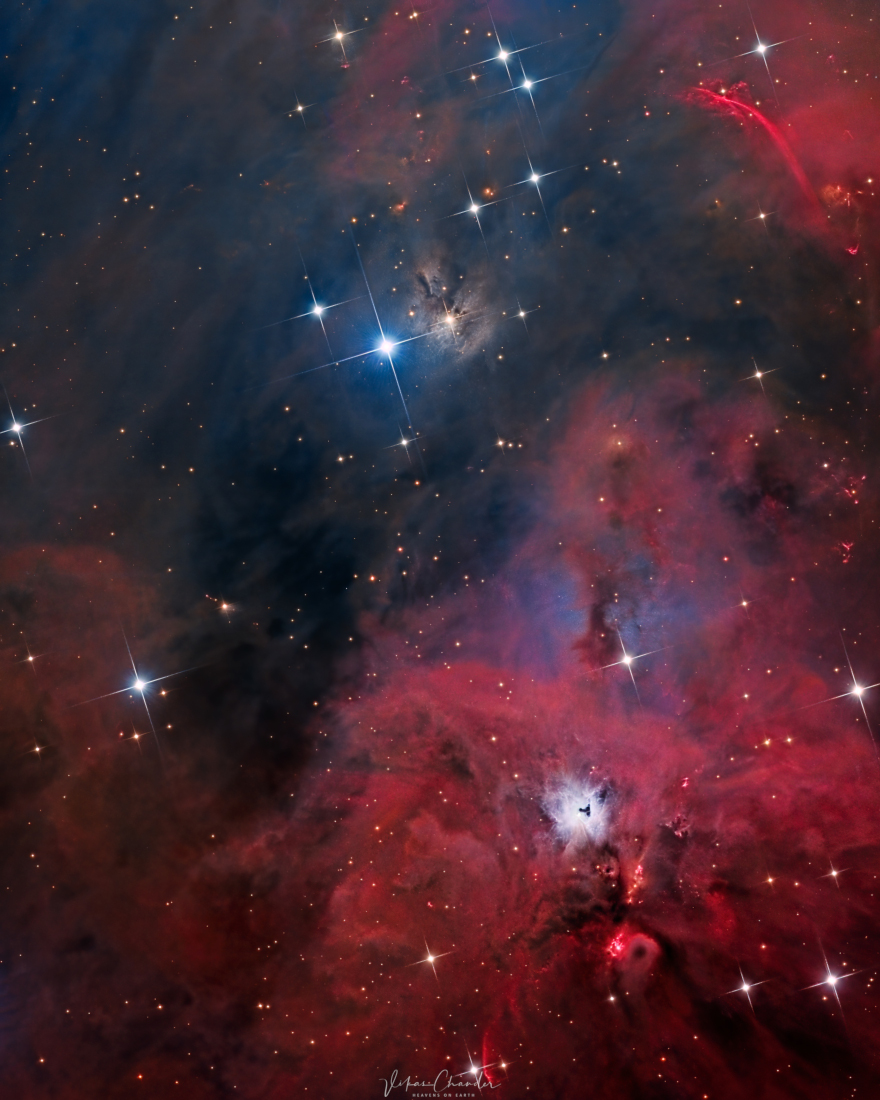
South of the large star-forming region known as the Orion Nebula, lies bright blue reflection nebula NGC 1999. At the edge of the Orion molecular cloud complex some 1,500 light-years distant, NGC 1999's illumination is provided by the embedded variable star V380 Orionis. The nebula is marked with a dark sideways T-shape at center right in this telescopic vista that spans about two full moons on the sky. Its dark shape was once assumed to be an obscuring dust cloud seen in silhouette. But infrared data suggest the shape is likely a hole blown through the nebula itself by energetic young stars. In fact, this region abounds with energetic young stars producing jets and outflows with luminous shock waves. Cataloged as Herbig-Haro (HH) objects, named for astronomers George Herbig and Guillermo Haro, the shocks have intense reddish hues. HH1 and HH2 are just below and right of NGC 1999. HH222, also known as the Waterfall nebula, looks like a red gash near top right in the frame. To create the shocks stellar jets push through the surrounding material at speeds of hundreds of kilometers per second.
© Vikas Chander — used with the credit NASA publishes
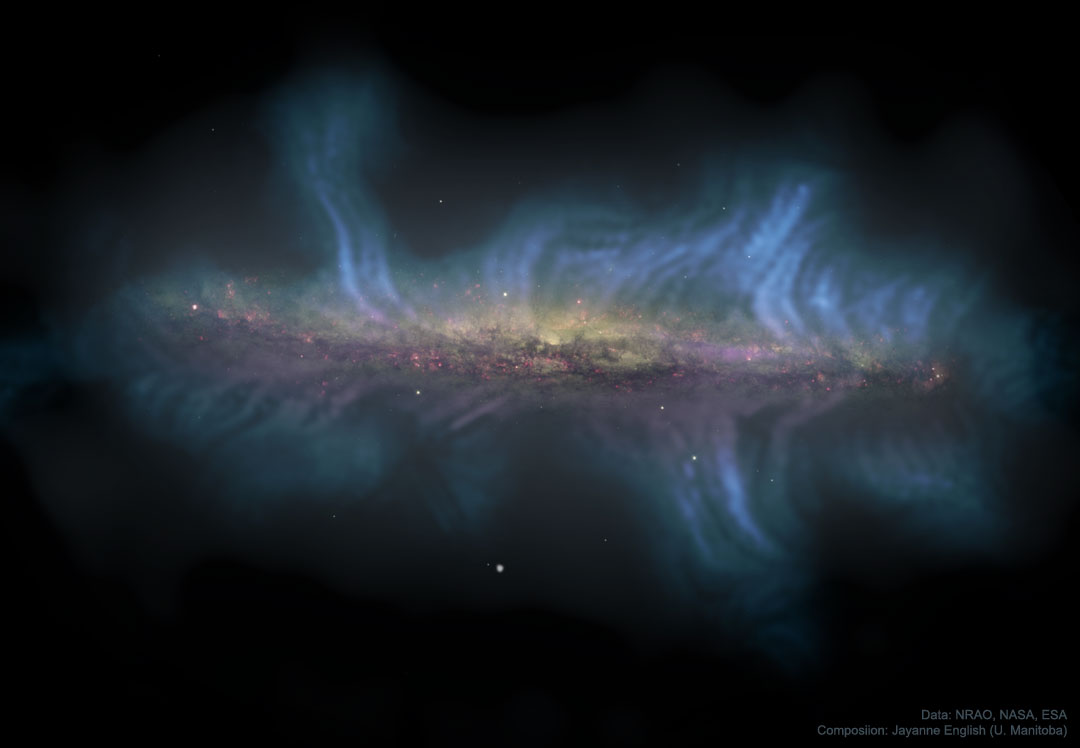
2021
How far do magnetic fields extend up and out of spiral galaxies? For decades astronomers knew only that some spiral galaxies had magnetic fields. However, after NRAO's Very Large Array (VLA) radio telescope (popularized in the movie Contact) was upgraded in 2011, it was unexpectedly discovered that these fields could extend vertically away from the disk by several thousand light-years. The featured image of edge-on spiral galaxy NGC 5775, observed in the CHANG-ES (Continuum Halos in Nearby Galaxies) survey, also reveals spurs of magnetic field lines that may be common in spirals. Analogous to iron filings around a bar magnet, radiation from electrons trace galactic magnetic field lines by spiraling around these lines at almost the speed of light. The filaments in this image are constructed from those tracks in VLA data. The visible light image, constructed from Hubble Space Telescope data, shows pink gaseous regions where stars are born. It seems that winds from these regions help form the magnificently extended galactic magnetic fields.
NASA · public domain

1967
A fire during a launch simulation for the Apollo 1 mission at Cape Kennedy killed astronauts Gus Grissom, Ed White and Roger Chaffee.
Apollo 1 ↗
1967
Apollo program: Astronauts Gus Grissom, Ed White and Roger Chaffee are killed in a fire during a test of their Apollo 1 spacecraft at the Kennedy Space Center, Florida.
Apollo program ↗
1967
Cold War: The Soviet Union, the United States, and the United Kingdom sign the Outer Space Treaty in Washington, D.C., banning deployment of nuclear weapons in space, and limiting the usage of the Moon and other celestial bodies to peaceful purposes.
Cold War ↗
2011
Astronomers documented H1504+65, a white dwarf in Ursa Minor (chart pictured) with the hottest surface temperature known at the time, at 200,000 kelvins (360,000 °F).
H1504+65 ↗Event text and thumbnails come from Wikipedia and are used under CC BY-SA 4.0. Images are drawn only from Wikimedia Commons, which does not accept non-free content — each thumbnail links to its file page, where its licence and author are recorded.
Launch records are from The Space Devs’ Launch Library 2. This archive is still being mirrored, so some days are incomplete. Pictures are NASA’s Astronomy Picture of the Day; NASA imagery is generally not subject to copyright, but individual APOD entries are frequently the property of the photographer, and each caption says which applies.
General-audience astronomy and spaceflight — none of it a textbook.
As an Amazon Associate I earn from qualifying purchases. Links here cost you nothing extra.
LISTING
Still the best single argument for why any of this matters, and it leaves the arithmetic in. For a reader who wants the science, not just the awe.
LISTING
The case for leaving Earth, written by someone unsentimental about how hard that is. Suits readers who want the argument rather than the poster.
LISTING
Hard-SF problem solving in The Martian's key — for anyone who liked the engineering more than the peril. The only novel on this list.
BROWSE opens an Amazon search, not a specific recommendation.
LINKS AMAZON.COM