Launches
NO DATA0MISSIONS
The launch archive is still being mirrored, so this day has no launches listed yet.
ARCHIVE // DAY OF YEAR
Wikipedia records 7 spaceflight and astronomy events on January 24. Below are the pictures NASA published on January 24 in 6 different years — each one taken or released on this exact date.
0MISSIONS
The launch archive is still being mirrored, so this day has no launches listed yet.
7ENTRIES
Spaceflight and astronomy entries from Wikipedia's record of this date, oldest first — from 1848 onward.
6IMAGES
NASA's Astronomy Picture of the Day for January 24, one per year. Some are public domain and some belong to the photographer — each says which.
NASA’s Astronomy Picture of the Day, for this calendar date in each of the last several years.

2026
ght billion people are about to disappear in this snapshot from space taken on 2022 November 21. On the sixth day of the Artemis I mission, their home world is setting behind the Moon's bright edge as viewed by an external camera on the outbound Orion spacecraft. Orion was headed for a powered flyby that took it to within 130 kilometers of the lunar surface. Velocity gained in the flyby maneuver was used to reach a distant retrograde orbit around the Moon. That orbit is considered distant because it's another 92,000 kilometers beyond the Moon, and retrograde because the spacecraft orbited in the opposite direction of the Moon's orbit around planet Earth. Swinging around the Moon, Orion reached a maximum distance (just over 400,000 kilometers) from Earth on 2022 November 28, exceeding a record set by Apollo 13 for most distant spacecraft designed for human space exploration. The Artemis II mission, carrying 4 astronauts around the moon and back again, is due to launch as early as February 6.
NASA · public domain

2025
Comet C/2024 G3 ATLAS has made a dramatic appearance in planet Earth's skies. A visitor from the distant Oort Cloud, the comet reached its perihelion on January 13. On January 19, the bright comet was captured here from ESO Paranal Observatory in the Atacama desert in Chile. Sporting spectacular sweeping dust tails, this comet ATLAS is setting in the southern hemisphere twilight and was clearly visible to the unaided eye. In the foreground is the closed shell of one of the observatory's famous auxiliary telescopes. Still wowing southern hemisphere observers, the comet's bright coma has become diffuse, its icy nucleus apparently disintegrating following its close approach to the Sun. Growing Gallery: Comet ATLAS (G3)
© Yuri Beletsky — used with the credit NASA publishes
2024
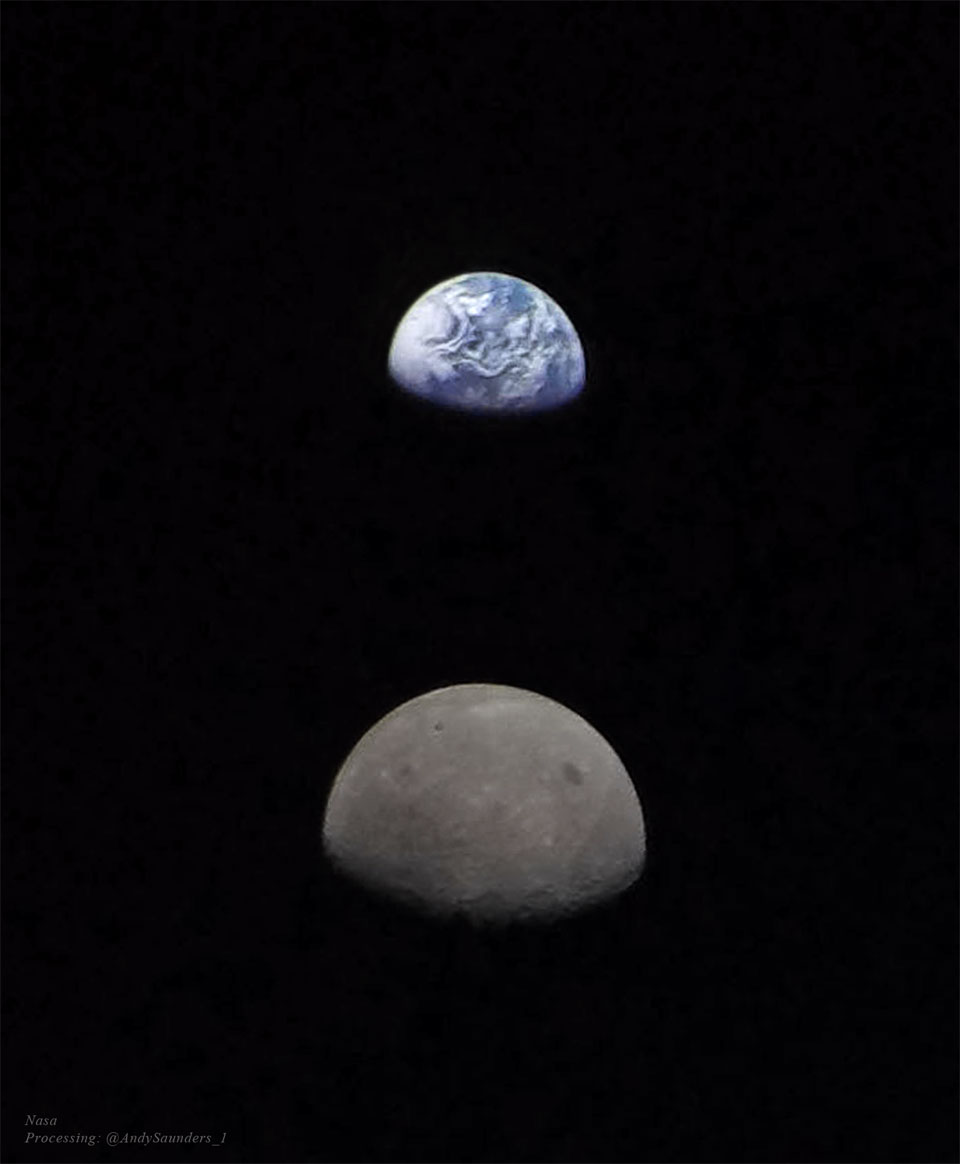
What do the Earth and Moon look like from beyond the Moon? Although frequently photographed together, the familiar duo was captured with this unusual perspective in late 2022 by the robotic Orion spacecraft of NASA's Artemis I mission as it looped around Earth's most massive satellite and looked back toward its home world. Since our Earth is about four times the diameter of the Moon, the satellite’s seemingly large size was caused by the capsule being closer to the smaller body. Artemis II, the next launch in NASA’s Artemis series, is currently scheduled to take people around the Moon in 2025, while Artemis III is planned to return humans to lunar surface in late 2026. Last week, JAXA's robotic SLIM spacecraft, launched from Japan, landed on the Moon and released two hopping rovers. Explore Your Universe: Random APOD Generator
NASA · public domain

2023
If you could stand on exoplanet LHS 475 b, what might you see? No one knows for sure but pictured here is an interesting guess made by an Earth-based artificial intelligence (AI) engine. The existence of the exoplanet was indicated in data taken by the Earth-orbiting TESS satellite but confirmed and further investigated only this year by the near-Earth Sun-orbiting James Webb Space Telescope. What is known for sure is that LHS 475 b has a mass very similar to our Earth and closely orbits a small red star about 40 light years away. The featured AI-illustrated guess depicts a plausibly rugged Earth-like landscape replete with molten lava and with the central red star rising in the distance. Webb data does not as yet reveal, however, whether LHS 475 b has an atmosphere. One of Webb’s science objectives is to follow up previous discoveries of distant exoplanets to better discern their potential for developing life. Comet ZTF Gallery: Notable Submissions to APOD
NASA · public domain
2022
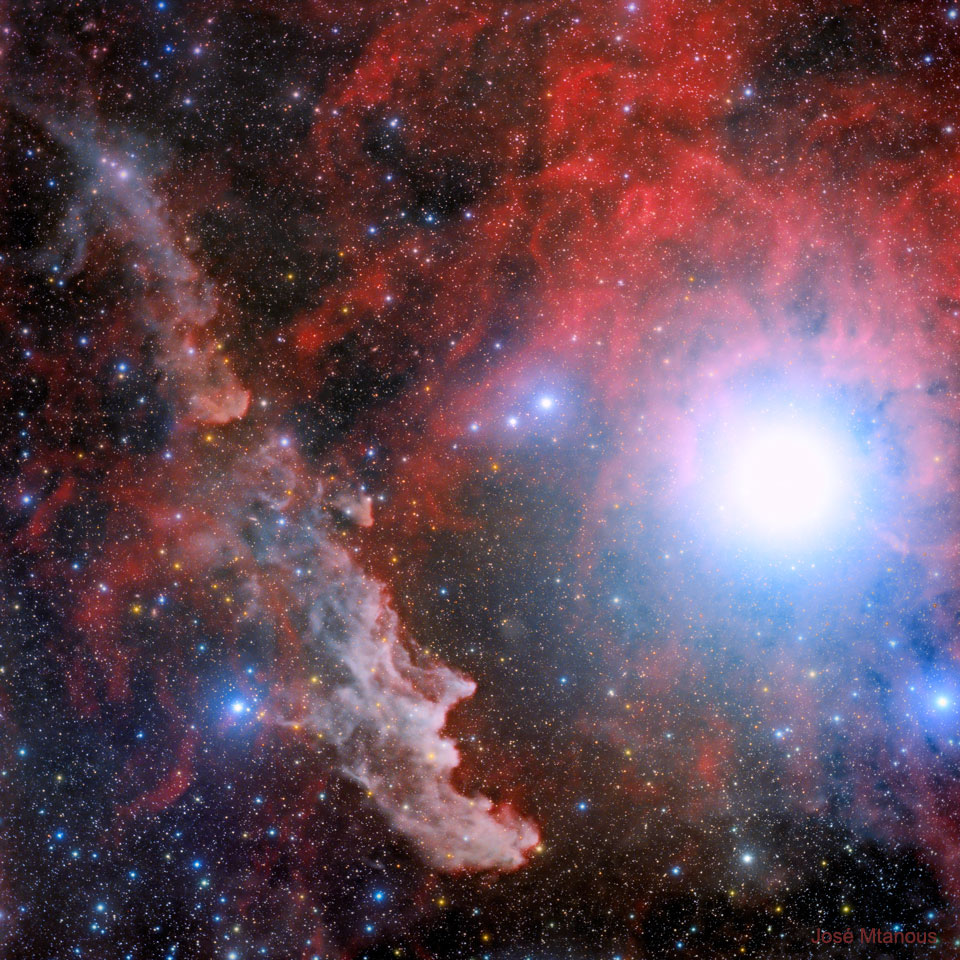
By starlight this eerie visage shines in the dark, a crooked profile evoking its popular name, the Witch Head Nebula. In fact, this entrancing telescopic portrait gives the impression that the witch has fixed her gaze on Orion's bright supergiant star Rigel. More formally known as IC 2118, the Witch Head Nebula spans about 50 light-years and is composed of interstellar dust grains reflecting Rigel's starlight. The blue color of the Witch Head Nebula and of the dust surrounding Rigel is caused not only by Rigel's intense blue starlight but because the dust grains scatter blue light more efficiently than red. The same physical process causes Earth's daytime sky to appear blue, although the scatterers in Earth's atmosphere are molecules of nitrogen and oxygen. Rigel, the Witch Head Nebula, and gas and dust that surrounds them lie about 800 light-years away.
© José Mtanous — used with the credit NASA publishes
2021
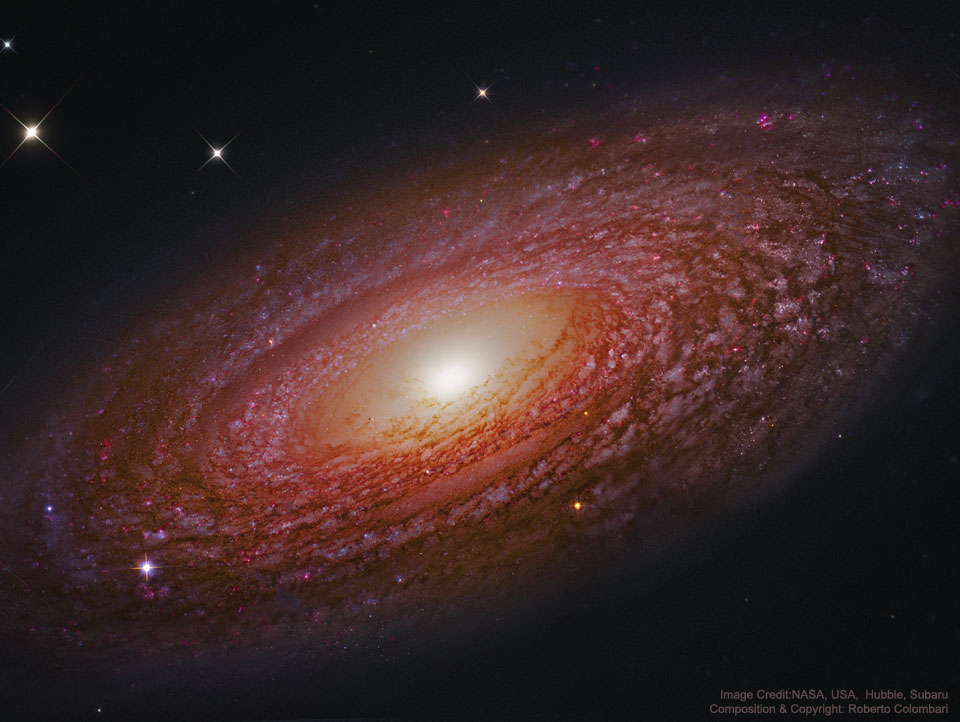
It is one of the more massive galaxies known. A mere 46 million light-years distant, spiral galaxy NGC 2841 can be found in the northern constellation of Ursa Major. This sharp view of the gorgeous island universe shows off a striking yellow nucleus and galactic disk. Dust lanes, small, pink star-forming regions, and young blue star clusters are embedded in the patchy, tightly wound spiral arms. In contrast, many other spirals exhibit grand, sweeping arms with large star-forming regions. NGC 2841 has a diameter of over 150,000 light-years, even larger than our own Milky Way. The featured composite image merges exposures from the orbiting 2.4-meter Hubble Space Telescope and the ground-based 8.2-meter Subaru Telescope. X-ray images suggest that resulting winds and stellar explosions create plumes of hot gas extending into a halo around NGC 2841.
© Roberto Colombari — used with the credit NASA publishes

1848
James W. Marshall discovered gold at Sutter's Mill (reconstruction pictured) in Coloma, California, leading to the California gold rush.
James W. Marshall ↗
1848
California Gold Rush: James W. Marshall finds gold at Sutter's Mill near Sacramento.
California gold rush ↗
1978
The Soviet nuclear-powered satellite Kosmos 954 burned up during atmospheric reentry, scattering radioactive debris across Canada's Northwest Territories.
Nuclear power ↗
1978
Soviet satellite Kosmos 954, with a nuclear reactor on board, burns up in Earth's atmosphere, scattering radioactive debris over Canada's Northwest Territories. Only 1% is recovered.
Soviet Union ↗

1990
Japan launched the Hiten spacecraft (pictured), the first lunar probe launched by a country other than the Soviet Union or the United States.
Hiten (spacecraft) ↗1990
Japan launches Hiten, the country's first lunar probe, the first robotic lunar probe since the Soviet Union's Luna 24 in 1976, and the first lunar probe launched by a country other than Soviet Union or the United States.
Hiten (spacecraft) ↗Event text and thumbnails come from Wikipedia and are used under CC BY-SA 4.0. Images are drawn only from Wikimedia Commons, which does not accept non-free content — each thumbnail links to its file page, where its licence and author are recorded.
Launch records are from The Space Devs’ Launch Library 2. This archive is still being mirrored, so some days are incomplete. Pictures are NASA’s Astronomy Picture of the Day; NASA imagery is generally not subject to copyright, but individual APOD entries are frequently the property of the photographer, and each caption says which applies.
General-audience astronomy and spaceflight — none of it a textbook.
As an Amazon Associate I earn from qualifying purchases. Links here cost you nothing extra.
LISTING
Still the best single argument for why any of this matters, and it leaves the arithmetic in. For a reader who wants the science, not just the awe.
LISTING
The case for leaving Earth, written by someone unsentimental about how hard that is. Suits readers who want the argument rather than the poster.
LISTING
Hard-SF problem solving in The Martian's key — for anyone who liked the engineering more than the peril. The only novel on this list.
BROWSE opens an Amazon search, not a specific recommendation.
LINKS AMAZON.COM