Launches
NO DATA0MISSIONS
The launch archive is still being mirrored, so this day has no launches listed yet.
ARCHIVE // DAY OF YEAR
Wikipedia records 1 spaceflight and astronomy event on January 10. Below are the pictures NASA published on January 10 in 6 different years — each one taken or released on this exact date.
0MISSIONS
The launch archive is still being mirrored, so this day has no launches listed yet.
1ENTRY
Spaceflight and astronomy entries from Wikipedia's record of this date, oldest first — from 1954 onward.
6IMAGES
NASA's Astronomy Picture of the Day for January 10, one per year. Some are public domain and some belong to the photographer — each says which.
NASA’s Astronomy Picture of the Day, for this calendar date in each of the last several years.

2026
Jupiter reaches its 2026 opposition today, January 10. That puts our Solar System's most massive planet opposite the Sun and near its closest and brightest for viewing from planet Earth. In fact, captured only 3 days ago this sharp telescopic snapshot reveals excellent details of the ruling gas giant's swirling cloudtops, in light zones and dark belts girdling the rapidly rotating outer planet. Jupiter's famous, persistent anticyclonic vortex, known as the Great Red Spot, is south of the equator at the lower right. But two smaller red spots are also visible, one near the top in the northernmost zone, and one close to Jupiter's south pole. And while Jupiter's Great Red Spot is known to be shrinking, it's still about the size of the Earth itself.
© Christopher Go — used with the credit NASA publishes

2025
An unassuming region in the constellation Taurus holds these dark and dusty nebulae. Scattered through the scene, stars in multiple star systems are forming within their natal Taurus molecular cloud complex some 450 light-years away. Millions of years young and still going through stellar adolescence, the stars are variable in brightness and in the late phases of their gravitational collapse. Known as T-Tauri class stars they tend to be faint and take on a yellowish hue in the image. One of the brightest T-Tauri stars in Taurus, V773 (aka HD283447) is near the center of the telescopic frame that spans over 1 degree. Toward the top is the dense, dark marking on the sky cataloged as Barnard 209.
© Long Xin — used with the credit NASA publishes
2024
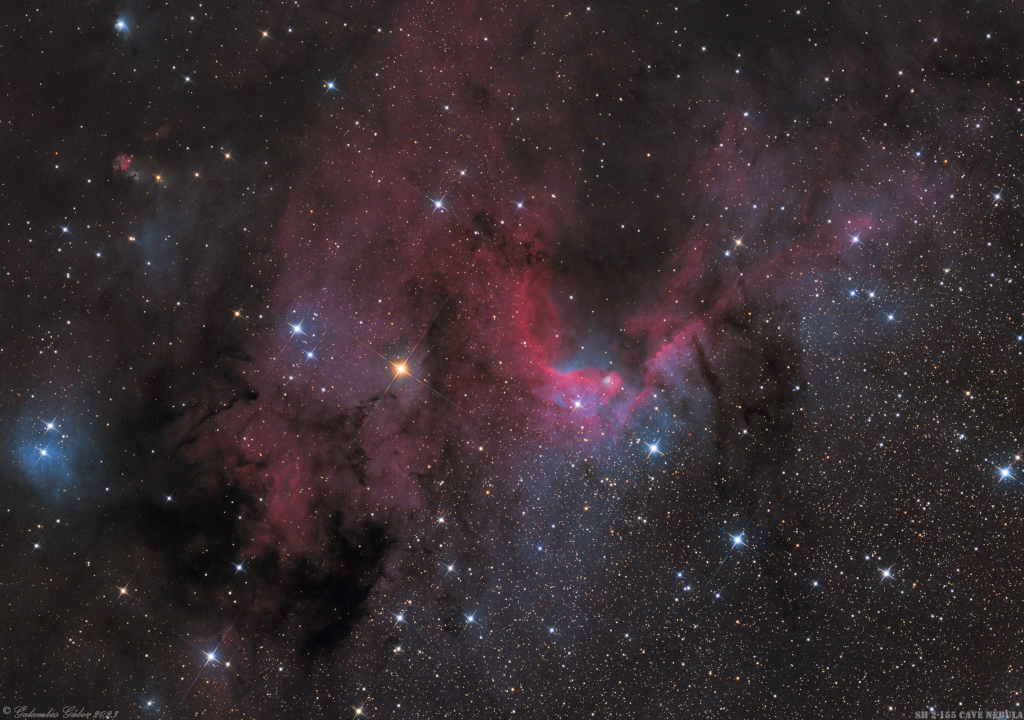
This colorful skyscape spans about three full moons across nebula rich starfields along the plane of our Milky Way Galaxy toward the royal northern constellation Cepheus. Near the edge of the region's massive molecular cloud some 2,400 light-years away, bright reddish emission region Sharpless (Sh)2-155 is at the center of the frame, also known as the Cave Nebula. About 10 light-years across the cosmic cave's bright walls of gas are ionized by ultraviolet light from the hot young stars around it. Dusty bluish reflection nebulae, like vdB 155 at the left, and dense obscuring clouds of dust also abound on the interstellar canvas. Astronomical explorations have revealed other dramatic signs of star formation, including the bright reddish fleck of Herbig-Haro (HH) 168. At the upper left in the frame, the Herbig-Haro object emission is generated by energetic jets from a newborn star.
© Gábor Galambos — used with the credit NASA publishes
2023
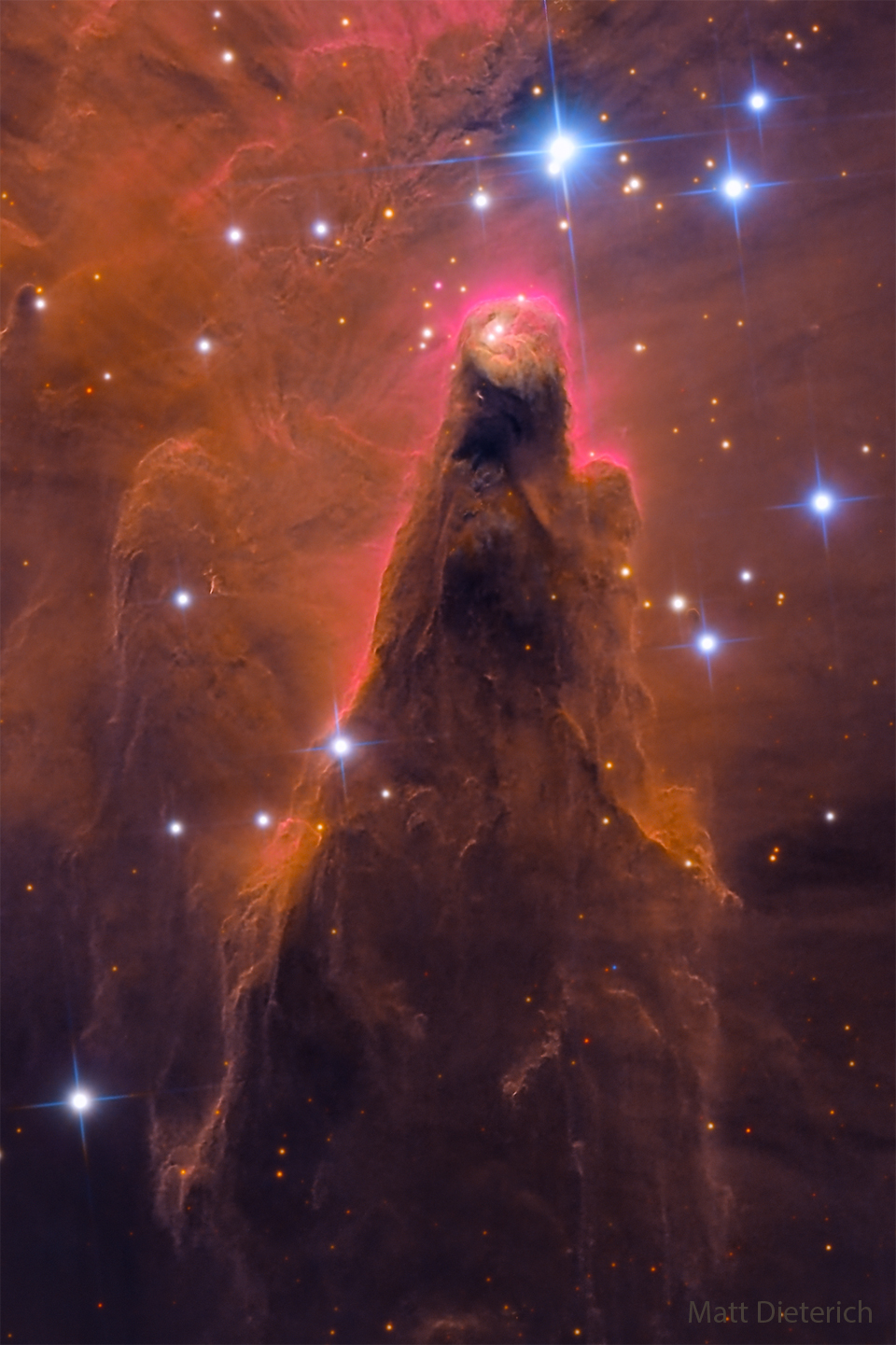
Stars are forming in the gigantic dust pillar called the Cone Nebula. Cones, pillars, and majestic flowing shapes abound in stellar nurseries where clouds of gas and dust are sculpted by energetic winds from newborn stars. The Cone Nebula, a well-known example, lies within the bright galactic star-forming region NGC 2264. The featured image of the Cone was captured recently combining 24-hours of exposure with a half-meter telescope at the El Sauce Observatory in Chile. Located about 2,500 light-years away toward the constellation of the Unicorn (Monoceros), the Cone Nebula's conical pillar extends about 7 light-years. The massive star NGC 2264 IRS, is the likely source of the wind sculpting the Cone Nebula and lies off the top of the image. The Cone Nebula's reddish veil is produced by glowing hydrogen gas. Discovery + Outreach: Graduate student research position open for APOD
© Matthew Dieterich — used with the credit NASA publishes
2022
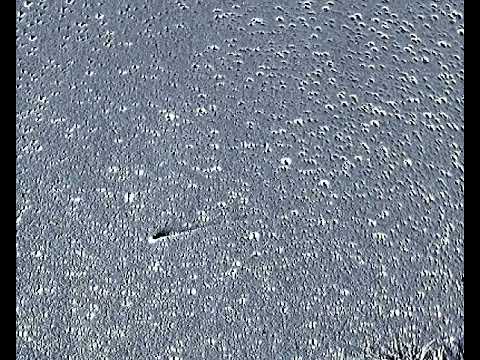
Why does Comet Leonard's tail wag? The featured time-lapse video shows the ion tail of Comet C/2021 A1 (Leonard) as it changed over ten days early last month. The video was taken by NASA's Solar Terrestrial Relations Observatory-Ahead (STEREO-A) spacecraft that co-orbits the Sun at roughly the same distance as the Earth. Each image in this 29-degree field was subtracted from following image to create frames that highlight differences. The video clearly shows Comet Leonard's long ion tail extending, wagging, and otherwise being blown around by the solar wind -- a stream of fast-moving ions that stream out from the Sun. Since the video was taken, Comet Leonard continued plunging toward the Sun, reached its closest approach to the Sun between the orbits of Mercury and Venus, survived this closest approach without breaking apart, and is now fading as heads out of our Solar System. Tuesday over Zoom: APOD editor to present the Best APOD Space Images of 2021
NASA · public domain
2021
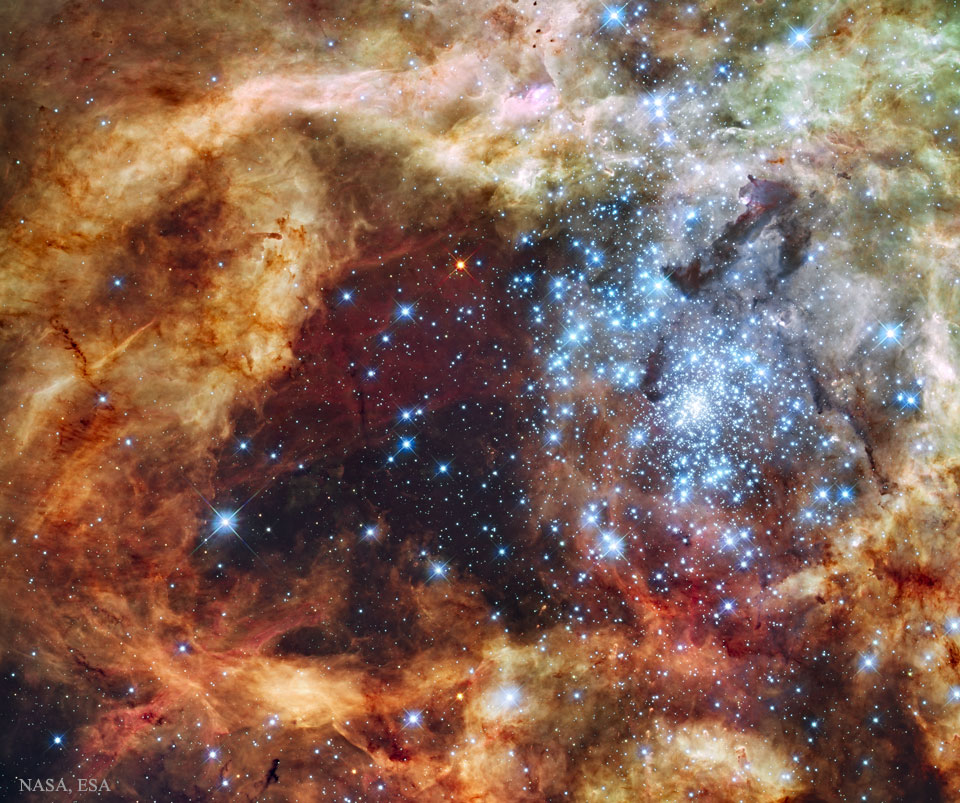
In the center of nearby star-forming region lies a huge cluster containing some of the largest, hottest, and most massive stars known. These stars, known collectively as star cluster R136, part of the Tarantula Nebula, were captured in the featured image in visible light in 2009 through the Hubble Space Telescope. Gas and dust clouds in the Tarantula Nebula, have been sculpted into elongated shapes by powerful winds and ultraviolet radiation from these hot cluster stars. The Tarantula Nebula lies within a neighboring galaxy known as the Large Magellanic Cloud and is located a mere 170,000 light-years away.
NASA · public domain

1954
BOAC Flight 781, a de Havilland DH.106 Comet 1, explodes and falls into the Tyrrhenian Sea, killing 35 people.
BOAC Flight 781 ↗Event text and thumbnails come from Wikipedia and are used under CC BY-SA 4.0. Images are drawn only from Wikimedia Commons, which does not accept non-free content — each thumbnail links to its file page, where its licence and author are recorded.
Launch records are from The Space Devs’ Launch Library 2. This archive is still being mirrored, so some days are incomplete. Pictures are NASA’s Astronomy Picture of the Day; NASA imagery is generally not subject to copyright, but individual APOD entries are frequently the property of the photographer, and each caption says which applies.
General-audience astronomy and spaceflight — none of it a textbook.
As an Amazon Associate I earn from qualifying purchases. Links here cost you nothing extra.
LISTING
Still the best single argument for why any of this matters, and it leaves the arithmetic in. For a reader who wants the science, not just the awe.
LISTING
The case for leaving Earth, written by someone unsentimental about how hard that is. Suits readers who want the argument rather than the poster.
LISTING
Hard-SF problem solving in The Martian's key — for anyone who liked the engineering more than the peril. The only novel on this list.
BROWSE opens an Amazon search, not a specific recommendation.
LINKS AMAZON.COM