Launches
ON RECORD9MISSIONS
9 of them reached orbit. The earliest was 1973, the most recent 2025.
ARCHIVE // DAY OF YEAR
9 orbital launches flew on January 8, the earliest of them in 1973, and 9 reached orbit. Wikipedia records 2 spaceflight and astronomy events on January 8. Below are the pictures NASA published on January 8 in 6 different years — each one taken or released on this exact date.
9MISSIONS
9 of them reached orbit. The earliest was 1973, the most recent 2025.
2ENTRIES
Spaceflight and astronomy entries from Wikipedia's record of this date, oldest first — from 1973 onward.
6IMAGES
NASA's Astronomy Picture of the Day for January 8, one per year. Some are public domain and some belong to the photographer — each says which.
NASA’s Astronomy Picture of the Day, for this calendar date in each of the last several years.

2026
Similar in size to large, bright spiral galaxies in our neighborhood, IC 342 is a mere 10 million light-years distant toward the long-necked, northern constellation Camelopardalis. A sprawling island universe, IC 342 would otherwise be a prominent galaxy in our night sky, but it is hidden from clear view and only glimpsed through the veil of stars, gas and dust clouds along the plane of our own Milky Way galaxy. Even though IC 342's light is dimmed and reddened by intervening cosmic clouds, this sharp telescopic image traces the galaxy's own obscuring dust, young star clusters, and glowing star forming regions along spiral arms that wind far from the galaxy's core. IC 342 has undergone a recent burst of star formation activity and is close enough to have influenced the evolution of the local group of galaxies and the Milky Way.
© Gaetan Maxant — used with the credit NASA publishes
2025
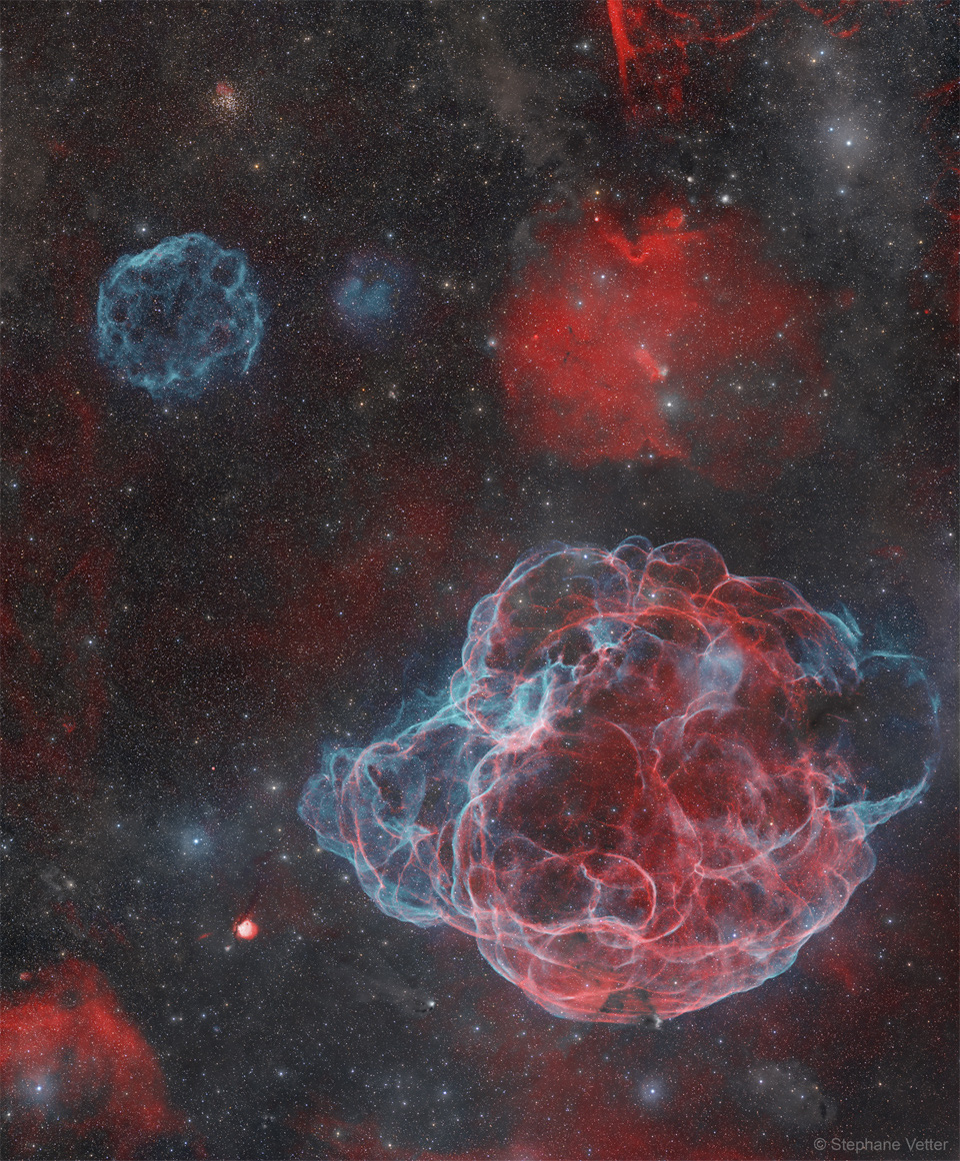
What happens after a star explodes? A huge fireball of hot gas shoots out in all directions. When this gas slams into the existing interstellar medium, it heats up so much it glows. Two different supernova remnants (SNRs) are visible in the featured image, taken at the Oukaïmeden Observatory in Morocco. The blue soccer ball-looking nebula toward the upper left is SNR G179.0+02.6, which appears to be the smaller one. This supernova, about 11,000 light years distant, detonated about 50,000 years ago. Although composed mostly of hydrogen gas, the blue light is emitted by a trace amount of oxygen. The seemingly larger SNR, dominating the lower right of the frame, is the Spaghetti Nebula, cataloged as Simeis 147 and sh2-240. This supernova, only about 3,000 light years away, exploded about 40,000 years ago. Comparatively, even though they appear different sizes, both supernova remnants are not only roughly the same age, but about the same size, too.
© Stéphane Vetter (Nuits sacrées) — used with the credit NASA publishes
2024
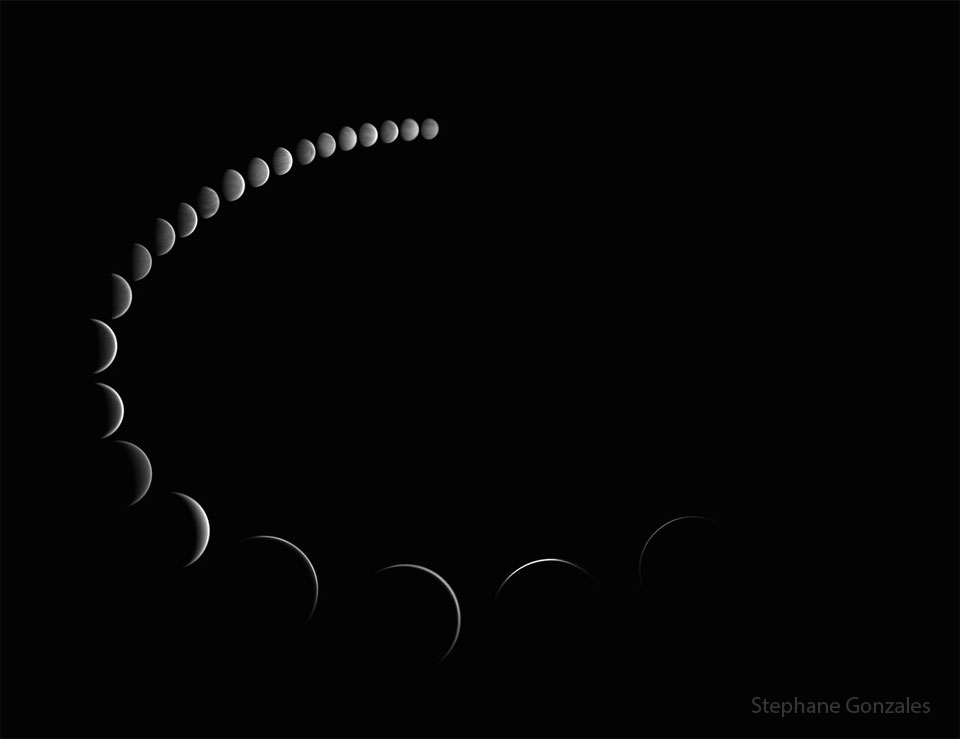
Venus goes through phases. Just like our Moon, Venus can appear as a full circular disk, a thin crescent, or anything in between. Venus, frequently the brightest object in the post-sunset or pre-sunrise sky, appears so small, however, that it usually requires binoculars or a small telescope to clearly see its current phase. The featured time-lapse sequence was taken over the course of six months in 2015 from Surgères, Charente-Maritime, France, and shows not only how Venus changes phase, but changes angular size as well. When Venus is on the far side of the Sun from the Earth, it appears angularly smallest and nearest to full phase, while when Venus and Earth are on the same side of the Sun, Venus appears larger, but as a crescent. This month Venus rises before dawn in waxing gibbous phases. Free APOD Lecture: January 9, 2024 to the Amateur Astronomers of Association of New York
NASA · public domain
2023
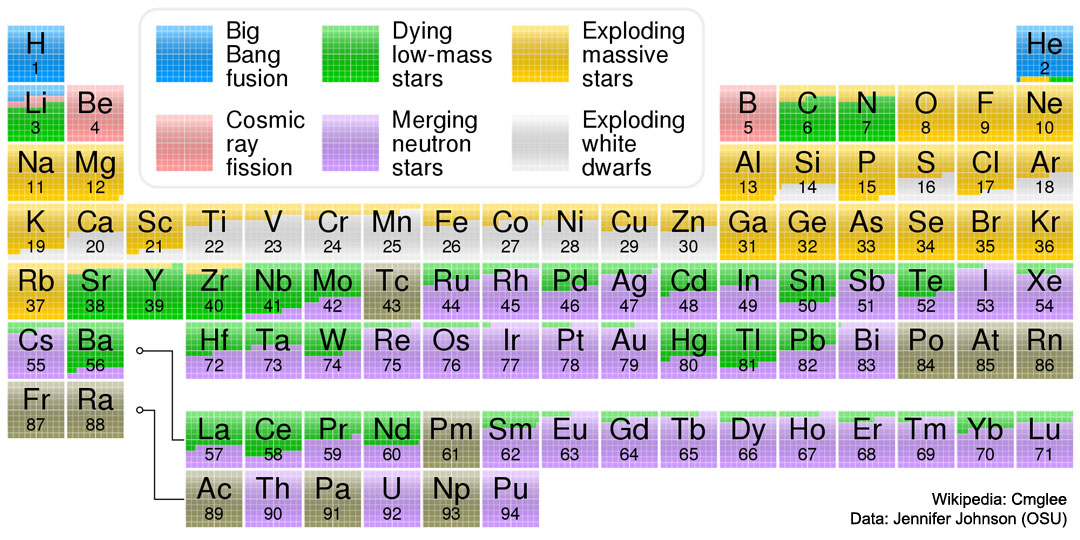
The hydrogen in your body, present in every molecule of water, came from the Big Bang. There are no other appreciable sources of hydrogen in the universe. The carbon in your body was made by nuclear fusion in the interior of stars, as was the oxygen. Much of the iron in your body was made during supernovas of stars that occurred long ago and far away. The gold in your jewelry was likely made from neutron stars during collisions that may have been visible as short-duration gamma-ray bursts or gravitational wave events. Elements like phosphorus and copper are present in our bodies in only small amounts but are essential to the functioning of all known life. The featured periodic table is color coded to indicate humanity's best guess as to the nuclear origin of all known elements. The sites of nuclear creation of some elements, such as copper, are not really well known and are continuing topics of observational and computational research. Discovery + Outreach: Graduate student research position open for APOD
NASA · public domain
2022
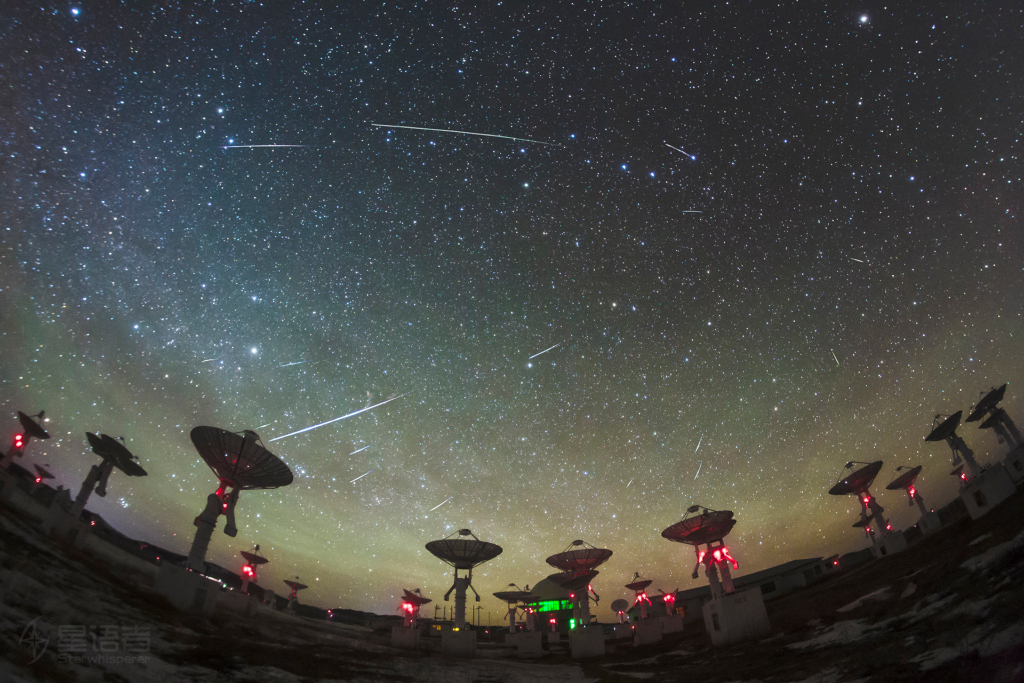
Named for a forgotten constellation, the Quadrantid Meteor Shower puts on an annual show for planet Earth's northern hemisphere skygazers. The shower's radiant on the sky lies within the old, astronomically obsolete constellation Quadrans Muralis. That location is not far from the Big Dipper, at the boundaries of the modern constellations Bootes and Draco. In fact north star Polaris is just below center in this frame and the Big Dipper asterism (known to some as the Plough) is above it, with the meteor shower radiant to the right. Pointing back toward the radiant, Quadrantid meteors streak through the night in the panoramic skyscape, a composite of images taken in the hours around the shower's peak on January 4, 2022. Arrayed in the foreground are radio telescopes of the Chinese Spectral Radioheliograph, Mingantu Observing Station, Inner Mongolia, China. A likely source of the dust stream that produces Quadrantid meteors was identified in 2003 as an asteroid. Status Updates: Deploying the James Webb Space Telescope
© Cheng Luo — used with the credit NASA publishes
2021
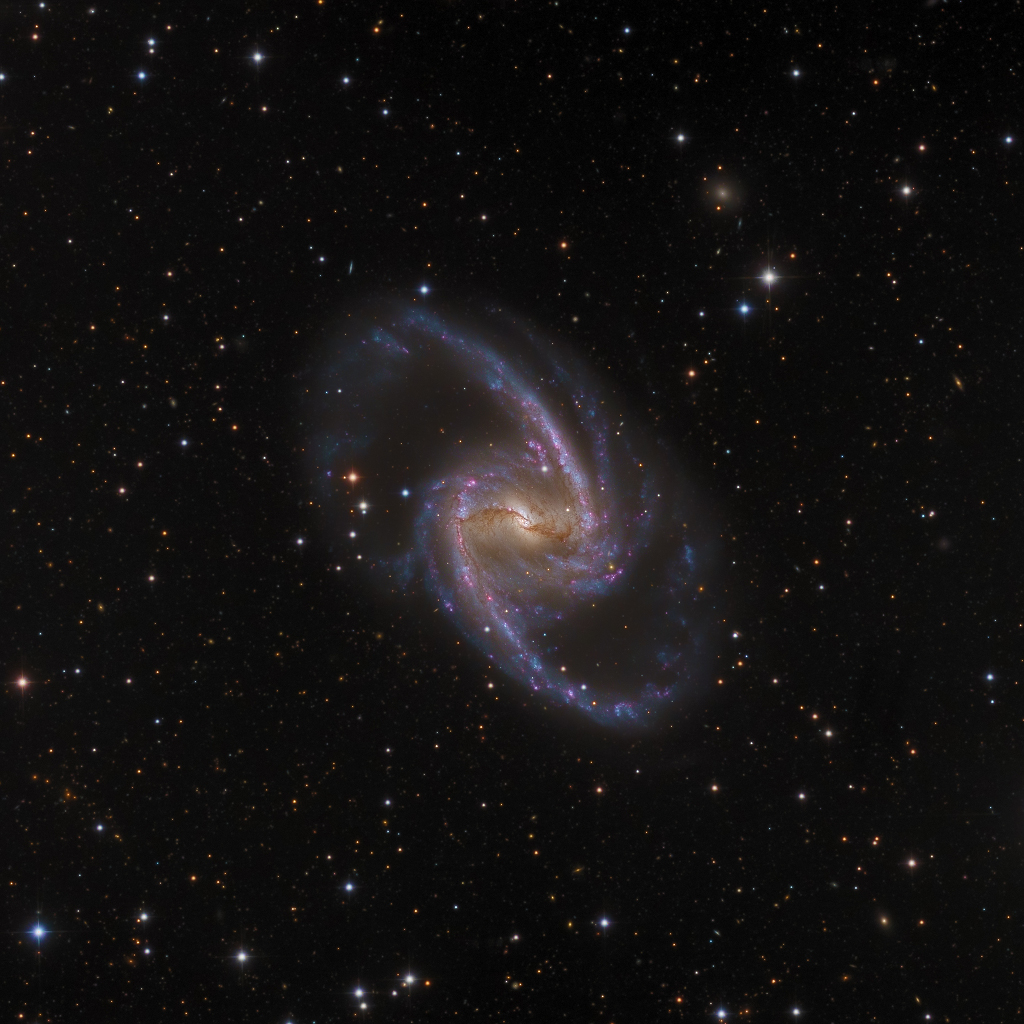
Barred spiral galaxy NGC 1365 is truly a majestic island universe some 200,000 light-years across. Located a mere 60 million light-years away toward the chemical constellation Fornax, NGC 1365 is a dominant member of the well-studied Fornax Cluster of galaxies. This impressively sharp color image shows the intense, reddish star forming regions near the ends of central bar and along the spiral arms, with details of the obscuring dust lanes cutting across the galaxy's bright core. At the core lies a supermassive black hole. Astronomers think NGC 1365's prominent bar plays a crucial role in the galaxy's evolution, drawing gas and dust into a star-forming maelstrom and ultimately feeding material into the central black hole.
© island universe — used with the credit NASA publishes


1994
Russian cosmonaut Valeri Polyakov on Soyuz TM-18 leaves for Mir. He would stay on the space station until March 22, 1995, for a record 437 days in space.
Astronaut ↗Event text and thumbnails come from Wikipedia and are used under CC BY-SA 4.0. Images are drawn only from Wikimedia Commons, which does not accept non-free content — each thumbnail links to its file page, where its licence and author are recorded.
Launch records are from The Space Devs’ Launch Library 2. Pictures are NASA’s Astronomy Picture of the Day; NASA imagery is generally not subject to copyright, but individual APOD entries are frequently the property of the photographer, and each caption says which applies.
General-audience astronomy and spaceflight — none of it a textbook.
As an Amazon Associate I earn from qualifying purchases. Links here cost you nothing extra.
LISTING
Still the best single argument for why any of this matters, and it leaves the arithmetic in. For a reader who wants the science, not just the awe.
LISTING
The case for leaving Earth, written by someone unsentimental about how hard that is. Suits readers who want the argument rather than the poster.
LISTING
Hard-SF problem solving in The Martian's key — for anyone who liked the engineering more than the peril. The only novel on this list.
BROWSE opens an Amazon search, not a specific recommendation.
LINKS AMAZON.COM