Ariane 62 | Metop-SG B1
Arianespace launches Ariane 62 carrying Metop-SG B1 from Ariane Launch Area 4, Guiana Space Centre, French Guiana at 2026-12-31 00:00:00Z. The operator has not published how precise that target time is. The date is still provisional and can move.
COUNTDOWN
FLIGHT PLAN
The window is instantaneous: the vehicle flies at T-0 or stands down to the next opportunity. Current date is a placeholder or rough estimation based on unreliable or interpreted sources.
FIELD KIT / OPTICS
Where to start if the plan is a real telescope in a real back garden.
As an Amazon Associate I earn from qualifying purchases. Links here cost you nothing extra.
- VIEW
LISTING
Celestron Travel Scope 70 mm Refractor
70 mm of aperture on a light tripod that packs into its own backpack, which is the whole argument for it: a scope that travels gets used. Shows lunar craters, Jupiter's four bright moons and Saturn's rings as a shape rather than a smudge. The tripod is the weak part of the package — expect to steady it.
- BROWSE
SEARCH
Beginner Dobsonians
The category most experienced observers point a beginner at: aperture on a simple rocker mount, with no motors to fail. A starting point for browsing rather than a specific pick — compare 130 mm and 150 mm before buying.
- BROWSE
SEARCH
Beginner refractors
Lighter and quicker to set up than a Dobsonian, weaker on faint deep-sky objects. Worth browsing if the scope has to live in a cupboard and come out on a whim.
BROWSE opens an Amazon search, not a specific recommendation.
LINKS AMAZON.COM
MISSION BRIEF
Second of EUMETSAT's second generation of Metop weather satellites.
SOURCE: LAUNCH LIBRARY 2 // THE SPACE DEVS
LAUNCH CORRIDOR
- Due east
- The lowest orbit inclination a direct launch from here can reach — 5.3°, which is this pad’s own latitude. It also collects the most free speed from Earth’s rotation.
- Due south
- The polar and sun-synchronous corridor: 90° inclination, passing over both poles. It gets no help from Earth’s spin, which is why it costs more payload.
Drag the globe to turn it. The shading is the real terminator, and it moves.
A globe of the Earth centred on Ariane Launch Area 4 at latitude 5.26 degrees north, longitude 52.79 degrees west. Two curved lines leave the pad. The solid gold line runs due east and marks the lowest orbital inclination a direct launch from this site can reach, 5.3 degrees, equal to the pad’s latitude of 5.3 degrees. The dashed cyan line runs due south and marks the polar corridor at 90 degrees inclination. The darkened part of the globe is the night side. Surface wind is blowing from 95°, at 16 km/h, shown as the cyan arrow at the pad.
LAUNCH SITE
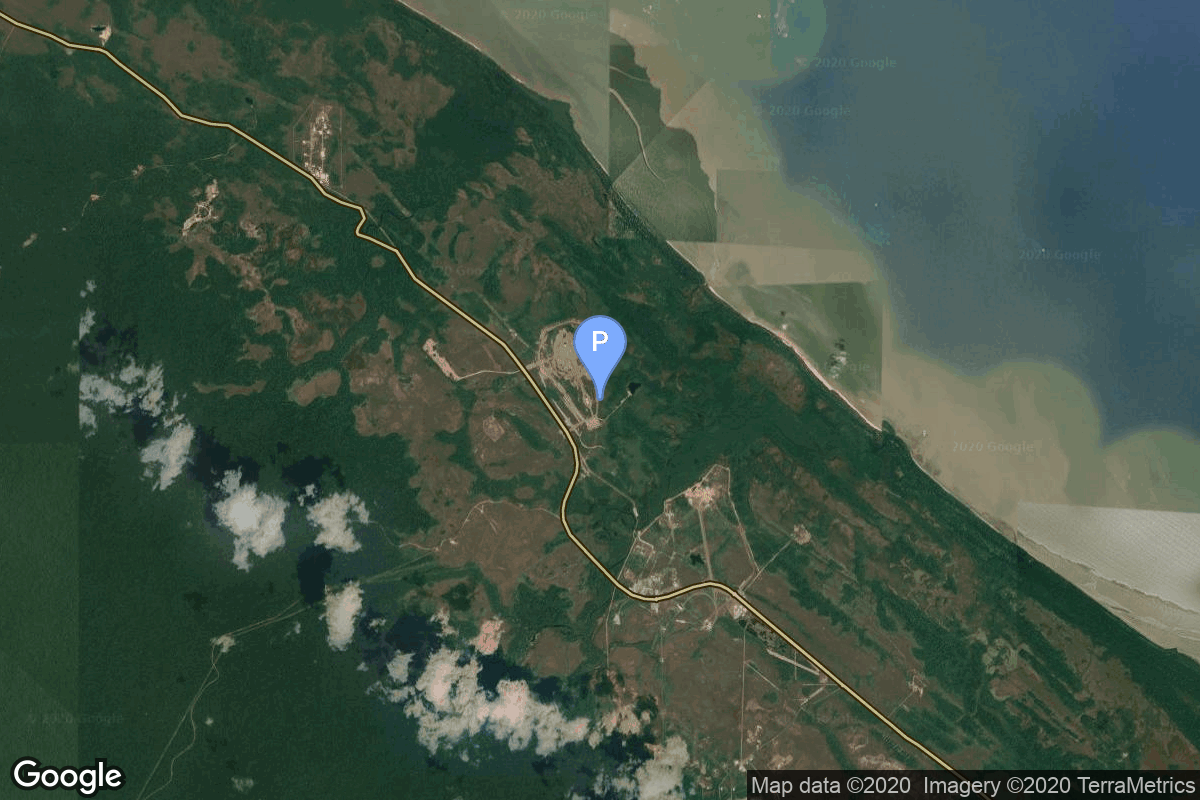
Ariane Launch Area 4
Guiana Space Centre, French Guiana
OBSERVED 2026-10-21 01:00:00Z // OPEN-METEO (CC BY 4.0) // GENERAL CONDITIONS, NOT LAUNCH CRITERIA
Minimum direct inclination 5.3°. From 5.3° north of the equator, a direct ascent cannot enter an orbit inclined less than 5.3°, because an orbit of inclination i never passes over latitudes beyond ±i. Reaching an equatorial plane — what a geostationary transfer ultimately needs — therefore costs a plane change of 5.3° somewhere in the flight, while inclinations of 5.3° and above are available straight off the pad. The ground here is carried eastward at about 463 m/s (465 m/s at the equator, falling with the cosine of latitude), and a due-east launch keeps that head start.
DATUM WGS-84 // EQUIRECTANGULAR PROJECTION // ORBIT FIGURES DERIVED FROM THE PUBLISHED LATITUDE
PAD CONDITIONS
SURFACE WIND @ 10 M
16km/h
Blowing from the east, bearing 95 degrees
GUSTING
33km/h
Clear sky
SOURCE: OPEN-METEO CC BY 4.0
The observed block is general weather for the coordinates of Ariane Launch Area 4, not launch-commit criteria. Those are written per mission by the operator and the range, cover conditions this forecast does not carry at all (electric fields, cloud layers aloft, winds through the vehicle’s own load limits), and are published only by the operator. Wind is a common reason countdowns stop for weather — that is general context, not a rule about this flight, and no number in this block is a threshold. Nothing here is a go or no-go call, and no operator figure was published for this attempt.